-
-
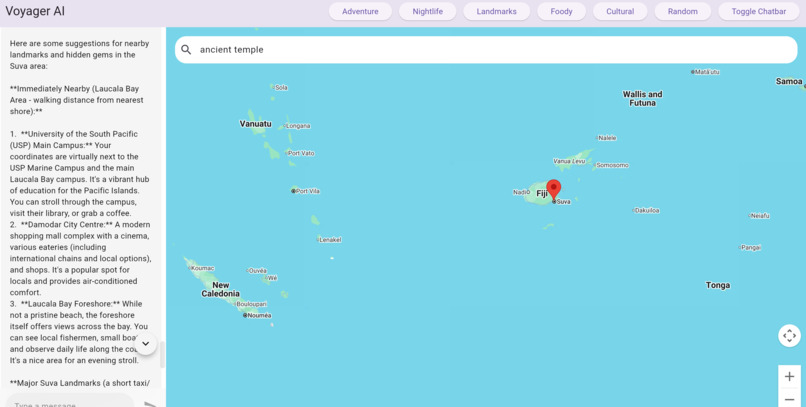
Remote location travel recommendations (Suva, Fiji)
-
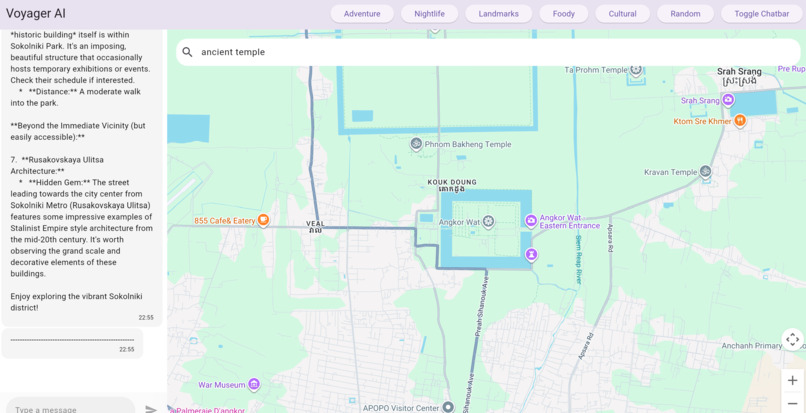
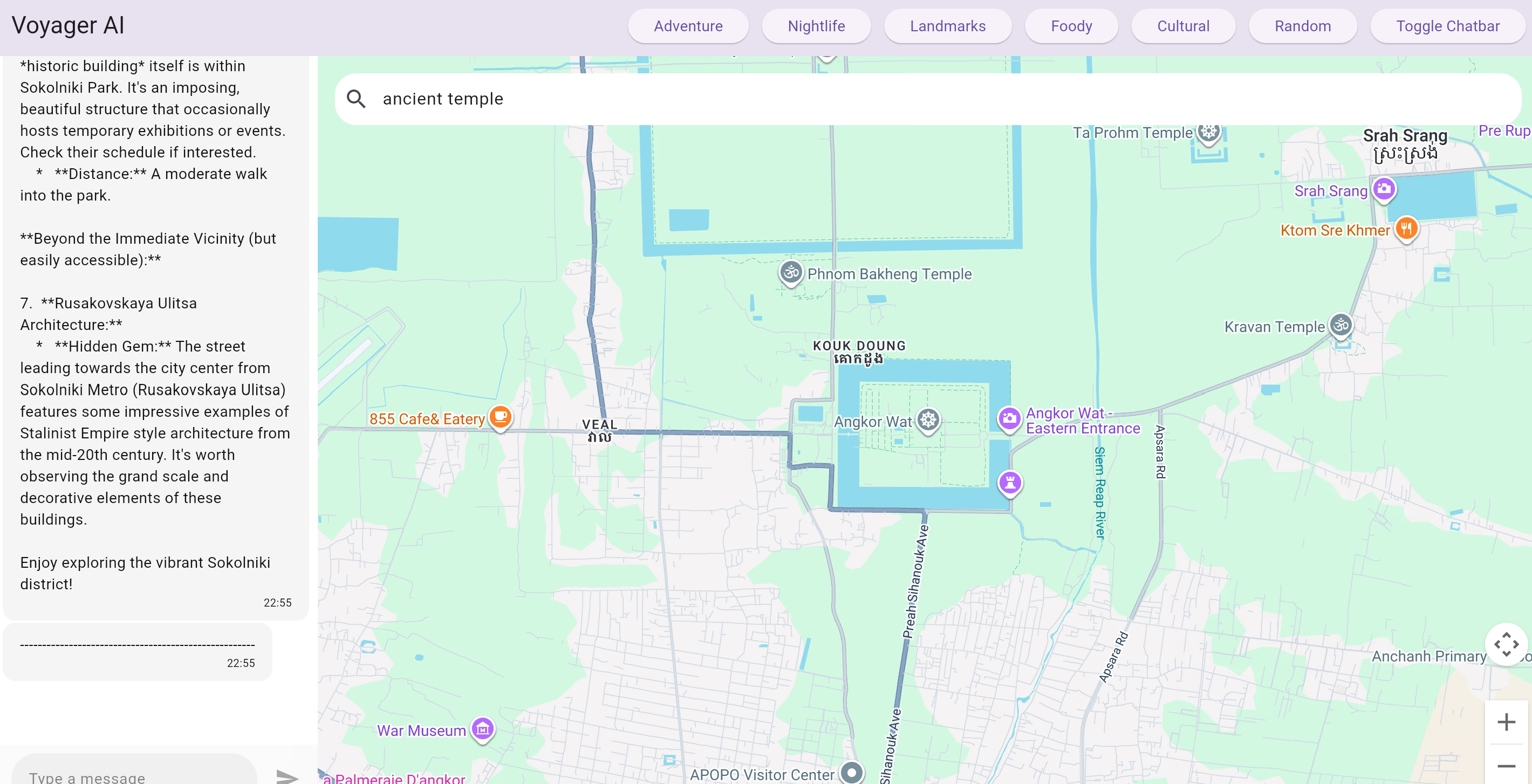
Search bar AI-assisted recommendation for "ancient temple" (Angkor Wat, Thailand)
-
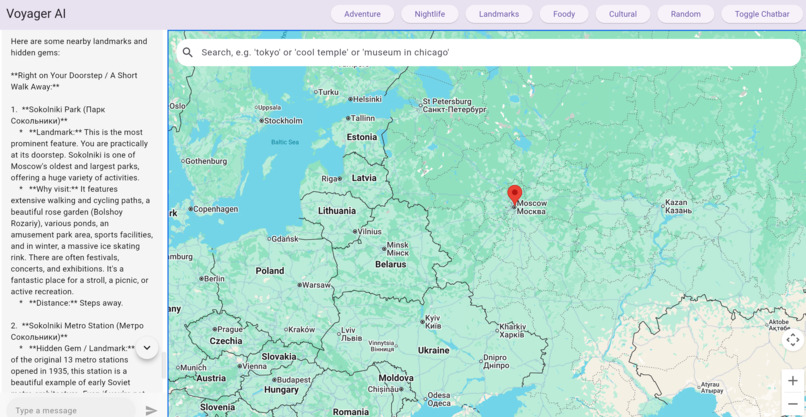
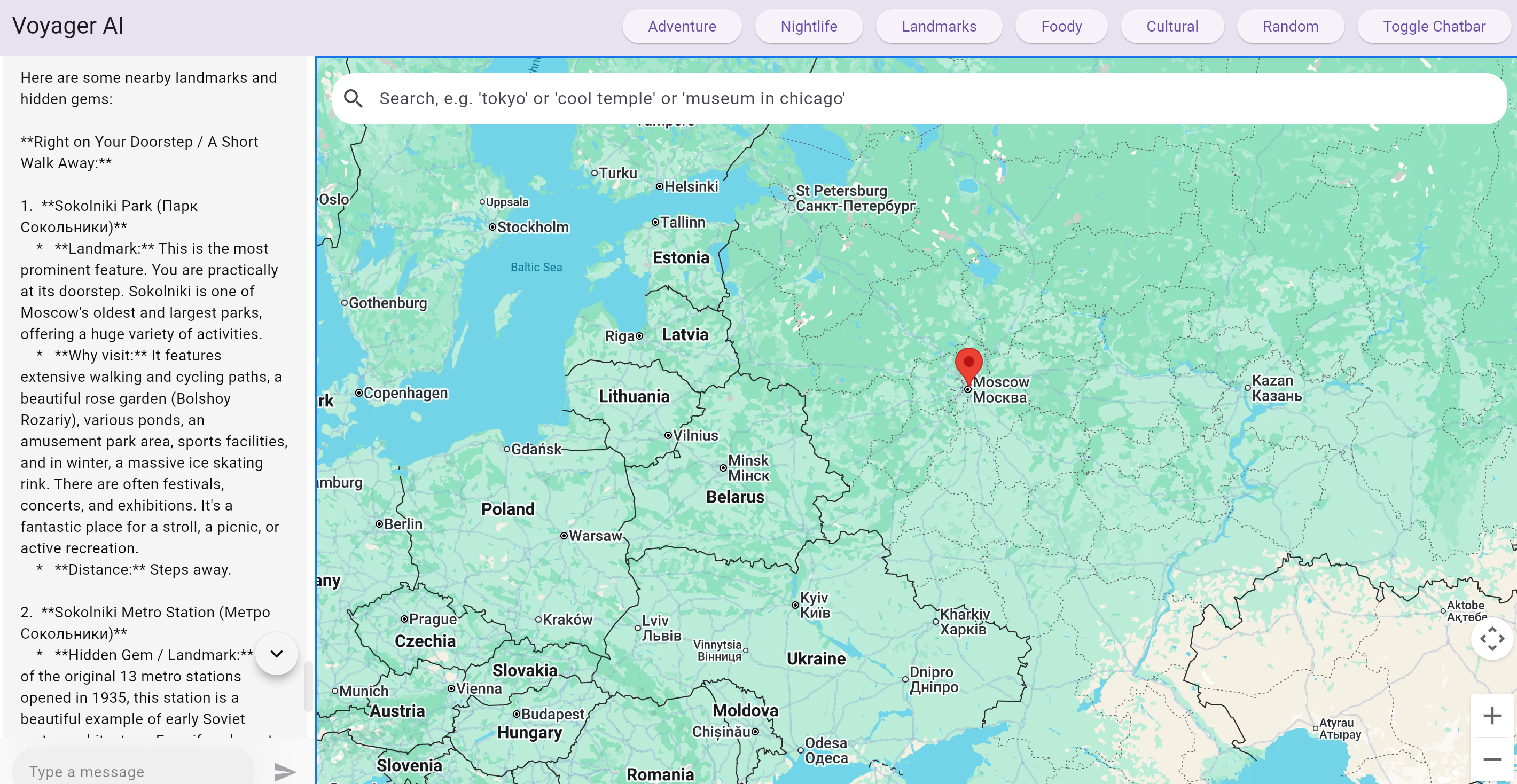
Big city travel recommendations (Moscow, Russia)
Inspiration
The inspiration for Voyager AI came from a personal frustration with planning a trip. Something that was supposed to be exciting and fun quickly became overwhelming as I struggled to navigate countless websites, compare recommendations, search for destinations, and piece together an itinerary. I realized that discovering the world should not have to be so cumbersome. After seeing other people online express similar frustrations with travel planning, I decided I wanted to do something about it. I wanted to create a tool that made exploring new places feel as exciting as the trip itself, rather than another stressful task. This idea became Voyager AI, an AI-powered travel companion designed to make discovering destinations more intuitive, interactive, and personalized.
What it does
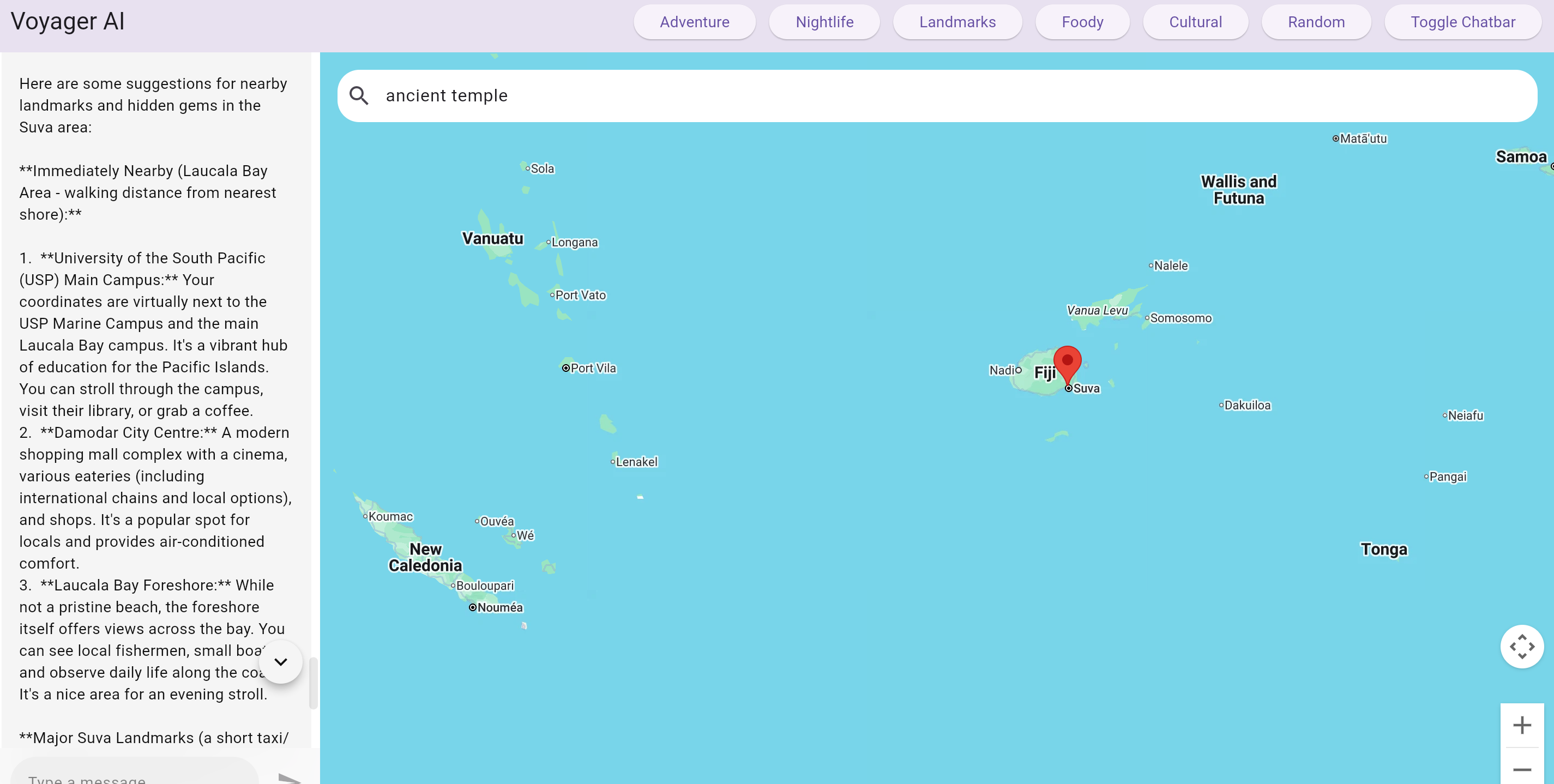
Voyager AI combines an interactive map with an AI-powered chat interface to make exploring destinations easier and more engaging. Users can search for places using natural language, whether they are looking for a specific city, a famous landmark, or an interesting hidden gem. By integrating Google Maps with Google's Gemini AI model, the application can provide AI-generated recommendations based on a user's interests and the location they are exploring. Users can discover destinations through dedicated categories, including adventure, nightlife, landmarks, food, cultural experiences, and random destinations. The application also features interactive map markers, animated camera movements that create a more immersive experience when navigating between locations, and a chat interface that allows users to ask follow-up questions. By maintaining a conversation history and considering the user's last explored location in its responses, Voyager AI aims to make recommendations feel more contextual and useful. Ultimately, the goal is to bring destination discovery, location exploration, and AI assistance together in one place.
How we built it
I built Voyager AI using Flutter and Dart, learning the language and framework from scratch as I developed the application. I used Google Maps Flutter to create the interactive map, display location markers, and navigate between destinations. I integrated Google's Gemini AI API to generate conversational responses and travel recommendations, allowing users to explore places through natural-language prompts instead of relying entirely on traditional search methods. I also incorporated geolocation utilities for calculating distances, HTTP requests for communicating with external services, JSON parsing for processing API responses, and environment-variable management through Flutter Dotenv for handling configuration. The interface was built around a dynamic layout that combines a map, search bar, category buttons, and an animated chat panel. I implemented a simple first-in, first-out conversation history system to retain recent messages and provide context for future AI responses. Additionally, I created collections of destinations across different categories to support spontaneous exploration. Bringing these components together required me to learn not only how each technology worked independently, but also how to integrate them into a cohesive application.
Challenges we ran into
One of my biggest challenges was learning Dart and Flutter while simultaneously building a project that depended on several external APIs and interconnected features. Managing operations was particularly challenging because map animations, AI requests, user input, and interface updates all needed to work together without causing unexpected behavior. I also had to work through the difficulty of interpreting AI-generated responses as usable geographic coordinates, since a response that looks understandable to a person is not always formatted in a way that an application can reliably process. Designing the interface presented another challenge: I needed the map, search bar, category controls, and expandable chat panel to coexist without overlapping or making the application difficult to navigate across different screen sizes. I spent considerable effort thinking about formatting, layout behavior, animations, and how to make the overall experience feel natural. Security was another important learning curve. I had to understand the risks of exposing API keys, the importance of environment variables, and the need for proper API restrictions, secure configuration, and responsible handling of external services. I also encountered the broader challenge of making the application genuinely useful to the people I wanted to help. It was not enough to make the features work; the recommendations needed to be relevant, the interface needed to be intuitive, and errors or unreliable responses needed to be handled gracefully. Balancing all these requirements while learning unfamiliar technologies made development difficult, but each challenge helped me understand the process more deeply.
Accomplishments that we're proud of
I am proud that I took a personal frustration and transformed it into a functional application that brings together AI, maps, conversational interaction, and destination discovery. Learning Dart and using Flutter to build an interactive application was a significant accomplishment for me, especially while integrating multiple technologies I had not previously worked with at this level. I am particularly proud of the natural-language search concept, which allows users to think about destinations in their own words, and the animated map navigation that makes exploring locations feel more dynamic. I also developed a category-based discovery system that encourages users to explore beyond destinations they already know, along with a chat interface that uses recent conversation context to support more meaningful interactions. Beyond the features themselves, I am proud that I approached the project with a real problem in mind. Voyager AI represents my attempt to make travel discovery less intimidating and more accessible, and the process pushed me to think like both a developer and a person designing a solution for others.
What we learned
Throughout this project, I learned a tremendous amount about Dart, Flutter, widget-based UI development, state management, asynchronous programming, API integration, JSON parsing, geolocation, and interactive map development. I gained practical experience working with Google's Gemini AI model and Google Maps, including the complexities of connecting external services and making their responses useful within an application. I also developed my first substantial understanding of cybersecurity considerations in application development, including API key protection, environment configuration, access restrictions, and the importance of not assuming that a working prototype is automatically a secure one. I learned that AI integrations require careful handling because responses can be unpredictable, and that robust applications need validation, error handling, and reliable data-processing strategies. Equally important, I learned that user experience involves much more than adding features. Layout, readability, responsiveness, accessibility, and the flow between different interactions all influence whether an application actually solves the problem it was designed to address. Most importantly, I learned how to approach unfamiliar technical problems through experimentation, research, debugging, and persistence.
What's next for Voyager AI
My next goal is to make Voyager AI more reliable, secure, and personalized. I would like to improve location search by integrating dedicated place-search and autocomplete services, allowing the application to retrieve verified place details and coordinates instead of depending on AI-generated coordinate formatting. I also want to improve recommendation quality by incorporating real place information, ratings, opening hours, and other relevant details where available. Another priority is strengthening API security through server-side credential management, appropriate API restrictions, and better protection of sensitive configuration. On the user-experience side, I envision adding itinerary creation, saved destinations, personalized travel preferences, route planning, and the ability to organize recommendations into a complete trip. I would also like to improve the interface across different screen sizes and make the chat experience more responsive and intuitive. Ultimately, I want Voyager AI to evolve from a destination-discovery prototype into a dependable travel companion that helps people spend less time struggling with planning and more time looking forward to the experiences ahead. I hope for it to become a useful tool for travelers around the globe.
Built With
- ai
- api
- chatbot
- dart
- flutter
- geminiapi
- gui
- mapsapi
- recommendation
- traveling


Log in or sign up for Devpost to join the conversation.