-
-
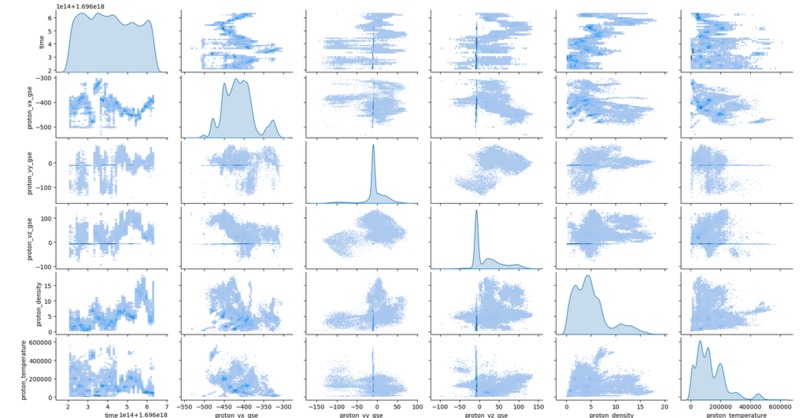
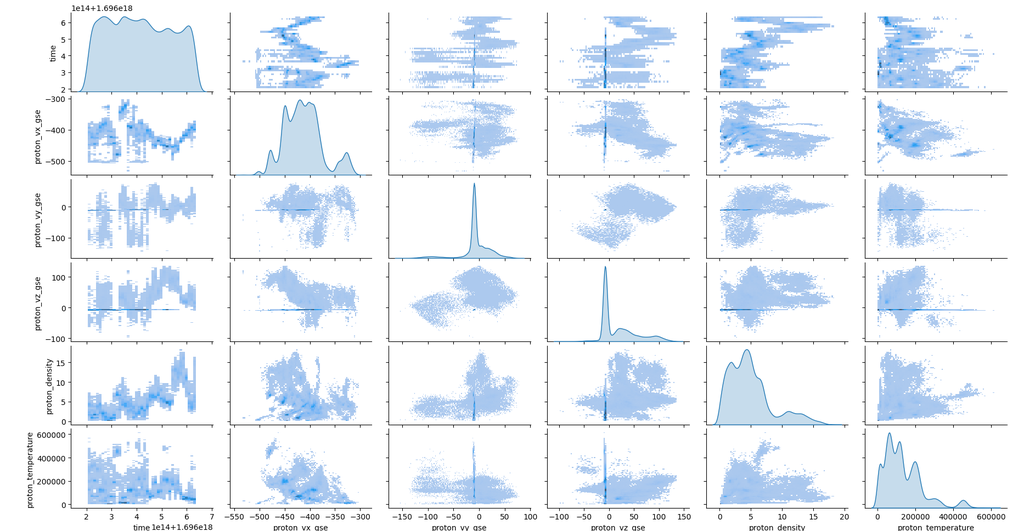
L1 data
Inspiration
When operating reliably, the National Oceanic and Atmospheric Administration’s (NOAA’s) space weather station, the Deep Space Climate Observatory (DSCOVR), can measure the strength and speed of the solar wind in space, which enables us to predict geomagnetic storms that can severely impact important systems like GPS and electrical power grids on Earth. DSCOVR, however, continues to operate past its expected lifetime and produces occasional faults that may themselves be indicators of space weather. Your challenge is to use the "raw" data from DSCOVR—faults and all—to predict geomagnetic storms on Earth.
What it does
In this project, we present a solution to the problem of using anomalous and noisy "Level 1" raw data from the DSCOVR Faraday Cup to predict geomagnetic storms on Earth. Using this data, the corresponding "Level 2" data, and the accepted, "ground truth" Kp-index data starting from October 2015 when DSCOVR was launched, we created a machine learning algorithm that, after being trained on the ground truth Kp-index data, takes in anomalous Level 1 data and generates a synthetic set of Level 2 data that would not have been produced with the anomaly-ridden Level 1 data. Then, using this new and improved Level 2 data, we apply an algorithm to calculate the predicted Kp-index, which we display in a chart in 3-hour intervals on the website we created, similar to NOAA's "Planetary K-Index" page on their "Current Space Weather Conditions" website. Our website will host a feature allowing users to query the machine learning algorithm to output a Kp-index value based on the user's current time, which will allow the user to forecast how severe an incoming geomagnetic storm will be up to 2 hours in advance of its effects being felt on Earth. Naturally, there is great importance in being able to predict the strength of incoming geomagnetic storms, as it can provide valuable information such as how far south an aurora borealis will be visible and whether satellite communications and electrical grids will be disrupted. With future improvements, we believe our work will also strengthen our understanding of geomagnetic phenomena as a whole.

Log in or sign up for Devpost to join the conversation.