-
-
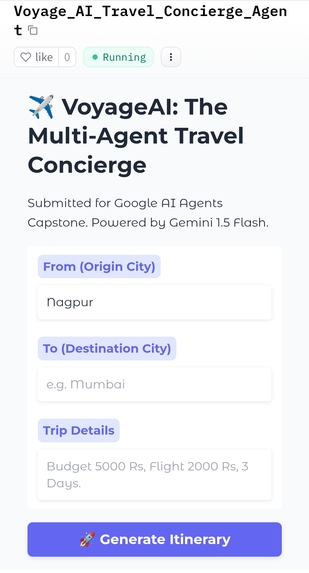
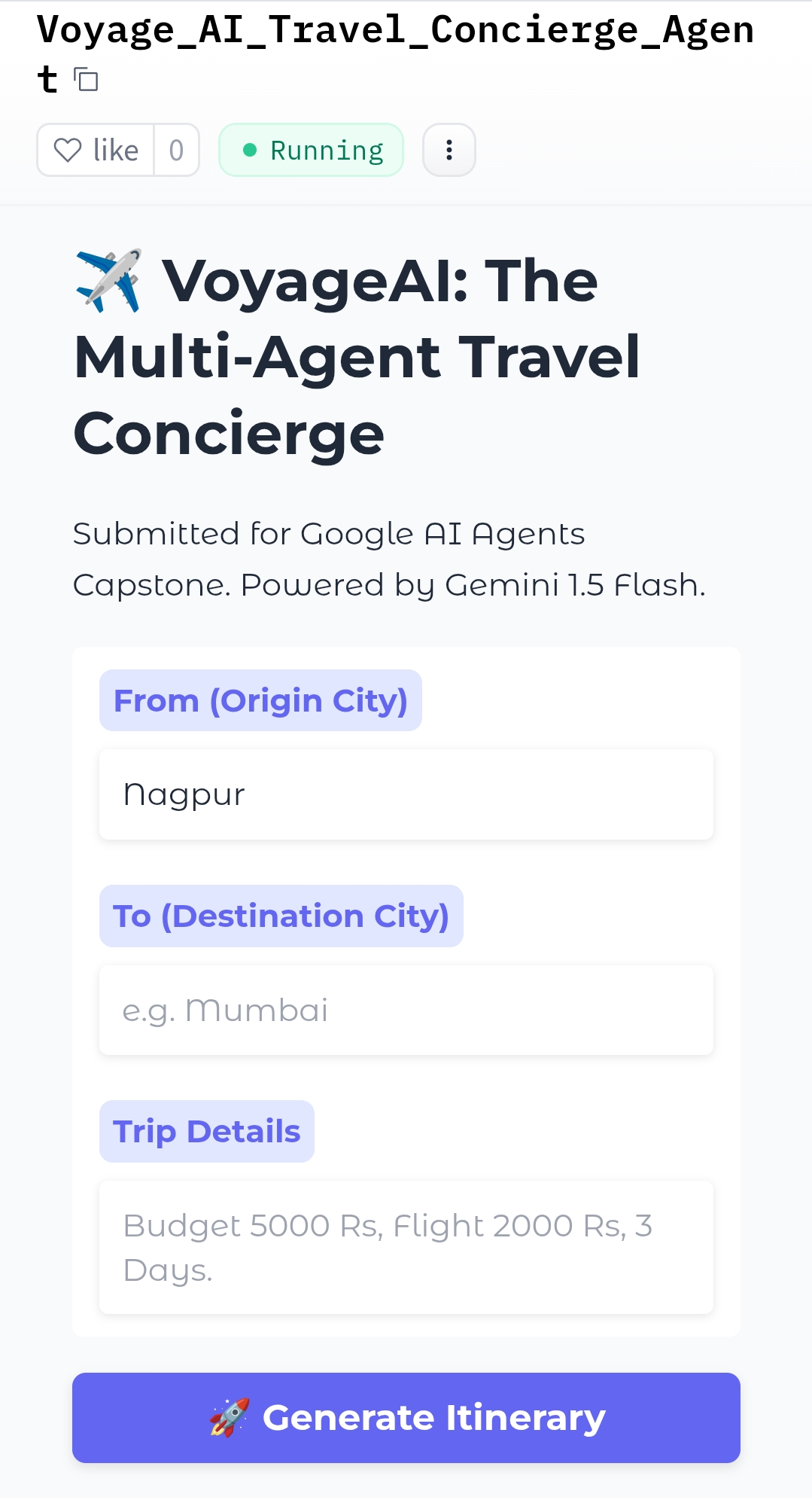
The clean Gradio interface where users input their origin, destination, and budget constraints to kick off the AI planning process.
-
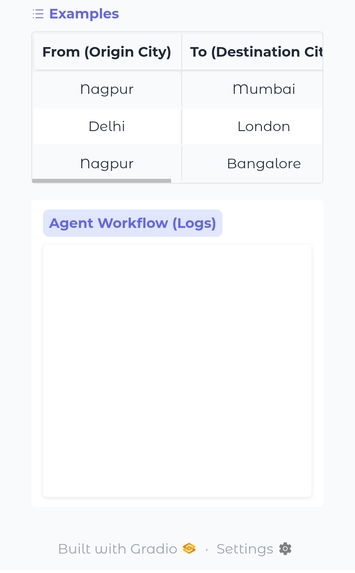
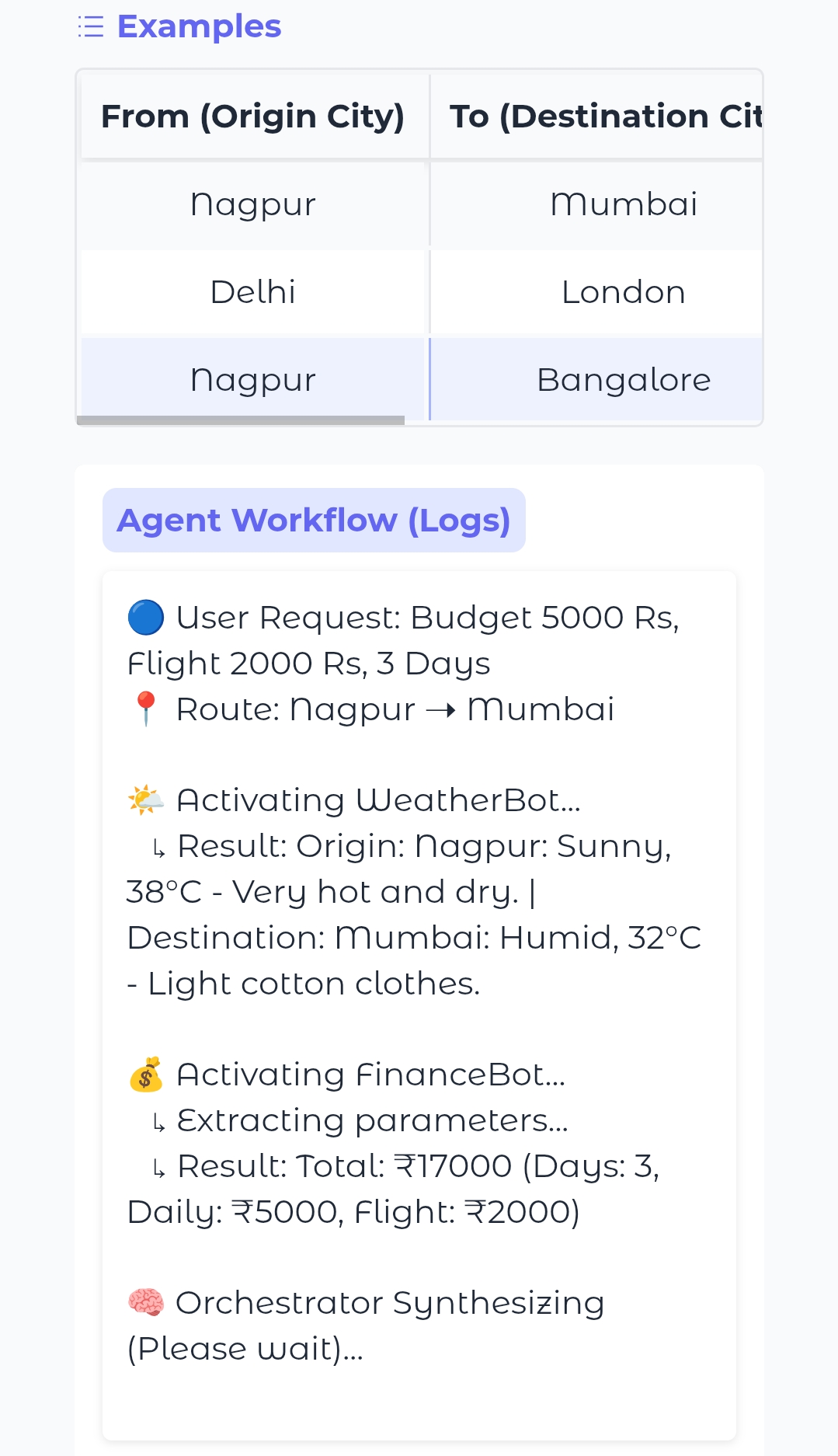
Quick-start examples let users try VoyageAI in one click. The Agent Workflow box provides full observability into the AI's reasoning.
-
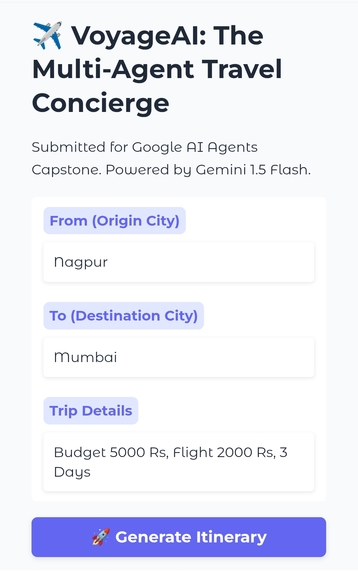
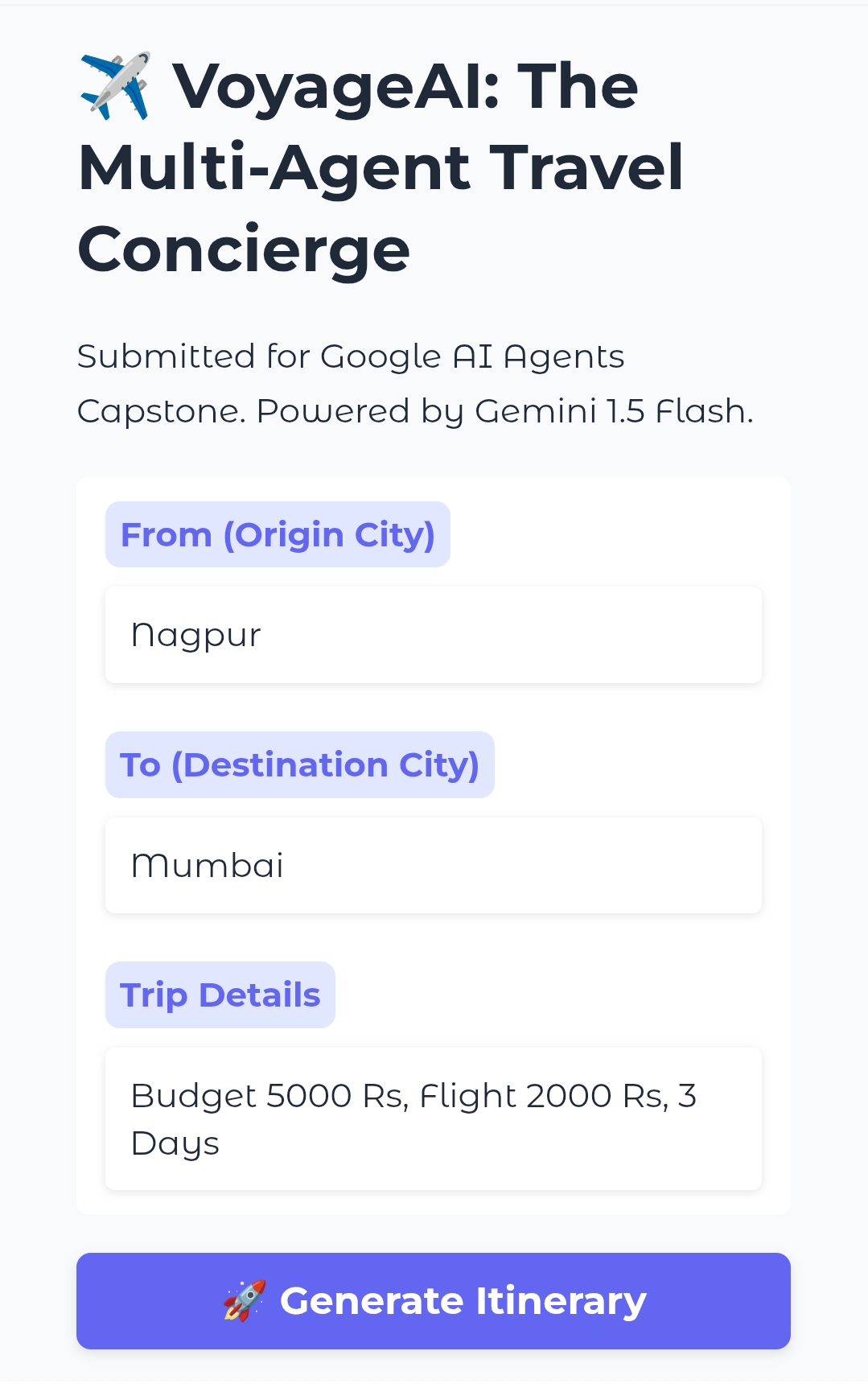
A user inputs a trip from Nagpur to Mumbai. The AI will use these strict budget and time constraints to build the perfect itinerary.
-
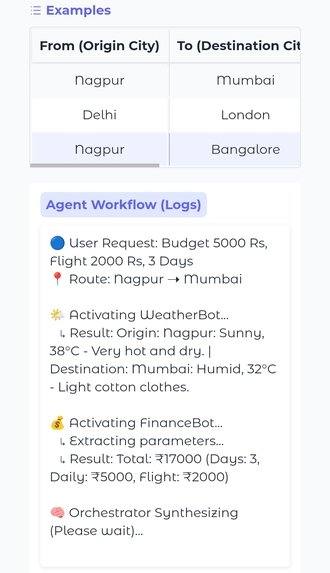
Real-time Agent Workflow logs provide full observability. See WeatherBot and FinanceBot extract data and calculate costs instantly.
-
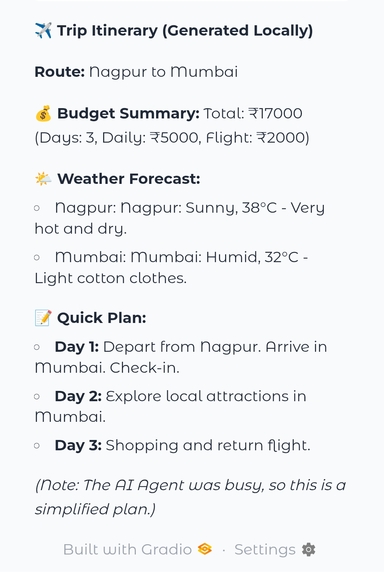
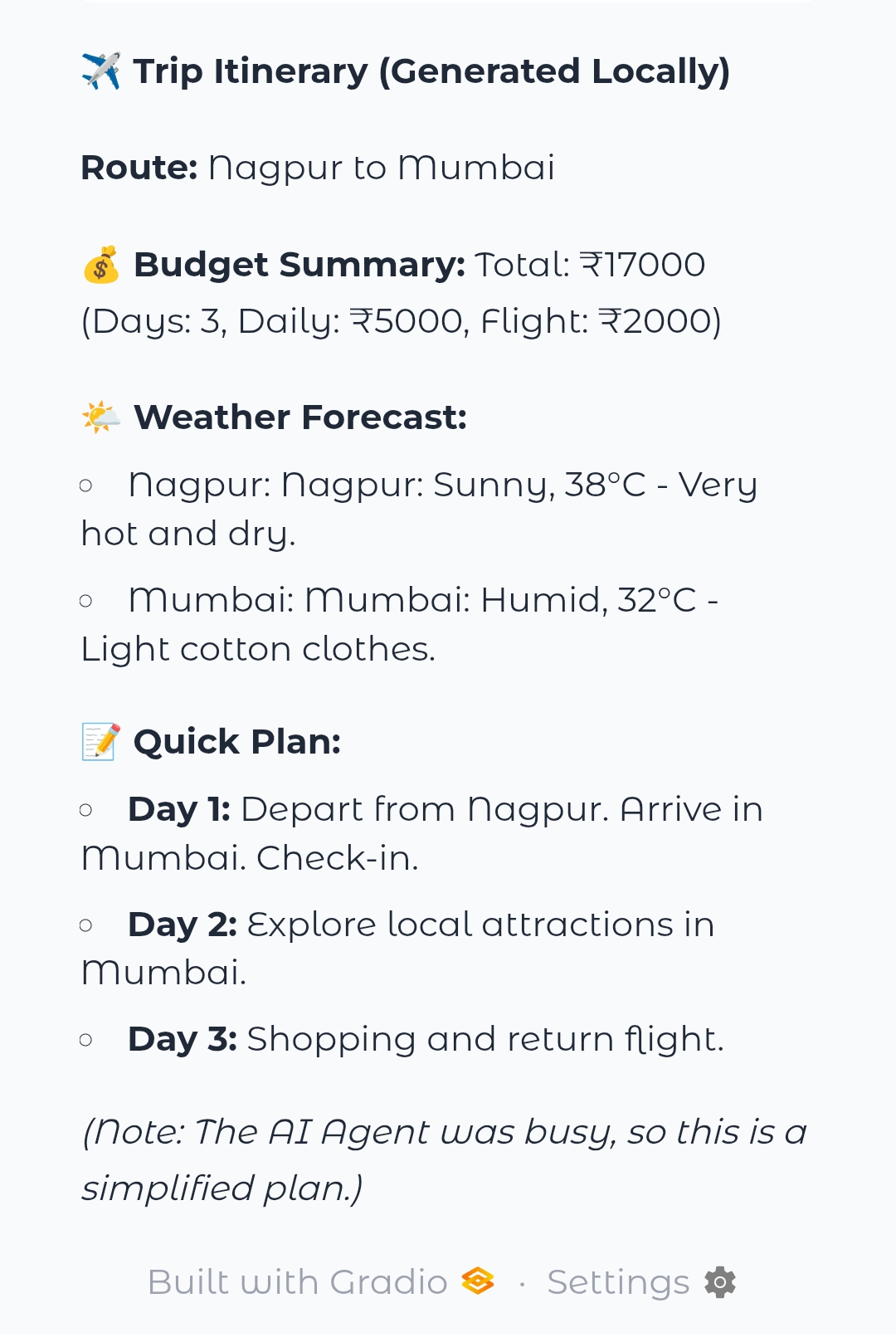
Showcasing the robust fallback feature! If the Gemini API times out, VoyageAI gracefully delivers a locally generated, simplified itinerary.

Inspiration
Planning a trip is rarely a linear process; it is a fragmented and stressful cognitive load. A traveler typically juggles between 5 to 10 browser tabs simultaneously: one for weather forecasts, another for flight prices, a spreadsheet for budgeting, and blogs for itinerary ideas.
The core problem is "Context Switching." A standard flight search engine doesn't know it's going to rain at your destination, and a basic chatbot often hallucinates math when trying to stick to a strict budget. We built VoyageAI to cure "Tab Fatigue" by combining creative planning with strict, deterministic logic.
What it does
VoyageAI is a Multi-Agent Travel Concierge. It ingests a complex, natural language request (e.g., "Plan a 3-day trip to Bangalore from Nagpur. Cost 20000 total.") and handles the logic, math, and environmental checks in the background.
Instead of just generating text, VoyageAI gives you a feasibility-checked itinerary in seconds, complete with accurate budget breakdowns and weather-appropriate clothing advice. The Gradio UI features a real-time "Agent Workflow Log" that exposes the system's thinking process to the user.
How we built it
We utilized a Hub-and-Spoke Multi-Agent Architecture powered by Google Gemini 1.5 Flash and Python:
- The Orchestrator (The Hub): Parses the user's intent, detects the route, and delegates tasks.
- WeatherBot (Agent-W): Retrieves environmental context for both the origin and destination to influence the itinerary.
- FinanceBot (Agent-F): A strict logic agent. Instead of letting the LLM guess the math, this agent uses Python Regex to extract numbers and calculates the exact
(Days * Daily_Spend) + Flight_Costequation. - The Synthesizer: Compiles the structured data from the sub-agents into an enthusiastic, final narrative.
The frontend is built with Gradio, utilizing state management to create a live streaming log effect.
Challenges we ran into
- LLM Math Hallucinations: Initially, the LLM would confidently give incorrect budget totals. We solved this by creating the specialized
FinanceBotthat forces the LLM to use deterministic Python tools for arithmetic. - API Timeouts: Multi-agent loops can sometimes cause network hangs. We engineered a strict 8-second timeout and a "Local Fallback" template engine. If the API lags, VoyageAI instantly gracefully degrades to a simplified itinerary so the app never crashes.
Accomplishments that we're proud of
We successfully decoupled "Creative Reasoning" from "Strict Logic." By proving that an Orchestrator can confidently delegate math to a tool and weather to a separate agent, we created a system that is infinitely more reliable than a standard ChatGPT prompt.
What we learned
We learned the immense value of Agentic Observability. By showing the user the exact steps the agents were taking (Extracting parameters -> Calculating Budget -> Checking Weather), user trust in the final generated itinerary skyrocketed.
What's next for VoyageAI
- Live API Integration: Connecting WeatherBot to OpenWeatherMap and FinanceBot to Skyscanner for real-time, real-world data.
- Long-Term Memory: Implementing a vector database to remember user preferences (e.g., "User prefers aisle seats and hates cold weather").
- Action Agents: Upgrading the system from "Planning" to "Booking" by allowing agents to execute API calls to purchase tickets.
Built With
- dotenv
- google-gemini-api
- gradio
- multi-agent-systems
- prompt-engineering
- python

Log in or sign up for Devpost to join the conversation.