Inspiration
We were inspired by the idea that cultural learning often feels passive. People usually learn about other countries through documentaries, articles, or short videos, but those formats don’t always leave a lasting impression. We asked ourselves: What if people could walk through another culture, interact with its traditions, and feel its atmosphere firsthand?
That’s where VR came in. VR allows immersion beyond reading or watching — it lets people step directly into a new environment. By blending cultural exploration with interactivity, we wanted to create an experience that is not only fun but also educational and impactful, sparking curiosity and empathy for different parts of the world.
What it does
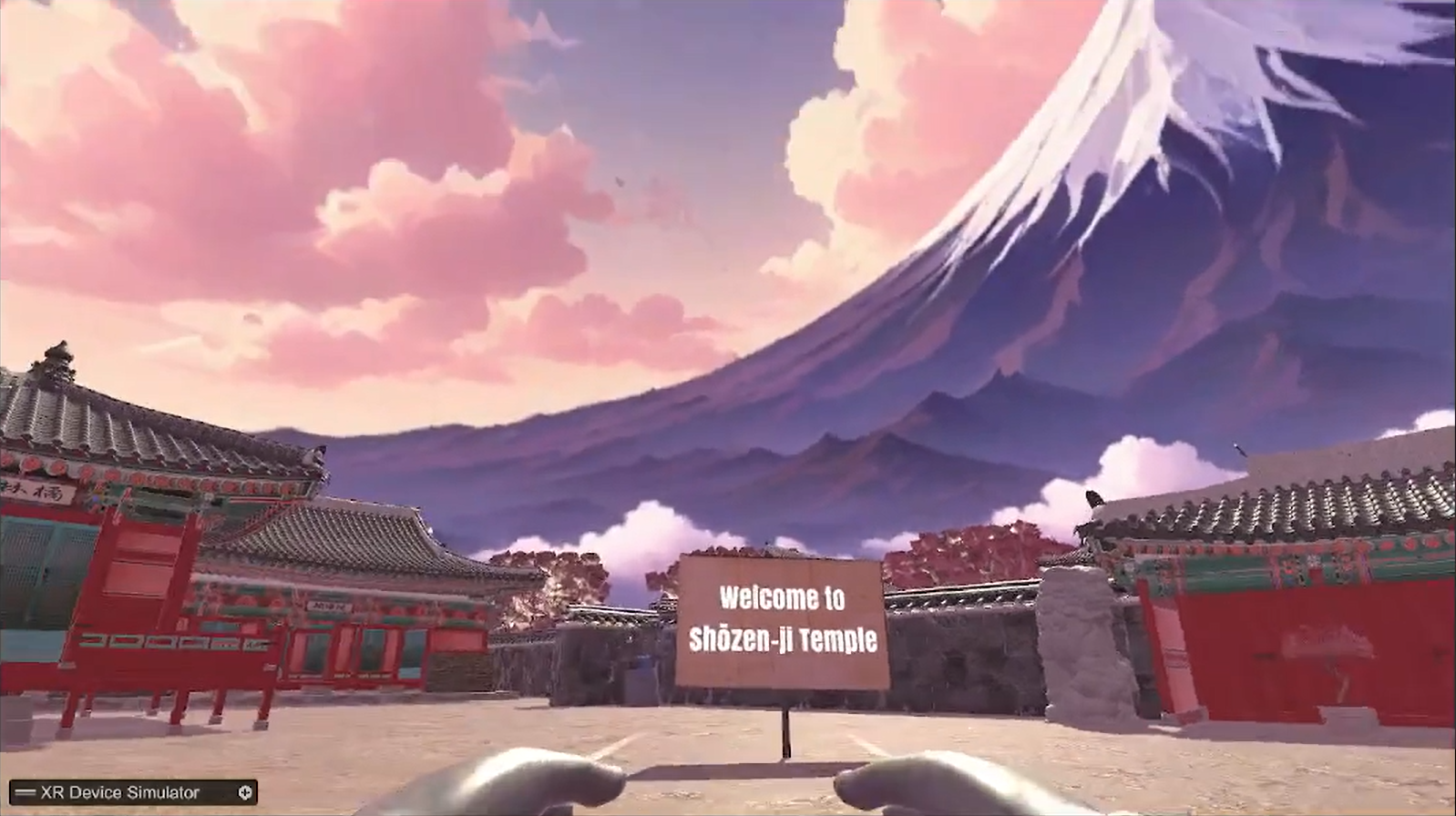
Voyage VR is a cultural exploration platform built in virtual reality. Our prototype transports users to Japan, where they can engage in interactive activities like walking around a koi pond, tossing a coin into a wishing well, and viewing Mount Fuji in a tranquil setting. Instead of static content, users explore these spaces at their own pace, creating a sense of agency and discovery.
The long-term vision is to make Voyage VR a global cultural hub. Imagine walking through India’s Diwali celebrations, exploring Egypt’s pyramids, or joining Brazil’s Carnival parade — all from the comfort of VR. The experience blends exploration, interactivity, and storytelling to make learning about different cultures not only informative but also personal and memorable.
How we built it
We built Voyage VR in Unity, leveraging its VR development tools and asset pipeline. One of the key components we integrated was Cinemachine, which allowed us to create smooth camera transitions and guided perspectives that feel natural in a VR environment. This gave our prototype the polished, immersive feel we wanted, instead of disjointed or disorienting movements.
Our team collaborated by dividing responsibilities: some focused on environment design and modeling, while others concentrated on interaction scripting and camera logic. We worked iteratively, testing each interaction to make sure it was both functional and intuitive. By the end, we had a working prototype that not only showcases Japan but also serves as a framework that can scale to new cultures and regions in the future.
Challenges we ran into
One of the biggest challenges was learning how to properly use Cinemachine within VR. Unlike in traditional 3D development, VR demands extra care to avoid motion sickness, awkward perspectives, or jarring camera cuts. We spent significant time experimenting with camera rigs, fine-tuning transitions, and making sure that movement was smooth enough to feel immersive but comfortable.
We also had to carefully scope our project. Our original idea was to include multiple countries from the start, but we quickly realized that building polished, interactive VR environments takes time. Scaling back to one country allowed us to focus on quality over quantity, ensuring that our prototype set a strong foundation for future expansion.
Accomplishments that we're proud of
We’re proud of building our very first VR cultural exploration experience from scratch — an ambitious goal for a hackathon setting. Successfully integrating Cinemachine for smooth transitions was a big milestone, as it elevated the overall user experience and immersion.
Another accomplishment is that we created a framework for expansion. The way Voyage VR is built makes it easy to add new cultural environments without starting over. Beyond the technical achievement, we’re also proud that we designed something that blends entertainment with learning, highlighting VR’s potential to go beyond gaming.
What we learned
Throughout the project, we learned how to use Unity’s VR tools effectively and discovered the importance of camera design in immersive environments. Small details — like how the camera pans across Mount Fuji or how close you feel when tossing a coin — can make or break a VR experience. This taught us the importance of user comfort and thoughtful design.
We also learned how to scope ambitious projects in a limited timeframe. By narrowing our focus to Japan, we ensured that we finished with a polished, functional prototype instead of spreading ourselves too thin. More importantly, we realized how VR can be a powerful tool for education and empathy, opening the door to projects with real social impact.
What's next for Voyage VR
Next, we plan to expand the platform to include more countries like India, Egypt, and Brazil — each with unique traditions, festivals, and landmarks. We also want to introduce more interactive features such as gaze-based navigation, controller-based mini-games, and cultural quizzes that reward users with badges as they learn.
Beyond the technical expansion, we see real-world applications for Voyage VR. It could be used in classrooms as an immersive learning tool, in DEI workshops to foster empathy across cultures, or even as a travel preview for people considering international trips. Ultimately, our goal is to create a global hub where cultural learning is not just informative, but exciting, interactive, and deeply personal.
Built With
- c#
- headset
- mixamo


Log in or sign up for Devpost to join the conversation.