Voyage
Inspiration
NASA ranks psychological breakdown — not technical failure — as the highest-risk factor for long-duration spaceflight. The specific threat isn't loneliness. It's purposelessness.
Researchers call it the "third-quarter phenomenon": a documented collapse in mood and motivation that hits during the later phase of isolated missions, from Antarctic stations to ISS rotations. Crew don't break when things are new. They break when the destination still feels impossibly far and the mission has become routine.
On a 6-month ISS stay, this is manageable. On a 250-year generational voyage where most people are born, live, and die mid-transit — never seeing either endpoint — it's existential. What does it feel like to be generation 5? Your great-grandparents remembered Earth. Your grandchildren might arrive. You get neither.
What it does
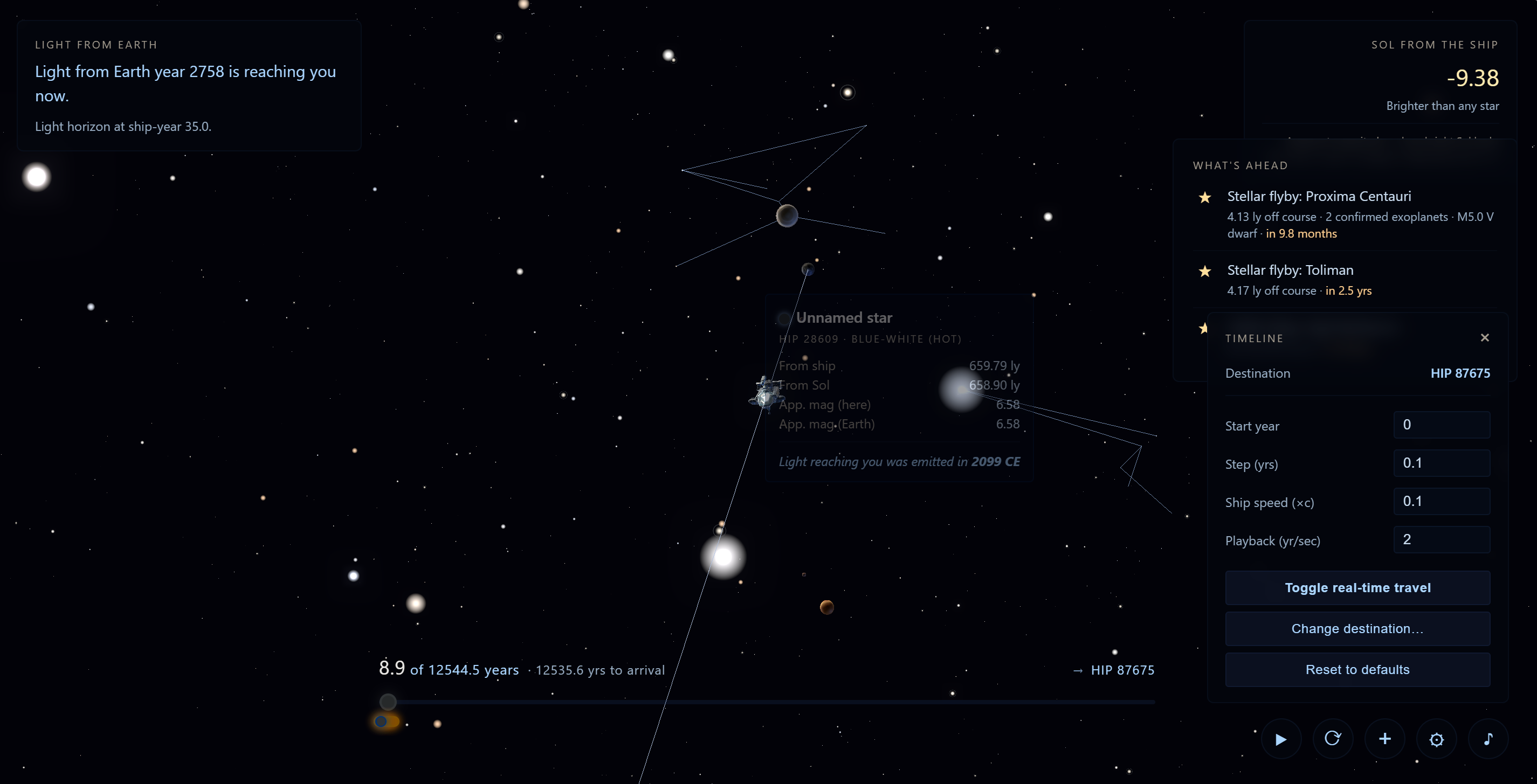
Voyage is a 3D interstellar mission navigator. Pick any star, set your ship's speed, and scrub through centuries of travel — watching stellar flybys, Sol fading to invisibility, Earth's radio signal going silent forever at the light horizon.
The core is the ship's log: memory pins left by crew across generations. Read a launch-day entry from generation 1. A child in generation 2 trying to understand "rain." An anonymous halfway entry from generation 5 who doesn't understand what there is to celebrate. Add your own voice to the timeline.
You're never just watching a trajectory. You're inside a 250-year human story with an inheritance from the past and a stake in the future.
How we built it
Three.js with custom shaders, bloom post-processing, and a 119,000-star field from the real Hipparcos catalog with spectroscopically accurate colors. A Python pipeline generates the trajectory, computes Sol's apparent magnitude at each waypoint, and calculates the light horizon. We bolted on the RECONS Top 100 nearest stars (catching brown dwarfs Hipparcos missed) and the NASA Exoplanet Archive (so flybys say "7 confirmed exoplanets"). Earth radio audio fades via Web Audio API precisely at the light horizon year. Everything runs locally — no backend.
Challenges we ran into
Scale vs. beauty. Real interstellar space is so empty that a geometrically accurate scene is invisible — Earth is 10⁻¹⁰ parsecs wide, the trajectory is 1.3 parsecs long. We spent real time calibrating visual scale constants that are scientifically wrong but emotionally right.
Coordinate transforms. Hipparcos gives RA/Dec/parallax; everything else wants Cartesian parsecs. Getting this consistent between the Python pipeline and JS renderer produced early bugs where Proxima Centauri was on the wrong side of the galaxy.
Brown dwarfs don't have Hipparcos IDs. Merging RECONS data (different naming conventions, no HIP numbers) with the main star catalog required building a parallel ID namespace.
Accomplishments that we're proud of
The flyby events are real. Aim for Tau Ceti and Barnard's Star appears as a close flyby at 0.3 ly — because that's where it actually is in 3D space. Real astronomy emerging from the simulation, unprompted, felt like the project working.
The memory pins landed emotionally. During testing, people read the pre-seeded crew entries and immediately wanted to add their own. The generational arc — from watching Earth shrink to confirming a nitrogen-oxygen atmosphere at Proxima b — creates something that feels like inherited memory.
The audio fade at the light horizon. You don't notice it until it's gone.
What we learned
Narrative is a precision instrument. "Sol is no longer visible" is data. "I went to the observation deck to say goodbye. Forty people were already there. Nobody spoke." is something you remember. That difference is the entire project.
Also: real data always beats invented data. Every time we swapped a placeholder for a real Hipparcos measurement, the simulation got better.
What's next for Voyage
- Shared memory log — multiple people contributing to the same voyage
- Gaia DR3 integration — 1.5 billion stars instead of 119,000
- AI-generated crew entries that respond to actual mission events
- Mission control mode — the same voyage seen from Earth, with light-delay applied, watching the signal fade from the other side

Log in or sign up for Devpost to join the conversation.