-
-
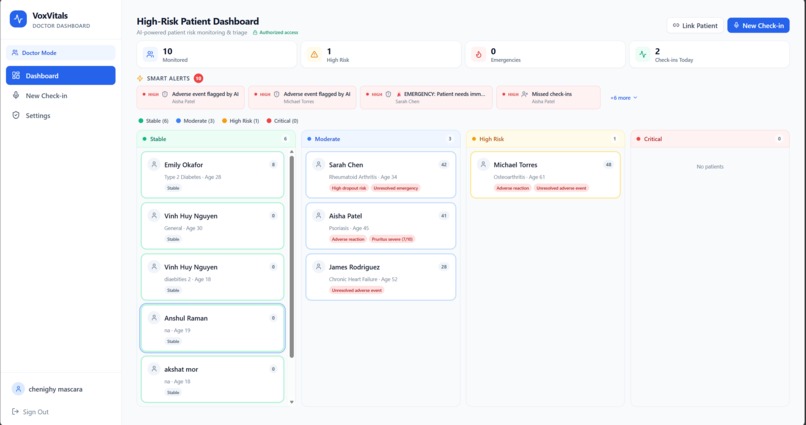
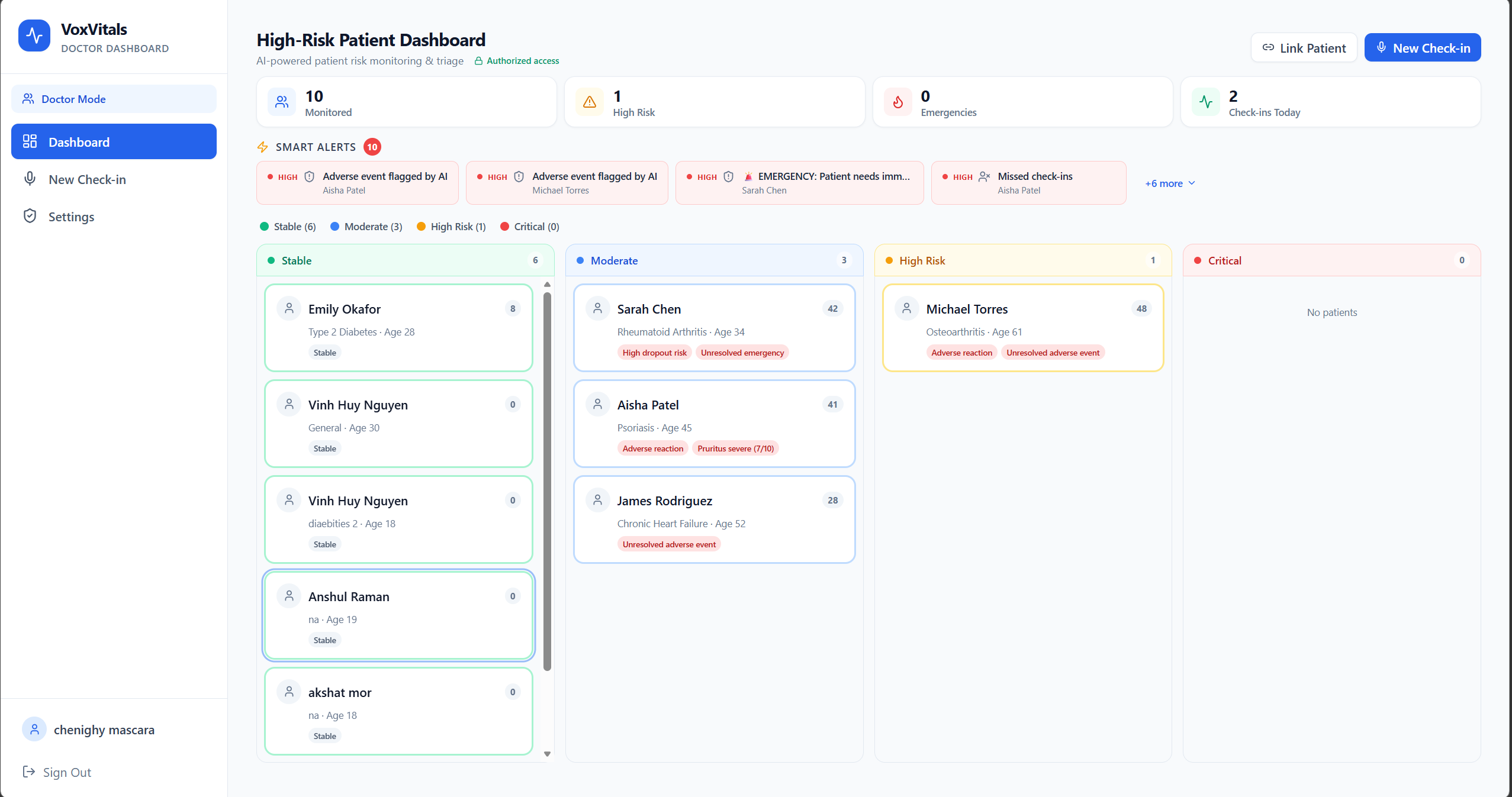
doctor dashboard
-
Inspiration
We were inspired by a critical gap in how clinical trials are currently conducted. Patients are typically monitored only during scheduled visits, which creates long periods where symptoms, medication issues, and emotional distress go unreported. At the same time, patients often feel disconnected from their care teams, leading to low engagement and high dropout rates. Doctors also struggle to monitor multiple patients simultaneously and often receive information too late to act effectively. We wanted to redesign this experience by creating a system that enables continuous, real time monitoring while also strengthening communication between patients, doctors, and lead doctors. Our goal was to make reporting effortless for patients through voice interactions and ensure that care teams can respond quickly through intelligent alerts and built in messaging.
What We Built
We built VoxVitals, an AI powered clinical trial monitoring platform that transforms how patient data is collected, analyzed, and acted upon. Patients complete daily check ins using voice, allowing them to naturally describe how they feel instead of filling out complex forms. The system transcribes and analyzes their input to extract symptoms, detect emotional signals, and assess medication adherence. We also incorporated a simulated physiological sensing layer to represent how real time vital signals such as heart rate, breathing, and focus could be integrated into future clinical systems. In addition, we implemented a voice based login option using personalized phrases to make the experience more intuitive and secure.
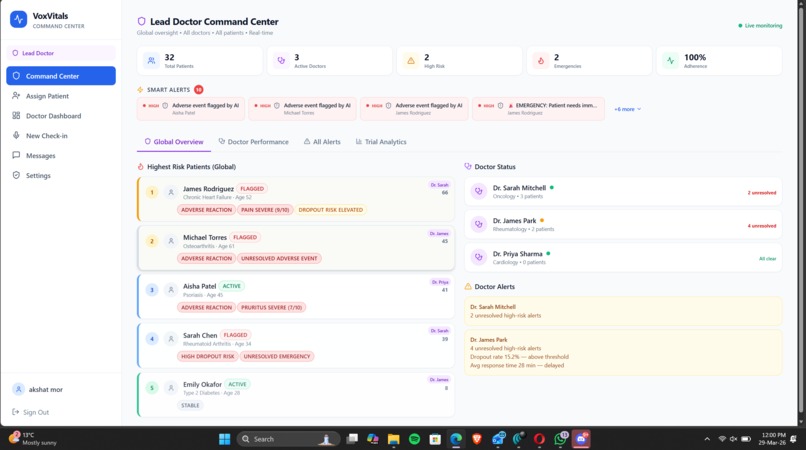
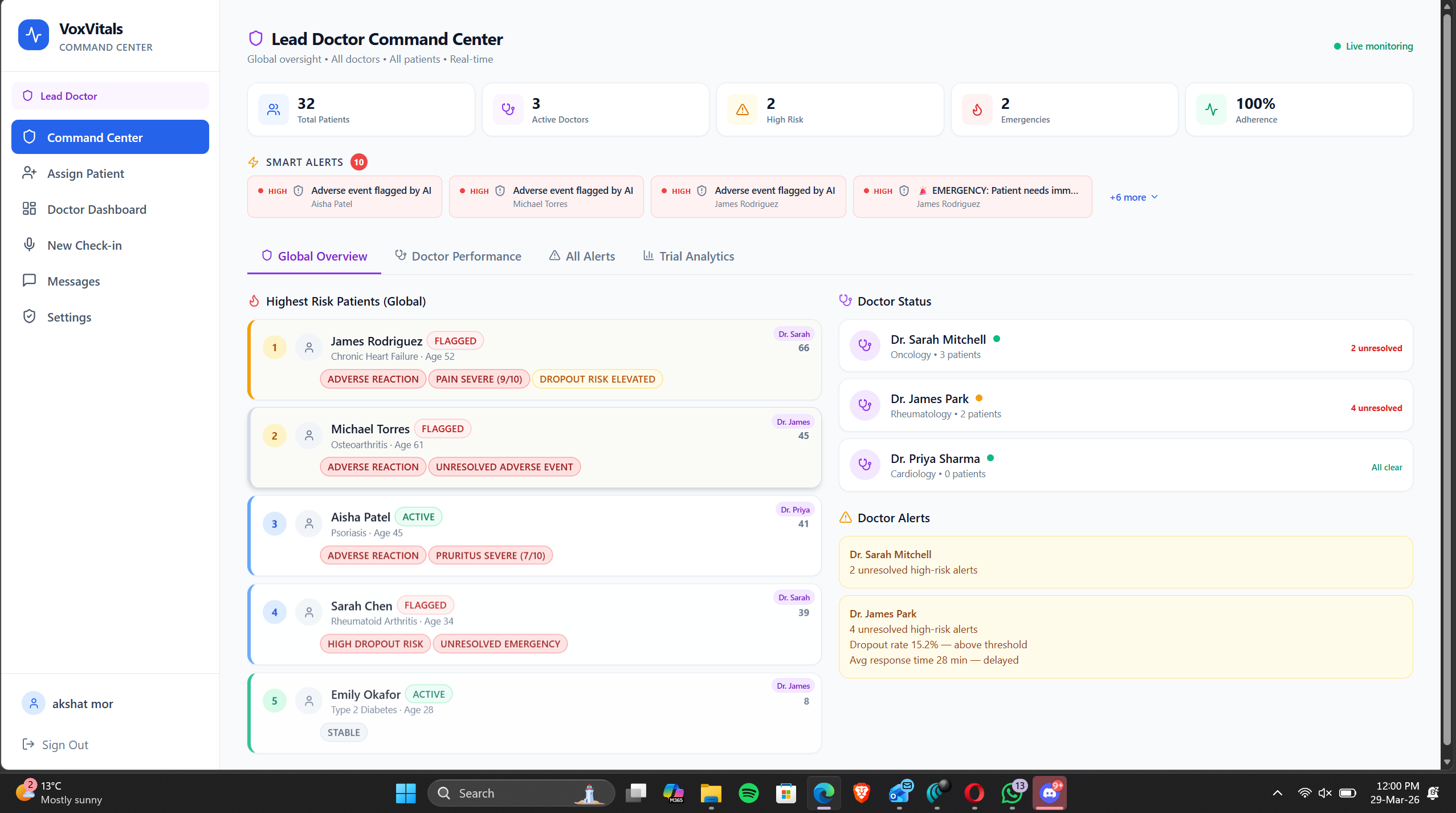
A key feature of our platform is the role based communication system. Patients can message their assigned doctor or the lead doctor directly, ensuring they always have access to support. Doctors can communicate with their assigned patients and escalate concerns to the lead doctor, while the lead doctor can oversee the entire system and communicate with all doctors. On the doctor side, we built a real time dashboard that ranks patients by risk, displays AI generated alerts, and provides detailed summaries and timelines for each patient. This creates a complete loop where patient input is continuously collected, analyzed, and acted upon without delays.
How We Built It
We built VoxVitals using a modern full stack architecture designed for speed, scalability, and reliability. The frontend is developed with Next.js and React, styled using Tailwind CSS, and enhanced with interactive data visualizations. The backend is powered by Supabase, which handles authentication, database management, row level security, and real time features such as messaging and alerts.
We integrated ElevenLabs for speech to text to process both patient check ins and voice based verification, allowing natural voice interactions throughout the app. For AI analysis, we used Gemini to process transcripts and extract structured insights such as symptoms, risk levels, and recommended actions. The system is built with a multi stage fallback pipeline to ensure that even if one AI provider fails, another takes over so the experience remains uninterrupted. We also implemented role based access control to manage permissions across patients, doctors, and lead doctors, ensuring that each user sees only the data relevant to their role.
Challenges We Faced
One of the biggest challenges was integrating multiple advanced systems into a single seamless experience. We had to combine voice input, AI analysis, simulated physiological data, real time alerts, and a role based messaging system while keeping the interface simple and intuitive for all users. Managing real time communication between patients, doctors, and lead doctors required careful handling of permissions and data synchronization.
Another major challenge was ensuring reliability in a hackathon environment where external APIs can fail or behave unpredictably. To address this, we built fallback mechanisms and graceful degradation so that the system continues to function even if certain services are unavailable. We also faced challenges in designing a database schema that could support complex relationships between users, check ins, alerts, and messages without causing inconsistencies. Debugging and refining these interactions required significant iteration and testing.
What We Learned
Through this project, we learned that successful healthcare solutions must prioritize both usability and actionability. Collecting data is not enough; the system must transform that data into clear insights that help doctors make decisions quickly. We also learned that communication is just as important as monitoring in clinical trials. By integrating messaging directly into the platform, we created a more connected and responsive experience for all users.
We gained valuable experience in building resilient systems that can handle failures gracefully, which is especially important when working with multiple external APIs. Additionally, we learned how powerful it is to combine different types of data, such as voice input and physiological signals, to create a more comprehensive understanding of patient health. Overall, this project showed us how technology can significantly improve patient safety, engagement, and outcomes in clinical research.
Built With
- javascript
- next.js
- typescript

Log in or sign up for Devpost to join the conversation.