-
-
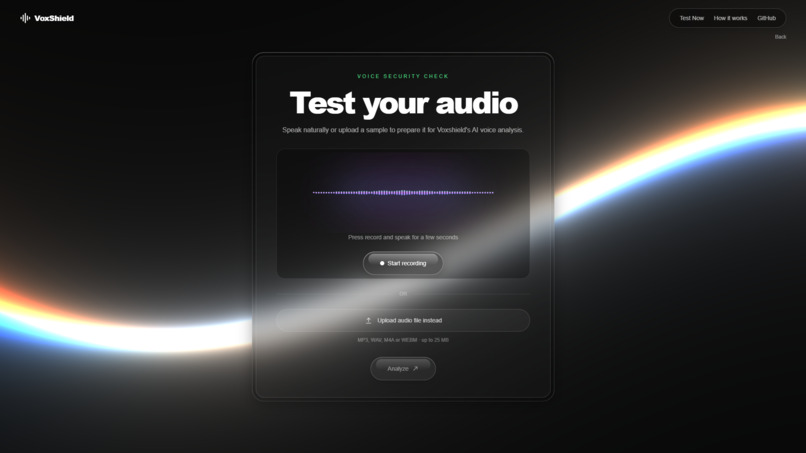
Audio Test
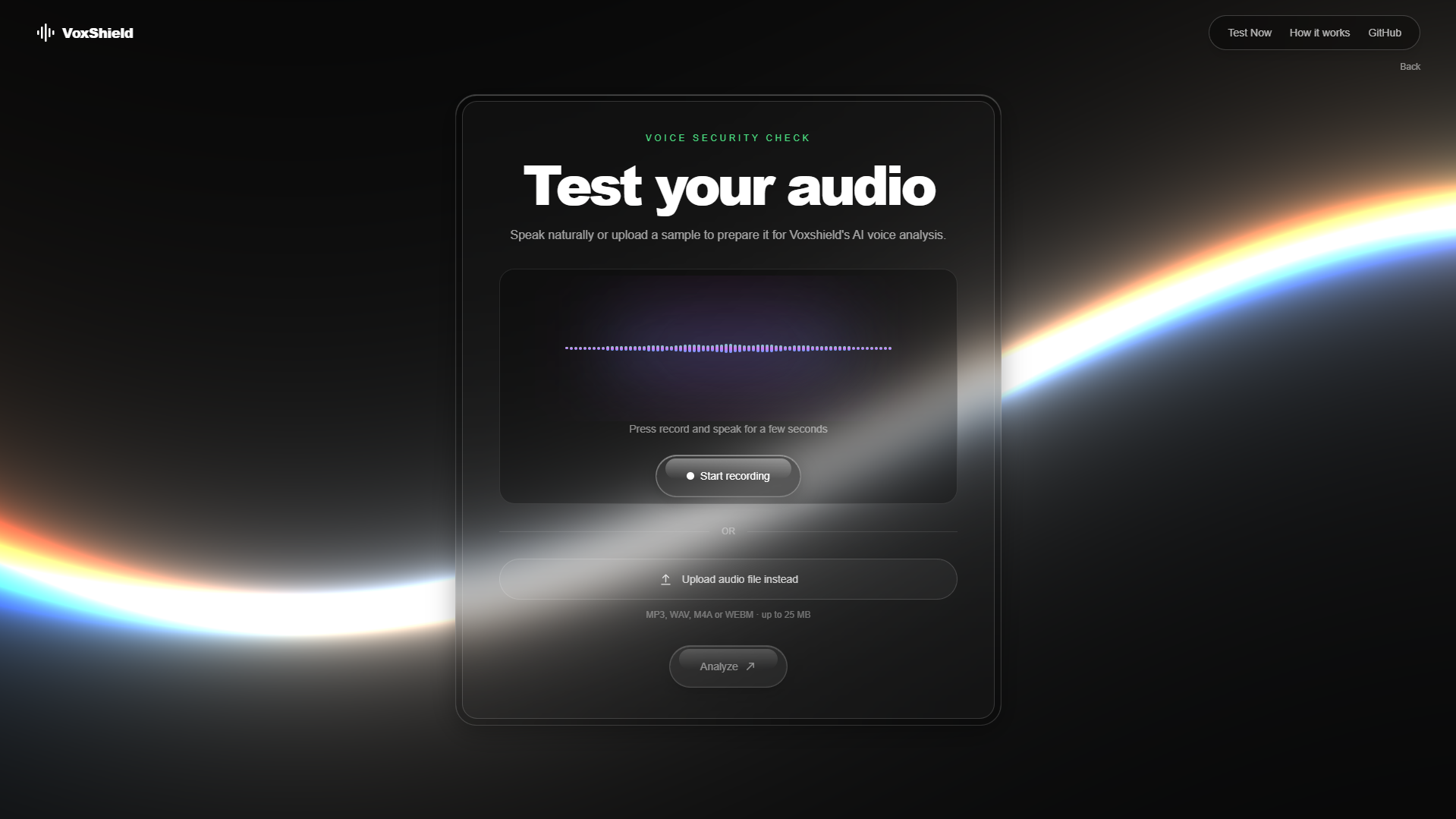
Inspiration
Voice cloning technology is advancing rapidly, making it easier to generate synthetic speech that sounds like a real person. While this technology has legitimate applications, it can also be misused for impersonation, social engineering, and voice-based fraud.
We built VoxShield to explore how machine learning can help identify potentially AI-generated or manipulated speech, with particular attention to Indian speakers and accents that may be underrepresented in existing datasets.
Our goal is to make voice authenticity analysis more accessible through a practical web-based application.
What it does
VoxShield is an AI-powered voice cloning detection prototype that analyzes audio recordings and classifies them as REAL or FAKE using machine learning.
Key features include:
- Audio analysis: Supports audio uploads and browser-based microphone recordings.
- Feature extraction: Uses audio signal processing to extract acoustic and spectral characteristics.
- Machine learning classification: Uses trained models to distinguish patterns in real and synthetic speech.
- Prediction results: Returns a classification and a confidence-related score.
- Web interface: Provides a simple way to submit audio and view detection results.
- Indian-speaker focus: Explores synthetic voice detection with an emphasis on Indian-accented and Indian-speaker audio.
VoxShield is currently a detection prototype. It does not directly intercept phone calls or guarantee prevention of voice-cloning attacks.
How we built it
We developed VoxShield by combining audio signal processing, supervised machine learning, and web application development.
Machine Learning and Audio Processing
- Python for model development and audio analysis.
- Librosa and NumPy for audio processing and numerical feature extraction.
- Acoustic and spectral features, including MFCCs, Mel spectrograms, spectral characteristics, pitch, zero-crossing rate, chroma, and RMS energy.
- Scikit-learn to train and compare Random Forest and Gradient Boosting classifiers.
- Joblib for model persistence and loading during inference.
- A train/test split to evaluate the trained model on held-out samples.
Backend
- Flask to expose the audio classification API.
- Flask-CORS for cross-origin communication between the frontend and backend.
- A
/predictendpoint for audio classification and a/healthendpoint for backend health checks.
Frontend and Deployment
- React, Vite, and Tailwind CSS for the web interface.
- Vercel for frontend deployment.
- Render for backend deployment.
The workflow is straightforward: audio input → preprocessing → feature extraction → trained model inference → classification result.
Challenges we ran into
- Audio variability: Differences in speakers, accents, microphones, background noise, and recording quality make synthetic speech detection challenging.
- Feature engineering: Converting audio into meaningful numerical features required understanding how acoustic and spectral representations can support classification.
- Model selection: Comparing Random Forest and Gradient Boosting helped us explore different approaches to learning from extracted audio features.
- Dataset limitations: Finding suitable real and synthetic speech samples, especially for Indian speakers, highlighted the importance of dataset diversity and quality.
- Frontend-backend integration: Connecting browser-based audio input to a deployed Flask API required consistent audio handling and communication between the two components.
- Reliable evaluation: We learned that a successful prediction or a single train/test split does not establish reliable performance against unseen voice-cloning techniques.
Accomplishments that we're proud of
- Built an end-to-end voice cloning detection prototype that connects audio processing, machine learning inference, a backend API, and a web interface.
- Implemented a feature-based audio classification pipeline using Python and Librosa.
- Trained and compared Random Forest and Gradient Boosting models.
- Integrated model inference with Flask endpoints that return classification results.
- Deployed the frontend and backend so the application can be accessed online.
- Established an initial foundation for exploring synthetic speech detection with Indian-speaker audio.
We are proud that VoxShield brings together concepts from machine learning, digital audio processing, and cybersecurity in a working, demonstrable project.
What we learned
Building VoxShield helped us understand how a machine learning application moves beyond model training into a complete software system.
We learned how to:
- Process audio signals and extract features for machine learning.
- Apply supervised classification algorithms to a binary detection problem.
- Compare different models using a train/test evaluation workflow.
- Integrate a trained model into a Flask API.
- Connect a React frontend to a deployed Python backend.
- Recognize the importance of dataset diversity, generalization, and responsible interpretation of model predictions.
Most importantly, we learned that detecting synthetic speech is an evolving challenge. A model's confidence score should not be treated as definitive proof that a voice is genuine or AI-generated.
What's next for VoxShield (AI-Powered Voice Cloning Detection)
Our next steps focus on improving the reliability, evaluation, and usability of VoxShield.
- Stronger evaluation: Measure accuracy, precision, recall, F1-score, and confusion matrices on held-out data before reporting performance claims.
- Dataset expansion: Explore more diverse Indian speakers, languages, accents, and synthetic speech generation methods.
- Robustness testing: Investigate the effects of background noise, audio compression, recording devices, and unfamiliar synthesis systems.
- Model improvement: Experiment with feature engineering, hyperparameter tuning, and additional detection approaches.
- Better explainability: Provide more useful information about the audio characteristics associated with a prediction.
- Improved deployment: Strengthen API reliability, input validation, error handling, and monitoring.
- Future real-time research: Explore streaming audio analysis as a separate development step, without claiming direct phone-call interception in the current prototype.
Our long-term vision is to develop VoxShield into a more robust and accessible tool for researching AI-generated voice detection and helping people make better-informed assessments of suspicious audio.
Built With
- audio-processing
- cybersecurity
- flask
- librosa
- machine-learning
- python
- react
- scikit-learn


Log in or sign up for Devpost to join the conversation.