Inspiration
I was inspired to explore how AI could help people improve not just what they say, but how they say it. Pauses, speaking rate, pitch variation, and vocal energy can influence how a message is delivered, yet identifying the exact moments that need improvement can be difficult.
This motivated me to build VoxSage AI, a speech analytics platform that aims to make speech feedback more explainable, measurable, and actionable.
What it does
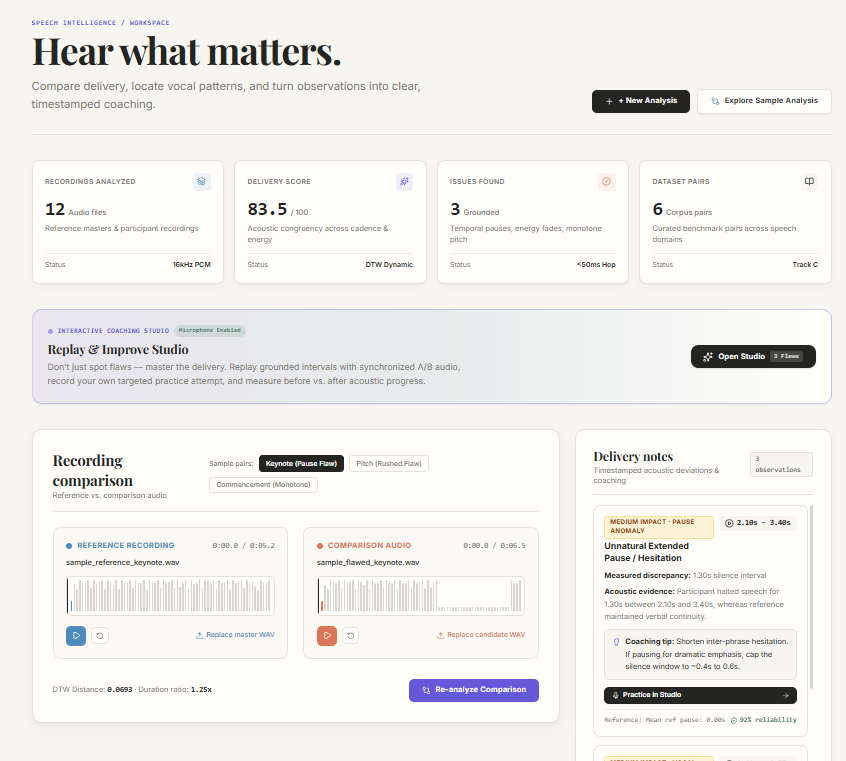
VoxSage AI focuses on comparing reference and comparison speech recordings to analyze delivery patterns and identify potential areas for improvement.
Key features include:
- Contrastive Speech Analysis: Compare two recordings to examine differences in speech delivery.
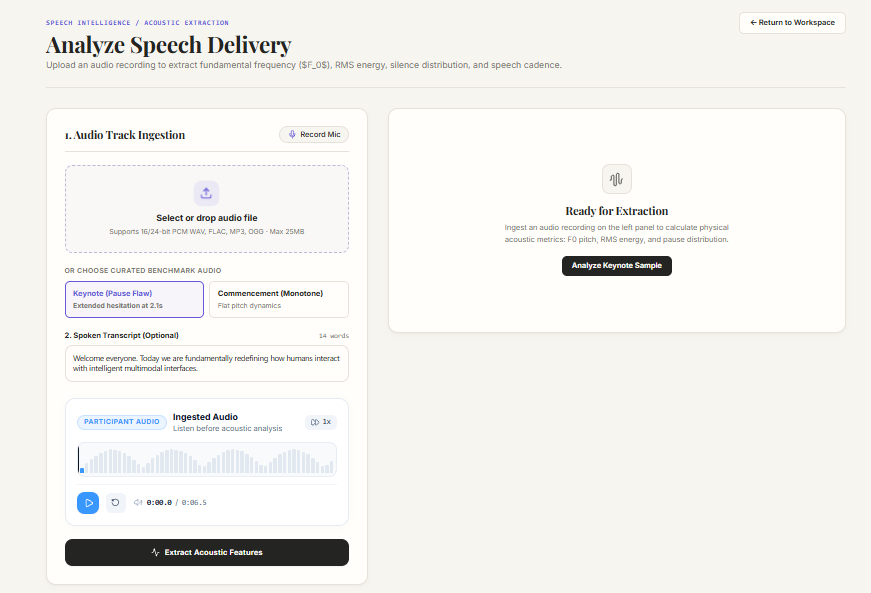
- Acoustic Feature Analysis: Explore features such as pitch, energy, pauses, and speaking rate.
- Temporal Issue Grounding: Associate detected issues with specific timestamps for closer inspection.
- Interactive Dashboard: Visualize audio waveforms, acoustic measurements, and issue timelines.
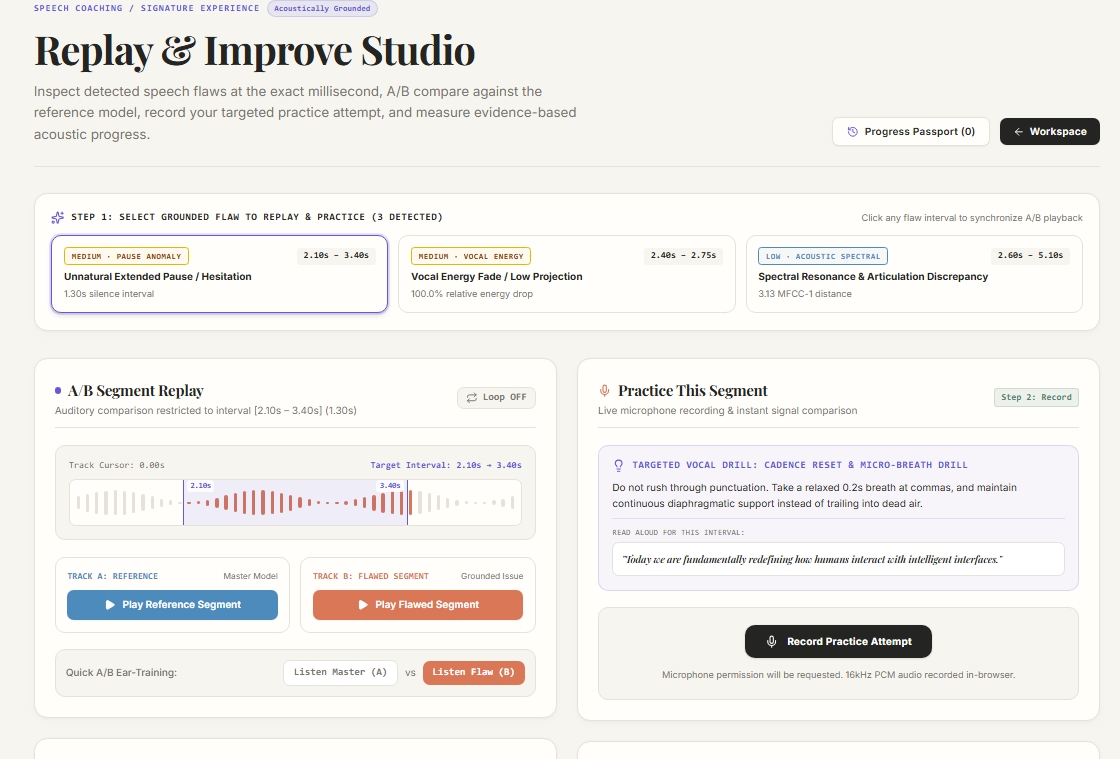
- Replay & Improve Workflow: Support reviewing specific segments, practicing delivery, and comparing new attempts.
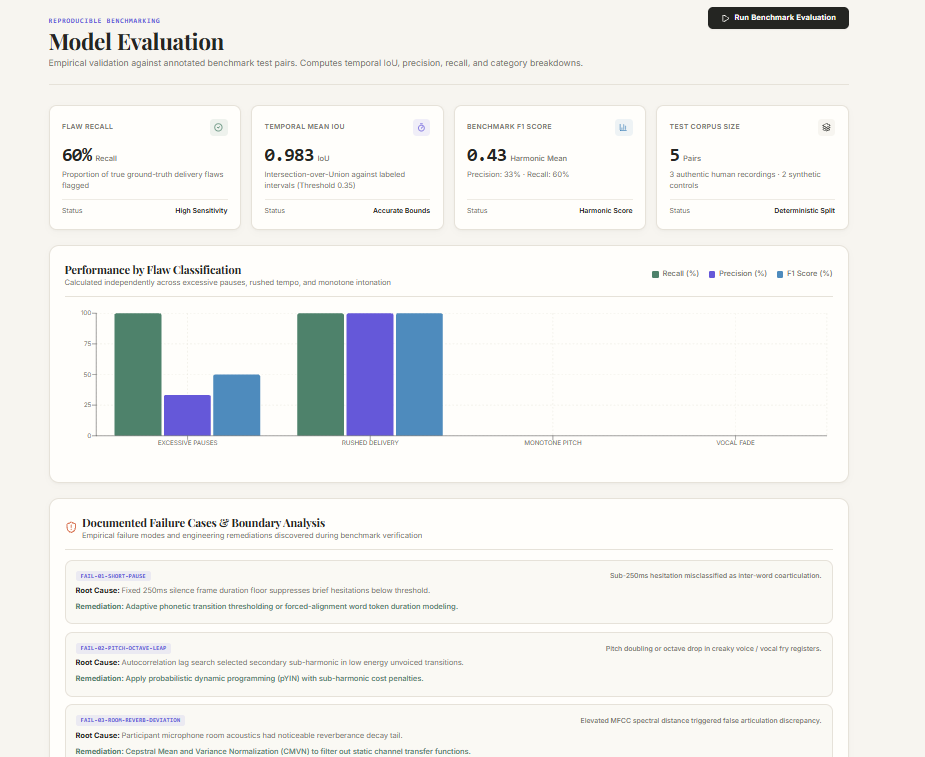
- Contrastive Dataset: Organize paired recordings with transcripts, flaw labels, and timestamp annotations.
How I built it
I approached VoxSage AI with a modular architecture separating the frontend, audio-processing backend, and visualization layer.
The frontend is built around React and Vite, with a clean, editorial-style interface designed to make technical audio insights easy to understand. The Python-based backend uses FastAPI and audio-processing libraries such as librosa, NumPy, SciPy, and SoundFile to support audio analysis.
The workflow centers on extracting measurable acoustic features and presenting available results through comparison panels, waveform visualizations, and timestamped feedback.
Challenges we ran into
One of the main challenges was understanding how to distinguish meaningful delivery variations from ordinary differences between recordings. Speaker characteristics, background noise, and recording conditions can all influence acoustic measurements.
Temporal accuracy was another important challenge. Identifying a potential issue is not enough; connecting it to the correct audio interval is essential for useful feedback.
Dataset quality also requires careful attention. Synthetic transformations can help create controlled test cases, but their results do not automatically demonstrate performance on naturally occurring speech. Reliable annotations and reproducible evaluation are therefore important parts of the project.
Accomplishments that we're proud of
I am proud of the idea of bringing speech comparison, acoustic analysis, and timestamp-based feedback together in one focused experience.
Another important accomplishment is the emphasis on explainability: helping users move beyond a generic score toward understanding which part of a recording deserves attention and why.
The project also provides a foundation for a custom contrastive dataset and a practice-oriented workflow that can connect analysis with improvement.
What we learned
Developing VoxSage AI helped me explore audio feature extraction, speech comparison, interactive data visualization, and the challenges of evaluating AI systems with labelled data.
I learned that useful AI feedback needs more than a prediction. It should be connected to observable evidence, relevant timestamps, and practical next steps. I also learned the importance of separating controlled synthetic testing from evaluation on natural speech.
What's next for VoxSage AI
The next steps are to strengthen timestamp-level issue detection, expand and improve the contrastive dataset, and evaluate the system across different speech-delivery variations.
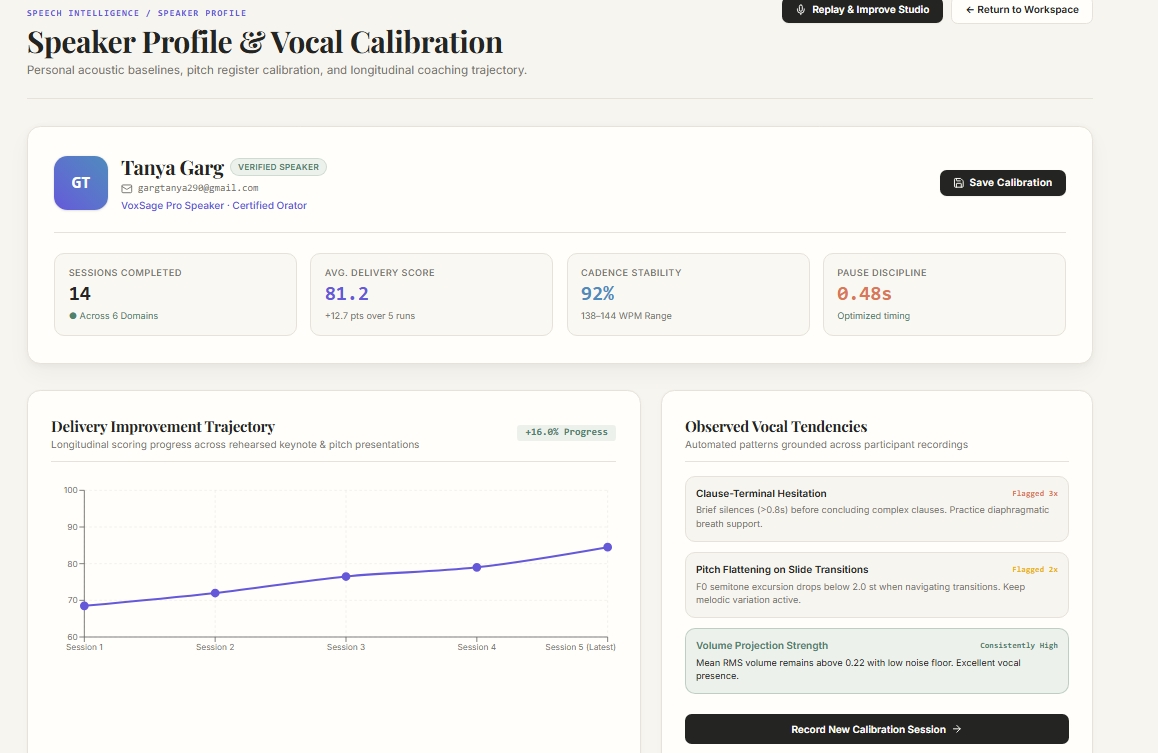
I also plan to refine Replay & Improve Studio, allowing users to revisit a specific segment, record a new attempt, and compare measurable acoustic changes over time.
The long-term vision is to make VoxSage AI a practical speech-coaching workspace that turns audio analysis into understandable feedback and guided practice.
VoxSage AI — Analyze the sound. Find the flaw. Master the delivery.
Built With
- artificialintelligence
- audioprocessing
- backenddevelopment
- datascience
- datavisualization
- fastapi
- frontenddevelopment
- librosa
- machine-learning
- numpy
- python
- react
- recharts
- scipy
- soundfile
- speechanalysis
- tailwindcss
- vite


Log in or sign up for Devpost to join the conversation.