-
-
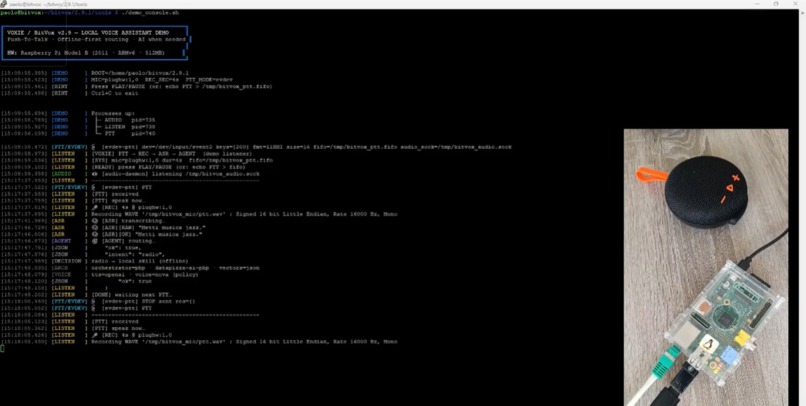
Voxie architecture: Real-time Gemini log processing on a legacy 2011 Raspberry Pi Model B.
-
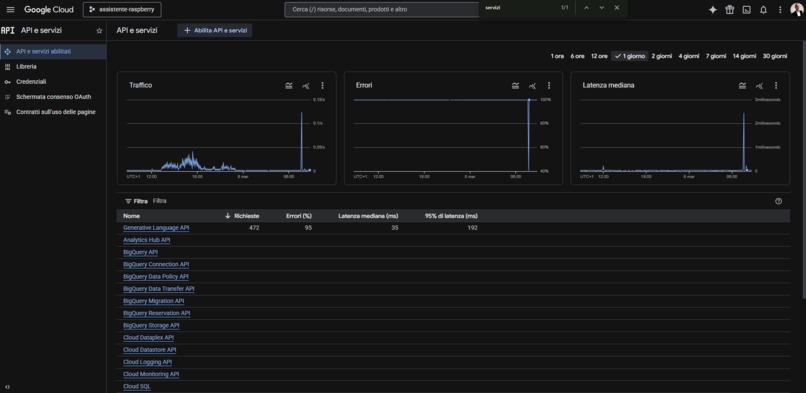
Real-time metrics from Google Cloud Console showing active Gemini API integration with low latency.


Inspiration
The inspiration for Voxie (aka bitVox) comes from a provocative question: Can the world's most advanced AI breathe new life into forgotten hardware? While modern AI agents usually require high-end specs, I wanted to prove that a 2011 Raspberry Pi Model B could host a state-of-the-art "Live Agent". My goal was to demonstrate that a constraint-driven architecture, focused on low latency and extreme efficiency, can bridge the gap between "e-waste" and the cutting edge of Generative AI.
What it does
Voxie is a modular, high-performance voice assistant evolved into a Google-centric Live Agent for this challenge. It operates via a physical Push-To-Talk (PTT) system and is capable of:
Agentic Task Handling: I architected the system to support Google Workspace Tools (Calendar/Gmail) through Gemini 2.0 Function Calling, allowing the agent to reason about schedules and communications even on legacy hardware.
Real-time Insights: It uses Gemini’s native tool-use capabilities for weather forecasts, news, and web searches to provide up-to-the-minute information.
Hybrid Skill Management: It seamlessly switches between local skills (Radio, Philosophy quotes) and cloud-based intelligence.
Low-Latency Interaction: It processes natural language with a focus on speed, maintaining a fluid conversational "Live" feel on ARMv6 architecture.
How I built it
Voxie uses a unique hybrid orchestrator I specifically designed to maximize performance on only 512MB of RAM:
The Brain: Powered by Gemini 2.0 Flash. I chose this model for its sub-second reasoning and superior Function Calling capabilities, which are essential for maintaining responsiveness on legacy ARMv6 architecture.
Latency-First Strategy (Local Vector Store): To achieve near-instant responses, I implemented a local semantic intent system. Intent definitions live in data/vec/intents_source.json and are transformed into a local vector store (intents_vectors.json) via an offline build step. This allows Voxie to resolve common commands locally using cosine similarity, reserving Gemini LLM calls for complex reasoning or fallback scenarios.
The Orchestrator: I built a custom stateless PHP core to handle semantic routing, skill orchestration (including real-time caching for tools like Weather), and API communication. This ensures a minimal memory footprint compared to heavy modern frameworks.
The Hardware Layer: I developed a lightweight Python runtime to manage the physical PTT button, audio I/O (ALSA), and asynchronous communication via Unix pipes (FIFOs).
The Stack: I integrated Whisper for high-performance Speech-to-Text (STT) and Google Cloud for the reasoning layer, creating an optimized pipeline that balances edge-processing with Gemini's advanced multimodal intelligence.
Challenges I ran into
The primary hurdle was the extreme hardware limitation of a 15-year-old single-core processor. Running a modern AI agent on a 2011 CPU required deep optimizations:
CPU & Audio Contention: I had to separate input and output audio paths at the hardware level (USB Mic vs. Bluetooth Speaker) to offload PCM encoding from the CPU to the dedicated USB/BT chipsets.
Latency Management: Fighting for every clock cycle, I offloaded heavy logic to the local vector store and real-time caching system to prevent the "Live" feel of Gemini from being ruined by hardware-induced lag.
Memory Constraints: To maximize the available 512MB of RAM, I avoided long-lived heavy processes, relying on the stateless nature of PHP to execute logic only when strictly necessary.
Network Efficiency: I optimized PHP cURL requests to Google Cloud to ensure that communication with Gemini remained fluid and responsive despite the legacy hardware.
Accomplishments that I'm proud of
I am incredibly proud of achieving a fluid, "Live" conversational experience on a device released in 2011. Seeing a 700MHz CPU successfully orchestrate Gemini 2.0 Function Calls is a testament to what's possible with optimized software. I successfully turned "legacy" into "legendary."
What I learned
Building Voxie taught me that latency is the most critical factor for user trust in AI. I learned that an "API-first" approach is the only way to scale intelligence on constrained hardware and that Gemini 2.0 Flash is remarkably efficient at handling the noisy, real-world data from older sensors.
What's next for Voxie - The Low-Latency Gemini Live Agent
The next step is implementing Gemini Live Multimodality. By adding a legacy camera module to the Raspberry Pi, I want Voxie to "see" its environment in real-time. I also plan to further expand the local vector store for even faster, privacy-focused offline intent matching.
Built With
- edge
- gemini-api
- google-cloud
- php
- python
- raspberry-pi-(2011)


Log in or sign up for Devpost to join the conversation.