Inspiration
Technical knowledge alone is not always enough to succeed in an interview. Many students understand concepts but struggle to explain them clearly, think through follow-up questions, or communicate confidently under pressure. Access to realistic mock interviews and personalized feedback can also be limited.
I wanted to build something that could make technical interview practice more interactive and accessible. Instead of relying on static question banks, I envisioned an AI interviewer that could listen, understand responses, ask relevant follow-up questions, and adapt the interview based on the candidate's performance. This idea led to VoxHire.
What it does
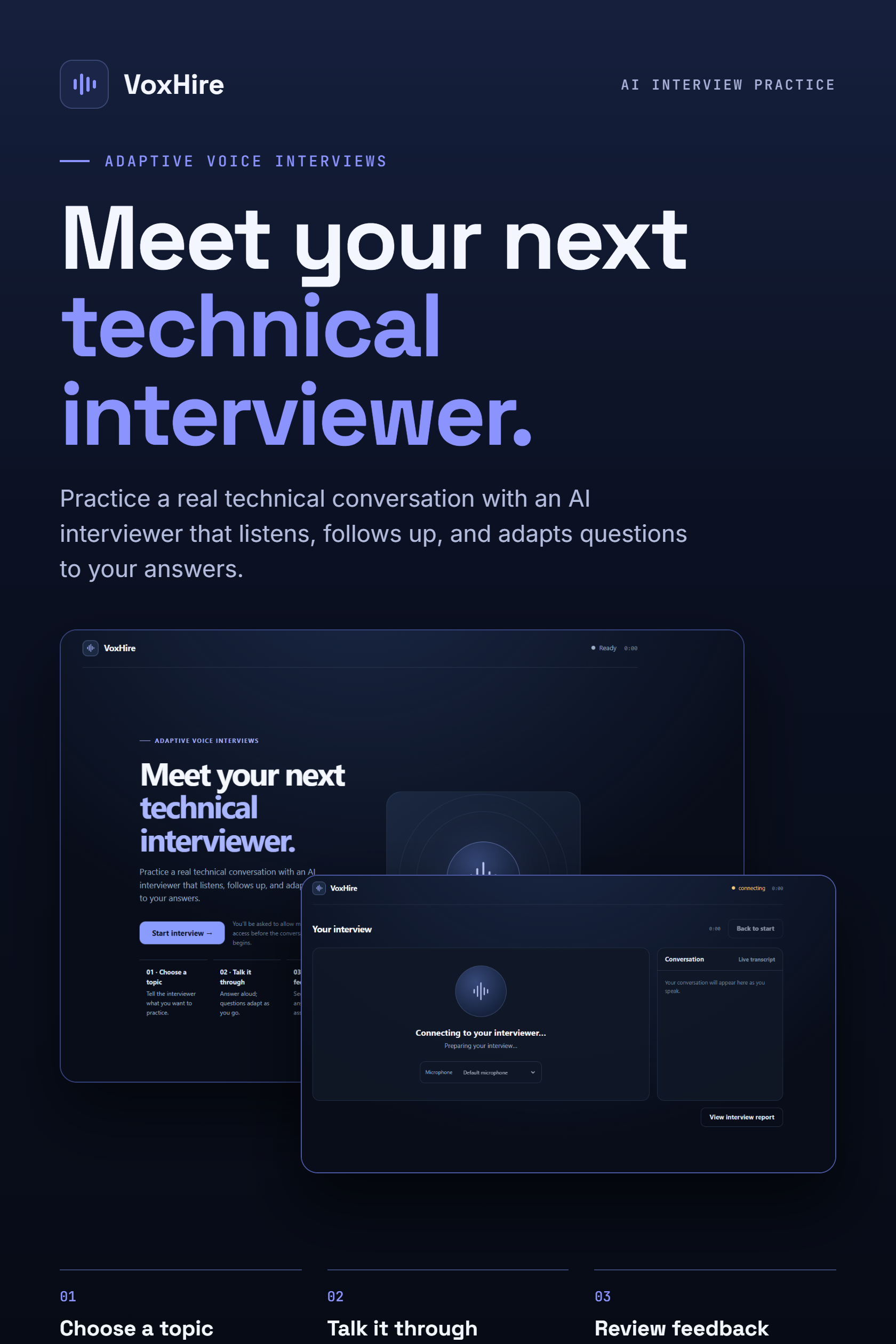
VoxHire is an AI-powered adaptive voice technical interviewer that simulates a real interview through natural, real-time voice conversations.
Candidates can choose a technical topic and answer questions verbally. The AI interviewer evaluates their responses, asks relevant follow-up questions, adjusts question difficulty, and redirects the conversation when necessary.
At the end of an interview, VoxHire generates an assessment covering:
- Technical knowledge
- Reasoning
- Problem-solving
- Communication
It also provides feedback, strengths, weaknesses, knowledge gaps, and recommendations for improvement.
How we built it
We built VoxHire using JavaScript and Node.js, integrating the AssemblyAI Voice Agent API to power real-time voice conversations.
WebSockets enable continuous communication between the browser and the voice agent, while the VoxHire interview engine manages the interview state, including the selected topic, current question, difficulty level, candidate answers, and performance data.
We implemented adaptive interview logic to process candidate responses, determine the next interview action, manage difficulty, and maintain the flow of the conversation. The application is hosted on Render and can be accessed directly through a web browser.
Challenges we ran into
One of our main challenges was making the interview feel like a genuine conversation rather than a sequence of unrelated questions.
We had to ensure that the AI could respond appropriately to candidate answers, ask meaningful follow-up questions, maintain context, and adjust difficulty without disrupting the interview flow.
Another challenge was managing interview state consistently across multiple interactions, including topic changes, question progression, answer recording, and performance evaluation.
Integrating real-time voice communication with our own interview logic also required careful coordination between the browser, server, and AssemblyAI Voice Agent.
Accomplishments that we're proud of
We are proud to have developed a functional, browser-based AI interviewer that goes beyond simply asking predefined questions.
VoxHire can conduct interactive technical interviews, adapt its questioning based on candidate responses, manage interview difficulty, and generate a structured performance report.
Most importantly, we transformed the original idea into a working product that people can actually try.
What we learned
Building VoxHire gave us practical experience with real-time AI applications, voice agent integration, WebSockets, backend development, and conversational workflows.
We learned that building an effective AI-powered application involves much more than connecting an API. It requires designing the logic around the AI, managing state, handling different conversational scenarios, and ensuring that the overall experience remains coherent.
We also gained a better understanding of how conversational AI can be applied to practical problems in education and employability.
What's next for VoxHire
Our long-term vision is to make VoxHire a more comprehensive interview preparation platform for students and aspiring professionals.
Potential directions include broader technical subject coverage, richer personalized feedback, candidate progress tracking, and adoption by educational institutions and college placement cells.
Ultimately, we want to help make quality interview practice more accessible, so that a candidate's opportunity to prepare does not depend solely on their access to mentors or professional networks.
Built With
- assemblyai
- javascript
- node.js
- render
- voiceai
- websockets

Log in or sign up for Devpost to join the conversation.