-
-
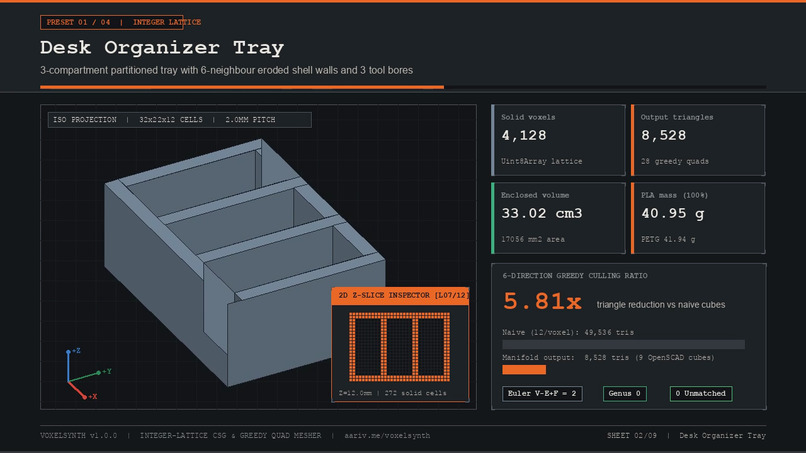
Built from scratch with zero runtime dependencies, interactive browser verification, and automated node:test unit tests.
-
-
-
-
-
Inspiration (and Artist Statement)
Digital design tools often hide the boundary between visual form and physical manufacturability. A shiny render cannot tell you whether a wall disappeared, a mounting bore pinched shut, or a mesh has non-manifold edge contacts that will fail in a slicer. VoxelSynth bridges functional CAD and algorithmic sculpture on one shared integer lattice: every cell, layer slice, Euler characteristic, and directed edge incidence stays visible in the studio so form, mathematics, and fabrication share the exact same geometric contract.
What it does
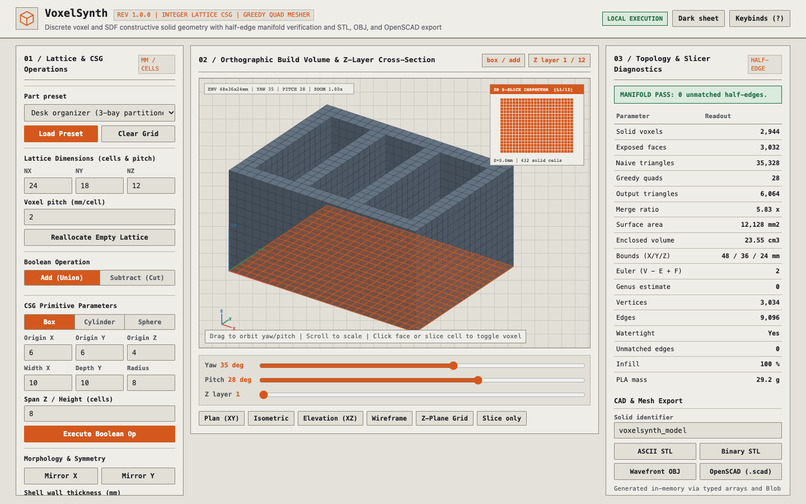
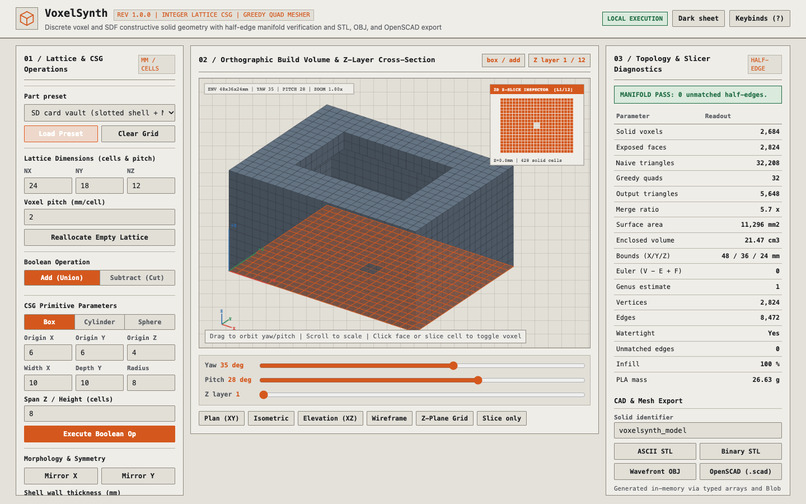
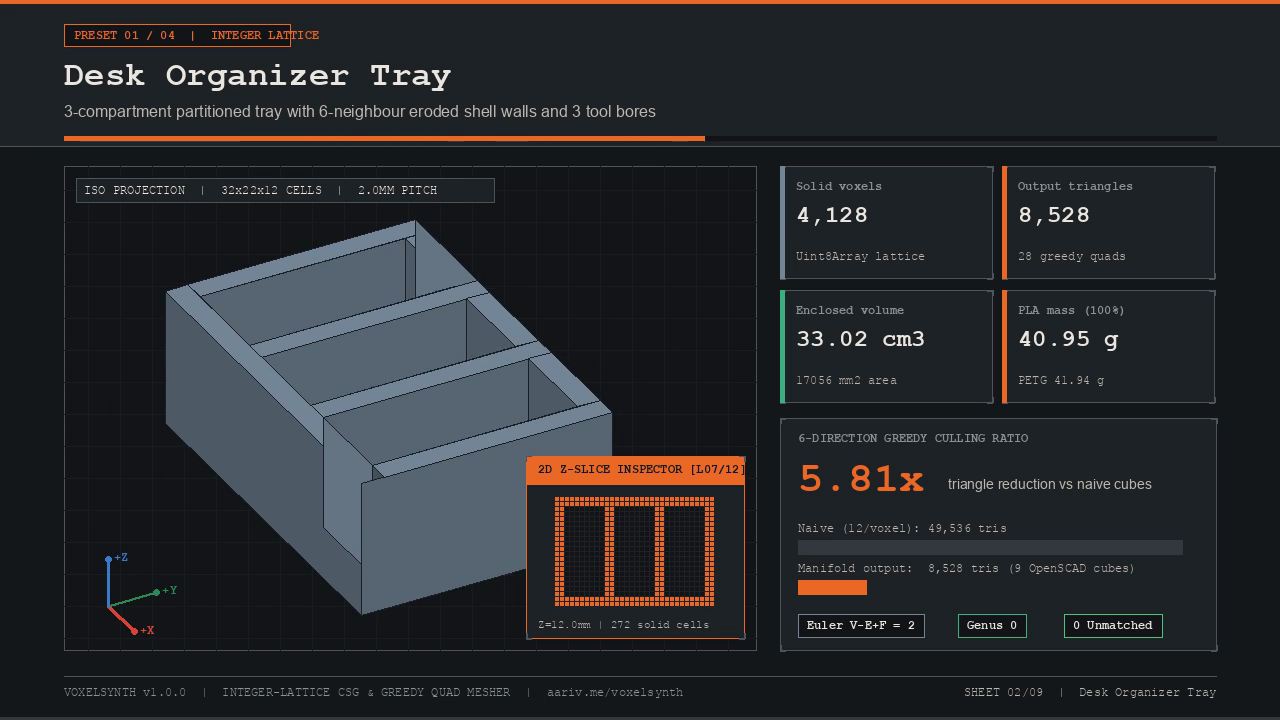
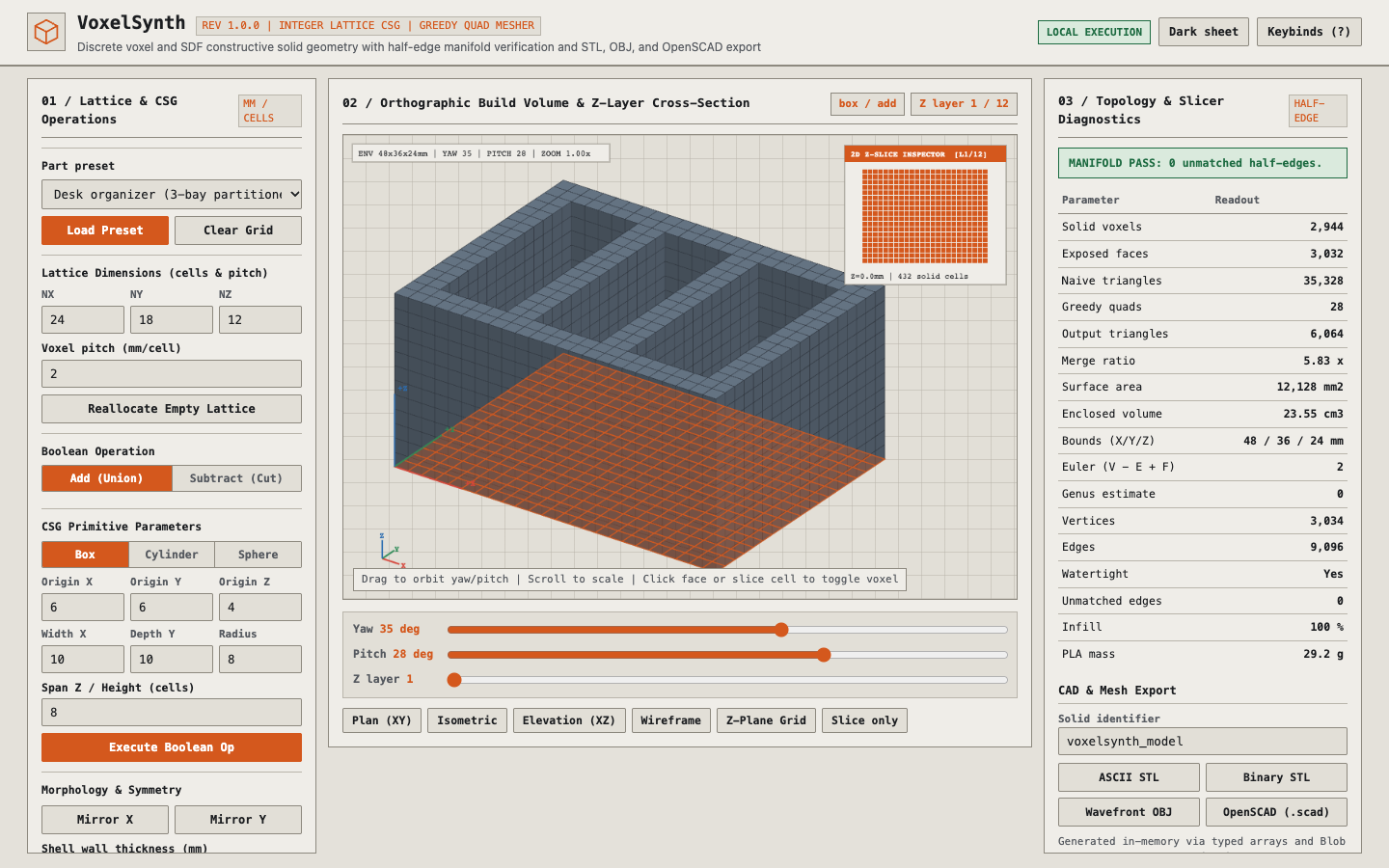
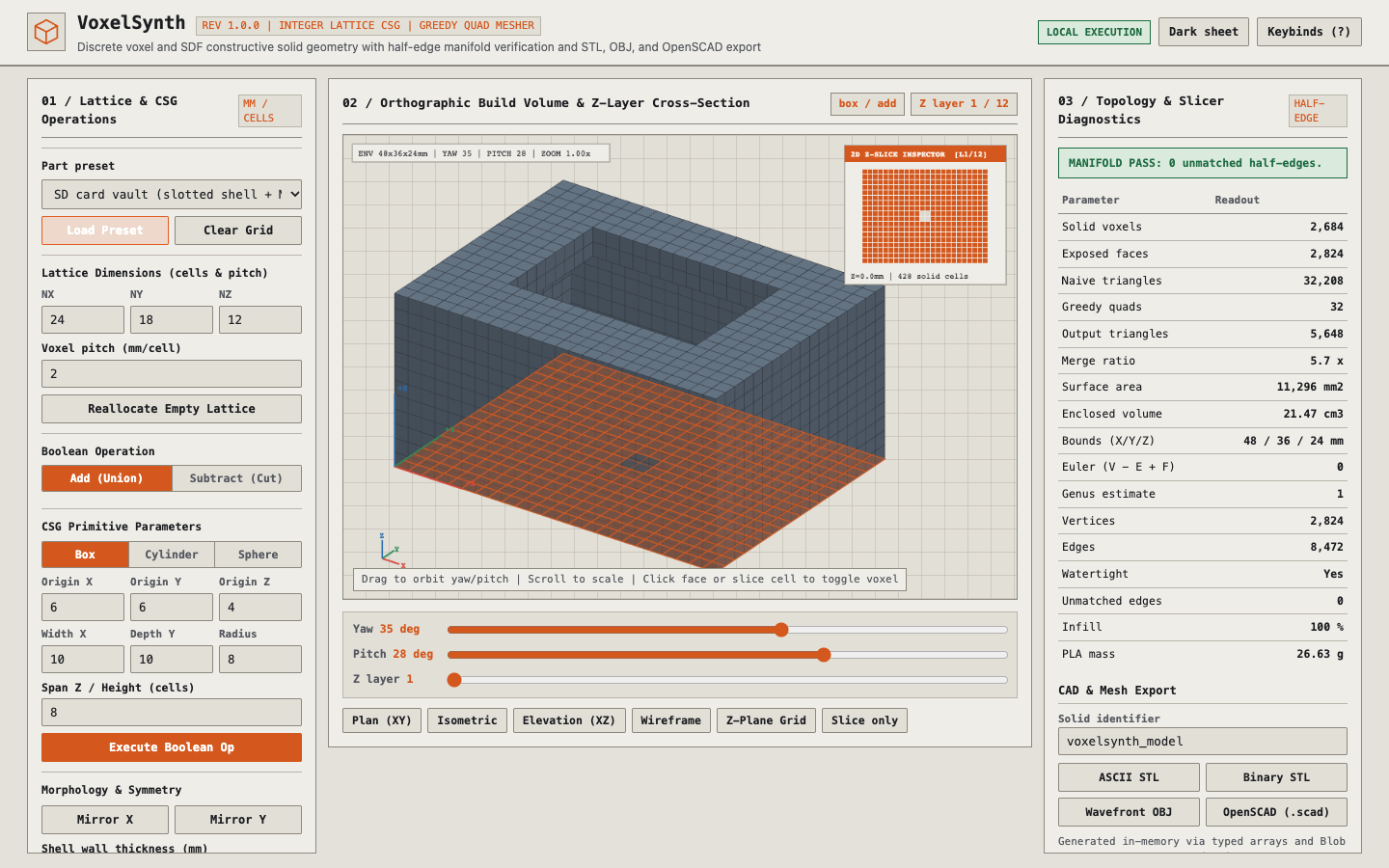
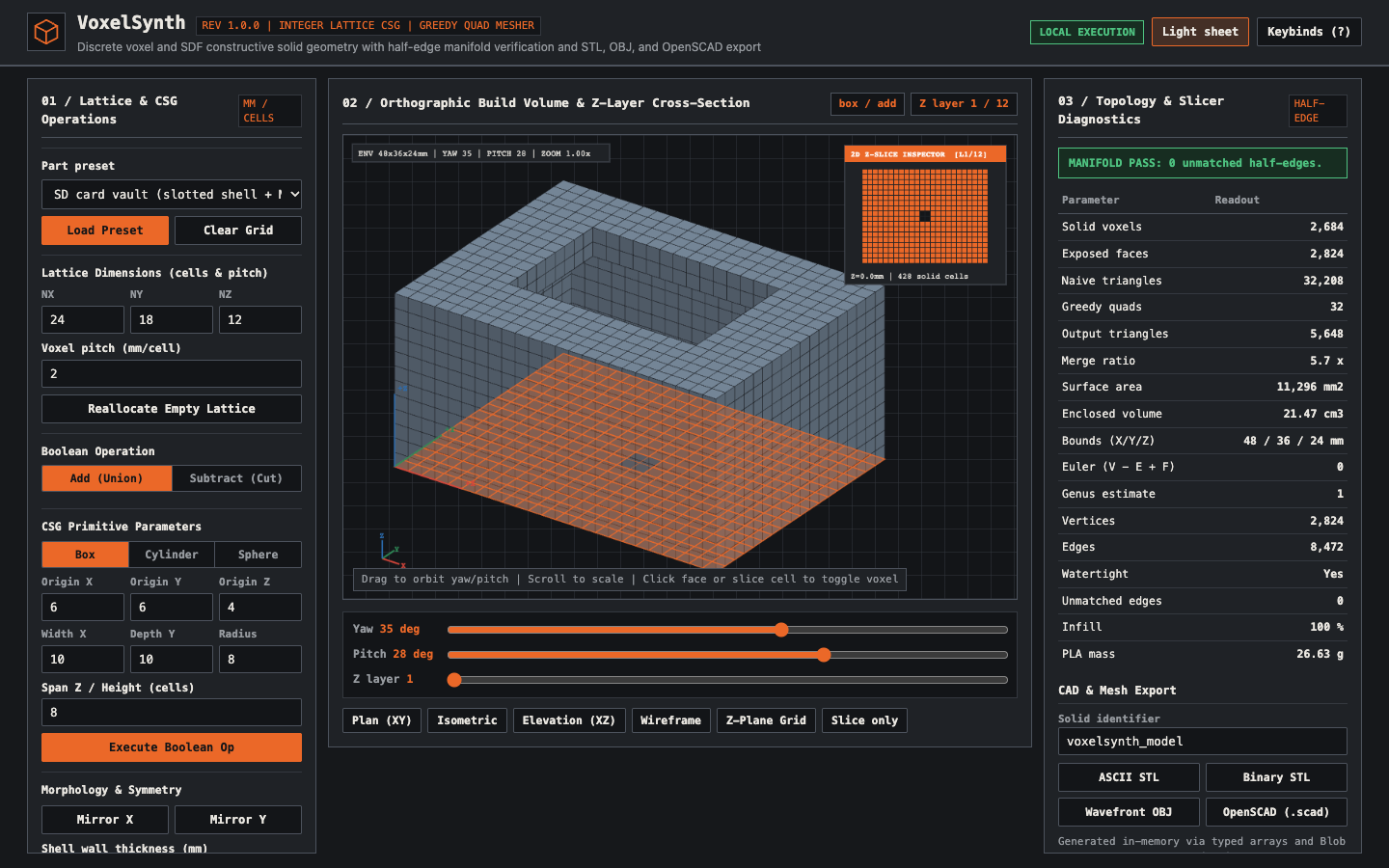
- Five functional CAD showcase parts: One-click editable designs for a Desk Organizer, Card Vault, Cable Comb, four-post Board Fixture (total genus 4), and smooth-blended SDF Sensor Dock, plus custom-resolution regeneration.
- Sculpture Mode (four algorithmic artworks): Samples mathematical forms onto the same editable, watertight voxel lattice:
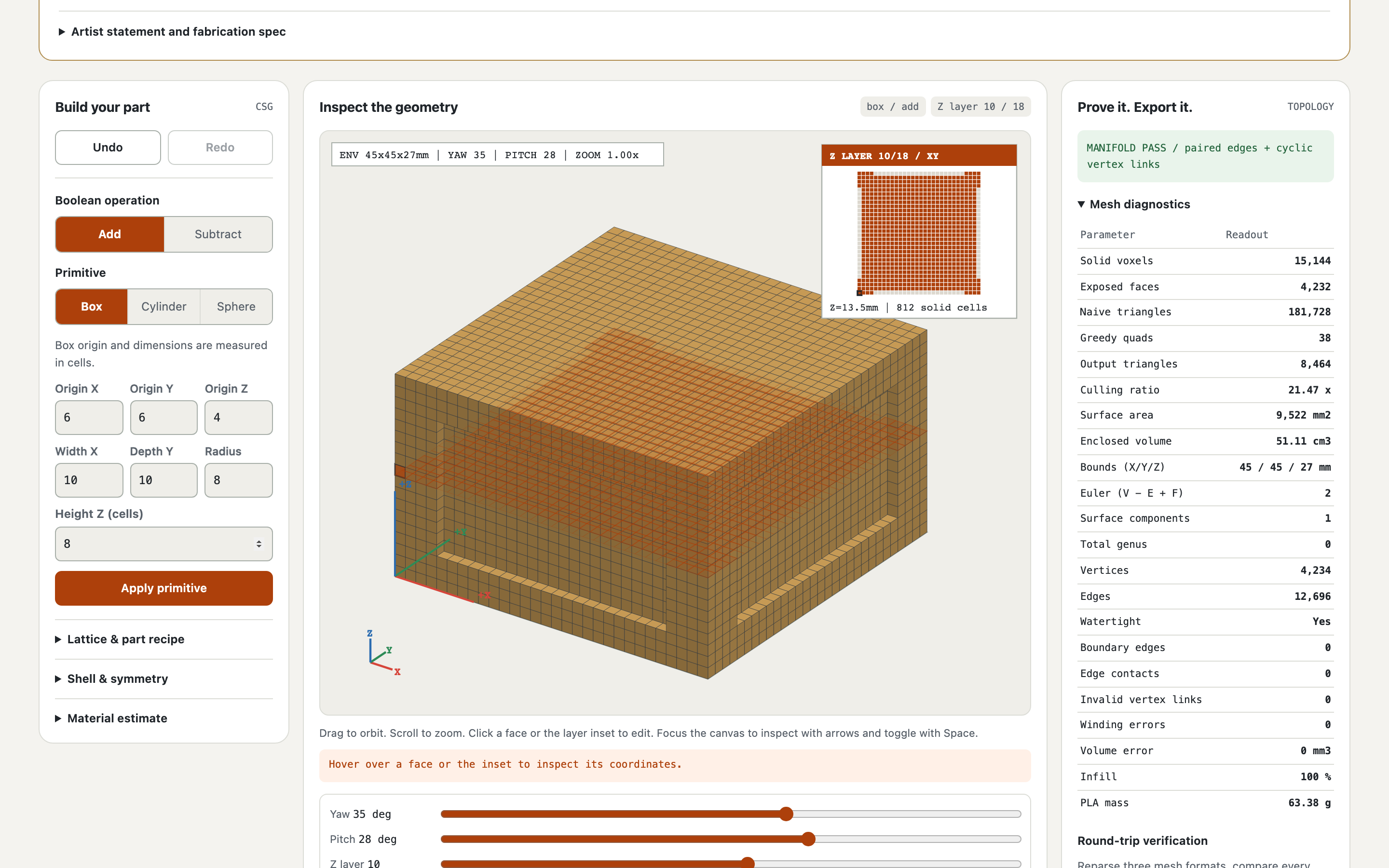
- Minimalist Gyroid Pavilion (dilated
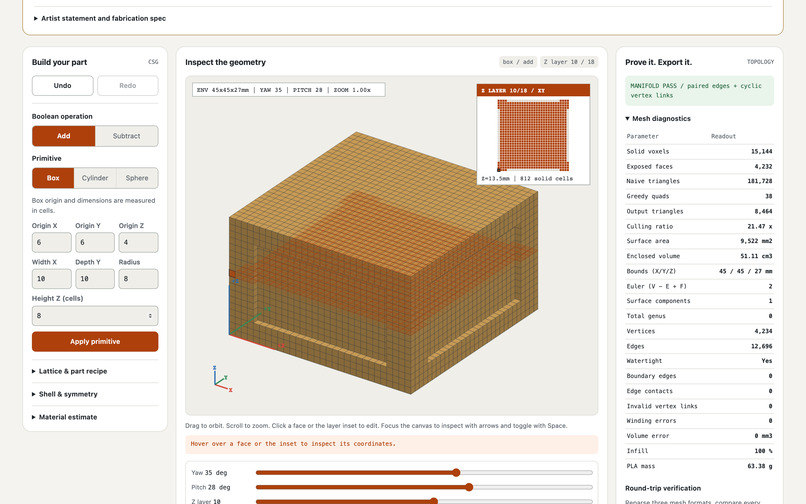
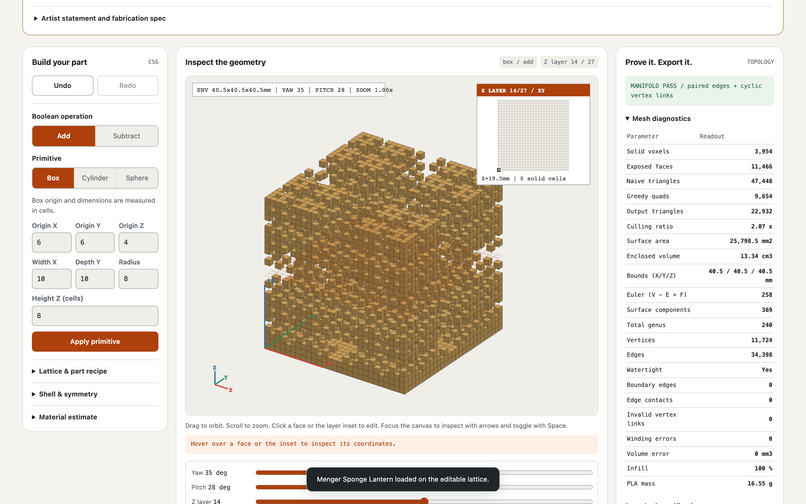
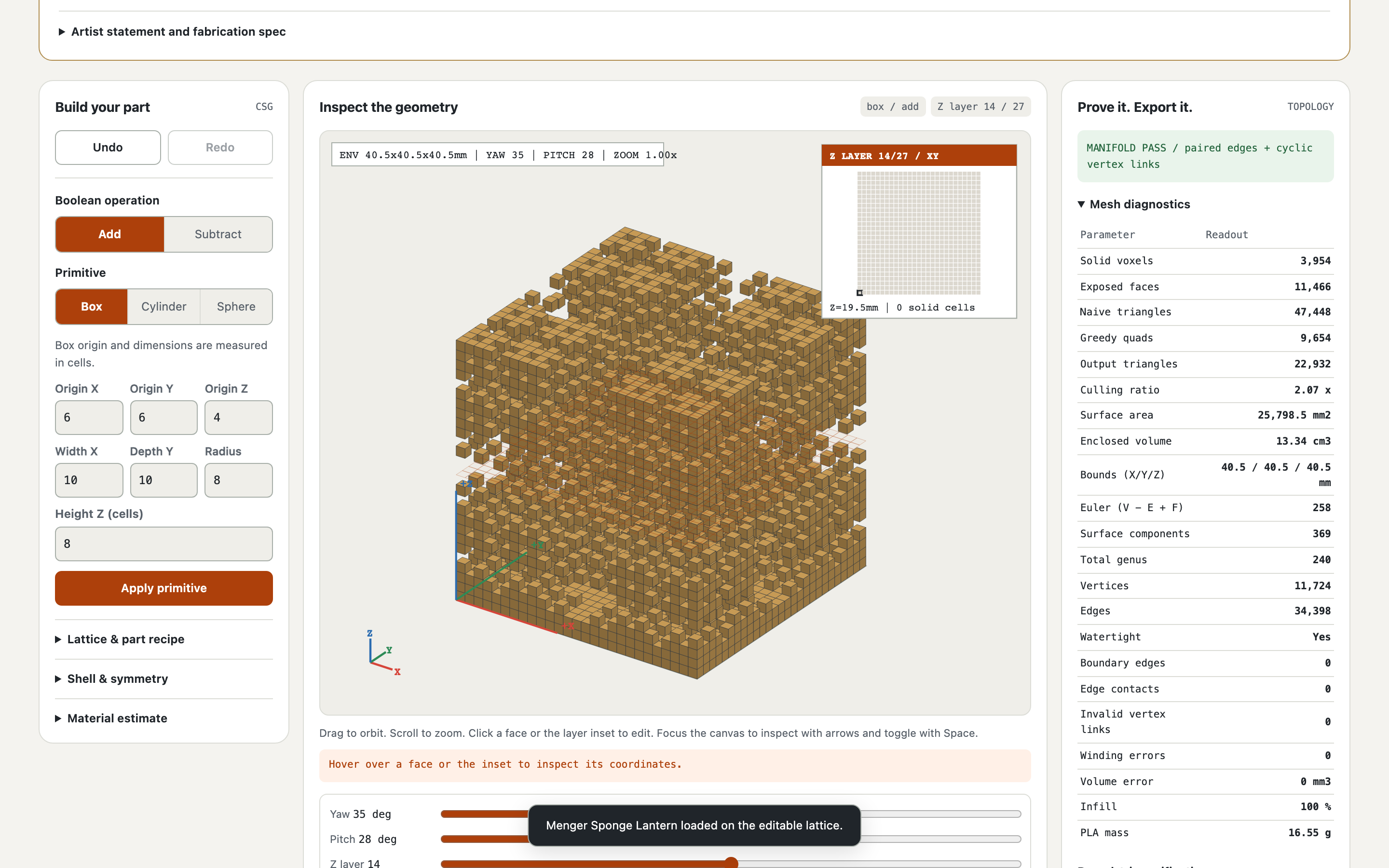
sin(x)cos(y) + sin(y)cos(z) + sin(z)cos(x)shell, 15,144 cells, genus 0) - Menger Sponge Lantern (recursive base-3 fractal on a plinth, 3,954 cells, 22,932 triangles, genus 240)
- Helical Kinetic Ribbon (triple-arm twisted helix between solid rings, 5,602 cells, genus 3)
- Voronoi Terraced Amphitheater (dual-nearest Voronoi distance stepping, 14,555 cells, genus 0)
- Includes warm exhibition lighting, a continuous 2-degree-per-tick wrapping turntable, and a locally encoded 1400 x 1000 museum-style Exhibition Plate PNG (custom deflate + Adler-32 + CRC32 encoder, zero external APIs).
- Minimalist Gyroid Pavilion (dilated
- Constructive solid geometry & SDF editing: Box, sphere, and cylinder unions/differences, polynomial smooth-union SDFs, X/Y/Z mirroring, minimum-wall shelling, interactive XY layer-slice editing with physical mm readouts, keyboard cell editing, and 32-step undo/redo.
- Strict manifold verification & 4-format round-trip export: Verifies counted undirected edge incidences (exactly 2 with opposite direction), connected vertex link cycles (catching point and edge contacts), surface components, Euler characteristic (
chi = V - E + F), total genus, surface area, and divergence-theorem volume before exporting ASCII STL, binary STL, indexed OBJ, cuboid-merged OpenSCAD, and JSON project snapshots.
How we built it
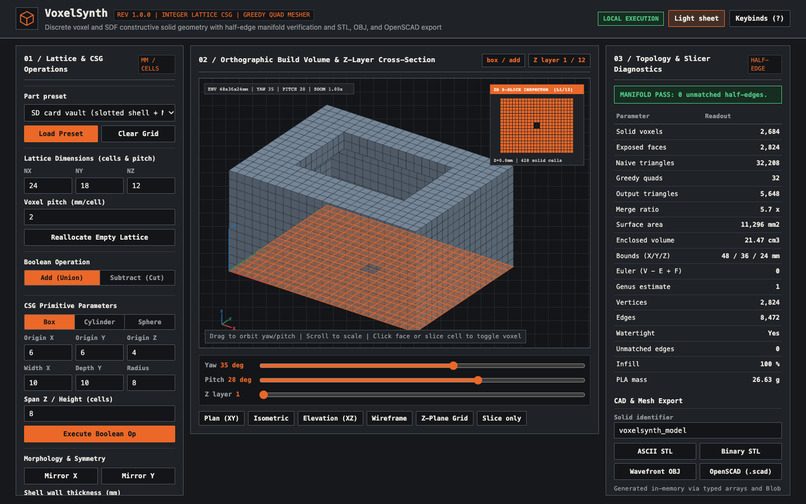
The geometry kernel (voxel.js) is a self-contained UMD JavaScript module with zero runtime dependencies, storing occupancy in a flat Uint8Array and culling internal faces with greedy coplanar quad merging while emitting export triangles on shared unit lattice vertices to eliminate T-junctions. Independent format readers inside voxel.js reparse every exported STL, OBJ, OpenSCAD cuboid union, and JSON snapshot before download. The frontend (app.js, index.html, style.css) renders via DPI-aware Canvas 2D with responsive mobile-first layout, light/dark themes, keyboard navigation, and reduced-motion support.
Challenges we ran into
Standard edge-set watertightness checks can be fooled by singular point contacts (two diagonal voxels touching at one corner) or edge contacts where four faces meet along one edge. Implementing counted directed edge incidences plus per-vertex link-cycle traversal caught every singular topology across all 256 configurations of a 2 x 2 x 2 voxel block. Ensuring float32 binary STL export never silently collapses fine translated geometry required explicit facet-degeneracy refusal and nearby-reference compensated volume summation. For Sculpture Mode, writing a zero-dependency PNG encoder with valid zlib/Adler-32 streams ensured the exhibition plate works 100% offline and passes strict automated stream-decoding tests.
Accomplishments that we're proud of
- 201 of 201 deterministic tests passing (
npm test: 117 engine tests intest.js, 39 format/precision/schema tests inexport-test.js, 45 DOM/interaction/PNG-decode tests inui-test.js). - Verified CAD & Sculpture Geometry (live engine output, 100% watertight & 4-format round-tripped):
- Desk Organizer:
32x22x12@ 2mm,4,128cells,8,528tris,33,024 mm3, genus0,9 OpenSCAD cuboids (426,484`-byte binary STL). - Board Fixture:
36x16x8@ 1.5mm,1,408cells,3,472tris,4,752 mm3, genus4,26OpenSCAD cuboids. - SDf Sensor Dock:
32x22x12@ 2mm,1,396 cells,3,424tris,11,168 mm3, genus031` OPenSCAD cuboids. - Menger Sponge Lantern:
27x27x27 @ 1.5mm,3,954cells,22,932tris,13.34 cm3, **genus240**,1,671` OpenSCAD cuboids. - Minimalist Gyroid Pavilion:
30x30x18@ 1.5mm,15,144cells,8,464tris,51.11 cm3, genus0, `9 OpenSCAD cuboids. - Helical Kinetic Ribbon:
30x30x23@ @ 1.5mm,5,602cells,15,212tris,18.91 cm3, genus3,485` OpenSCAD cuboids. - Voronoi Terraced Amphitheater:
36x36x16@ 1.5mm,14,555 cells,11,580tris,49.12 cm3, genus0,340` OpenSCAD cuboids.
- Desk Organizer:
- Tested across pitches from
0.000001 mmto1,000,000 mmand up to a2,000,000-cell project snapshot, with zero console errors in thenode:vmbrowser harness. (Automated geometry/format verification only; no physical 3D print or external slicer run is claimed.)
What we learned
Treating CAD geometry and mathematical art as two views of the exact same verified manifold engine turns topology metrics (genus, Euler characteristic, edge incidences) from dry diagnostics into creative material. A Menger Sponge Lantern with genus 240 that round-trips cleanly through binary STL and OpenSCAD proves that rigor enhances artistic expression.
What's next
Add interactive implicit-surface formula sliders for custom gyroid/Schwarz-P sculpture exploration, multi-material voxel color channels for 3MF export, and a guided 10-minute live gallery walkthrough mode for InnovArt's Jan 3 showcase.
Honest AI Disclosure
An AI coding assistant helped implement parts of the geometry engine, sculpture presets, exhibition plate PNG encoder, tests, and documentation. I reviewed every change, ran the full 201-test suite locally, and verified every geometry count and export round-trip directly from voxel.js. No external AI service runs inside VoxelSynth.
Built With
- 3d-modeling
- cad
- canvas-2d
- css3
- html5
- javascript
- node.js
- openscad
- stl
- voxel-engine
