-
-
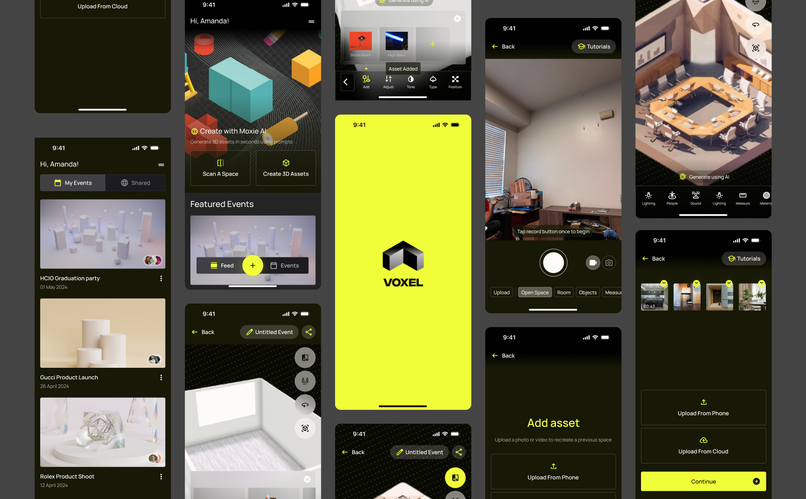
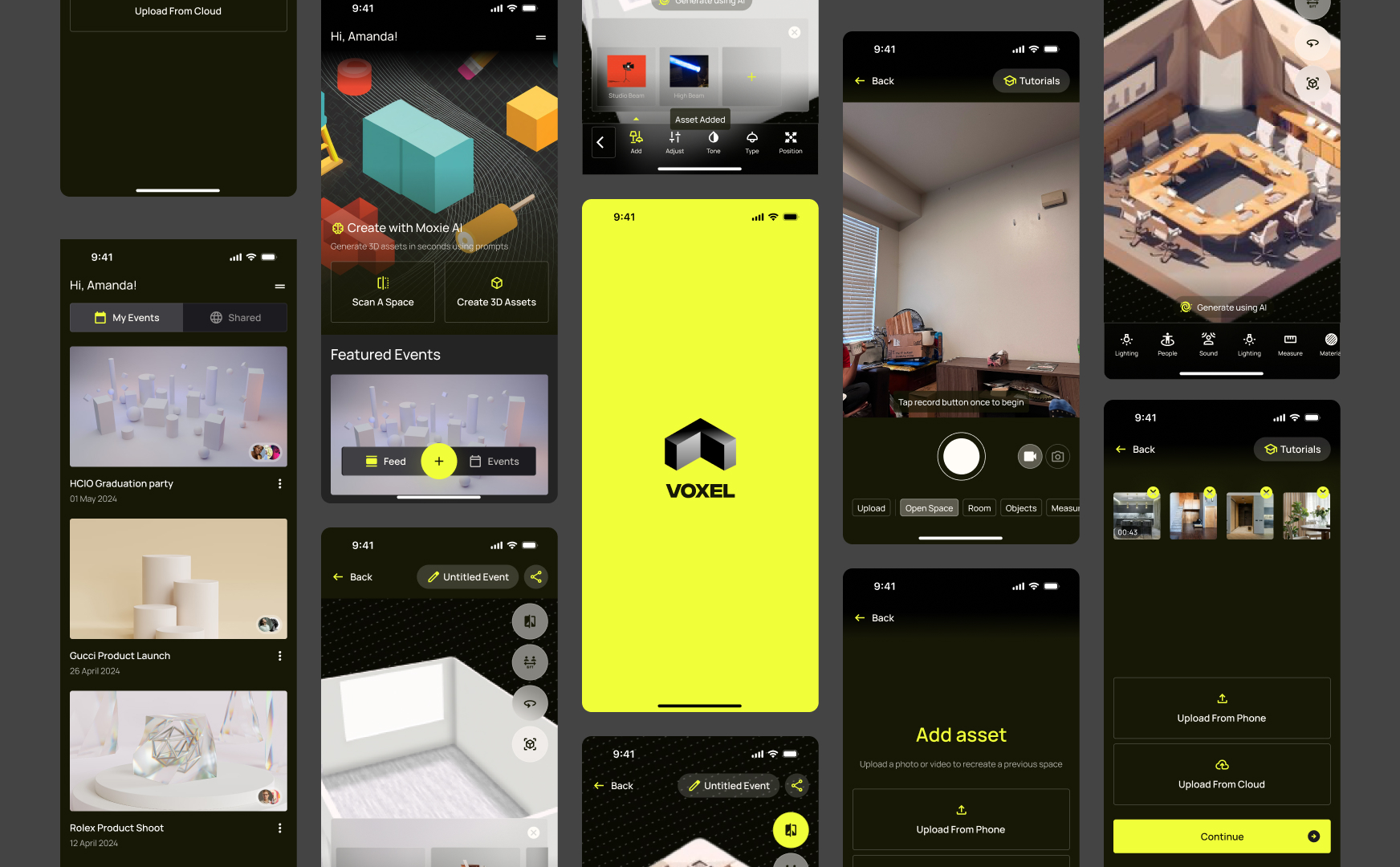
App's UI Glance
Inspiration
My sister is an architect, and I’ve seen firsthand how difficult it can be for her to visualize her projects in real time. Her process usually involves creating detailed 3D models and then rendering them to be as photorealistic as possible — a workflow that’s both time-consuming and lacks real-time interaction. That got me thinking: how might we make it easier for architecture students to visualize their projects, and how might we extend that capability to a broader creative and collaborative space? That question became the inspiration for Voxel.
What it does
Voxel is a conceptual app designed to revolutionize how people visualize and interact with physical spaces. It helps users — especially architects and designers — scan real-world environments in 3D, interact with them using natural language, and collaborate in real time. The goal is to combine Neural Radiance Fields (NeRF), Language Radiance Fields (LeRF), and photogrammetry to build immersive environments that can be explored and modified intuitively.
Imagine asking, “Where’s the kitchen in this layout?” or “Show me how the space looks with a skylight.” Voxel makes that kind of interaction possible.
How we built it
I designed this app from scratch and currently, Voxel exists as a proof-of-concept prototype built in Figma. The prototype explores user flows, wireframes, and the core functionality of the app, including scanning, semantic querying, and layout editing.
The technical implementation (in progress) will involve:
- NeRFs for photorealistic 3D scene generation.
- LeRFs enhanced with LLMs for language-based querying within 3D spaces.
- Photogrammetry as a fallback or complementary method for quick scanning.
- A UX design system built to support both technical and non-technical users.
Challenges we ran into
One of the biggest challenges was ensuring the app was user-friendly — especially for non-technical users like students who may not be familiar with advanced 3D tools. Designing intuitive interactions around complex technologies like NeRFs and LeRFs required a lot of thinking about simplification.
Another challenge was differentiating Voxel from existing apps like Polycam, Luma AI, and RealityScan. While those apps focus heavily on 3D scanning, Voxel aims to stand out by combining spatial understanding with semantic interaction and collaboration — features that are still largely missing from mainstream tools.
Additionally, because many of these technologies are still evolving, we had to work with certain assumptions about performance, scale, and accessibility that will need to be tested in future iterations.
Accomplishments that we're proud of
- Taking a complex, tech-heavy idea and turning it into a clear, user-centered design.
- Creating a proof-of-concept that blends AI, spatial computing, and intuitive UX.
- Identifying real user pain points (inspired by my sister’s experience) and addressing them with innovative thinking.
- Building a vision that goes beyond 3D — into intelligent, real-time, and collaborative space interaction.
What we learned
This project opened my eyes to the possibilities of mixed reality, AI-generated environments, and how natural language processing can enhance the way we interact with 3D spaces. I dove deep into the workings of NeRFs, LeRFs, and photogrammetry, and learned how they can work together to create rich, interactive environments.
More importantly, I learned how critical usability is when introducing emerging tech to everyday users.
What's next for Voxel
Voxel is currently in the design phase, but the next steps include:
- Building a working prototype using open-source NeRF models and integrating LeRF-like functionality via language models.
- Testing usability with architecture students and designers to refine interaction patterns.
- Exploring cloud-based infrastructure for real-time scene generation and collaboration.
- Eventually releasing a beta version for early adopters to experiment with intelligent 3D design.
Voxel is just getting started — but its potential to reshape how we design and experience spaces is limitless.
Built With
- figma
- lerfs
- nerfs
- photogrammetry
- ux

Log in or sign up for Devpost to join the conversation.