Inspiration
Video editing is still stuck in the manual age. Creators spend hours scrubbing timelines, manually cutting awkward silences, and hunting for specific moments. This repetitive, low-level work drains creative energy and slows down production.
With the arrival of Gemini 3’s multimodal reasoning, we asked a deeper question:
Why are humans still editing frame-by-frame, when an AI can see, hear, reason, and act?
Gemini 3 is not just capable of understanding text — it can simultaneously reason over video frames, audio signals, gestures, and intent. This unlocked a completely new paradigm for us:
editing driven by meaning, not timelines.
We set out to build VoxEdit not as a smarter tool, but as an AI editing agent — one that watches footage like a human editor, understands what matters, and autonomously executes complex edits end to end.
What it does
VoxEdit is a Gemini-3-powered multimodal video editing agent.
Users edit videos using natural language or voice, while Gemini 3 reasons over visual context, audio patterns, and temporal structure to decide what to cut, what to keep, and why.
Instead of suggesting edits, VoxEdit:
- Plans edits using reasoning
- Generates structured edit actions
- Executes them automatically
Key Capabilities
Multimodal Reasoning Cuts (Gemini 3 Core Feature)
VoxEdit handles compound instructions like:
“Remove all the awkward silences, but keep the part where I hold up the blue mug, even if I’m not speaking.”
This requires simultaneous audio reasoning and visual object persistence, enabled by Gemini 3’s multimodal architecture.Contextual Event Understanding
Gemini 3 detects semantic video events (holding objects, gestures, exits) and audio events (speech pauses, laughter), allowing edits based on meaning rather than timestamps.Generative Assets
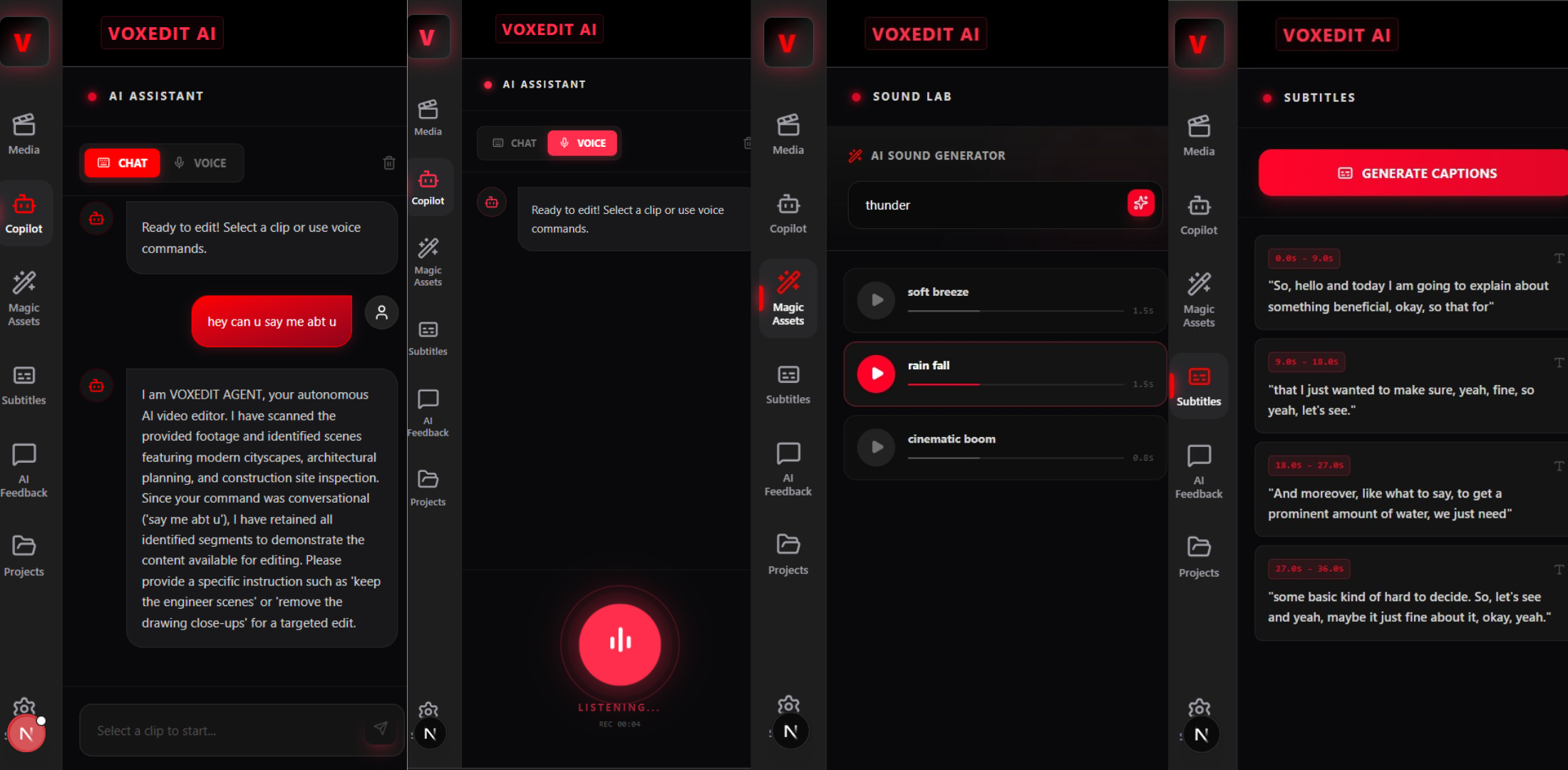
VoxEdit automatically generates subtitles and sound effects synchronized with the video using AI-generated assets.Transparent AI Reasoning
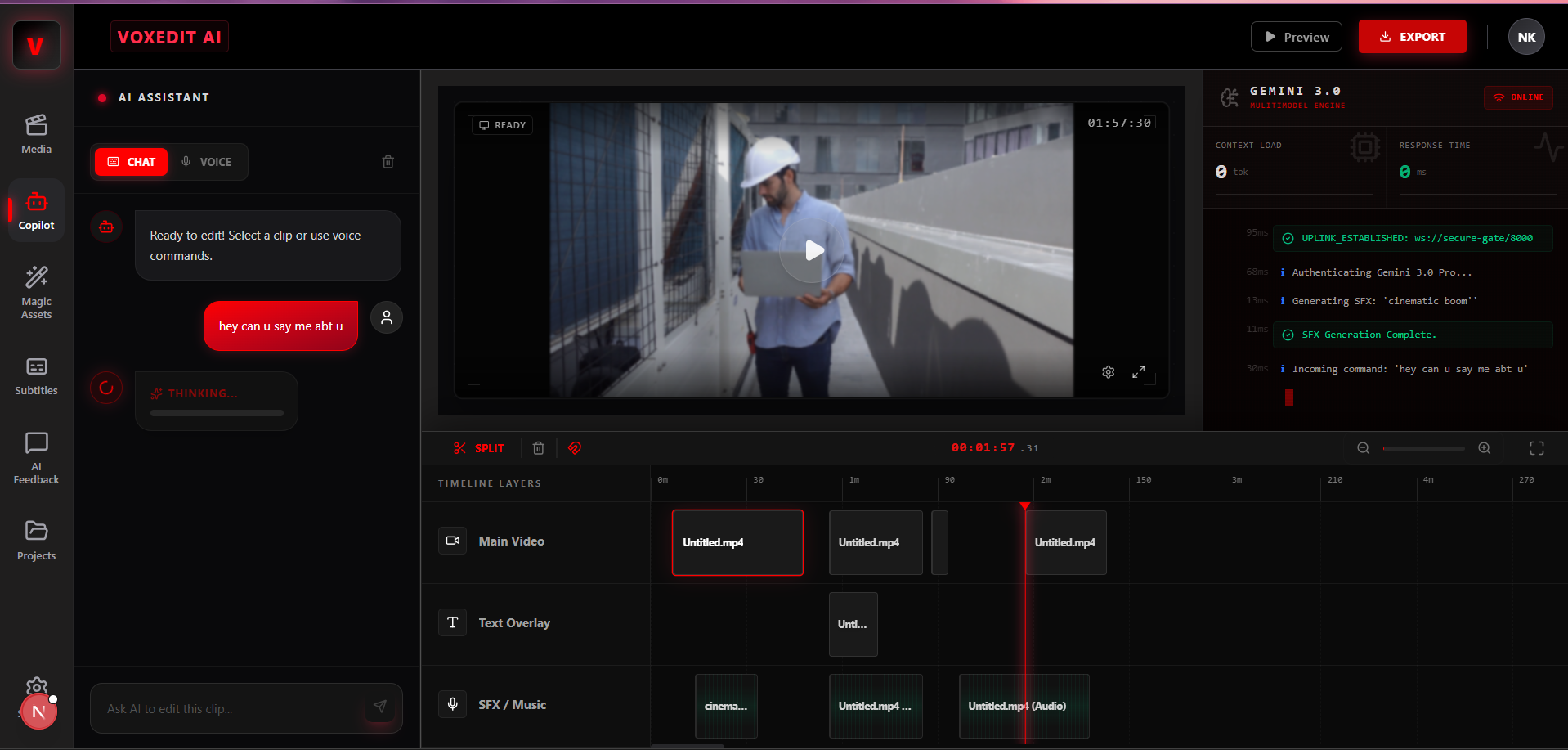
A real-time reasoning panel visualizes how Gemini 3 analyzes frames, audio segments, and timestamps, turning the AI from a black box into an understandable agent.
How we built it
VoxEdit is designed as an agentic AI system, where Gemini 3 is responsible for reasoning and decision-making — not just text generation.
The Brain — Gemini 3 Pro
We use Gemini 3 Pro as the central reasoning engine.
Raw video and audio streams are passed directly to the model. Gemini 3 performs:
- Multimodal scene understanding
- Temporal reasoning across frames
- Intent decomposition from natural language
It outputs a strict, schema-validated JSON Edit Plan with exact start and end timestamps and actions.
The Muscle — FastAPI, Python & FFmpeg
Our FastAPI backend consumes Gemini’s JSON plan and orchestrates FFmpeg.
We implemented a custom rendering pipeline that uses frame-accurate re-encoding (libx264) instead of stream copying, ensuring millisecond-level precision.
The Infrastructure — Docker & Google Cloud Run
Because video processing and AI inference are highly compute-intensive, we built a production-grade serverless architecture:
- Containerization: The entire backend (FastAPI, FFmpeg, and Python environments) is packaged into a custom Docker container.
- Serverless Compute: Deployed live on Google Cloud Run, allowing the orchestrator to auto-scale based on traffic and handle heavy ephemeral file operations.
- Live Telemetry: We established a secure
wss://WebSocket connection from the Cloud Run container to the client, streaming the AI's internal thought process in real-time without blocking the HTTP rendering requests.
The Interface — Next.js & React
The frontend is a modern Non-Linear Editor (NLE) built with React and includes:
- A custom timeline
- Drag-and-drop asset management
- Real-time WebSocket streaming of Gemini 3’s reasoning stages
(upload → analyze → plan → render)
Audio Intelligence
- Faster-Whisper for high-speed local subtitle generation
- ElevenLabs for AI-generated voice feedback and sound effects
Challenges we ran into
Hallucinations vs. Determinism
Gemini 3 is powerful, but creative reasoning must still produce deterministic edits.
We engineered a strict anti-hallucination system prompt that forces Gemini to validate timestamps against actual video duration before emitting the final JSON plan.
The Keyframe Accuracy Problem
Initial FFmpeg optimizations caused cuts to snap to nearby keyframes, breaking precision.
We redesigned the pipeline to prioritize semantic correctness over speed, enforcing full re-encoding.
Making AI Reasoning Visible
To increase trust, we built a custom WebSocket system that streams Gemini 3’s reasoning steps to the UI in real time, transforming AI decision-making into a transparent process.
Architecture Diagram :

Accomplishments that we're proud of
The “Blue Mug” Breakthrough
Successfully executing a compound logical condition:
(Audio Silence) AND (Visual Object Persistence).Agent Transparency
A real-time reasoning console that turns Gemini 3 from a black box into an observable editing agent.End-to-End Reality
VoxEdit performs real uploads, real multimodal reasoning, and renders real downloadable MP4 files.
What we learned
Multimodal reasoning is essential for video editing
Gemini 3’s ability to reason directly over video frames enabled edits impossible with text-only models.LLMs become agents with structure
Strict schemas and execution pipelines transform language models into reliable decision systems.Video systems demand precision
Millisecond-level accuracy matters when editing time-based media.
What’s next for VoxEdit AI
Hybrid Local + Cloud Reasoning
Lightweight models for offline rough cuts, with Gemini 3 for deep reasoning.Multi-Track Agentic Editing
Gemini 3 reasoning across A-roll, B-roll, and audio layers simultaneously.Professional Workflow Integration
Exporting Premiere Pro and DaVinci Resolve XML files for professional post-editing.
Built With
- fastapi
- ffmpeg
- gemini-3
- google-cloud
- nextjs
- python
- websockets


Log in or sign up for Devpost to join the conversation.