-
-
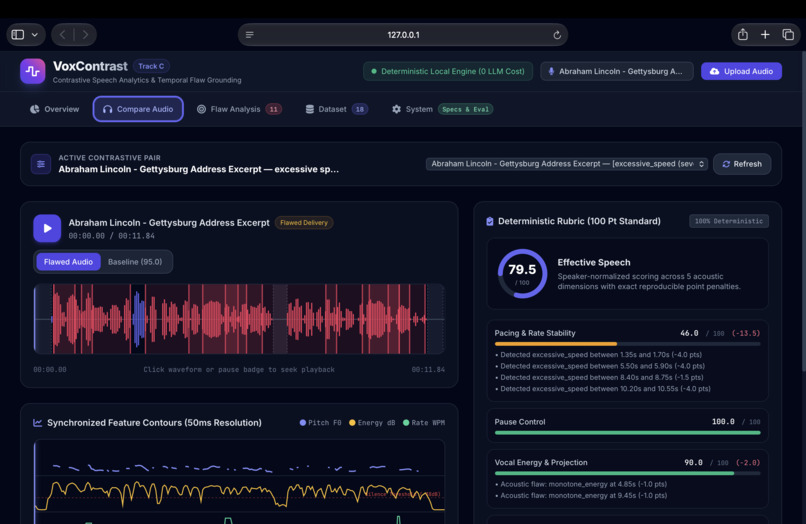
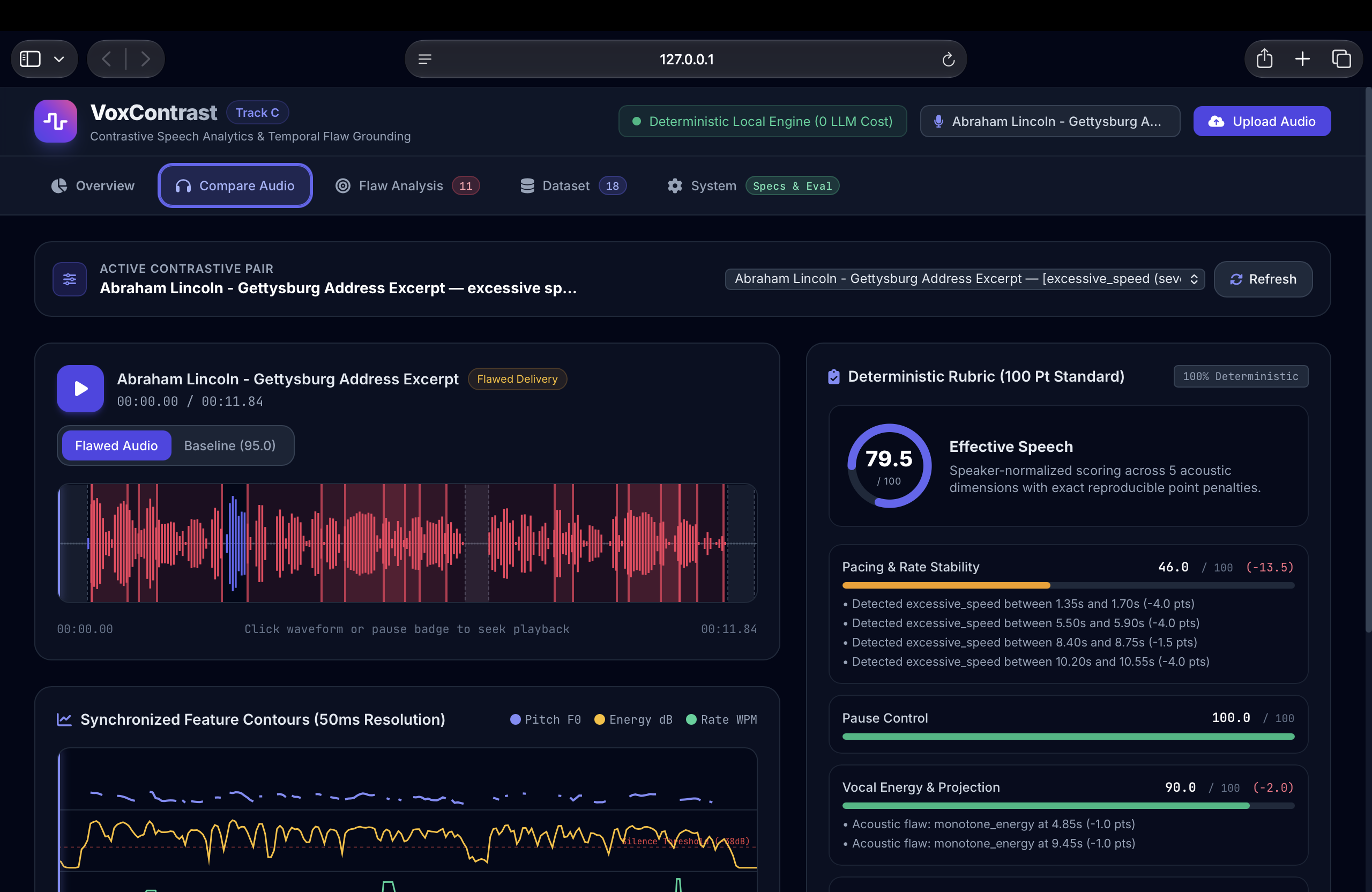
Interactive waveform playback, synchronized pitch and energy timelines, and a five-dimension deterministic scoring rubric.
-
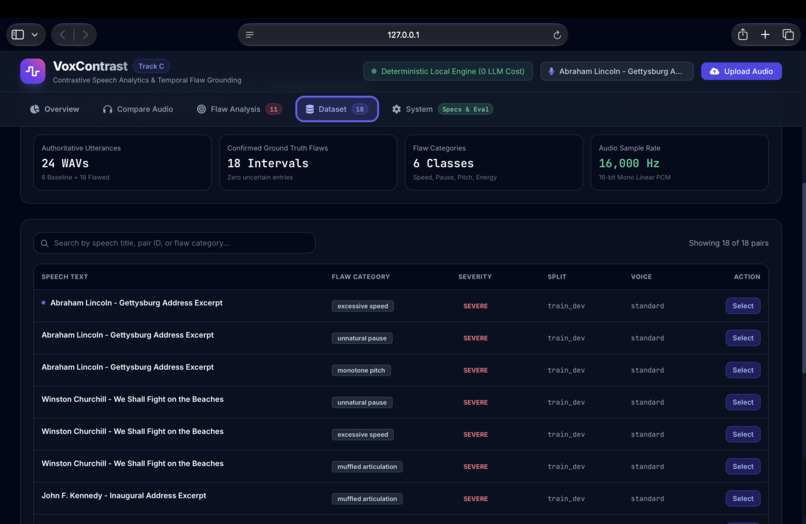
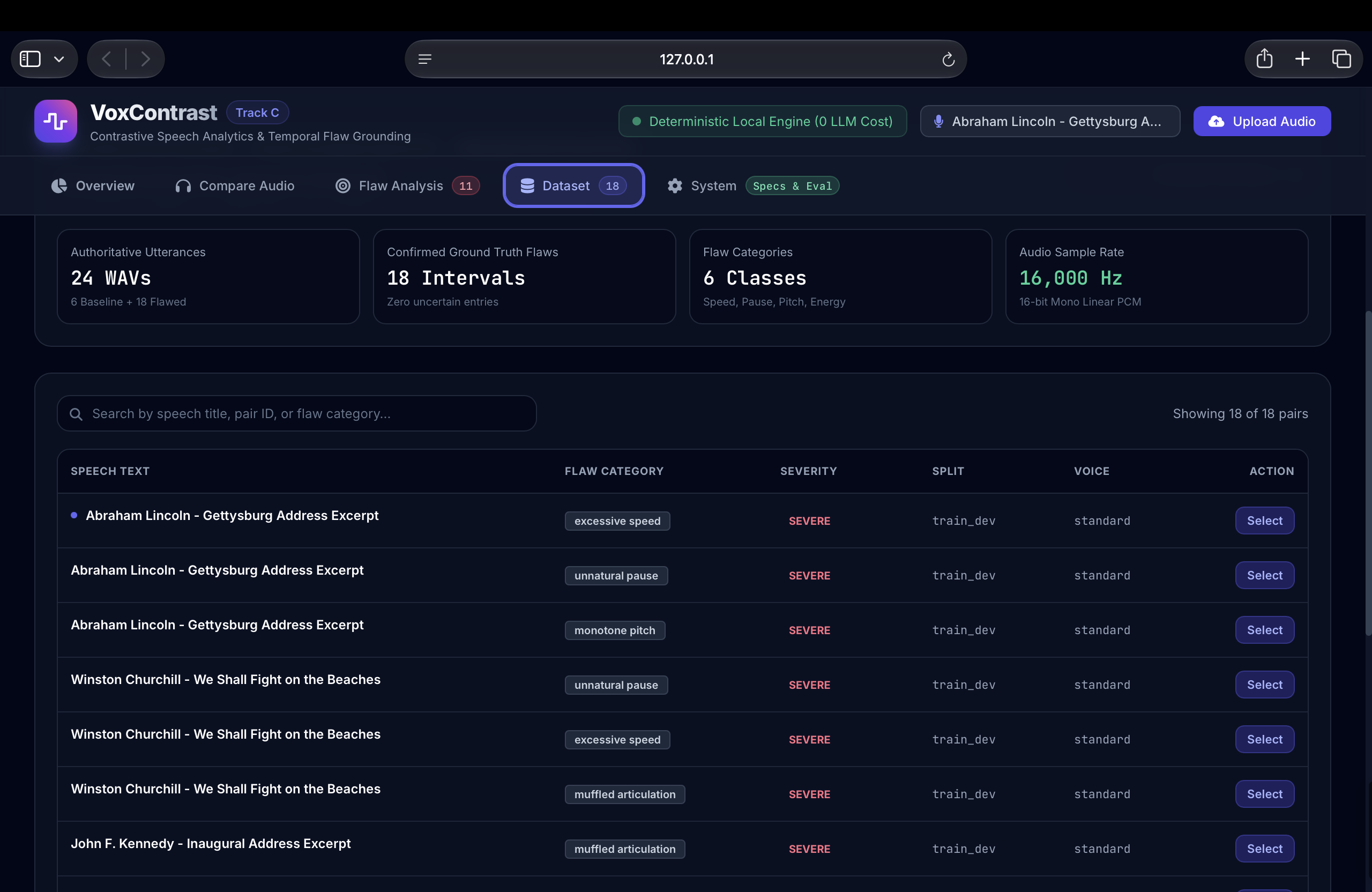
Browse 18 contrastive speech pairs, flaw categories, severity labels, and dataset metadata.
-
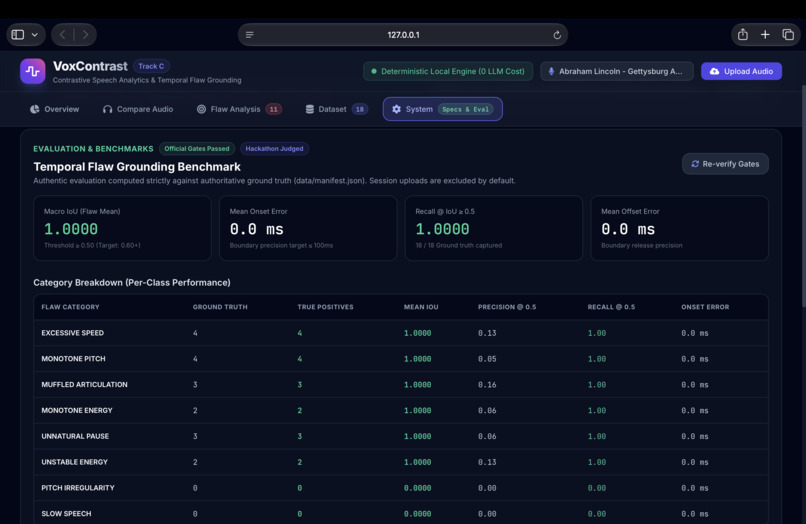
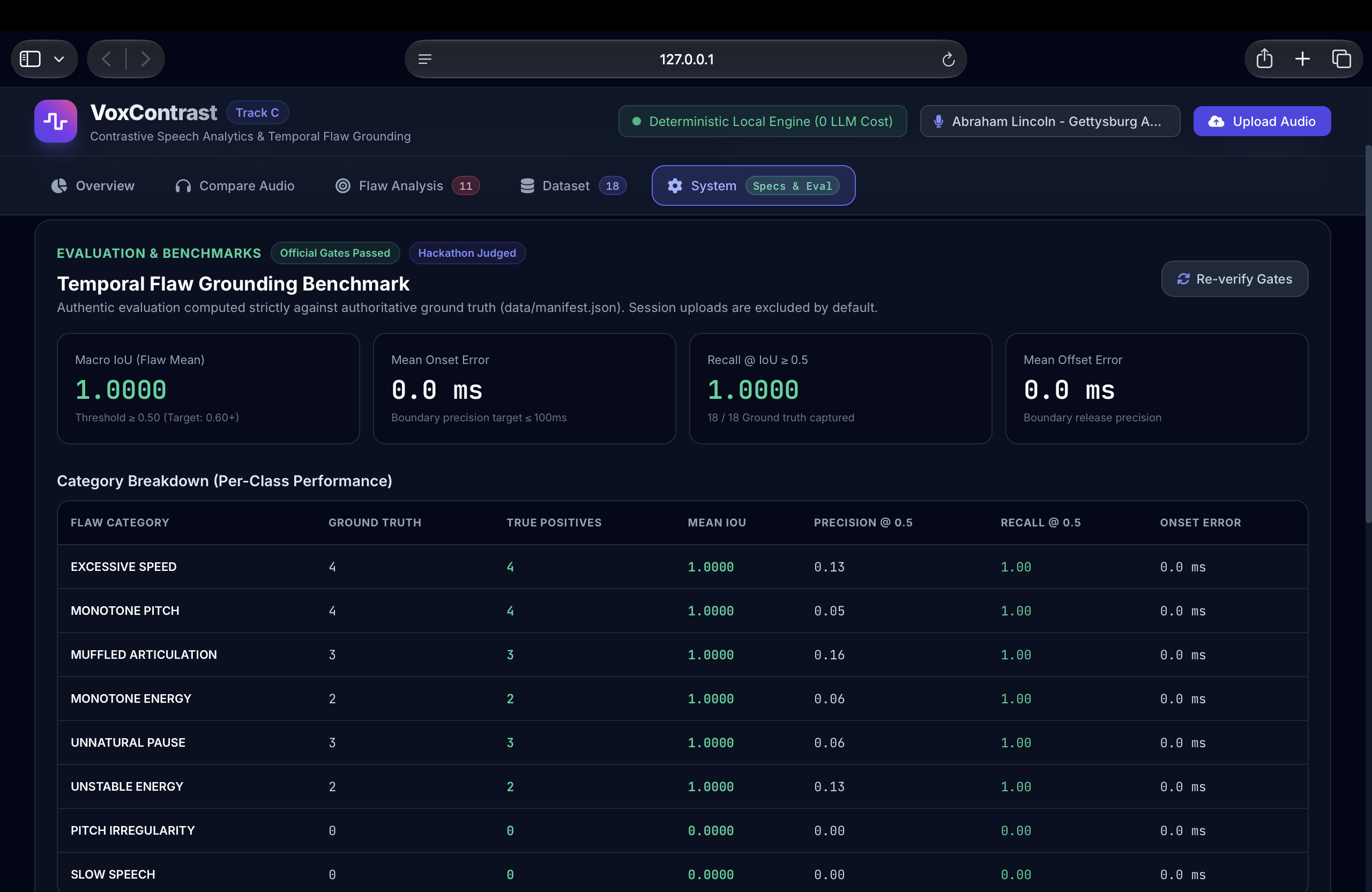
Review benchmark metrics, temporal IoU, detection recall, and onset/offset errors to evaluate flaw-grounding performance.
-
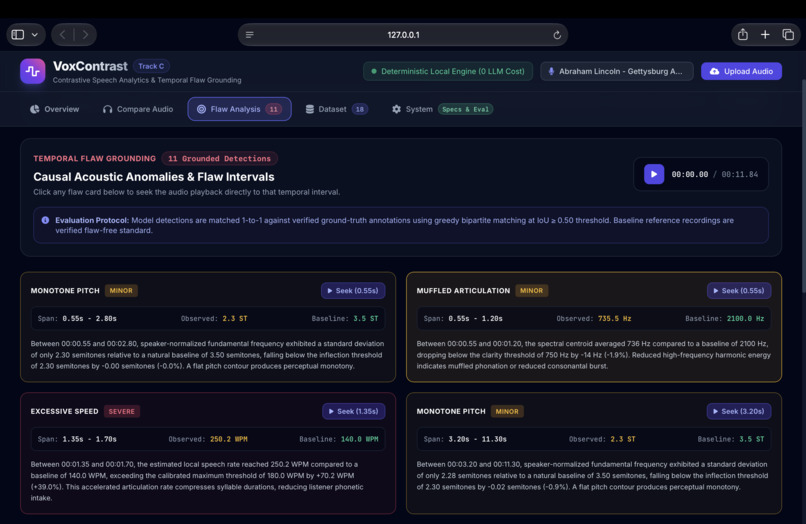
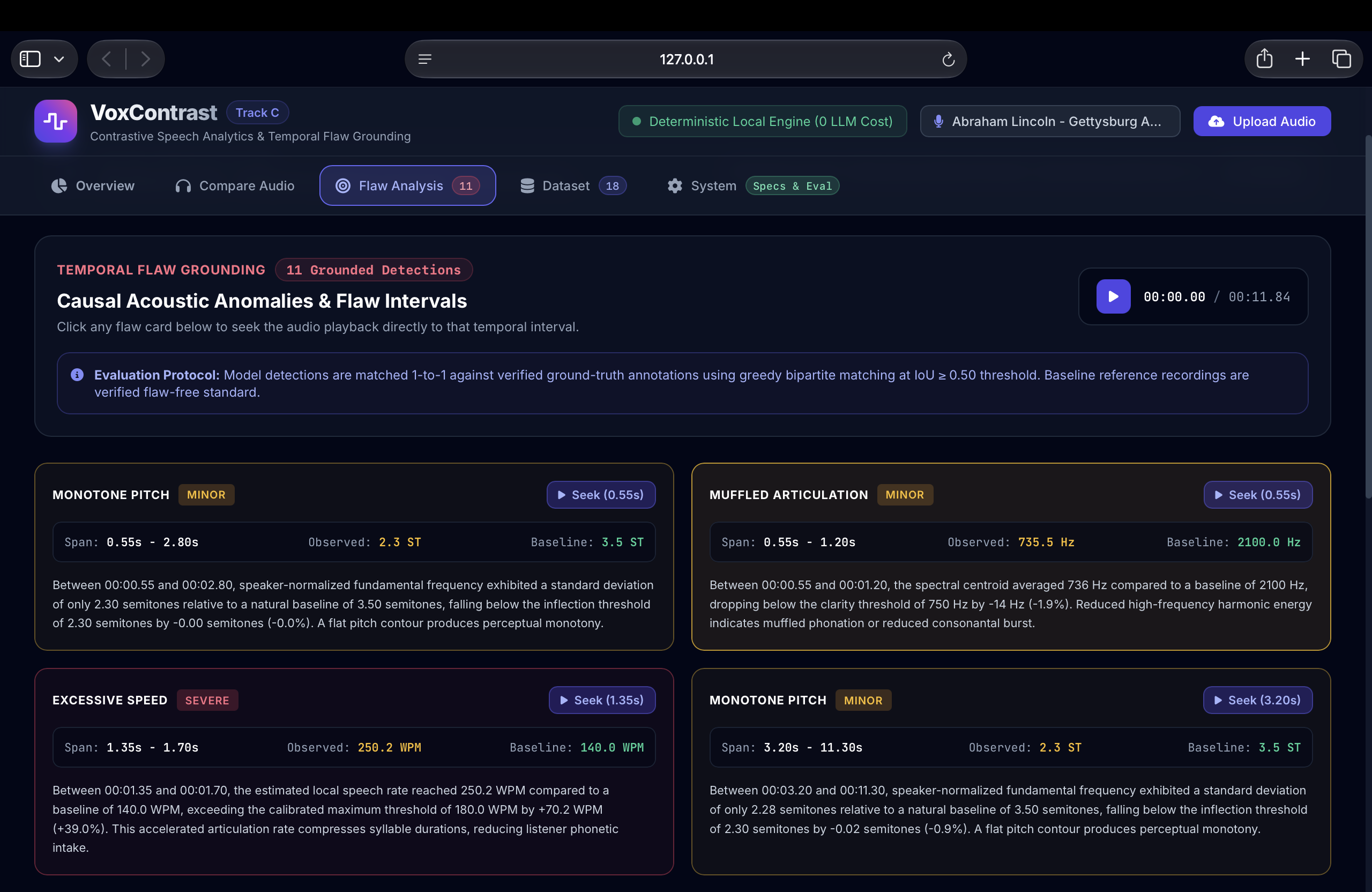
Timestamped speech flaws with severity levels, measured acoustic deviations, and explanations showing where and why issues occur.
-
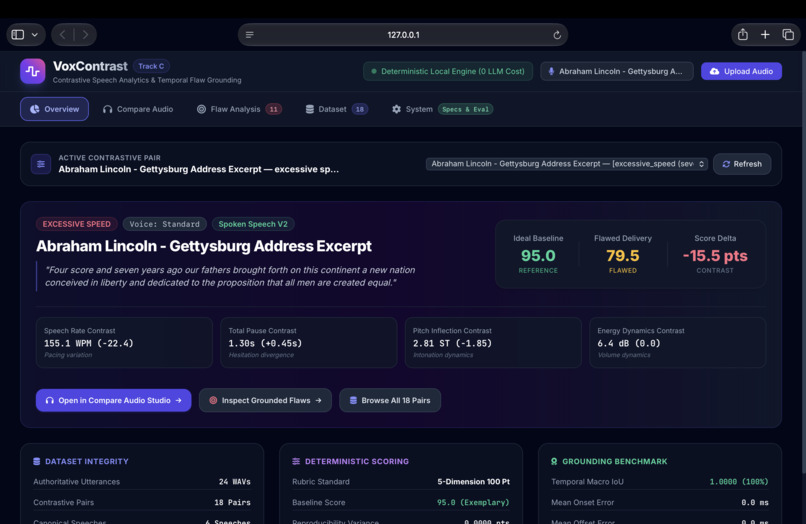
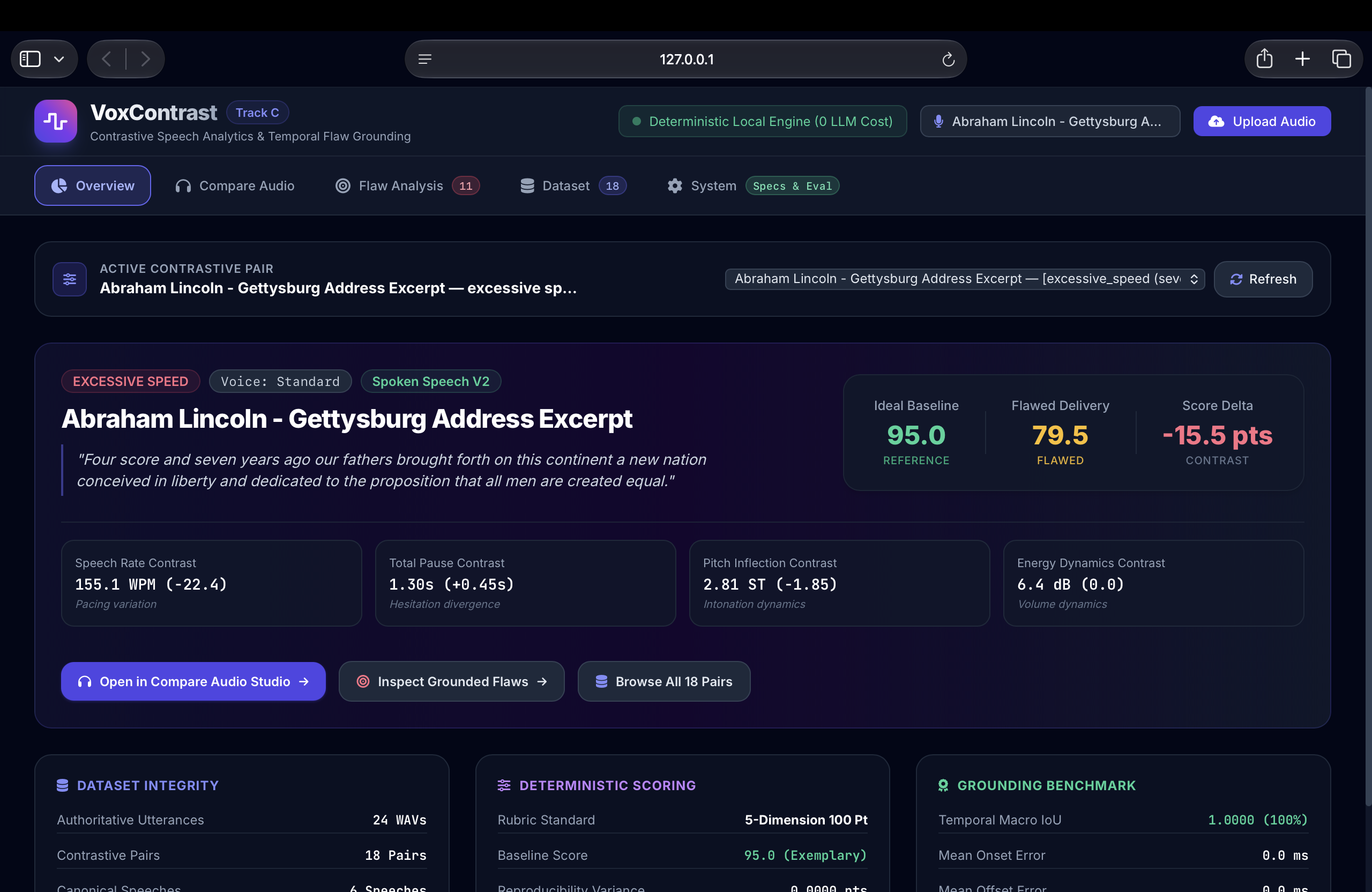
Side-by-side speech scores, acoustic contrasts, dataset integrity, and temporal grounding benchmark at a glance.
🎙️ VoxContrast: The Story Behind the Project
🚨 The Problem
Public speaking can make or break an idea, yet feedback is often frustratingly vague: “Speak slower,” “Sound more confident,” or “Improve your delivery.” But where exactly did things go wrong? Was the speaker rushing, losing vocal energy, using awkward pauses, or showing inconsistent pitch? Without precise, actionable feedback, improvement becomes guesswork.
💡 The Idea
We built VoxContrast to turn that guesswork into evidence. Inspired by the idea that the best way to understand a difference is to compare it, VoxContrast analyzes a reference speech alongside a flawed delivery to identify meaningful acoustic differences.
⚙️ How It Works
VoxContrast extracts measurable speech features, including pacing, pauses, pitch, energy, and spectral characteristics. It identifies potential delivery flaws, pinpoints their timestamps, and provides explanations grounded in acoustic evidence. Its interactive dashboard makes these insights easier to explore and understand.
Instead of simply saying “Something sounds wrong,” VoxContrast helps answer three crucial questions:
- What went wrong?
- When did it happen?
- Why might it have happened?
🔬 Built for More Than a Demo
VoxContrast combines contrastive analysis, temporal flaw detection, speaker-aware pitch analysis, and explainable feedback in one workflow. We have also tested it with independent audio samples to explore how it performs beyond the built-in examples.
Our goal is to make speech analysis more transparent, reproducible, and useful—not just produce a score that looks impressive.
How We Built It
We built VoxContrast as an end-to-end speech analysis platform that compares a reference delivery with a flawed or participant recording and turns measurable acoustic differences into actionable feedback.
The backend uses Python and FastAPI to expose the analysis and comparison workflows. Our signal-processing pipeline extracts features including fundamental frequency (F0), RMS energy, speech rate, pauses, and spectral characteristics. We use speaker-relative pitch normalization to make pitch comparisons more meaningful across different voices.
A deterministic analysis and scoring pipeline evaluates five delivery dimensions: pacing, pauses, energy, pitch, and clarity. Instead of returning only an overall score, VoxContrast connects detected delivery issues to specific time intervals and explains the acoustic evidence behind each finding.
The React-based dashboard brings these results together through audio playback, baseline-versus-flawed comparisons, synchronized feature timelines, a dataset explorer, and a dedicated flaw-analysis view. The system is designed to make both the results and the reasoning behind them inspectable.
Challenges We Ran Into
One of our biggest challenges was turning subjective speaking advice into measurable, time-localized evidence. Feedback such as “speak more naturally” is difficult to act on unless a speaker can see where a delivery issue occurs and understand which acoustic measurement supports it.
We addressed this by combining signal-processing features, threshold-based detection, reference comparisons, and timestamped explanations. We also had to make the analysis understandable through synchronized visualizations rather than relying on a single score.
Another challenge was evaluation. A detector must be assessed against independently established ground-truth intervals, not merely judged by whether its output looks plausible. We built a reproducible evaluation workflow to measure temporal overlap and boundary errors, and we tested the application with additional audio samples to examine its behavior beyond the built-in examples.
These challenges shaped our main engineering priority: making feedback traceable to measurable evidence and making evaluation repeatable.
What We're Proud Of
We are proud that VoxContrast goes beyond a basic speech-scoring tool. It connects acoustic measurements to specific moments in a recording, compares those measurements against a reference delivery, and presents the evidence in an interactive interface.
We brought together audio analysis, deterministic scoring, temporal flaw detection, dataset management, evaluation tools, and a deployed web dashboard in one workflow.
We are especially proud of the emphasis on explainability: users can investigate when a potential flaw occurs, which feature triggered it, and how the participant's delivery differs from the baseline. The project also includes a reproducible test and evaluation workflow so its results can be examined rather than accepted as a black-box judgment.
Our broader goal is to make speech feedback more specific, measurable, and actionable—helping people understand not only that a delivery could improve, but where to focus and why.
🌍 The Vision
From students preparing presentations to professionals pitching their next big idea, everyone deserves feedback they can act on.
We want to make speech improvement measurable, understandable, and accessible—one recording at a time.
Deployment Note: VoxContrast is currently hosted on Render’s free tier. The service may take a little longer to respond to the first request after a period of inactivity while the instance starts up. Subsequent requests may be faster. Thank you for your patience while the demo loads. It is recommended to run it locally for the best experience.
🚀 VoxContrast: Don't just hear the difference. Understand it.


Log in or sign up for Devpost to join the conversation.