-
-
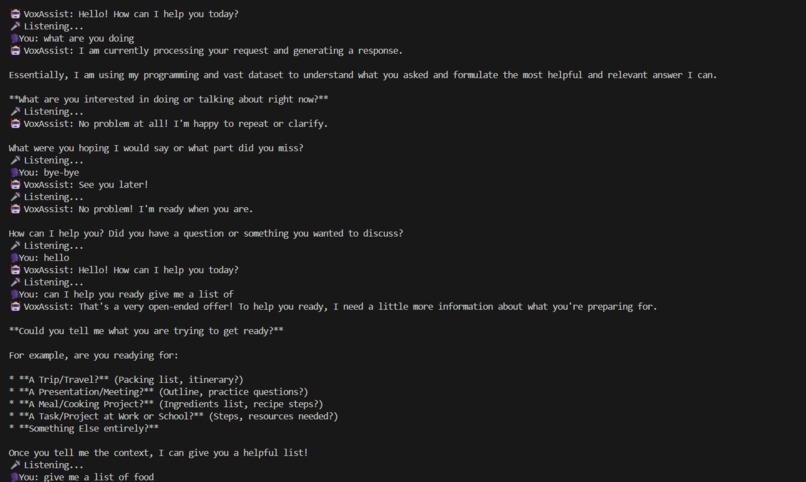
the conversation
Project Name VoxAssist – My Voice-Powered AI Assistant
🔹 Tagline A personal, real-time voice assistant that listens, understands, and responds naturally using Google Gemini.
🔹 The Story Behind VoxAssist I’ve always been fascinated by AI assistants and how they can make everyday tasks more seamless. I wanted to build something that felt personal—an AI that actually “listens” and talks back naturally. That’s how VoxAssist was born. It’s a voice-based AI assistant that lets you interact using real speech: you talk, it understands via Google Gemini, and responds back with natural-sounding voice. I designed it to run locally, so it’s fast, private, and accessible.
🔹 How I Built It I built VoxAssist entirely on my own using Python. The architecture is modular:
SpeechRecognition captures what the user says.
Google Gemini API interprets the input and generates intelligent responses.
pyttsx3 converts those responses back into speech in real time.
I focused on keeping it free-tier friendly, so it works without paid services, and designed it to be easily extendable for future features.
🔹 Challenges I Ran Into Being honest, there were a few hurdles:
Gemini’s models and APIs change frequently, so I had to handle dynamic model availability and quota limits.
Ensuring reliable voice input on Windows was tricky due to driver and microphone differences.
But overcoming these taught me a lot about resilience and adaptive coding.
🔹 Accomplishments I’m Proud Of
Built a fully working voice assistant that responds in real time.
Designed a system that runs locally and doesn’t rely on paid APIs.
Structured the project modularly so future features—like wake-word detection or multilingual support—can be added easily.
🔹 What I Learned Through VoxAssist, I learned how to integrate modern AI APIs, handle system limitations, design voice-based applications, and develop a robust, extendable backend—all as an individual developer.
🔹 What’s Next for VoxAssist
Implementing wake-word detection to make it truly hands-free.
Adding contextual memory so it can remember past interactions.
Expanding to multiple languages and creating a web/mobile interface for broader accessibility.

Log in or sign up for Devpost to join the conversation.