Inspiration
Great communication opens doors but improving it is surprisingly difficult. Whether it's a job interview, a presentation, a sales pitch, or public speaking, most people practice alone and only realise what they could have done better after the moment has passed.
We wanted to build something different. Instead of creating another AI tool that simply scores your performance, we asked a simple question:
What if AI could coach you, let you immediately try again, and actually prove that you improved?
That idea became Voxa an AI Communication Coach designed to help people build confidence and become more effective communicators through continuous practice and measurable progress.
What it does
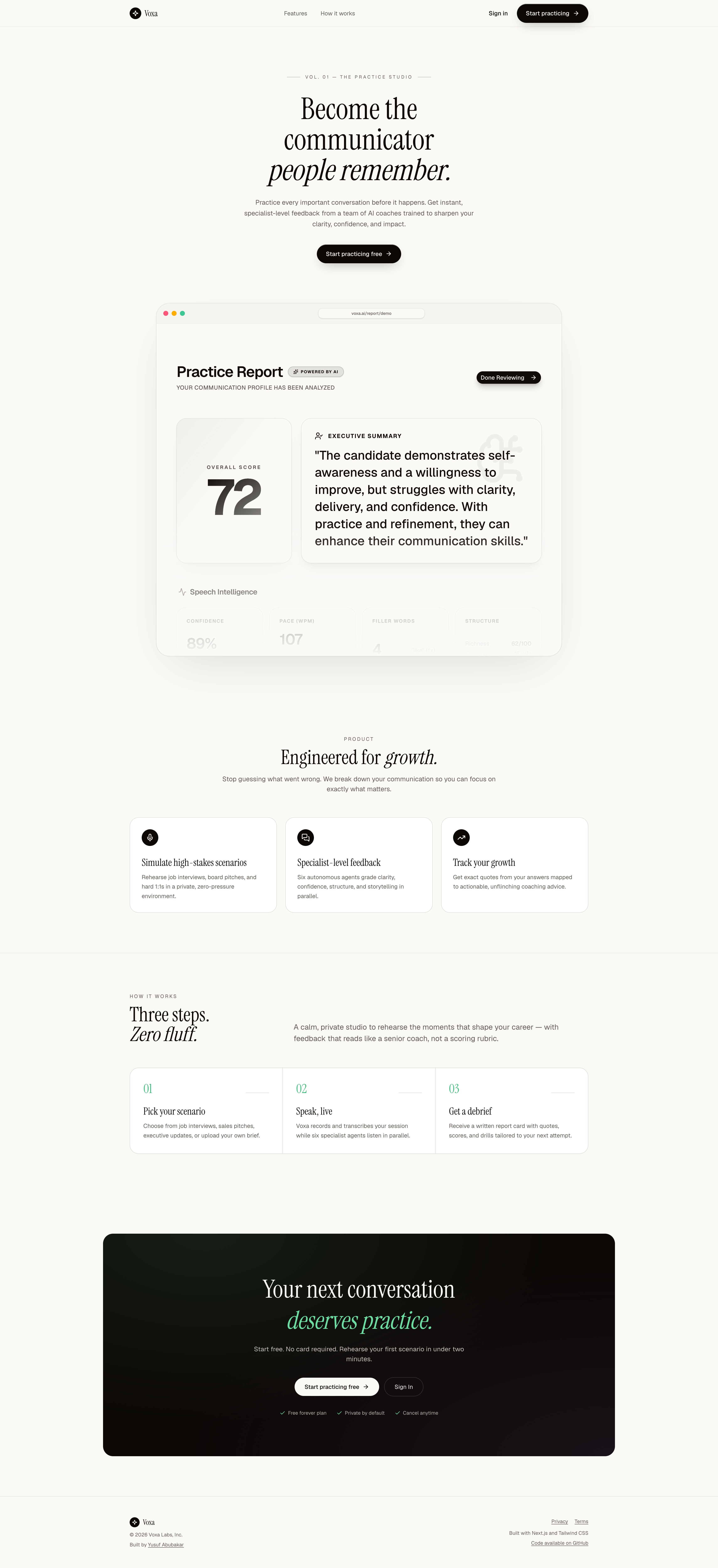
Voxa is an AI-powered communication coach that helps users improve how they communicate across real-world scenarios, including:
- Job Interviews
- Presentations
- Public Speaking
- Sales Pitches
- Difficult Conversations
After recording a response, Voxa:
- Transcribes the audio
- Analyses communication quality using AI
- Measures speaking pace and filler words
- Evaluates confidence, clarity, storytelling, delivery, engagement, and expertise
- Generates an executive summary with actionable coaching feedback
Voxa's signature feature is the Growth Loop.
Instead of ending the experience with a score, users can immediately click "Try That Again", apply the coaching, record a new response, and compare both attempts side by side. Voxa highlights measurable improvements such as higher confidence, fewer filler words, stronger storytelling, and a better overall communication score.
The goal isn't simply to evaluate communication it's to help people improve it.
How we built it
Voxa was built using a modern Next.js 16 App Router architecture with a feature-first design focused on performance, reliability, and user experience.
Our technology stack includes:
- Next.js 16
- Tailwind CSS
- Framer Motion
- OpenAI Whisper for speech transcription
- OpenAI Structured Outputs for reliable coaching analysis
- Zod for schema validation
- Supabase for authentication and data persistence
One of the core engineering decisions was building a resilient AI orchestration pipeline.
The workflow operates as follows:
- User records a response.
- OpenAI Whisper transcribes the audio.
- The transcript is analysed using OpenAI's structured outputs.
- If OpenAI is unavailable or rate-limited, the orchestrator automatically falls back to Google Gemini.
- If Gemini is also unavailable, it retries using Groq.
- If every external provider fails, Voxa gracefully returns a realistic local mocked response, ensuring the application remains fully functional during demonstrations and development.
Throughout development, Codex and GPT-5.6 played a significant role in accelerating the project. They were used to design the system architecture, AI orchestration pipeline, database schema, prompt engineering, structured output implementation, UI refinement, debugging, and performance optimization.
Development primarily took place inside Google's Antigravity IDE using its GPT OSS integration, while GitHub Copilot assisted with implementation. Codex served as the project's architectural partner throughout the build process.
Challenges we ran into
One of the biggest challenges was generating coaching feedback that remained consistent enough to power a polished user interface.
Large language models naturally produce varied responses, so we adopted OpenAI Structured Outputs with strict schema validation to ensure every coaching report followed a predictable format.
Another challenge was building a system that remained reliable even when AI providers experienced outages or rate limits. Implementing automatic provider failover and graceful degradation required significant engineering effort but resulted in a much more resilient application.
We also spent considerable time refining the user experience to ensure the coaching felt practical and actionable rather than generic AI-generated feedback.
Accomplishments that we're proud of
We're especially proud of building the Growth Loop, which transforms AI feedback into measurable improvement instead of a one-time evaluation.
Other accomplishments include:
- Building a resilient multi-provider AI orchestration pipeline
- Creating a polished premium user experience
- Implementing structured coaching across six communication dimensions
- Designing a guest-first experience that demonstrates value before requiring sign-up
- Ensuring the application continues working even when external AI providers are unavailable
Most importantly, we're proud of creating a product that helps people improve one of the most valuable professional skills they can develop.
What we learned
Building Voxa reinforced that successful AI products are about much more than connecting to an LLM.
We learned how important structured outputs, prompt engineering, resilient system design, and thoughtful user experience are when building AI-powered applications.
Working with Codex and GPT-5.6 demonstrated how AI can accelerate software engineering beyond code generation from architecture and system design to debugging, refactoring, prompt development, and implementation planning.
Perhaps our biggest takeaway was that users don't simply want AI to evaluate them—they want AI that helps them genuinely improve.
What's next for VOXA-AI
We're excited to continue expanding Voxa into a comprehensive AI communication platform.
Our roadmap includes:
- Personalized AI coaching plans
- Industry-specific interview preparation
- Live AI coaching during practice sessions
- Team and enterprise communication training
- Coach and mentor collaboration features
- Mobile applications for iOS and Android
- Long-term communication analytics and progress tracking
- Multilingual coaching support
Our long-term vision is to make Voxa the platform people use to prepare for every important conversation helping them become communicators others remember through consistent practice and measurable improvement.
Built With
- framer-motion
- groq
- next.js
- openai
- postgresql
- react
- shadcn-ui
- supabase
- tailwind-css
- typescript
- whisper

Log in or sign up for Devpost to join the conversation.