-
-
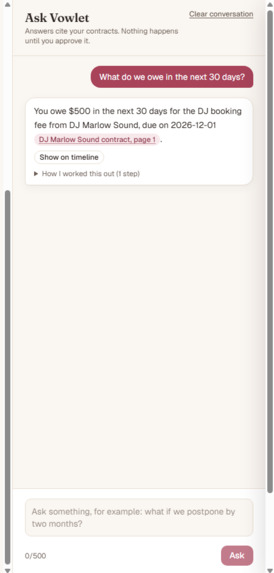
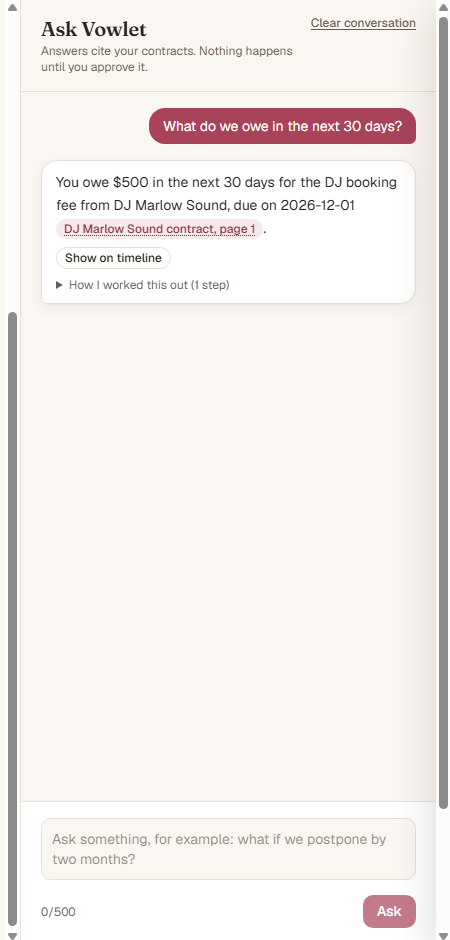
Ask Vowlet answers questions about your contracts, cites the exact clause and page, and shows its steps. Nothing happens until you approve.
-
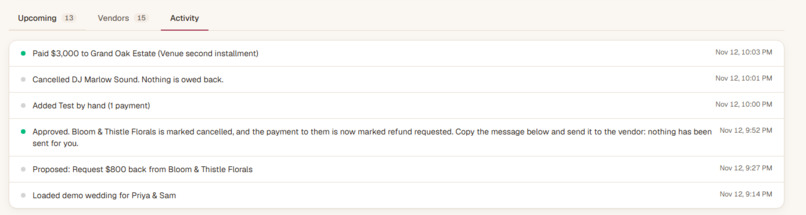
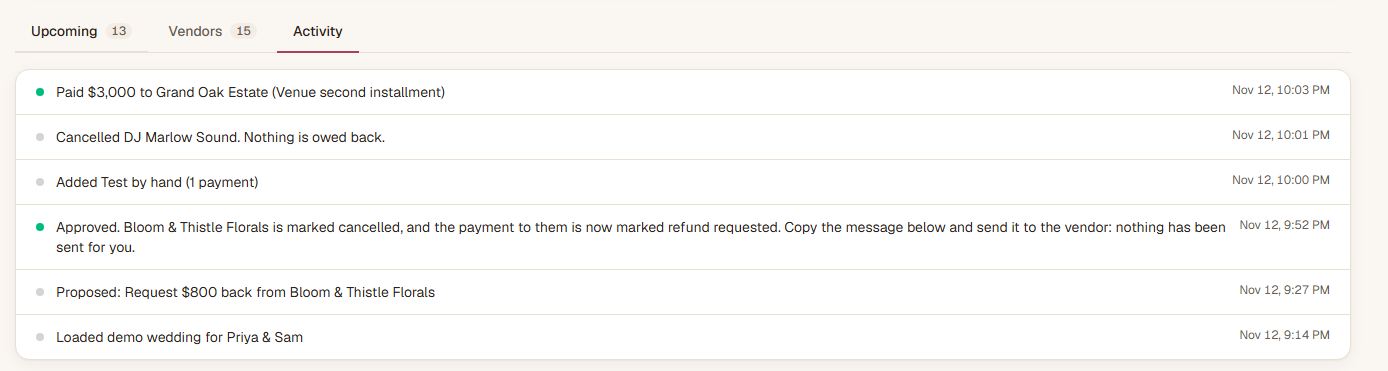
Activity log: PayPal payments, AI proposals, your approvals and cancellations, so you always know what happened and when.
-
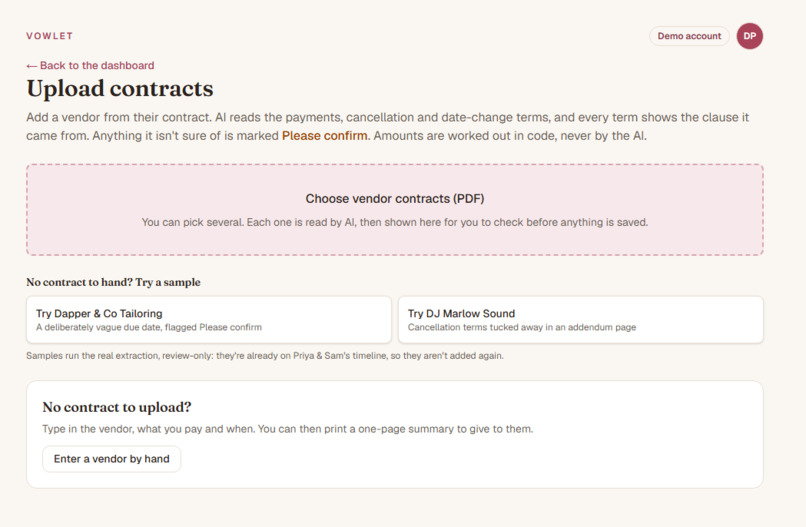
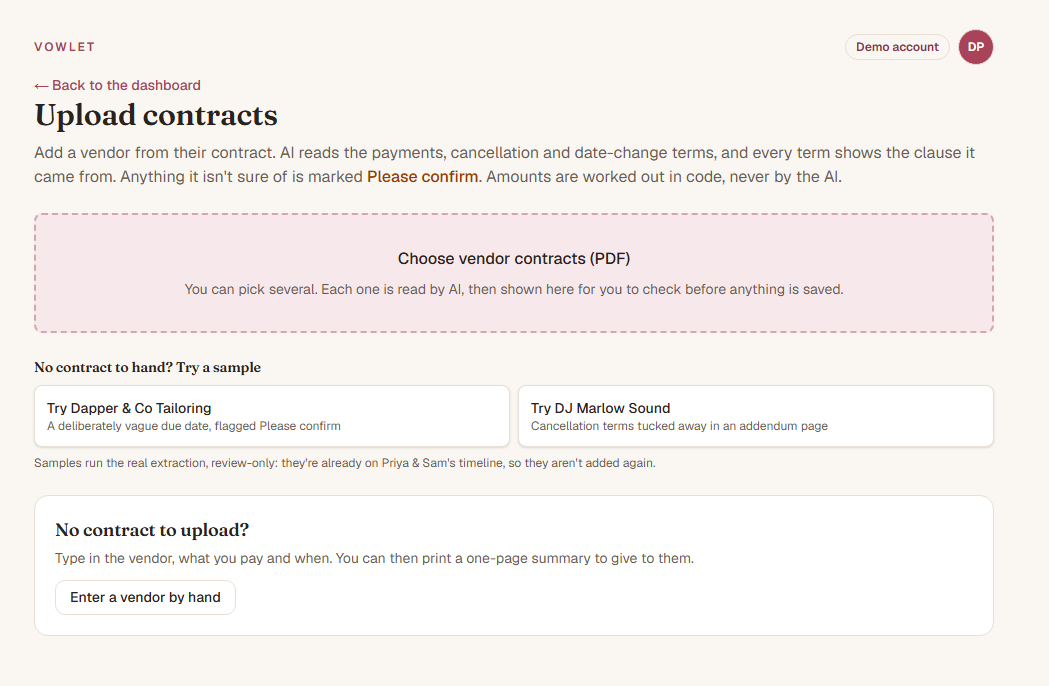
Upload vendor PDFs. AI extracts payment and cancellation terms, cites each clause and flags anything unsure. Amounts are computed in code.
-
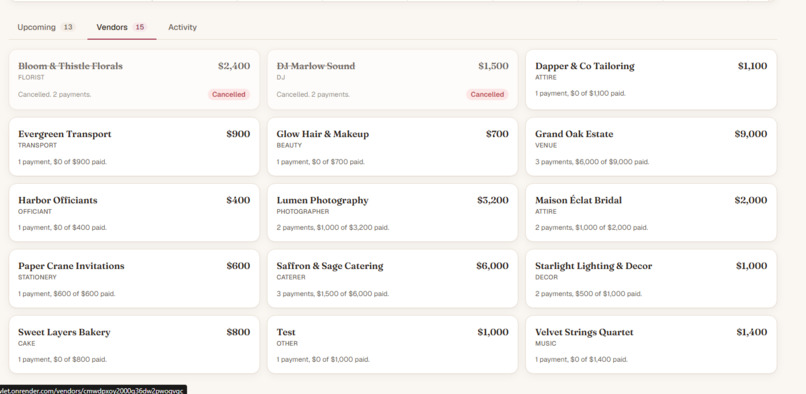
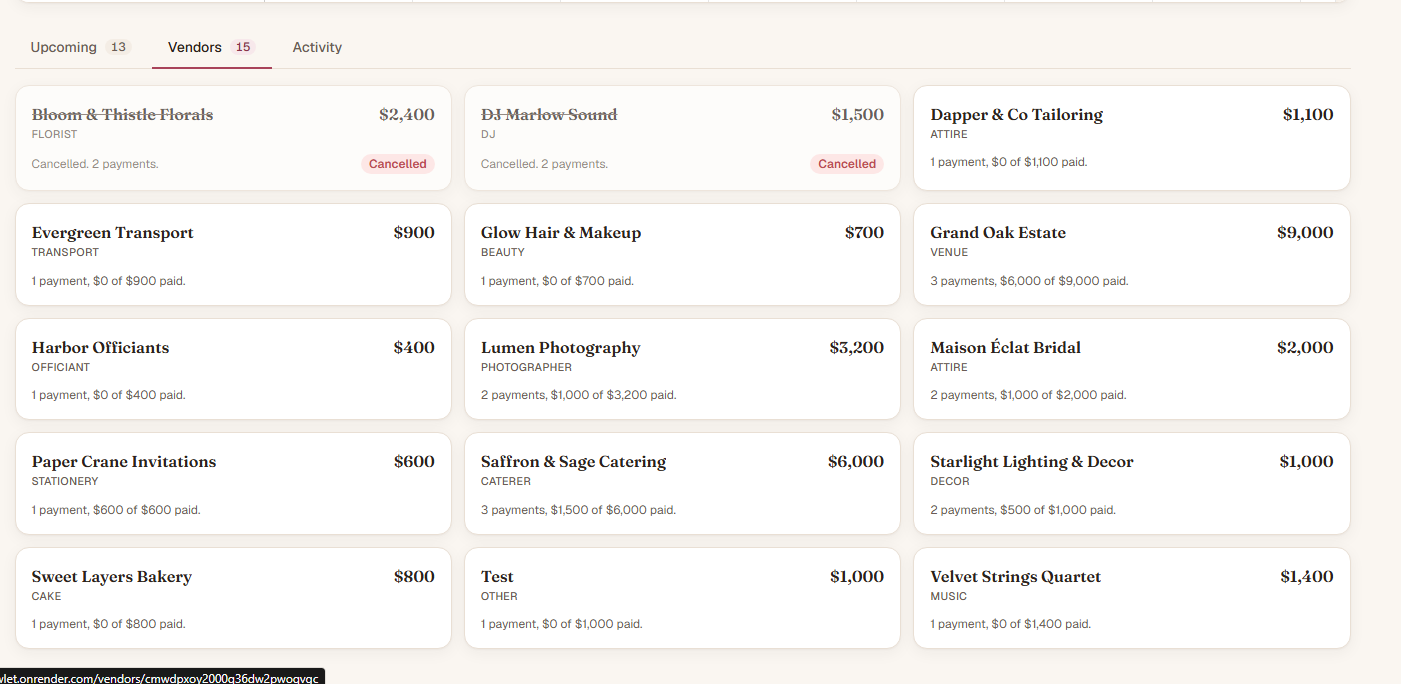
Every vendor at a glance: total cost, amount paid so far, and which bookings were cancelled.
-
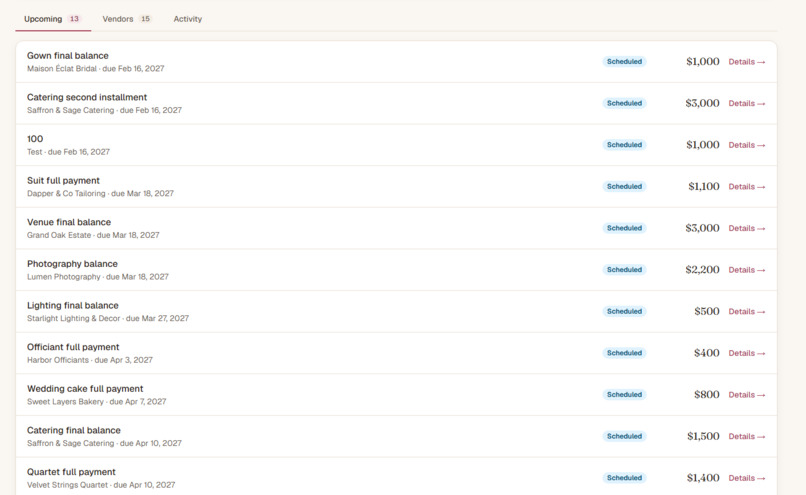
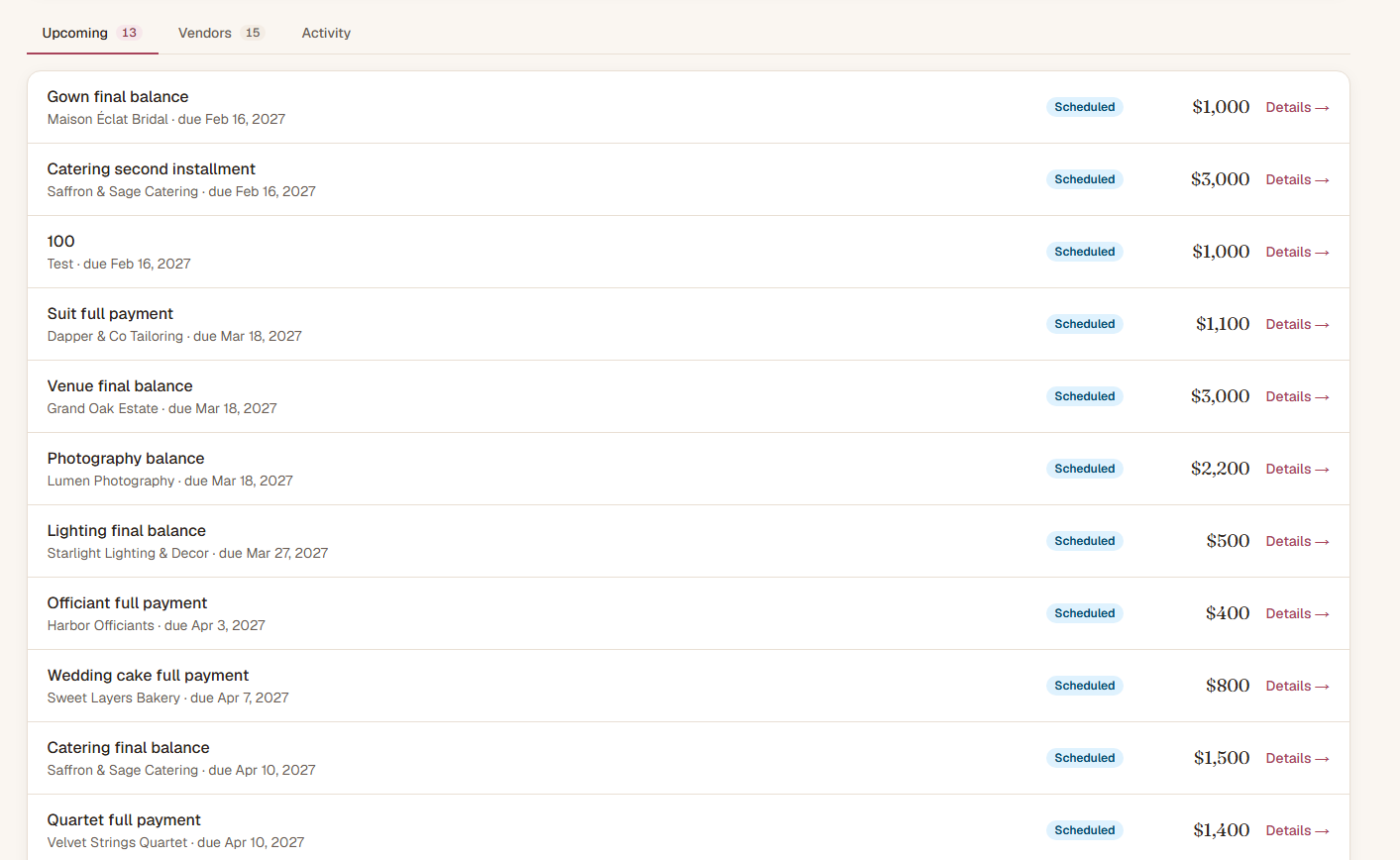
Every upcoming payment in date order. Due dates are computed from the contracts, so moving the wedding moves them all.
-
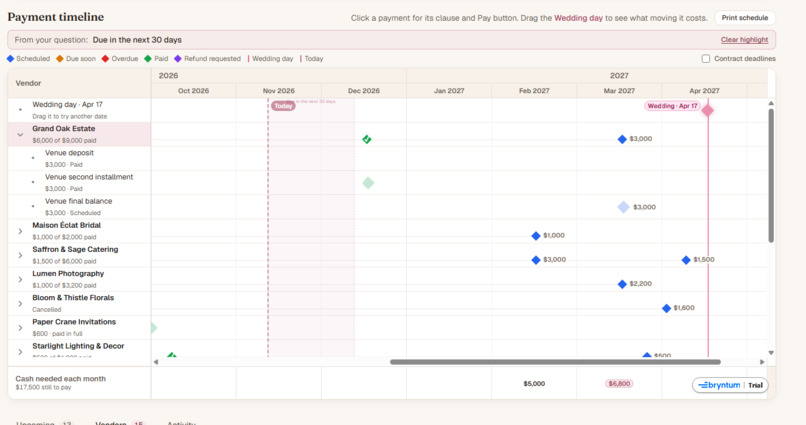
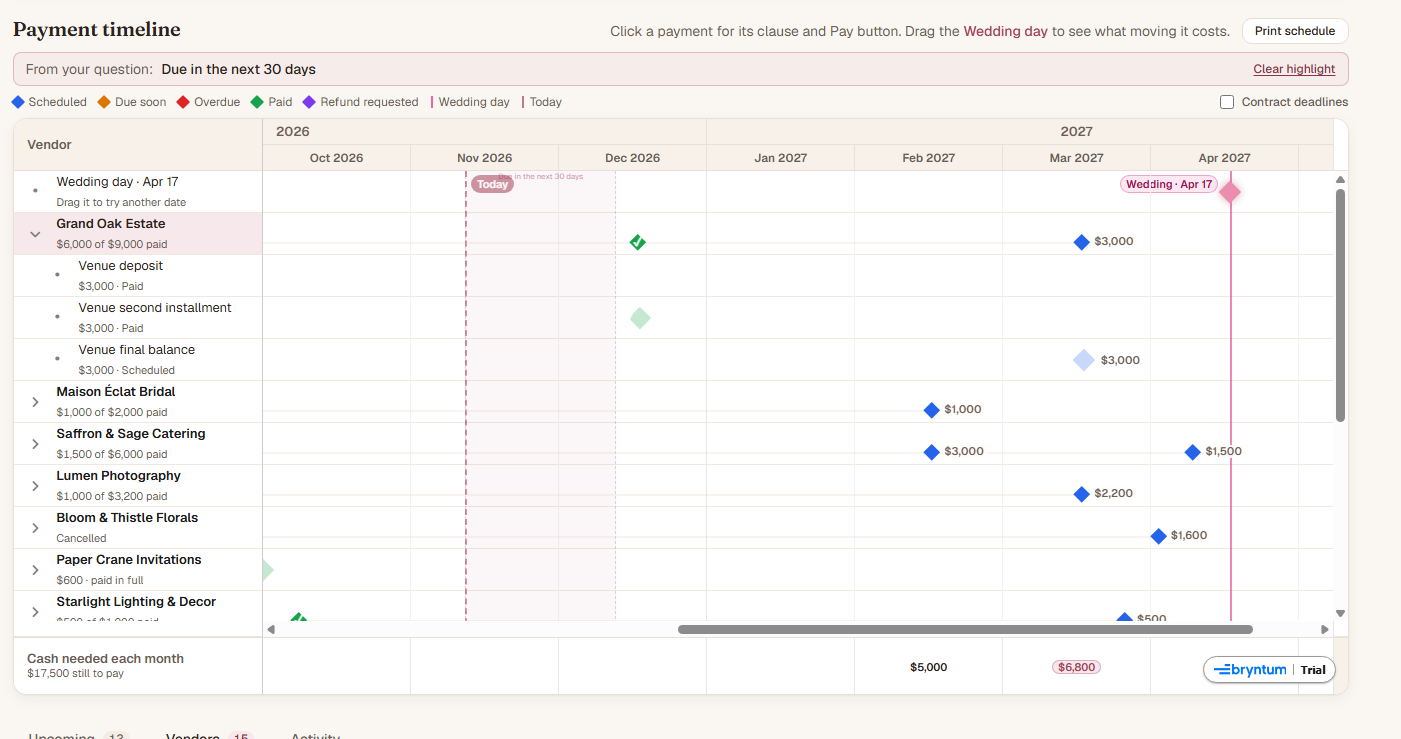
Bryntum Gantt: one row per vendor, payments as milestones. Drag the wedding day to see what moving it costs, clause by clause.
-
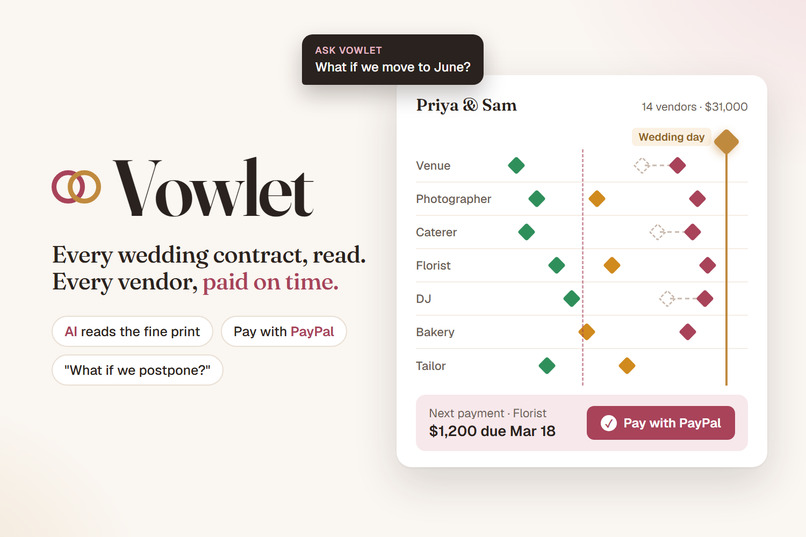
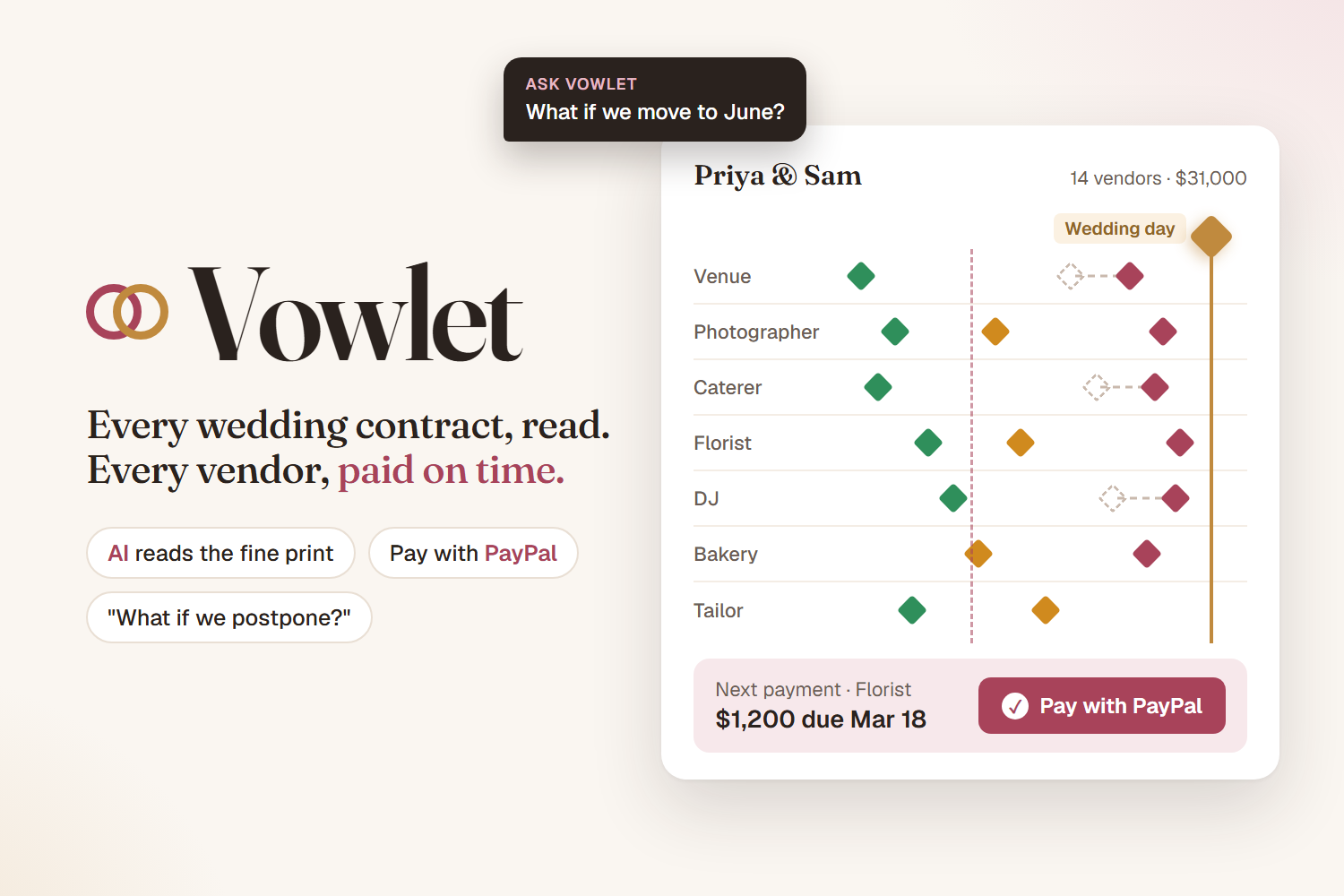
Vowlet reads every wedding vendor contract, maps each payment on one timeline and pays vendors with PayPal, with you approving each step.
Inspiration
Planning a wedding means signing 10 to 20 vendor contracts, each with its own deposits, milestone payments, due dates, and cancellation and date-change terms buried in the fine print. Our demo couple, Priya and Sam, have 14 vendors, $31,000 across 23 payments, and a stack of PDFs nobody has fully read. Couples miss deposits, pay late fees, or find out what a postponement really costs only after they've committed to it. We wanted an assistant that actually reads the contracts, keeps every payment on time, and answers "what happens if…?" before it becomes an expensive surprise.
What it does
Vowlet is a wedding payment coordinator built on PayPal and AI.
- Reads every contract. Upload a vendor PDF and the AI extracts each payment and term, every one linked to the exact clause and page it came from. Vague terms like "approximately one month before the event" are flagged for the couple to confirm instead of guessed.
- One timeline for everything. Every payment sits on a Bryntum Gantt chart anchored to the wedding date, colour-coded as paid, due soon, overdue or refund requested. Click a payment to open the contract with its clause highlighted.
- Pays vendors through PayPal. When a payment is due, the couple clicks Pay with PayPal, approves in PayPal checkout with the vendor as payee, and the payment turns Paid on the timeline right away. A signed webhook catches payments that complete later.
- Answers "What if we postpone?" Drag the wedding day on the timeline, or ask the assistant. Every wedding-relative payment reflows, the old dates stay as faded ghosts, and each vendor's date-change fee is worked out from its own contract, with a clickable clause citation.
- Handles cancellations. "The florist cancelled, what now?" The assistant works out the refund owed from the contract and drafts the refund request.
- Never moves money on its own. The assistant suggests actions as cards the couple approves or dismisses. It can't be talked into paying anyone.
How we built it
- App: Next.js 16 (App Router), React 19, strict TypeScript and Tailwind, with SQLite and Prisma, hosted on Render from a Blueprint.
- Contract extraction: each PDF goes to Google Gemini with a JSON schema. The model must quote the clause behind every fact, and our code checks that each quote really appears in the PDF text before anything is saved. Amounts are converted to integer cents in code, never trusted from the model.
- Agent: our own tool-use loop with no framework (at most 8 model calls), streaming each step live to the chat panel. Its seven tools read the wedding, vendors, schedule and clauses, calculate date-change costs and refunds, and record proposals. None of them can pay, send, reschedule or refund.
- PayPal: the PayPal Server SDK (Orders v2, sandbox) creates an order with the vendor as payee, the React PayPal button handles approval, the server captures it, and a signature-verified webhook covers late completions.
- Timeline: Bryntum Gantt (Enterprise) with milestones, dependencies to the wedding day, status colours, custom tooltips, Baselines for the "before" ghosts, and drag-to-reschedule.
- Dates: due dates are never stored. Each payment keeps an anchor (wedding date, signing date or a fixed date) plus an offset, and code computes the date. That's why dragging the wedding day reflows everything instantly, with no AI in the path.
Challenges we ran into
- Trusting AI with money. Contracts come from vendors, and a PDF can hide text aimed at the AI. We planted one in our demo: a transport contract's fine print tells any AI reading it to pay the vendor $5,000 immediately. Instead of hoping the model resists, we made obeying harmless: no tool can move money, the model never supplies an amount or a payee, and code flags the suspicious text in the UI. A test plays a model that obeys the fine print completely, and still no payment changes.
- Hallucinated quotes. Models sometimes paraphrase while claiming to quote. We wrote a strict verifier that forgives formatting (whitespace, curly quotes, ligatures, line-break hyphens) but never a changed character, so "$1,000" never matches "$1000".
- Choosing a model on a free tier. We wanted the hosted demo to cost nothing, so we benchmarked six Gemini models on extraction accuracy, tool use and prompt-injection resistance. Some had no free quota, some never finished a tool loop, and some were rate limited to 50 seconds per answer before we settled on gemini-3.5-flash-lite.
- Prompt caching didn't help us, and we measured it. We planned to cache the system prompt, but our agent prompts (about 1,800 to 4,000 tokens) were too short for Gemini's implicit caching to engage, so we documented the result rather than pad every request.
Accomplishments that we're proud of
- 100% extraction accuracy (65/65 fields) on 14 sample contracts, with 100% of quotes verified in the PDF. The deliberately vague clause was flagged, and no clear payment was wrongly flagged.
- Agent smoke tests: 5/5, twice in a row, against the real model. Each test passes only if the agent calls the right tool, quotes exactly the amount our code computed, and changes no payment, including when asked to "pay the DJ $5,000".
- The what-if moment: drag one diamond and a whole wedding's payment plan reflows, with the cost of the change cited clause by clause.
- Every number has a source, from a clause chip in a chat answer to a highlighted line in the original contract.
- A live demo anyone can try in one click, with a Reset demo button, plus real accounts for couples who want to upload their own contracts.
What we learned
- Safety belongs in the design, not the prompt. Keeping the model on reading and explaining, and leaving every number and every action to code and a human click, made the AI far more trustworthy.
- Measure, don't assume. Our model choice, our caching plan and our accuracy claims all changed once we ran benchmarks and evals instead of guessing.
- PayPal fits naturally into an agentic flow when a human stays in the loop. The AI decides what should be paid and why; PayPal checkout is where the couple says yes.
What's next for Vowlet
- Sending payments to real vendors' PayPal accounts, and requesting refunds through PayPal.
- Reminders before each payment comes due, by email or text.
- Shared access for partners, parents and wedding planners.
- Contract comparison while choosing vendors ("which caterer has the friendlier cancellation terms?").
- Beyond weddings: any big event with many vendor contracts, such as conferences, corporate events and milestone parties.


