-
-
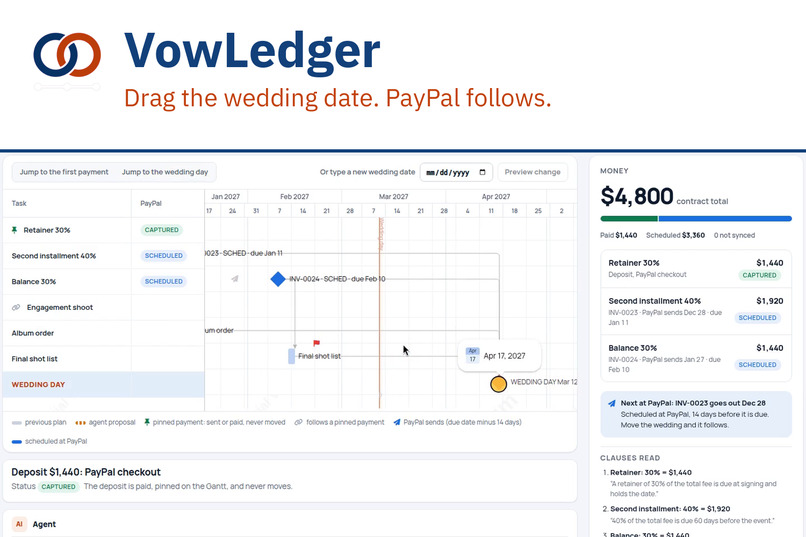
VowLedger: drag the wedding date, the scheduled PayPal invoices follow.
-
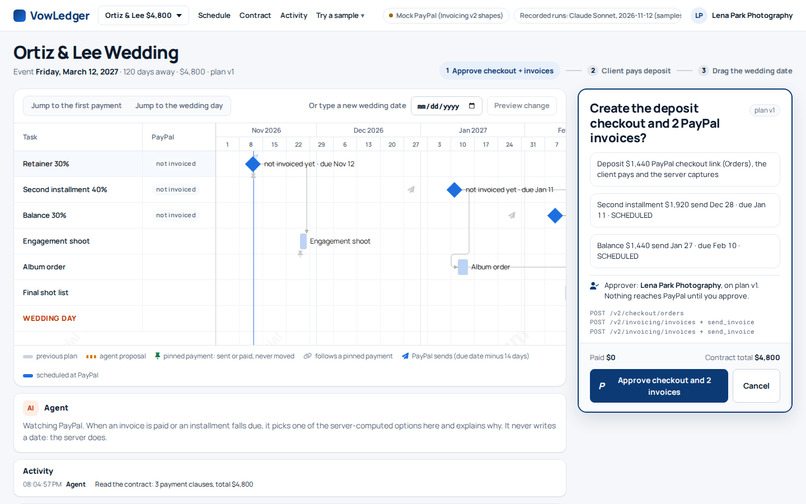
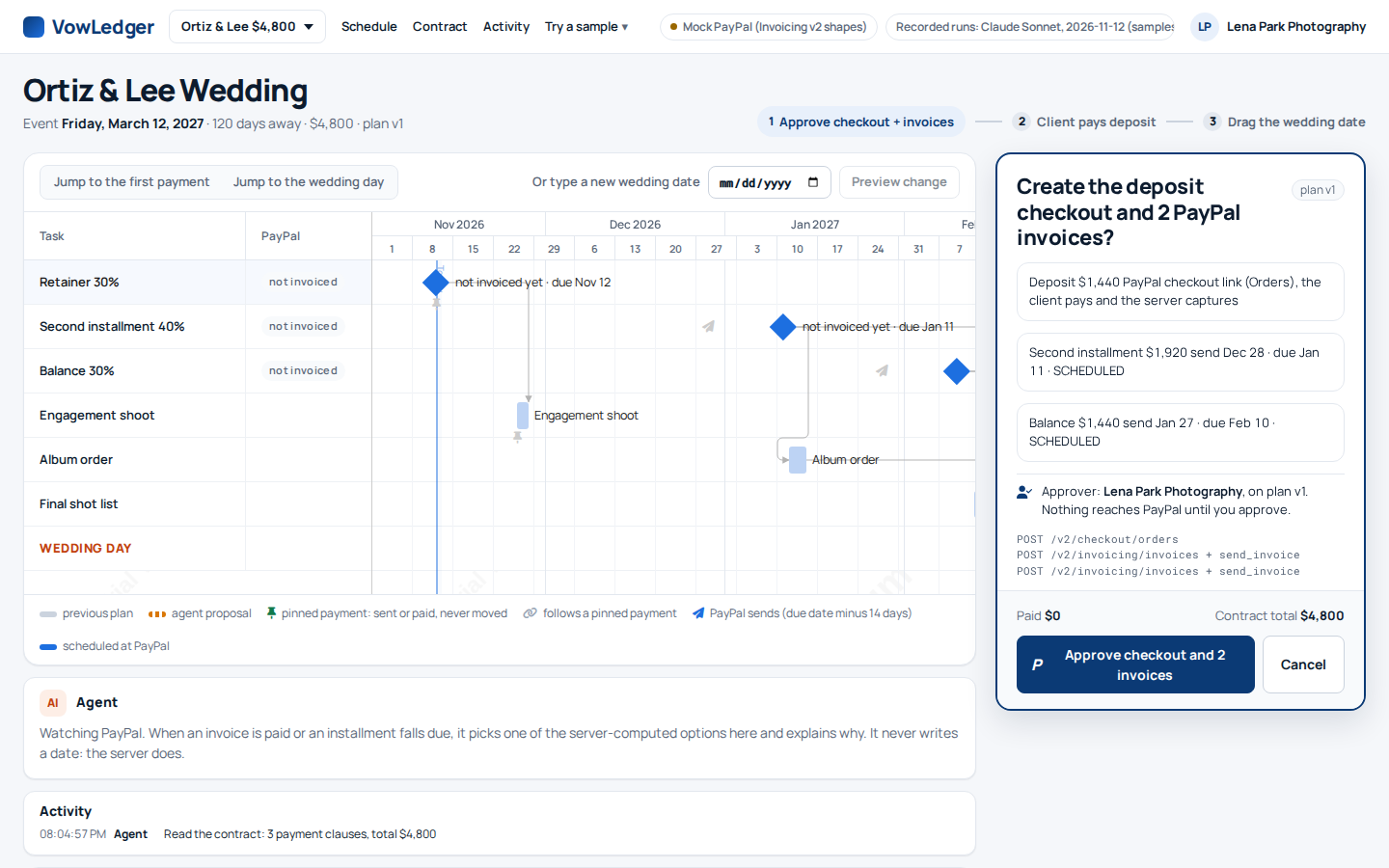
The agent reads the contract into quoted clauses; the server checks the sum and one card asks for approval.
-
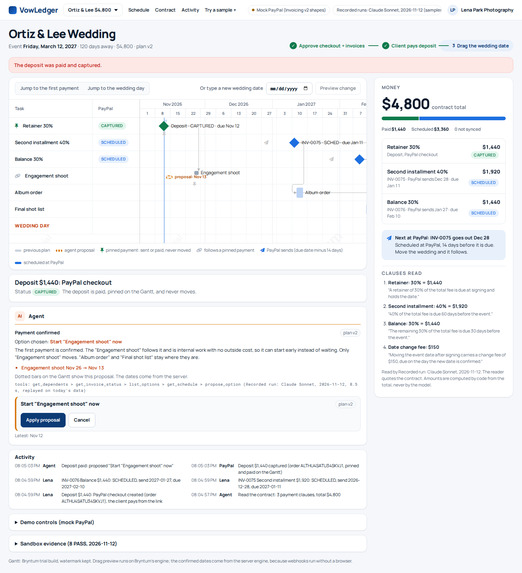
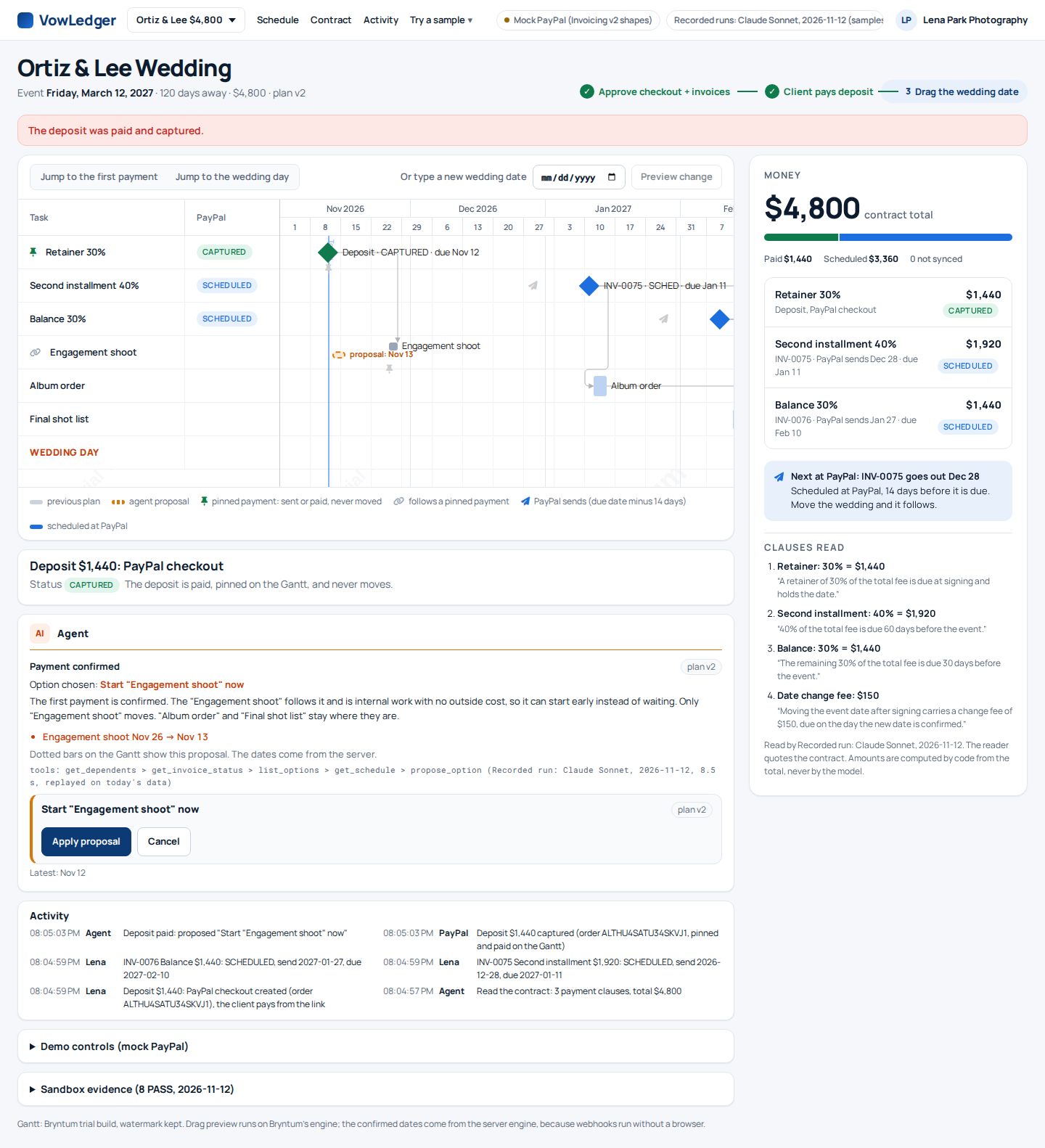
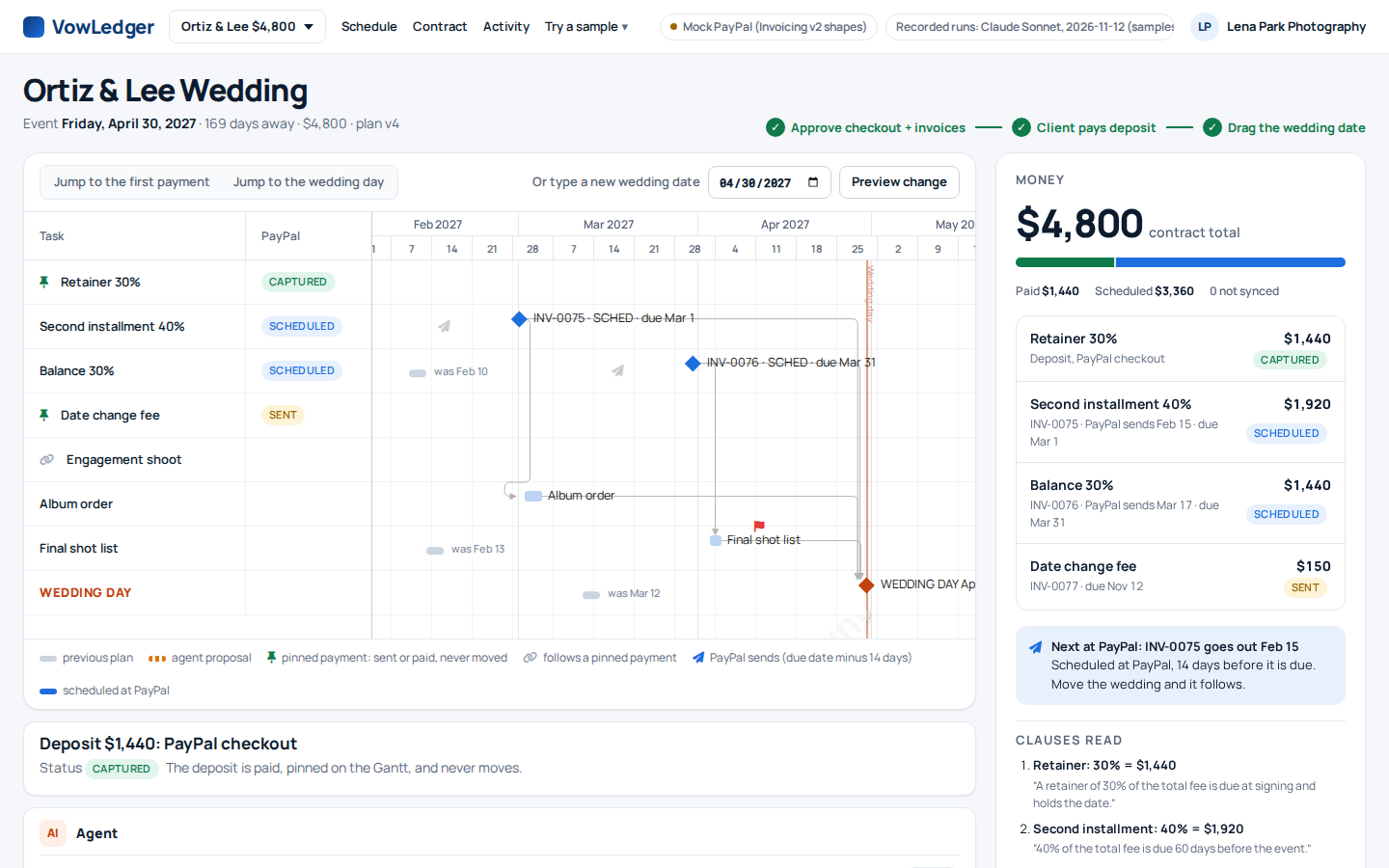
Deposit captured through PayPal Orders; the agent's proposal is a dashed second baseline.
-
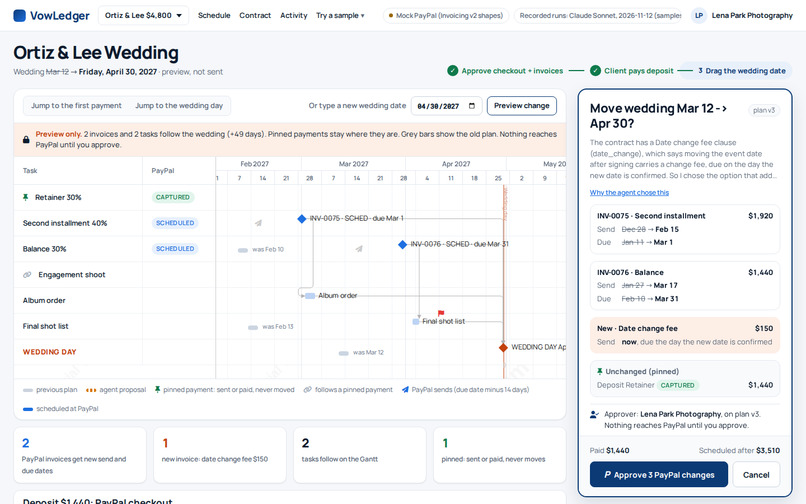
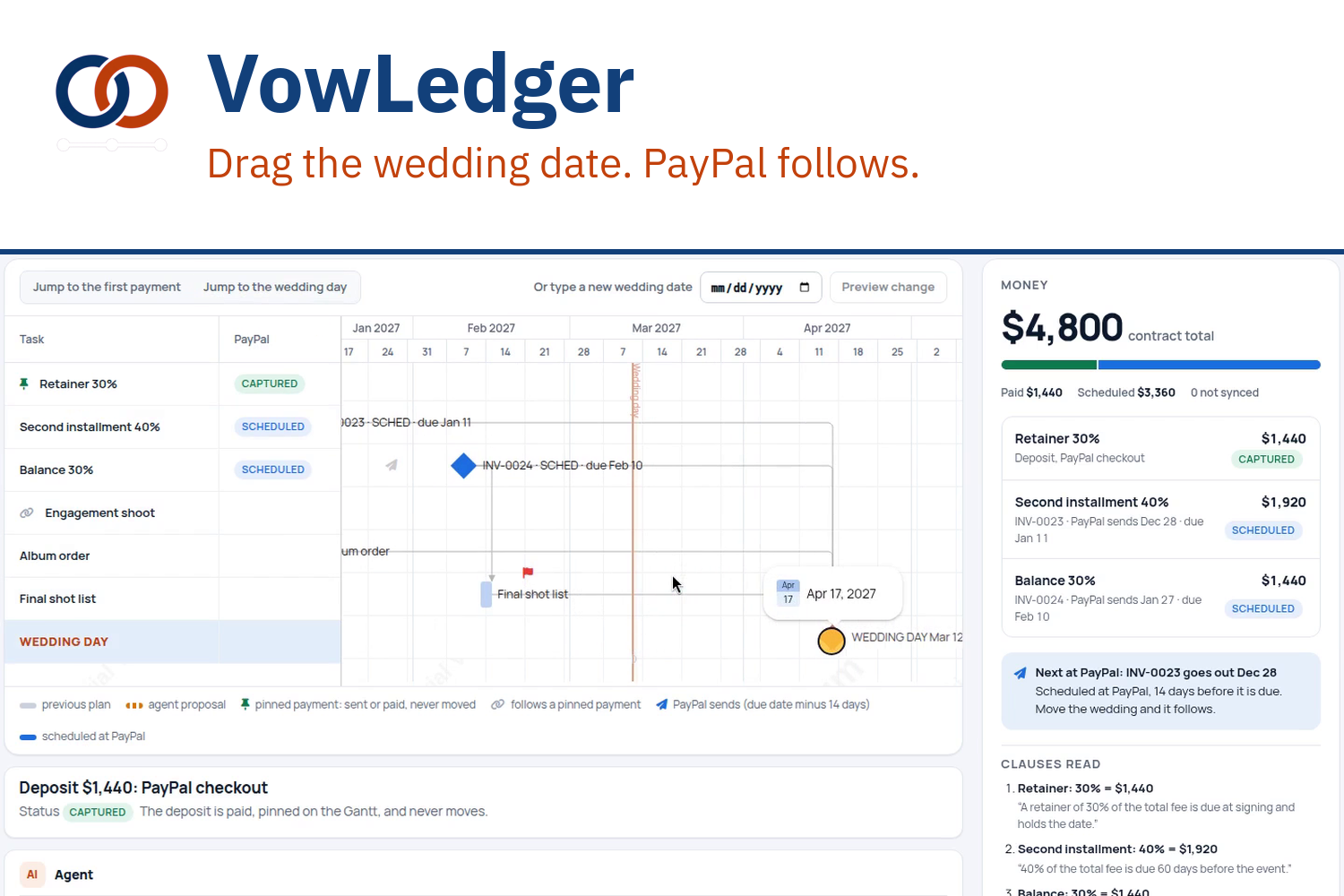
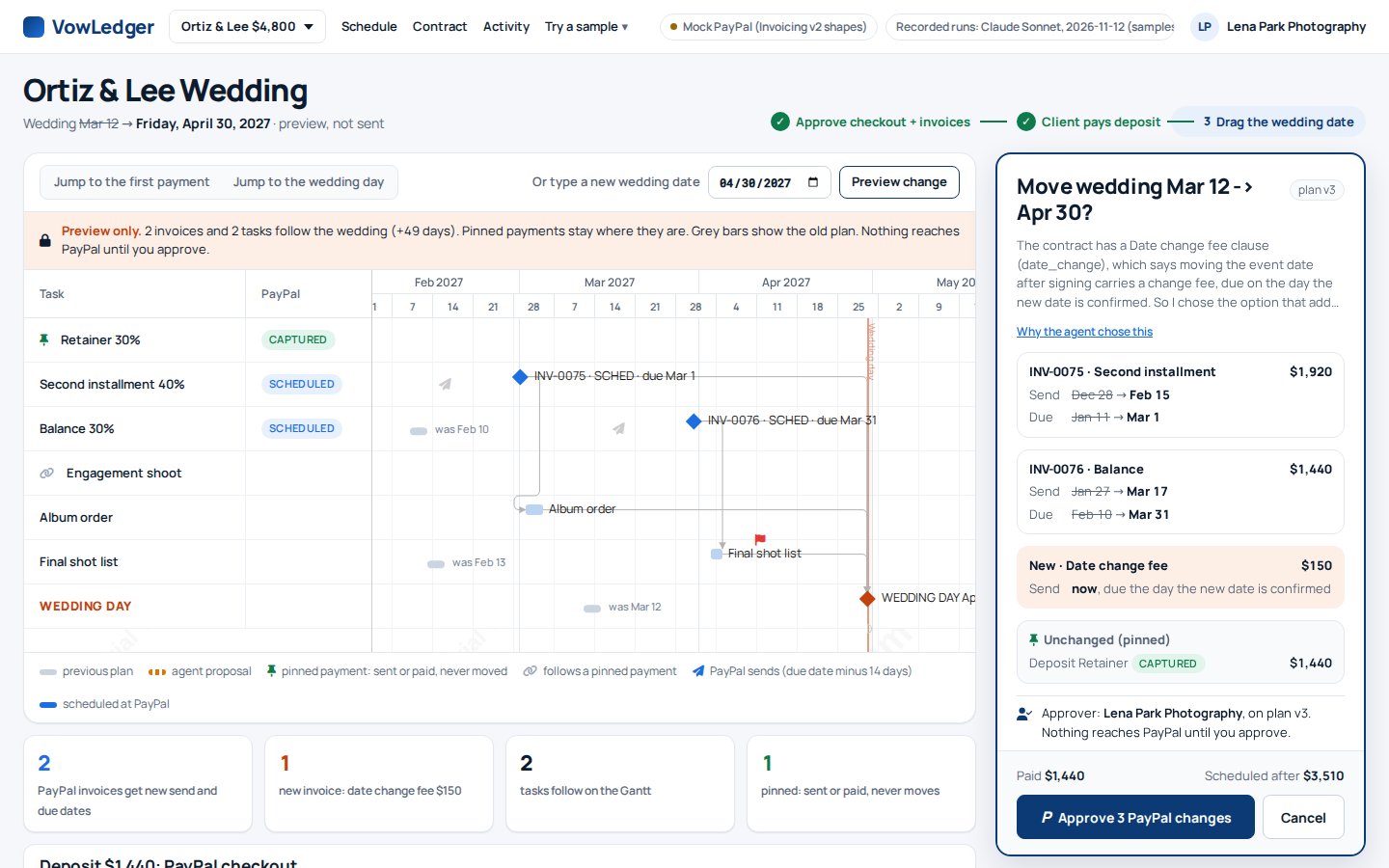
Wedding date drag: each invoice before and after, paid deposit pinned, PayPal calls listed.
-
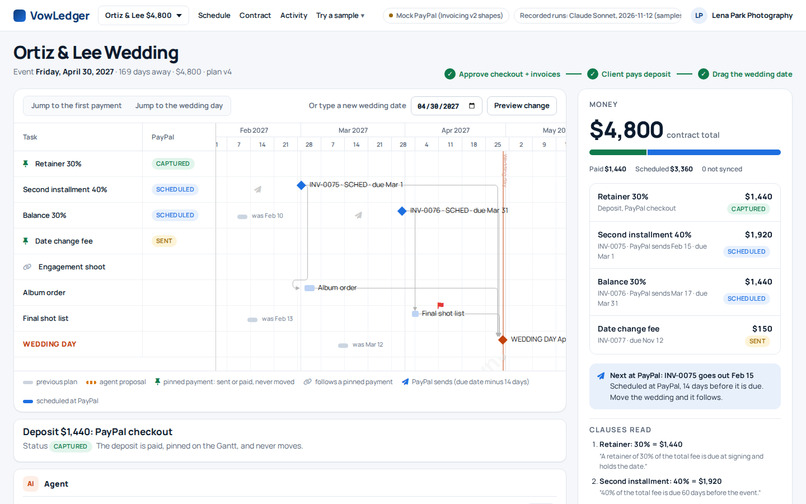
After approval every invoice is synced on PayPal and the Money rail says 0 not synced.
Inspiration
A wedding photographer's contract says "40% due 60 days before the event". When the couple moves the date, every due date and every scheduled invoice has to move too, and the deposit that is already paid must not. Today that is manual, one invoice at a time. Wedding payments count back from the day (The Knot quotes planners saying photography, videography and music are usually due 30 days before), and dates do move: The Knot's 2020 Real Weddings Study found 93% of weddings planned for 2020 were adjusted rather than canceled (an extreme year, so an upper bound, not a normal-year rate). The first user we built for is a solo wedding photographer who takes a deposit at signing and bills the rest through PayPal in installments.
What it does
VowLedger is a Bryntum Gantt where dragging the wedding date rewrites the real scheduled PayPal invoices to match.
- The photographer opens a signed contract (three made-up samples are included, or paste text). An agent reads the payment clauses into quotes and percentages. Code checks that every quote exists in the text and that 30% + 40% + 30% adds up to the $4,800 total.
- One approval card creates the deposit as a PayPal Orders checkout and the later milestones as PayPal Invoicing v2 invoices scheduled to send 14 days before their due dates.
- When the client pays the deposit, the server reads the order, checks the amount and captures once. The agent then picks one of the options the server computed for the production tasks and explains why, and why not for each other option. The proposal is drawn as a second, dashed baseline on the Gantt.
- When the couple moves the date, the photographer drags the wedding bar. Unsent payments and tasks follow, paid or sent payments stay pinned, and one approval rewrites the issue date and due date of every scheduled invoice (and adds a date-change fee invoice if the contract says so).
- Edge cases are built in: an unpaid installment makes the agent hold the one task that costs outside money and draft a reminder that cites the contract clause; a contract whose clauses do not add up is blocked; a partial PayPal failure keeps the successes and retries only the failed invoice.
Most Gantt ideas for PayPal go one way: PayPal events move the schedule. VowLedger goes both ways. A payment event makes an agent propose a schedule change, and a human edit of the Gantt becomes a PayPal write.
How we built it
- Bryntum Gantt (trial build, 7.3.8) as the input device: a Backward (ALAP) project anchored on the wedding day, milestones, FS dependencies with lags, constraints, two baselines per bar (previous plan, agent proposal), Indicators for each invoice's issue date, and TimeRanges for today and the wedding day. A headless-Chromium check (
npm run check:bryntum, 7 checks) confirms Bryntum's drag preview equals the server's plan. - Express 5 server as the only source of dates, amounts and PayPal calls. A pure date engine computes every date; amounts are
round(total * percent / 100)in code. The model never writes a date or an amount. - PayPal: Orders v2 for the deposit through the APIMatic Context Plugin SDK (
createOrder,getOrder,captureOrder); Invoicing v2 over REST for create and PUT; PayPal Agent Toolkit 1.11.0 for send, get, delete, reminder and record payment. Every write carries aPayPal-Request-Id, and a lost answer is settled by read-back or same-id replay. - Nothing reaches PayPal without a human approval card. A card runs once, only on the plan version it was drawn on, and under a lock per contract. Sent and paid invoices are pinned and never move.
- Claude Sonnet (
claude-sonnet-5-5) with tool use reads contracts and picks among server-computed options. It has read tools andpropose_optiononly, and the server rejects an unknown option id, a skipped option, or any date or dollar amount in the model's text. - React 19, Vite 7, Express 5, zod.
Built during the hackathon: the project was built inside the Oct 1 - Nov 12, 2026 submission period (the public repo was created and committed on 2026-11-12, and the sandbox runs in VERIFY.md are dated 2026-11-12).
How PayPal and AI are used: the PayPal sandbox hosted the real deposit order, capture and scheduled invoices in our test runs (see Accomplishments). The public hosted demo runs PayPal as a mock with the same response shapes, so judges can try it without keys. On the hosted demo Claude Sonnet runs live through the Anthropic API, with per-IP-hour and per-day caps; if the API fails or a cap is hit, the action still finishes with a labelled recorded run or a rule-based stand-in. Claude Code was used as the coding assistant.
Challenges we ran into
- Bryntum's Backward scheduling: an event milestone with a
muststartonconstraint cannot be dragged (the drop is reverted). Usingstartnolaterthanfor the wedding day lets ALAP place it correctly and the drag rewrite the date. The project end also has to lie well behind the wedding, or a later drop is refused. - PayPal sandbox surprises found by running it: the Agent Toolkit
send_invoicehides a 422USER_NOT_FOUNDand leaves the invoice in DRAFT;create_invoicehas no due date field;update_invoicingclearspayment_term. We use REST for create and PUT. Invoice numbers on the shared sandbox account collided (DUPLICATE_INVOICE_NUMBER), so a retry now takes the next number. - Keeping the model honest: our first recording of the agent said a task moves with the wedding when it was tied to the captured deposit. Both tools now say which tasks move, and the server refuses a reason that contradicts that.
Accomplishments that we're proud of
- The full path ran against the real PayPal sandbox on 2026-11-12 (VERIFY.md S1): the sandbox buyer paid the deposit order on the real PayPal checkout page and the app captured it once ($1,440.00 COMPLETED). The wedding was then dragged Mar 12 to Apr 30 and approved;
get_invoiceshows both later invoices still SCHEDULED with the new send and due dates, and the $150 date-change fee invoice SENT. - A PUT on SCHEDULED invoices kept them SCHEDULED (V1), a past due date is accepted (V2), and a PUT on a SENT invoice is allowed (V4).
- A second capture press sends no second call, and PayPal shows exactly one capture on the order (V9).
- Bryntum's drag preview matches the server plan in 7 of 7 checks, five runs in a row.
- The demo video was recorded on the hosted app with live Claude Sonnet, and the agent called its read tools in its own order with every pick passing the server validation.
What we learned
- Let the model decide, never compute. Dates and amounts from code, choices and explanations from the model, and validation between them, made the agent useful without making it a risk to real money.
- A Gantt is the right input device when the problem is a set of dates hanging off one date.
- Verify against the sandbox early: most of the real design constraints (scheduled invoices, PUT rules, idempotency, shared invoice numbers) only showed up there.
What's next for VowLedger
- A planner view (Bryntum Scheduler): one row per vendor, each vendor keeps their own PayPal account and approves their own card when the couple moves the date.
- A couple view (Bryntum Calendar): every upcoming due date across vendors on one calendar, each with the PayPal payment link.
- A feature request for PayPal: let Invoicing v2 reschedule invoices relative to an anchor date in one call, instead of a get and a full PUT per invoice.
- Not done yet: public sandbox webhook delivery (polling is used in the demo), automatic reminders, and a hosted-page partial payment by a buyer.
Built With
- agentic
- ai-agent
- anthropic
- apimatic
- bryntum
- claude
- express.js
- gantt
- invoicing
- node.js
- payments
- paypal
- paypal-orders
- react
- sandbox
- scheduling
- tool-use
- vite
- wedding
- zod
