-
-
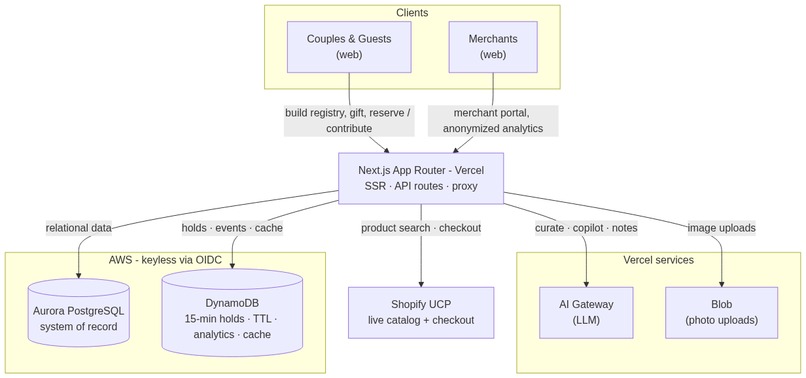
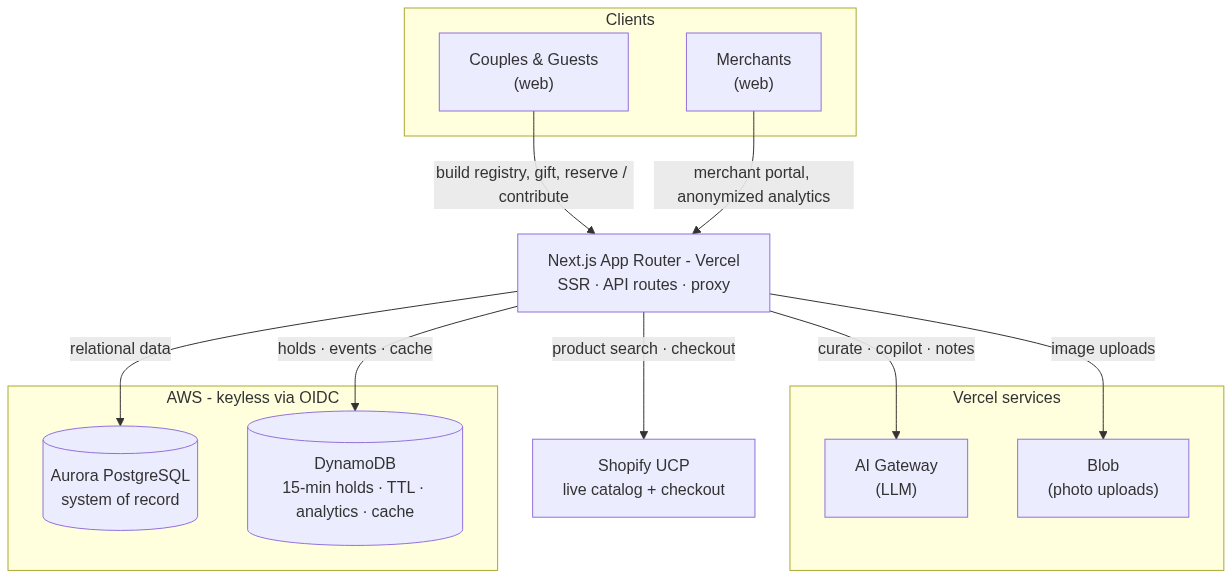
architecture
-
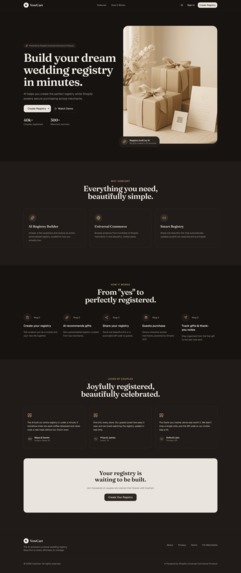
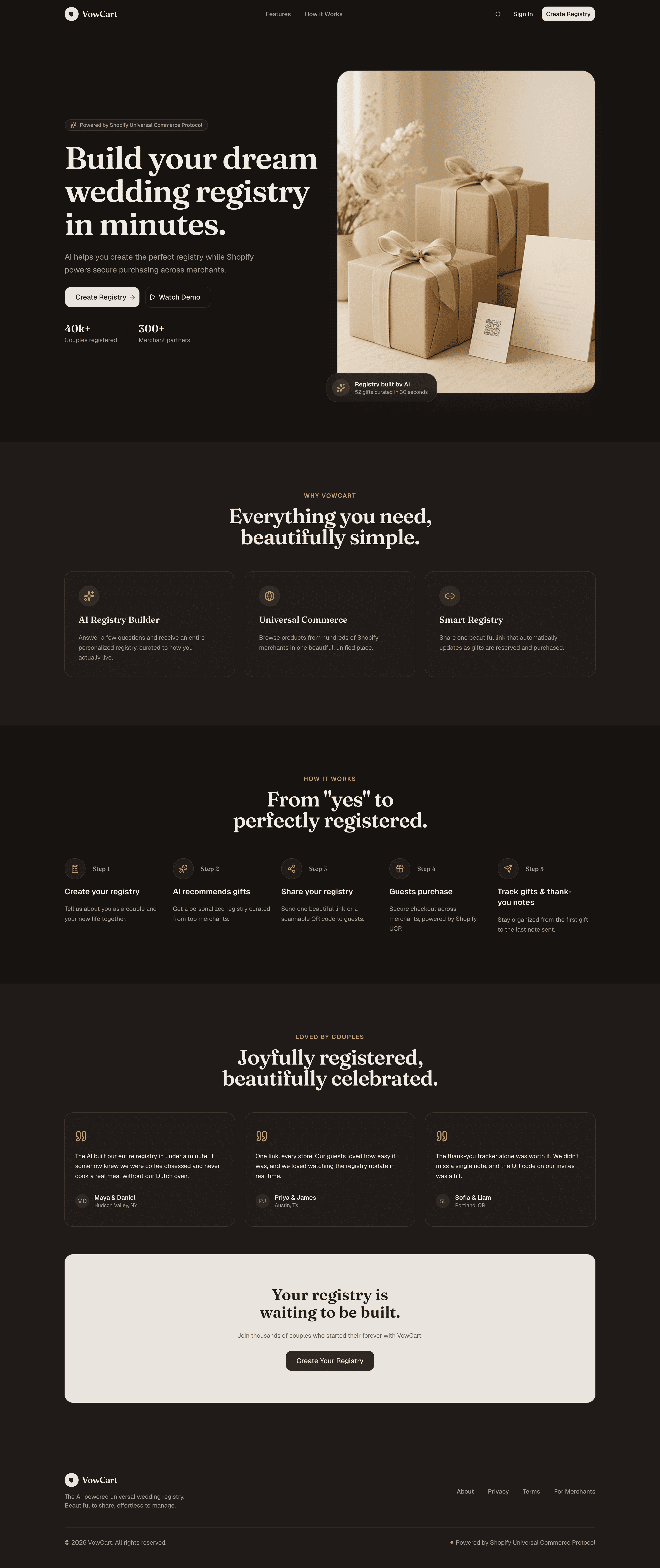
homepage
-
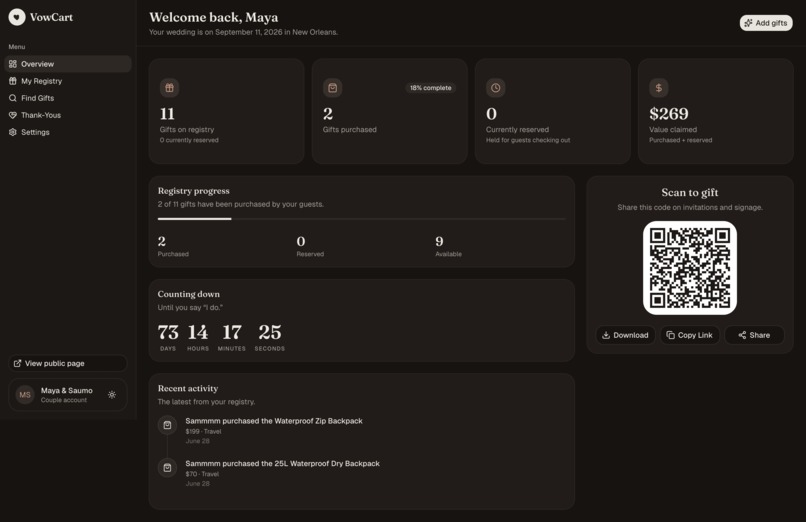
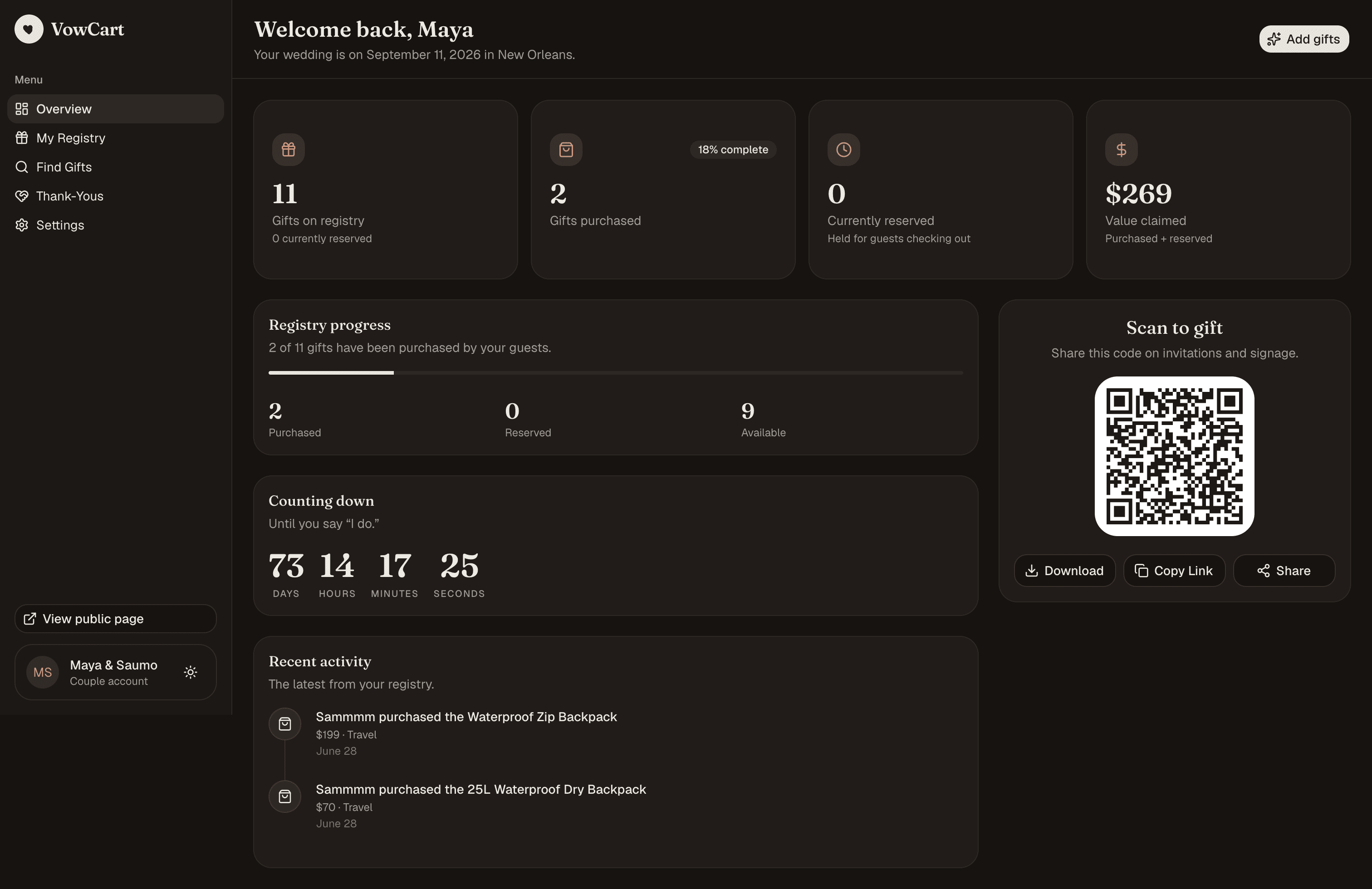
dashboard for couple
-
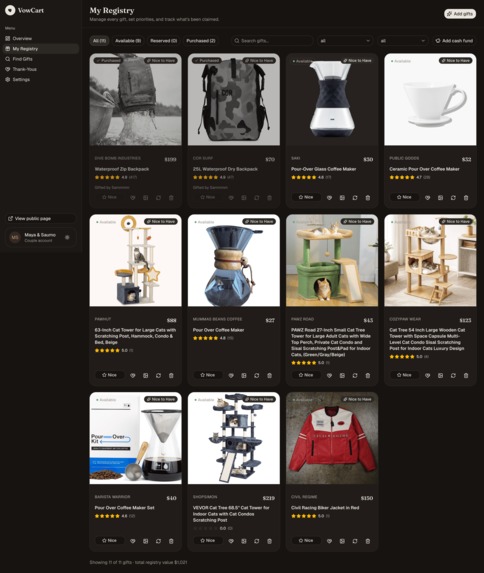
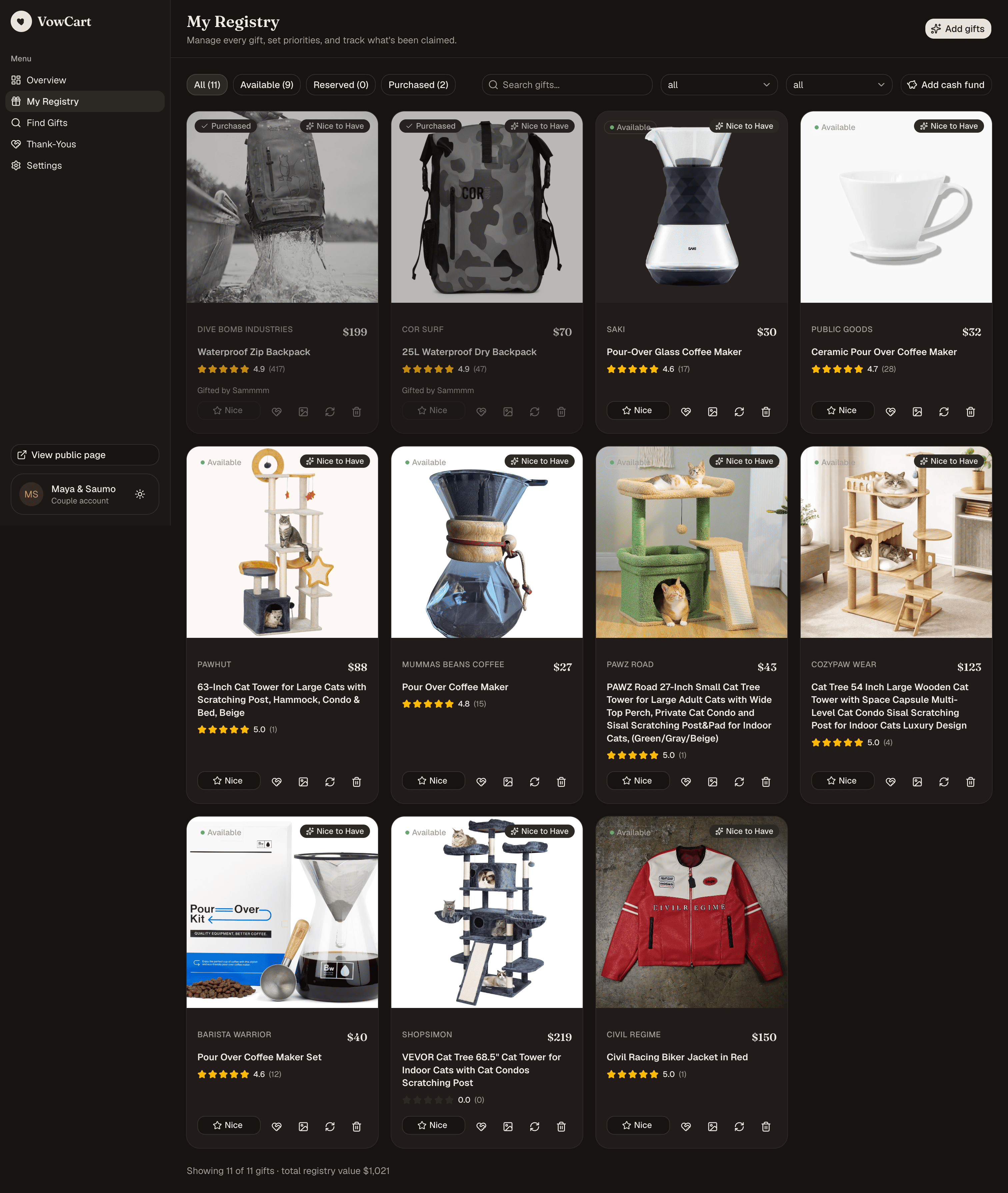
registry view for couples
-
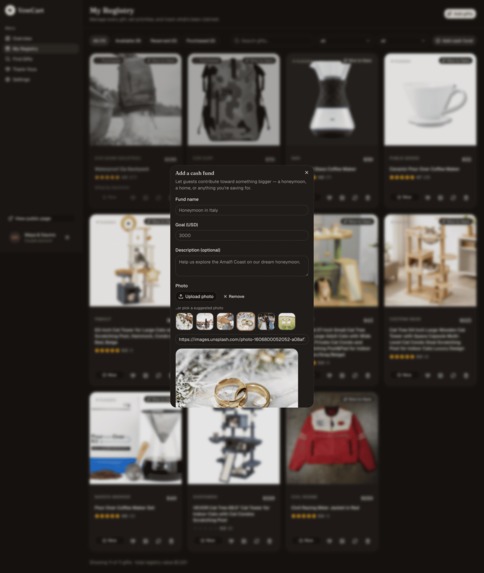
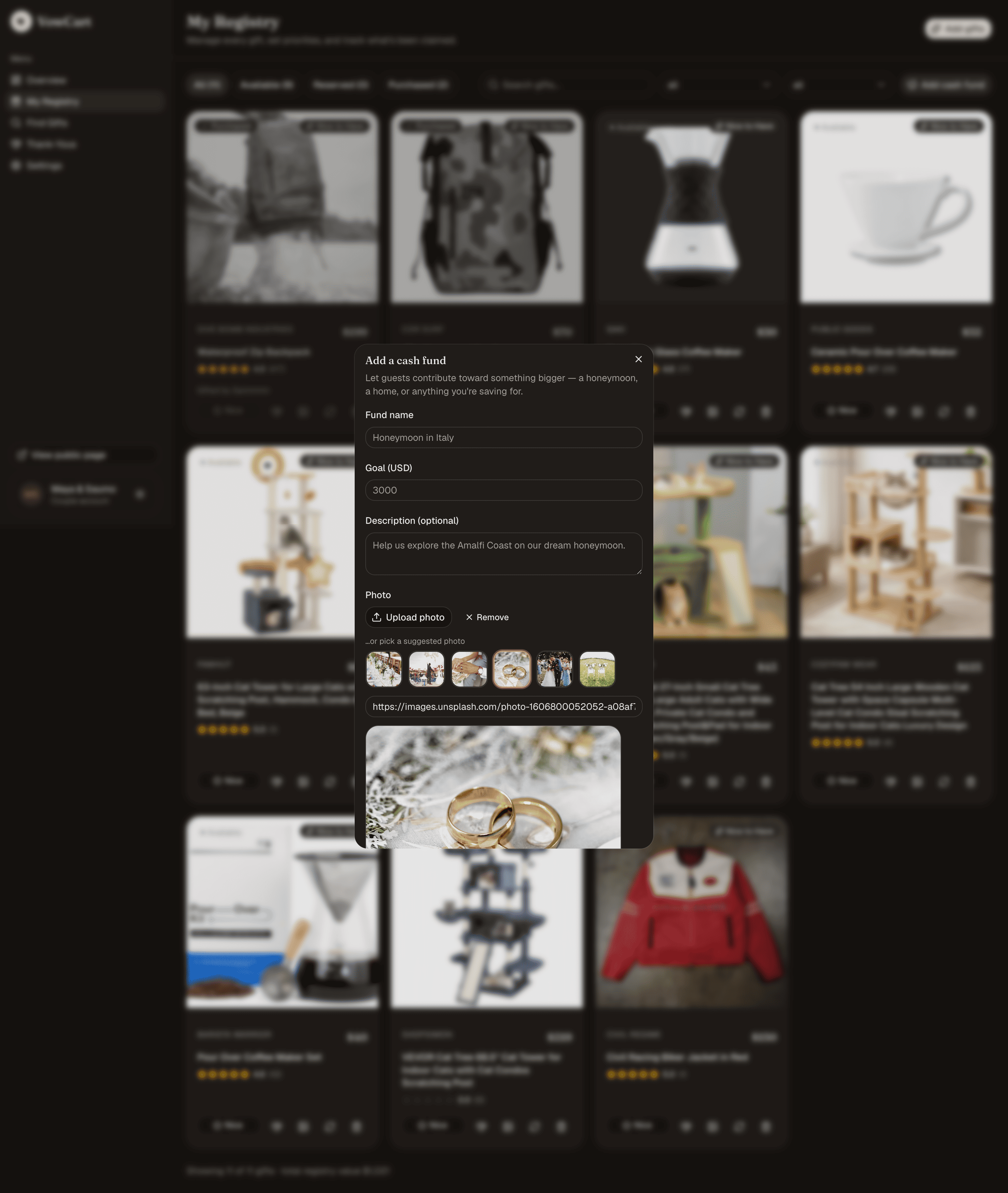
add cash gift
-
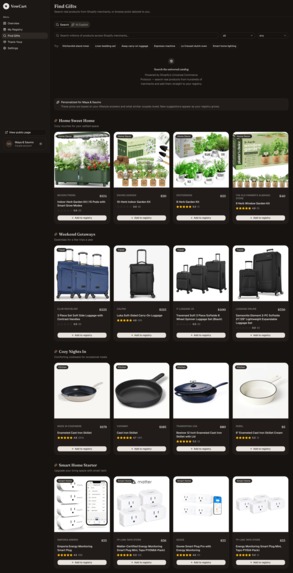
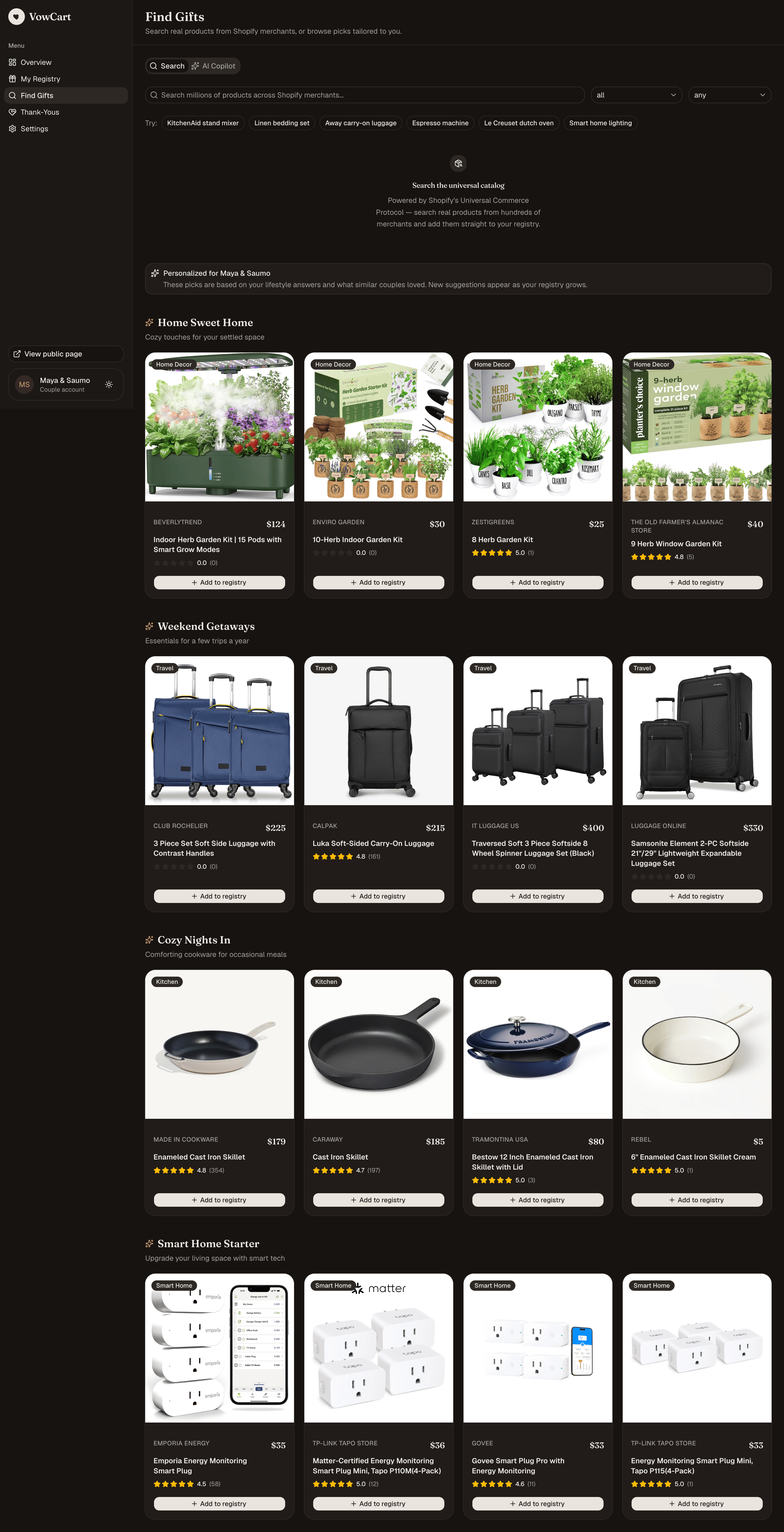
UCP powered registry builder
-
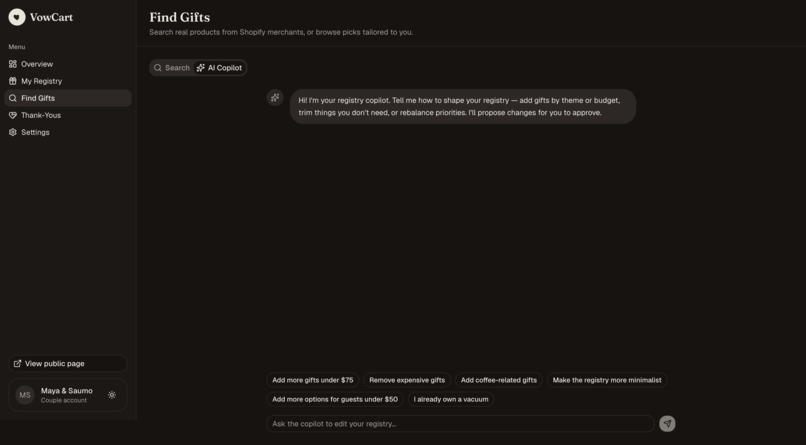
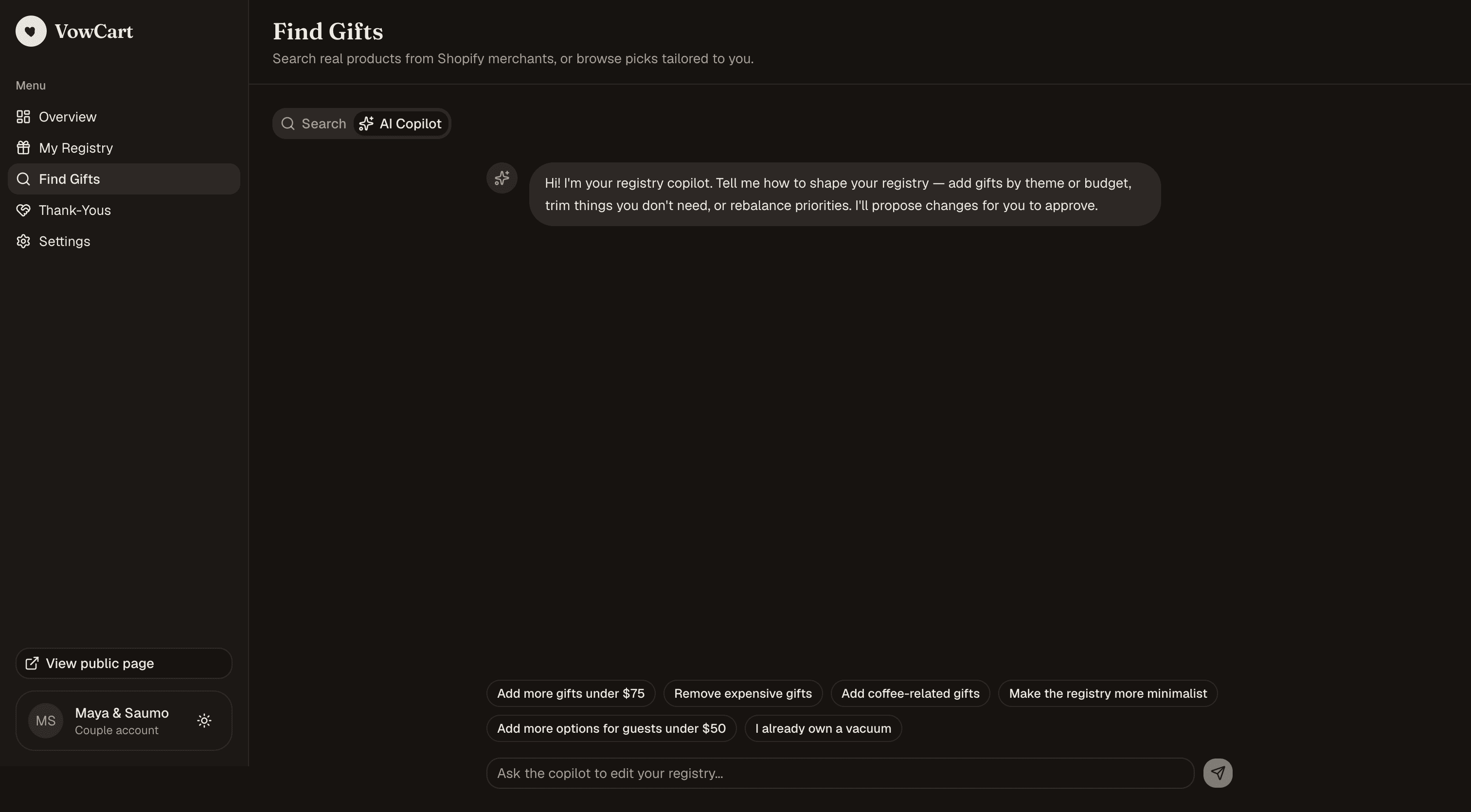
AI chat companion
-

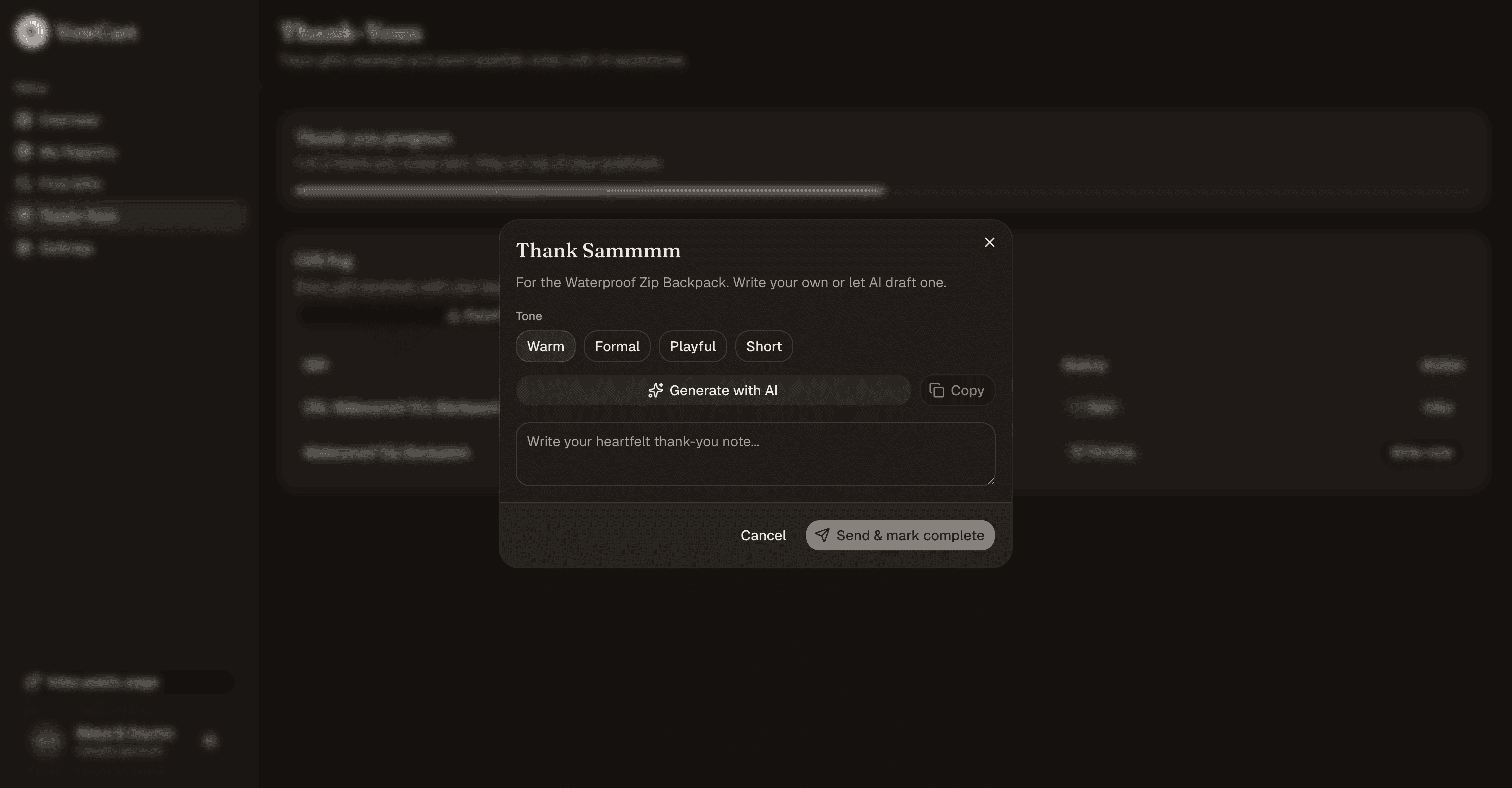
AI powered thank you acknowledgement
-
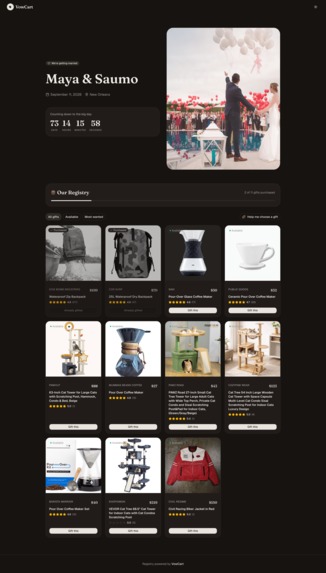
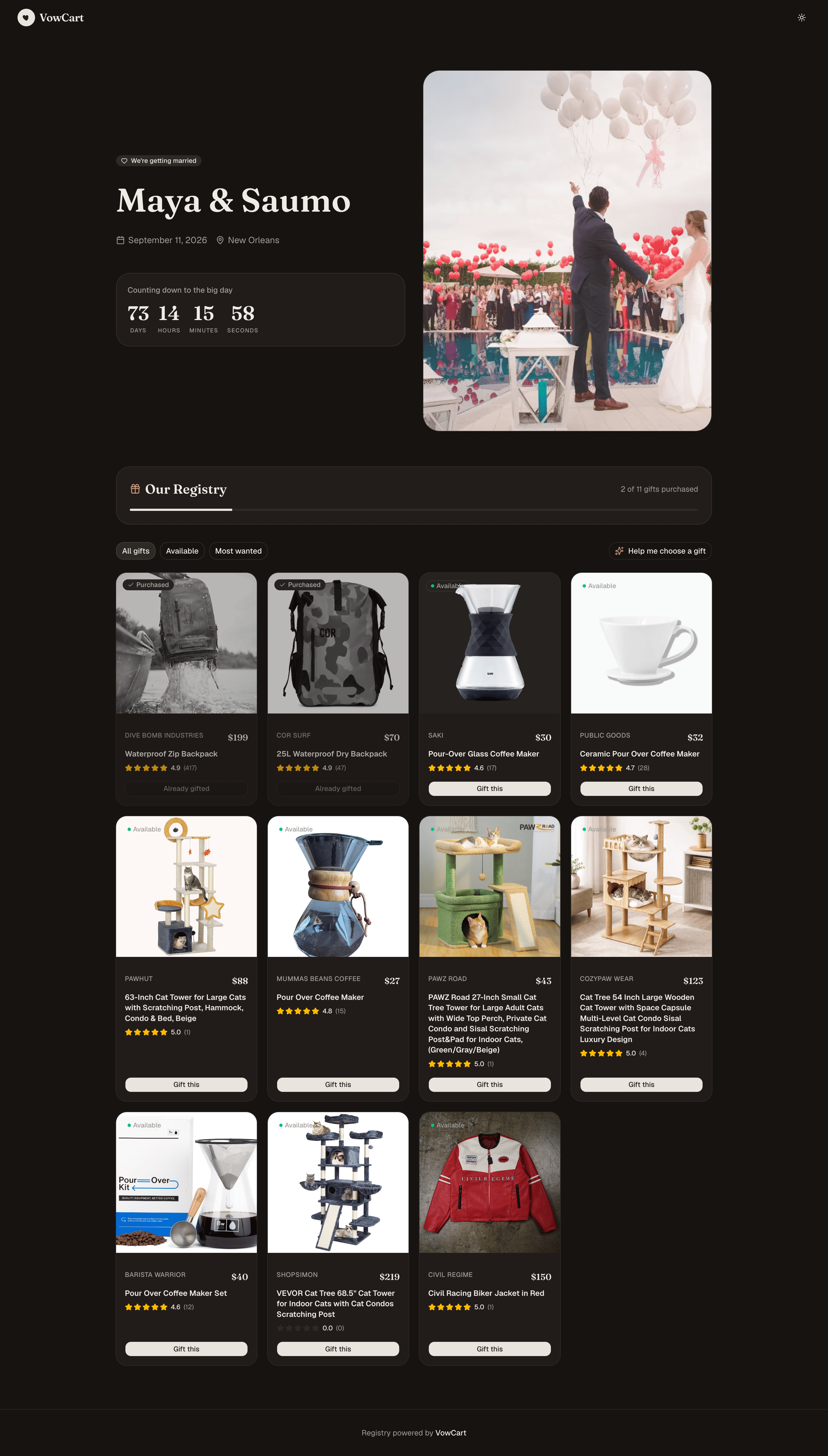
registry view for guests
-
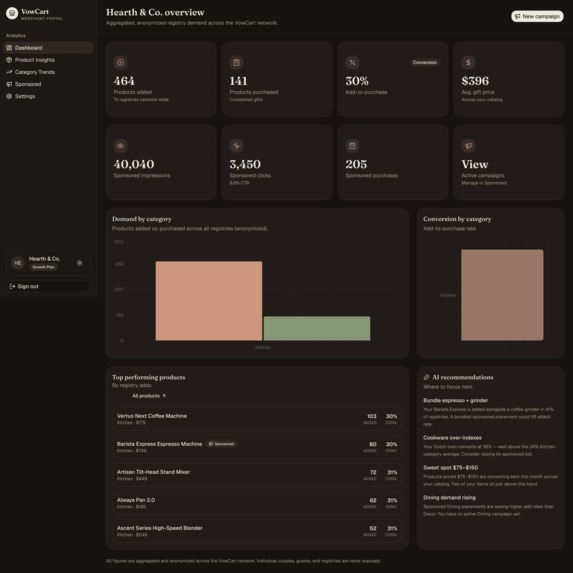
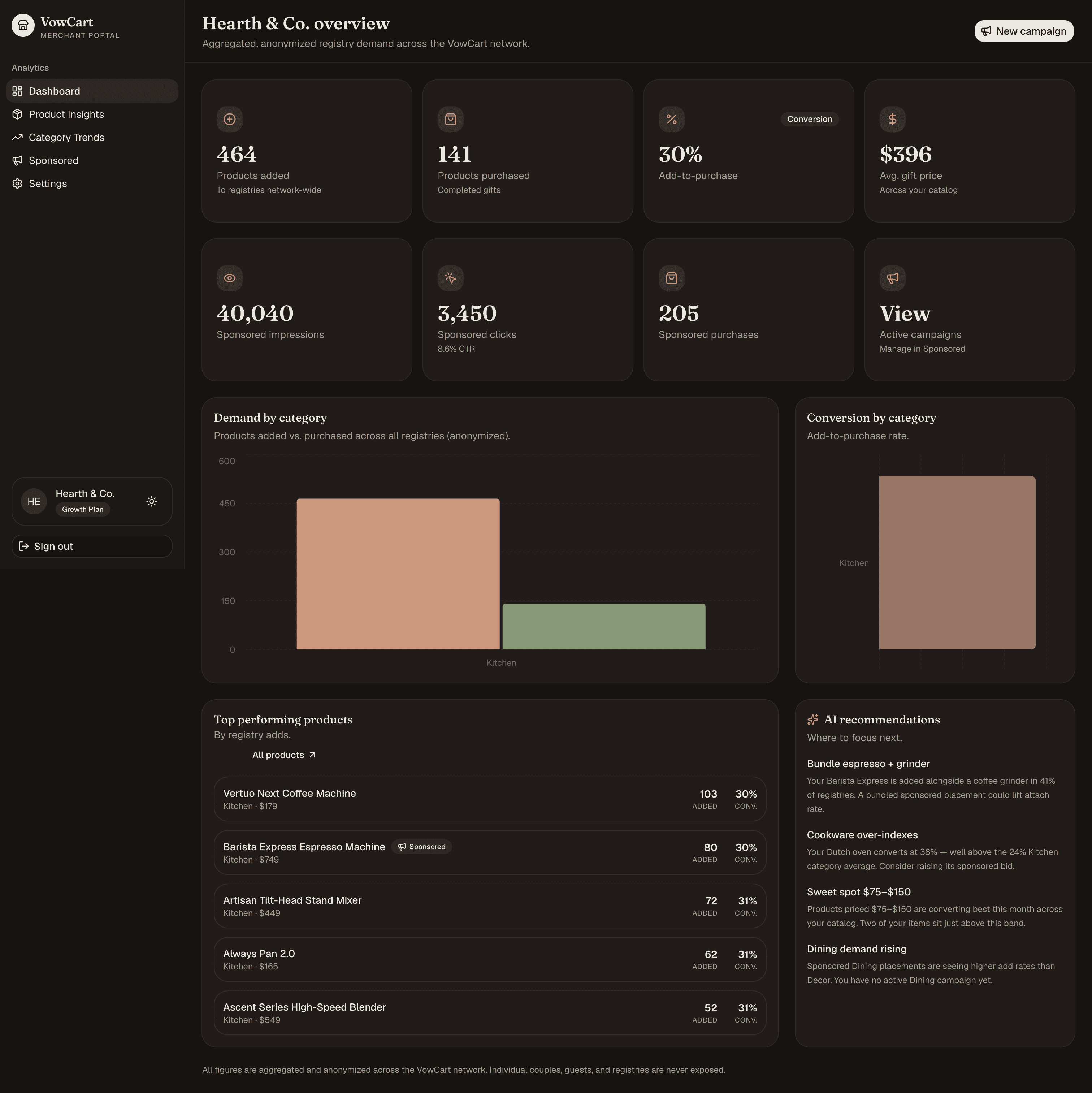
merchant analytics view
-
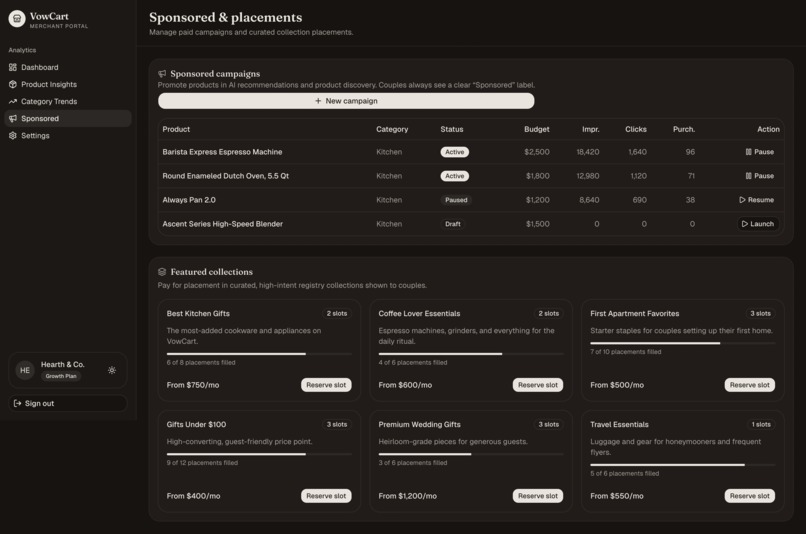
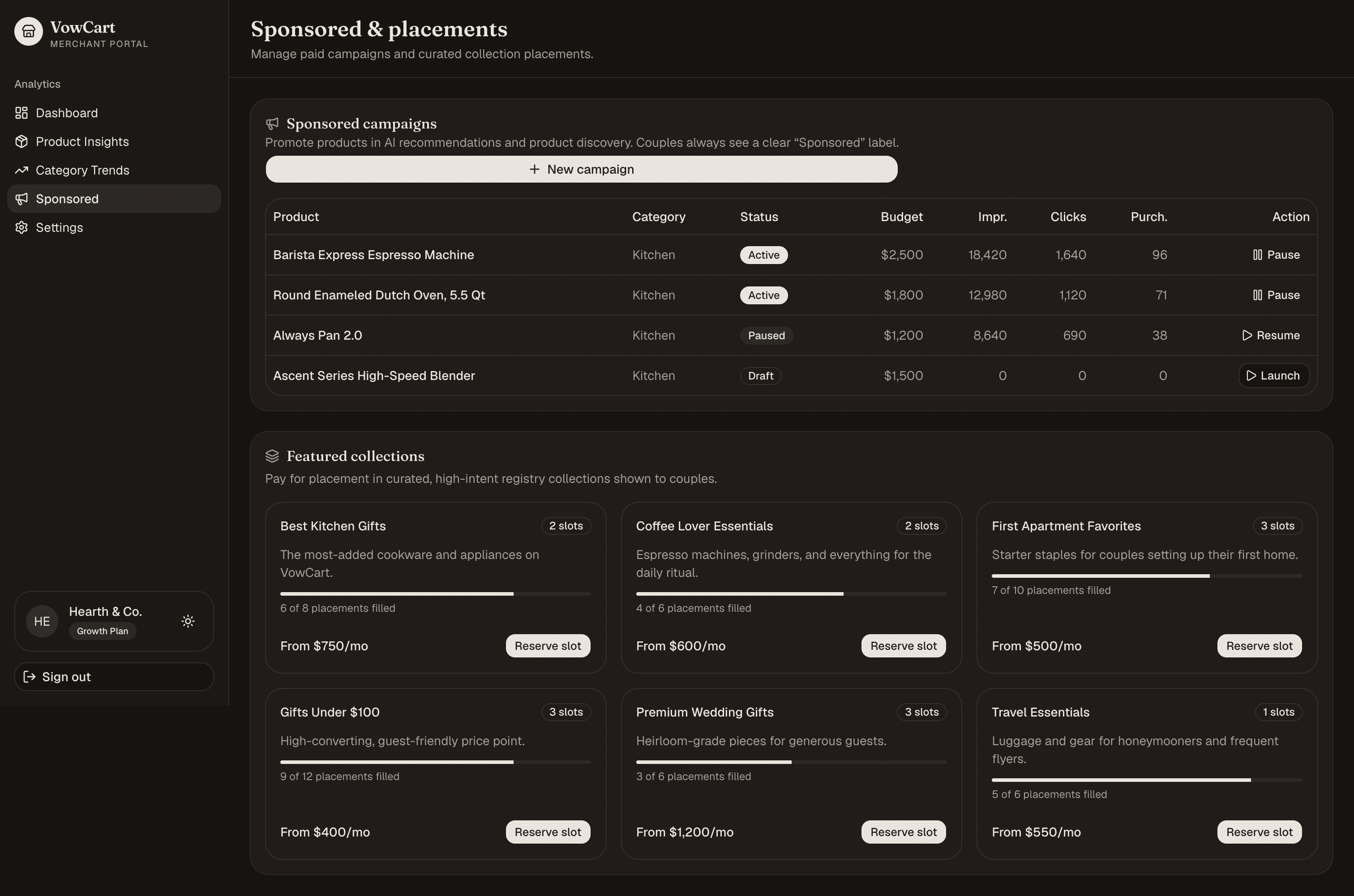
merchant sponsored product view
VowCart - AI-Powered Universal Wedding Registry
A universal wedding registry that pulls real products from any Shopify merchant, lets AI build and manage it for couples, and turns aggregate registry demand into privacy-safe analytics for brands.
Track: Monetizable B2C app (with a built-in B2B analytics/ads revenue side)
AWS Databases used: Aurora PostgreSQL (relational system of record) + Amazon DynamoDB (TTL-based reservation locks, analytics events, AI response cache)
Frontend & hosting: Next.js on Vercel
Architecture
How the pieces connect
- Next.js on Vercel serves both the couple-facing app and the separate merchant portal, and hosts all API routes.
- Aurora PostgreSQL is the relational source of truth - couples, registries, registry items, purchases, group-gift/cash-fund contributions, merchants, and sponsored campaigns.
- DynamoDB handles ephemeral, high-velocity, TTL-driven state: 15-minute reservation locks that auto-expire, analytics events, and an AI response cache.
- Vercel AI Gateway runs the LLM features (registry curation, AI Copilot, recommendations, thank-you notes).
- Shopify Universal Commerce Protocol provides keyless live product search across the global catalog and merchant checkout handoff.
- Vercel Blob stores uploaded cover and gift photos.
- OIDC lets Vercel deployments assume an AWS role to reach Aurora and DynamoDB with no long-lived secrets.
Market & why now
A large, resilient market. Weddings are one of the most durable consumer-spend categories there is: ~2.0M weddings per year in the US (CDC/NCHS reported ~2.04M marriages in 2023; The Wedding Report estimates ~2.0M weddings in 2024–25), inside a ~$63–70B/year US wedding industry (Grand View Research: $64.9B in 2024; IBISWorld: $70.3B in 2023) and a global wedding-services market estimated at $250B+ and growing double digits (Grand View Research).
The registry is the commerce core of it. About 91% of couples create a wedding registry, and (for the first time) online registry creation (55%) has overtaken in-store (44%) (The Knot). Guests spend an average of ~$150 per wedding gift (The Knot 2024 Guest Study), against an average US wedding cost of ~$33,000 (The Knot 2024 Real Weddings Study). The digital wedding registry market itself is estimated at roughly $16B in 2025, projected to ~$50B by 2033 (~14.8% CAGR) (market research, 2025). And the same registry primitive powers adjacent, year-round occasions (baby showers, housewarmings, birthdays, holidays), so the model extends well beyond weddings.
Why today's registries aren't actually universal. The incumbents (Zola, The Knot, Amazon, Target, Crate & Barrel) build their catalogs through merchant partnerships and one-off integrations. Every brand on the platform is the result of a BD deal plus custom engineering, so even a "universal" registry is really a curated set of a few hundred partner brands. "Add any item" usually degrades to "paste a link we can't transact on," and most independent / DTC brands are simply missing. The catalog is gated by business development, not by what couples actually want to shop.
Why now: UCP changes the unit economics. Shopify's Universal Commerce Protocol (UCP) flips that model. Instead of integrating merchants one at a time, an app gets programmatic, keyless access to entire commerce catalogs and checkout through a single protocol. Starting with the Shopify ecosystem (millions of merchants and a huge share of modern DTC/independent brands), the addressable product universe jumps from "our partner catalog" to the open commerce graph, effectively overnight. That is the entire thesis behind VowCart:
- Couples get a genuinely universal registry - any product from any Shopify merchant, actually transactable, not a dead link.
- The catalog scales with zero per-merchant BD or integration cost, making the product viable for a small team and compounding as UCP adoption grows.
- A broader, more relevant catalog lifts gift conversion - which makes the anonymized demand analytics we sell to brands meaningfully more valuable.
UCP is the reason a truly universal registry is suddenly buildable - and why the timing is now.
Sources: figures are from third-party industry research and may use differing methodologies; ranges are given where estimates vary.
Inspiration
Wedding registries are stuck in the past. Every store runs its own - so couples end up with three or four registries, and guests bounce between sites just to find something to buy. The result: duplicate gifts, abandoned big-ticket items nobody wants to buy alone, and hours of tedious curation for the couple.
Two things stood out to us. First, registries are pure purchase-intent data (a couple literally listing what they're about to buy and from which brands), yet the merchants behind those products never get to see that demand. Second, the curation itself is a perfect job for AI: "we love slow mornings and hosting friends" should be enough to generate a beautiful, personalized registry in seconds.
So we built VowCart: one universal registry that pulls real products from any Shopify merchant, an AI that does the heavy lifting for couples, and a privacy-respecting analytics layer that turns aggregate registry demand into something brands can actually act on.
What it does
VowCart is a two-sided product.
For couples & guests (B2C):
- AI-built registry - answer a few lifestyle questions and an LLM curates a starter registry of real products, pulled live from Shopify's Universal Commerce Protocol catalog.
- Truly universal - search and add products from any Shopify merchant; nothing is locked to a single store.
- AI Copilot - chat to shape the registry ("add more under $75," "make it more minimalist," "remove expensive gifts") and approve proposed changes.
- Group gifting & cash funds - let multiple guests rally toward a big-ticket item or a "Honeymoon in Italy" fund, with a live progress bar.
- Reservations & checkout - guests reserve a gift (a 15-minute hold) or buy it via the merchant's real Shopify checkout; the item is auto-held for 15 minutes the moment a purchase starts so nothing gets double-bought.
- Thank-you tracker - AI-generated thank-you notes in different tones, plus a beautiful public page and a scannable QR code for invitations.
For brands (B2B / monetization):
- A separate merchant portal with its own auth showing anonymized, aggregated demand analytics - which products and categories are being added and purchased across the network, and at what conversion.
- Sponsored placements that brands can pay to promote, always rendered to couples with a clear "Sponsored" label.
How we built it
- Frontend & hosting: Next.js (App Router) + React + TypeScript + Tailwind, deployed on Vercel.
- Aurora PostgreSQL - our system of record: couples, registries, registry items, purchases, contributions (group gifts/cash funds), merchants, and sponsored campaigns.
- DynamoDB - for everything ephemeral and high-velocity: reservation locks with native TTL (15-minute holds that auto-expire), analytics events, and an AI response cache.
- Vercel AI Gateway - powers the real AI features (registry curation, the Copilot, "For You" recommendations, and thank-you notes).
- Shopify Universal Commerce Protocol (UCP) - keyless live product search across the global catalog and merchant checkout handoff, so the registry is genuinely universal.
- Vercel Blob - couple cover-photo and gift-photo uploads.
- Keyless AWS access via OIDC - Vercel deployments assume an AWS role to reach Aurora and DynamoDB with no long-lived secrets; a seed-data fallback keeps local dev fully functional.
Challenges we ran into
- Aurora Serverless cold starts. After idle, the first request could exceed our connection timeout. We tuned the pool timeout, raised route
maxDuration, added keep-alive and a one-shot retry, and the experience smoothed out. - Making reservations actually mean something. The 15-minute hold lived in DynamoDB but was never read back, so other guests didn't see it. We added a lock overlay on the public registry so a held gift shows as "Reserved" to everyone, and extended holds to trigger when a purchase begins.
- Picking the right database for each job. Pushing fast-expiring reservation locks into Postgres would have meant a cleanup job; DynamoDB's TTL does it for free. Keeping relational integrity (purchases ↔ items ↔ couples) in DynamoDB would have been painful. Splitting responsibilities cleanly was a real design exercise.
- Privacy-safe B2B analytics. Brands get demand signal without ever seeing individual couples or guests - all metrics are aggregated and anonymized.
- Reliable AI output. Getting the LLM to return grounded, parseable curation (real product titles, correct counts) meant prompt iteration plus rule-based fallbacks so the app never breaks if the model wanders.
Accomplishments that we're proud of
- A registry that's genuinely universal - any product from any Shopify merchant, not a walled garden.
- A real two-sided business: a delightful B2C experience and a B2B analytics/ads product with a clear monetization model (sponsored placements + premium), built on one shared commerce graph.
- AI that's useful, not a gimmick - it builds the registry, edits it conversationally, recommends, and writes the thank-you notes.
- Privacy by design on the merchant side: actionable demand insights with zero exposure of individual users.
- A polished, mobile-friendly product running entirely on Vercel + Aurora PostgreSQL + DynamoDB with no servers to manage and keyless AWS auth.
What we learned
- Headless commerce via Shopify UCP lets you build a universal storefront/registry without integrating each merchant one by one.
- Use the right datastore for the data's shape: Aurora PostgreSQL for relational truth and reporting; DynamoDB for ephemeral, high-write, TTL-driven state. The combination is more than the sum of its parts.
- Vercel AI Gateway makes swapping/operating models trivial, and OIDC removes the whole class of "where do we store AWS keys" problems.
What's next for VowCart: AI-Powered Universal Wedding Registry
- Real payment rails (e.g., Stripe) so cash funds and group gifts actually collect money, not just track pledges.
- Live reservation updates pushed to open tabs so holds appear in real time without a refresh.
- Deeper merchant analytics + self-serve campaign billing to turn the B2B side into real revenue.
- Multi-merchant cart & checkout so a guest can buy several gifts across brands in one flow.
- Couple vanity domains and native mobile apps for an even more polished experience.
Built With
- ai-gateway
- amazon-web-services
- aurora
- dynamodb
- nextjs
- postgresql
- rds
- react
- v0
- vercel
- vercel-blob

Log in or sign up for Devpost to join the conversation.