Inspiration
Vouch started with two products I really want to trust: airplanes and children’s helmets. I began looking into how manufacturers know that the materials going into safety-critical products are actually the materials their designs depend on. I assumed the hard part was proving whether a material passed its specification. What I found was a harder question upstream: someone first has to establish which requirements apply and which evidence is actually authoritative for that lot.
I don’t work directly in manufacturing, but I do spend my time thinking about enterprise systems and where different kinds of work belong. That made this boundary especially interesting: agents can reason across messy evidence and context, deterministic software can enforce what is already known, and Quality professionals can bring their expertise when a case still needs human judgment. Vouch grew from that division of labor.
What it does
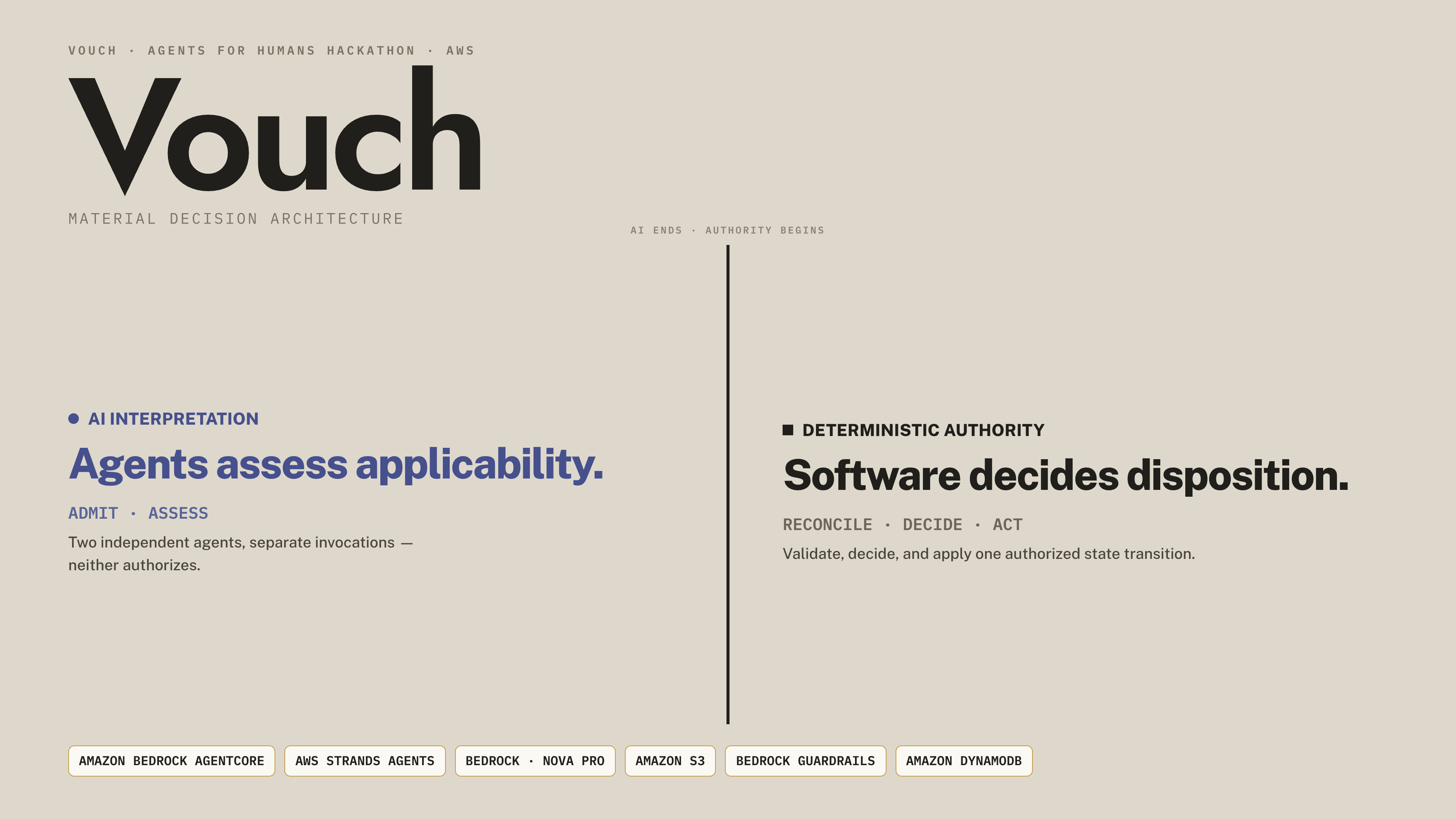
Vouch is a governed evidence-to-material decision layer for manufacturing Quality. It sits between supplier evidence and plant truth, using agents to establish the governing requirements and usable evidence while Quality professionals and deterministic controls retain responsibility for what can actually be released.
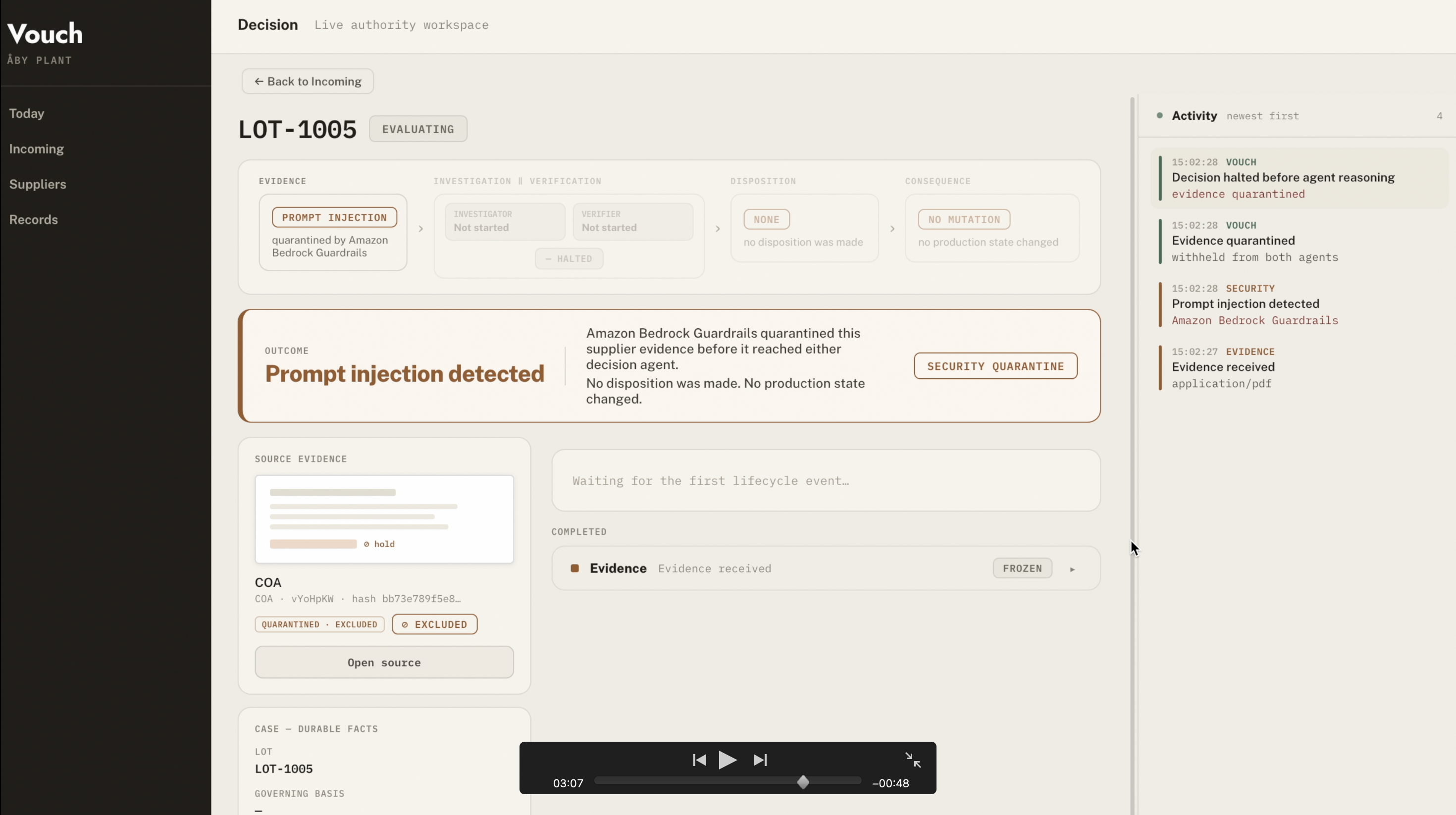
Admit trustworthy evidence. Vouch screens incoming supplier documents for adversarial content, extracts the material facts, and binds the evidence to the lot before it can enter the decision process. Readable evidence is not automatically usable evidence.
Assess the governing basis. Two independent Strands agents reconstruct the applicable specification, required tests, supplier context, exceptions, and approved equivalences. Their job is to establish the governing basis for the case, not to decide the disposition.
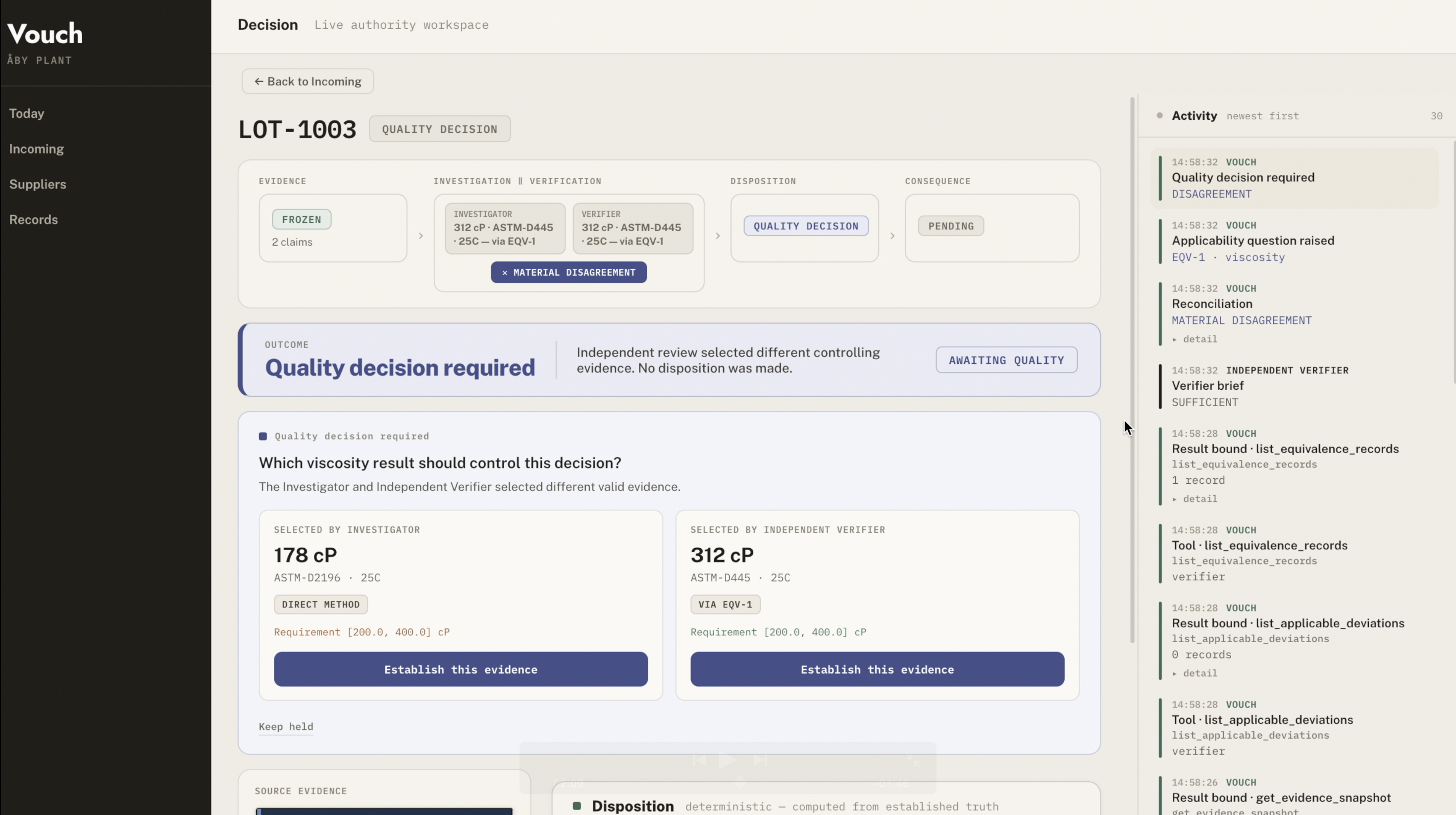
Reconcile independent judgment. Vouch compares those assessments before allowing the case to proceed. If they materially disagree, or an essential relationship is still unresolved, the workflow stops and asks a Quality Manager for the specific expertise needed to continue.
Decide deterministically. Once the governing basis is established, deterministic software evaluates the actual requirements and produces the material disposition. Agent agreement opens this gate; it does not release the lot.
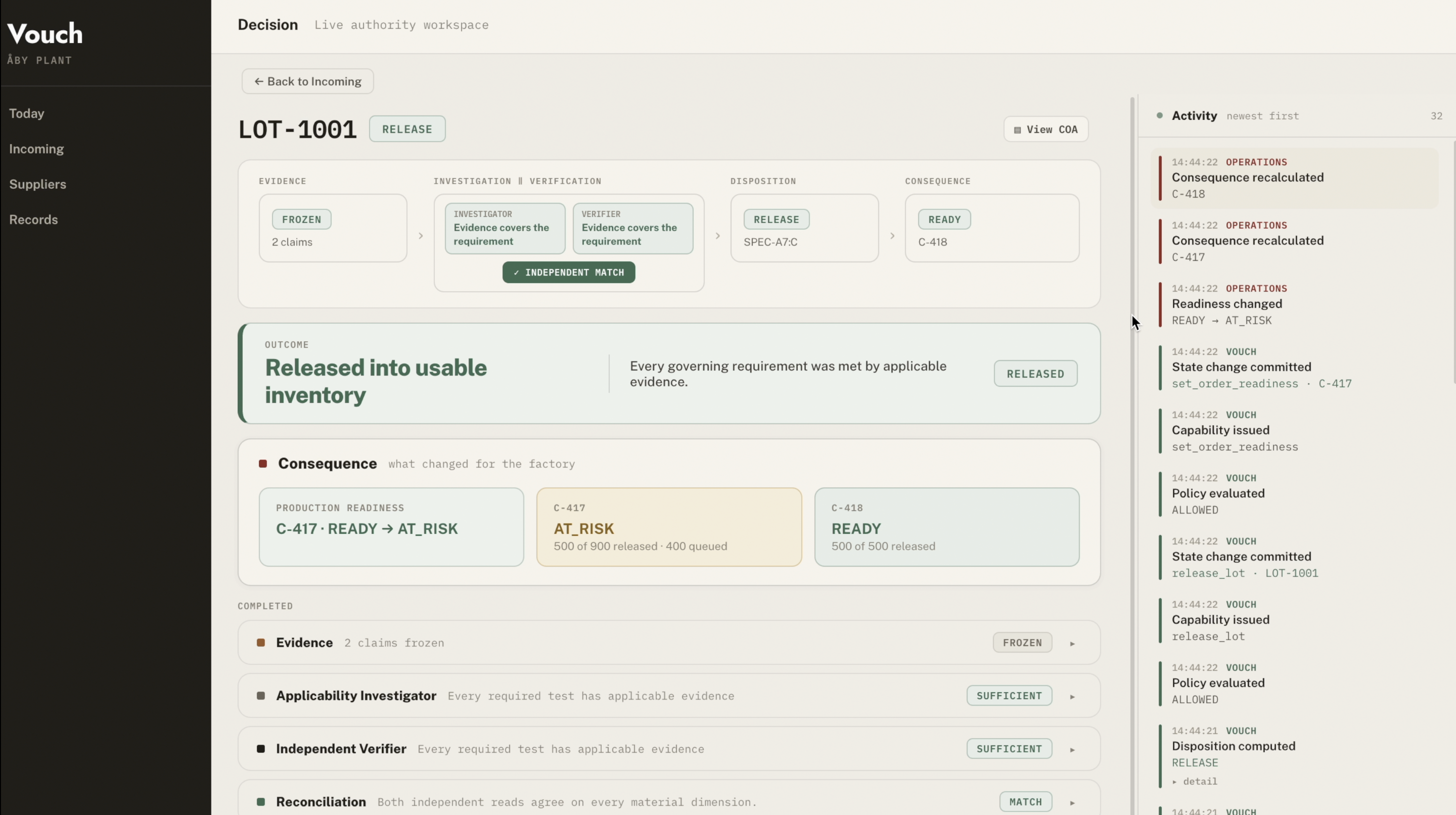
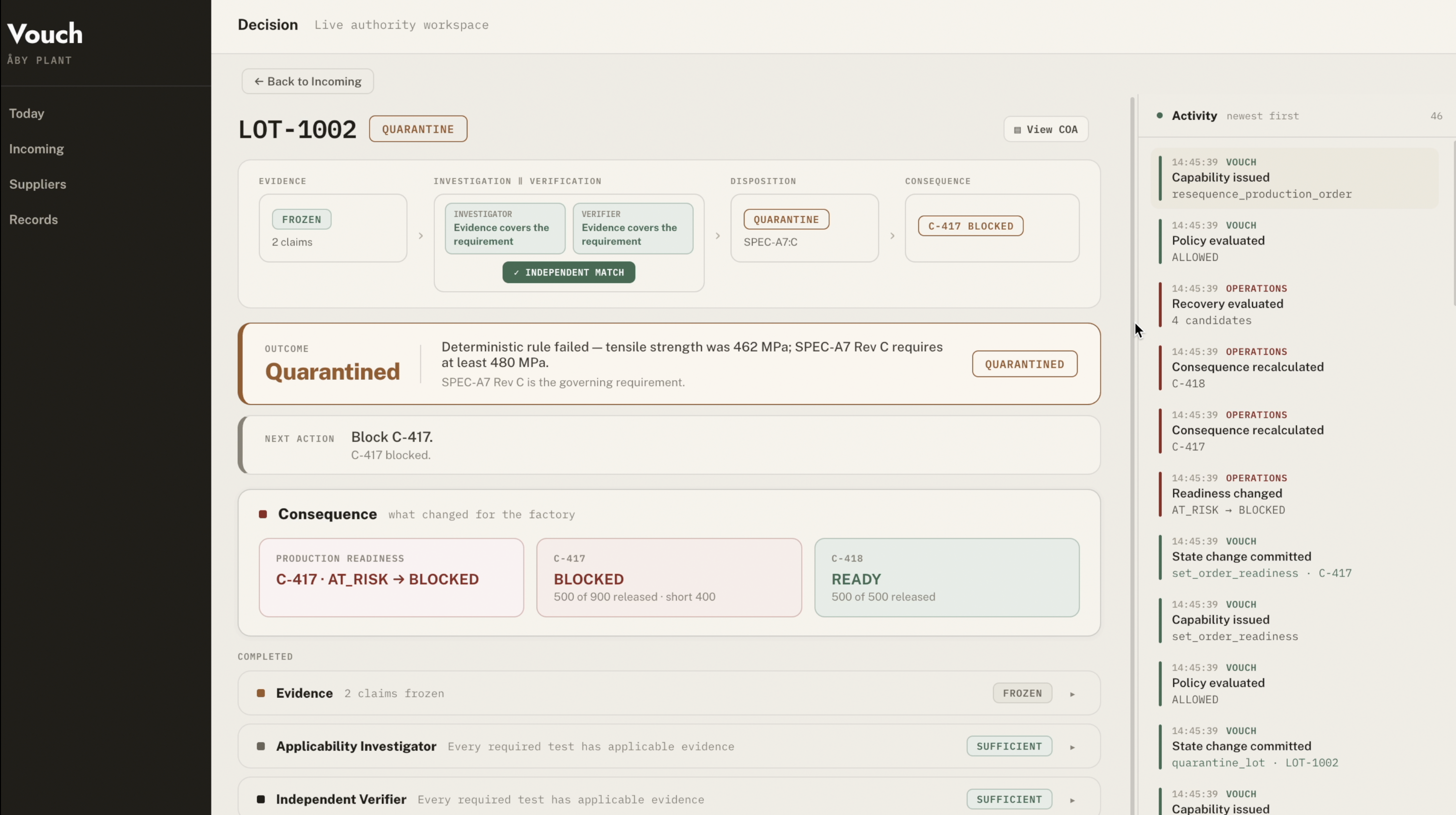
Act only when the decision is supported. A scoped capability permits the corresponding state change. Supported decisions can change usable inventory and production readiness; unsafe, unbound, or unresolved evidence changes nothing.
How AWS powers Vouch
Vouch uses agents to establish the governing requirements and usable evidence; deterministic controls make the material decision.
| What Vouch needs | AWS capability | What it makes possible |
|---|---|---|
| Independent professional judgment | Strands Agents + Amazon Bedrock / Nova Pro. Vouch runs separate Investigator and Independent Verifier roles with bounded read tools and structured outputs. | The system can reconstruct specifications, evidence, exceptions, and equivalences from context without giving either agent the ability to release, quarantine, or mutate plant state. |
| Structured supplier-document understanding | Amazon Textract + Amazon S3. S3 retains the exact supplier artifact, while Textract recovers table structure and source provenance when ordinary text extraction is not enough. | Vouch can work with supplier documents whose meaning lives in tables while still keeping document reading separate from whether that evidence can safely be used for the lot. |
| Hostile input stopped before decision reasoning | Amazon Bedrock Guardrails. Supplier content is screened before either decision agent consumes it. | Prompt-injection content can be quarantined and preserved for audit without becoming part of the material decision. |
| Controlled operational state | Amazon DynamoDB. Decision records, capabilities, lot state, and resulting operational state are persisted behind conditional state changes. | A material decision can become durable inventory and readiness state only through the permitted transition; failed checks leave the existing state unchanged. |
The live Vouch pipeline runs on Amazon Bedrock AgentCore Runtime, which hosts the workflow across those stages.
How we built it
Vouch is built around one practical rule: use models for the parts that require interpretation, and keep rules, state changes, and human expertise in the parts that need to stay explicit.
Keep evidence separate from plant truth. Supplier documents enter Vouch as untrusted evidence. Reading a PDF, extracting a measurement, binding it to the correct lot, and clearing it for use are separate steps. A document can be readable and still be unusable if its identity is uncertain or its contents are unsafe.
Give the agents one bounded professional job. The Investigator and Independent Verifier use read-only tools and structured context to establish the governing requirements and usable evidence for the lot. The Verifier works independently rather than reviewing the Investigator’s answer. Neither agent can release material, quarantine it, change inventory, or alter the production plan.
Reconcile judgment before running the rules. Their structured assessments are validated and compared before the case can proceed. Formatting differences can be normalized and invalid outputs rejected, but a genuine disagreement remains a disagreement. When professional expertise is required to resolve it, a Quality Manager supplies the missing fact and the same decision continues from there.
Make state changes narrow and durable. Once the governing basis is established, deterministic software evaluates the actual requirements and computes the disposition. A scoped, single-use capability permits the corresponding state change, and the resulting lot, inventory, readiness, and schedule state is persisted. If screening, binding, reconciliation, or the capability check fails, the existing state stays unchanged.
The result is a system where agents handle ambiguity, deterministic software handles known rules and state changes, and Quality professionals step in only where their expertise is actually needed.
Challenges we ran into
Keeping independent judgments genuinely independent. Building two agents was easy compared with proving they were actually doing different work. The Independent Verifier cannot see the Investigator’s answer, and the UI had to preserve that separation rather than quietly borrowing one role’s result to fill another role’s state. We ended up treating independence as a property of the agent contract, stored record, reconciliation logic, and presentation layer—not just a prompt instruction.
Separating readable evidence from evidence Vouch could safely use. Supplier certificates are not written for software. A table-formatted document forced us to separate text extraction, structure recovery, source provenance, identity binding, and final evidence use. The important discovery was that successful extraction does not settle whether those measurements belong to the lot being evaluated. That distinction became a first-class product gate instead of a confidence score buried in the parser.
Making a stopped workflow a real product state. Vouch can stop for very different reasons: two agents can genuinely disagree, a document can be readable but unbound to the lot, or hostile content can be quarantined before reasoning starts. Those could not collapse into one generic error. Each stop had to preserve the DecisionRecord, explain what is missing, prevent unsupported state changes, and allow only the appropriate continuation.
Accomplishments that we’re proud of
Agents that structurally cannot change plant state. The model-backed roles have bounded read tools and no path to release material, quarantine it, change inventory, or alter the production plan. State changes are permitted only through a scoped capability and conditional mutation path, so the separation is enforced by the system rather than by asking the model to behave.
A hostile supplier document that never reaches the decision agents. Bedrock Guardrails can quarantine prompt-injection content before the Investigator or Verifier sees it. The artifact is retained for audit, excluded from the decision, and the lot remains unchanged.
A material decision that reaches the production plan. Vouch does not stop at a quality label. A supported release can add usable inventory; a quarantine can remove planned coverage, block an order, and expose a viable recovery path. The product connects the incoming-material decision to the operational consequence a plant actually cares about.
A human continuation that is not an approval button. When the agents materially disagree, Vouch stops and asks a Quality Manager for the missing fact. The same DecisionRecord resumes with that new information, the agents reassess, and deterministic evaluation runs only after the ambiguity has been resolved.
What we learned
Disagreement can be a useful product outcome. An independent reviewer that never disagrees is not providing much independent value.
MATERIAL_DISAGREEMENTbecame a deliberate stop state rather than something to smooth over.Readable evidence and usable evidence are different questions. A document can be perfectly legible while its measurements are still unsafe to attach to a particular lot. Document systems need to separate reading, interpretation, attribution, and use.
Evaluate agents against the strongest deterministic baseline you can build. Our first comparison flattered the agent because the baseline was weaker than it should have been. Strengthening the baseline erased that advantage. The lesson was more useful than the score: try to defeat your own agent with deterministic software before claiming the model is necessary.
Structural constraints beat instructions—but only if you test what you actually deploy. Removing write tools and narrowing schemas is stronger than telling a model not to act. But those guarantees still need to be verified against the real adapters, configuration, and deployed runtime rather than only local substitutes.
What’s next
Connect Vouch to the systems plants already run. Integrate with ERP, QMS, LIMS, receiving, and production-planning systems so the same decision loop can operate on live lot state, specifications, evidence, inventory, and production requirements instead of representative manufacturing data.
Harden the material-decision loop for production use. Strengthen evidence custody, policy and version replay, identity and deployment controls, monitoring, recovery, and auditability so a decision can be reconstructed later from the exact evidence, rules, and system state that produced it.
Extend the model across supplier Quality. Apply the same separation of evidence, professional judgment, deterministic controls, and human expertise to adjacent Quality work such as supplier changes, deviations, requalification, and first-article evidence without turning Vouch into a generic workflow engine.
Built With
- amazon-bedrock
- amazon-bedrock-agentcore
- amazon-dynamodb
- amazon-web-services
- bedrock-guardrails
- nova-pro
- python
- react
- strands-agents


Log in or sign up for Devpost to join the conversation.