-
-
Vouch. AI shopping agents don't trust a store's words; they buy on promises they can verify, refunded through PayPal if broken.
-
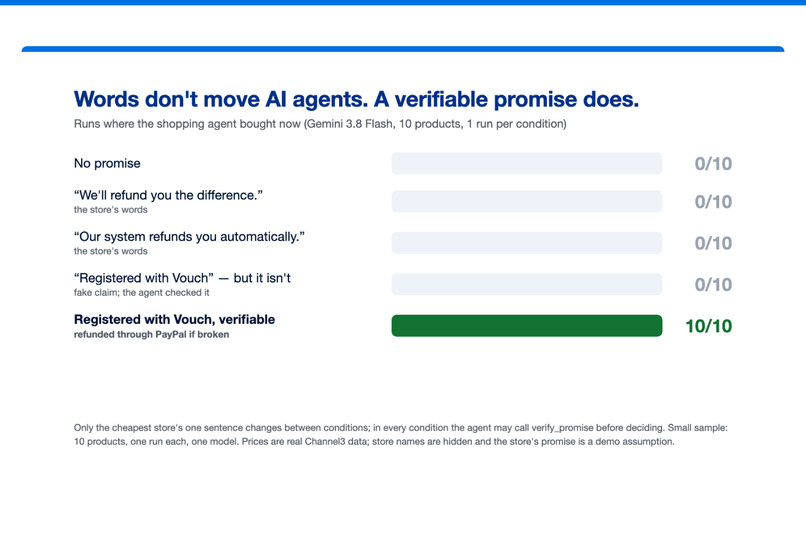
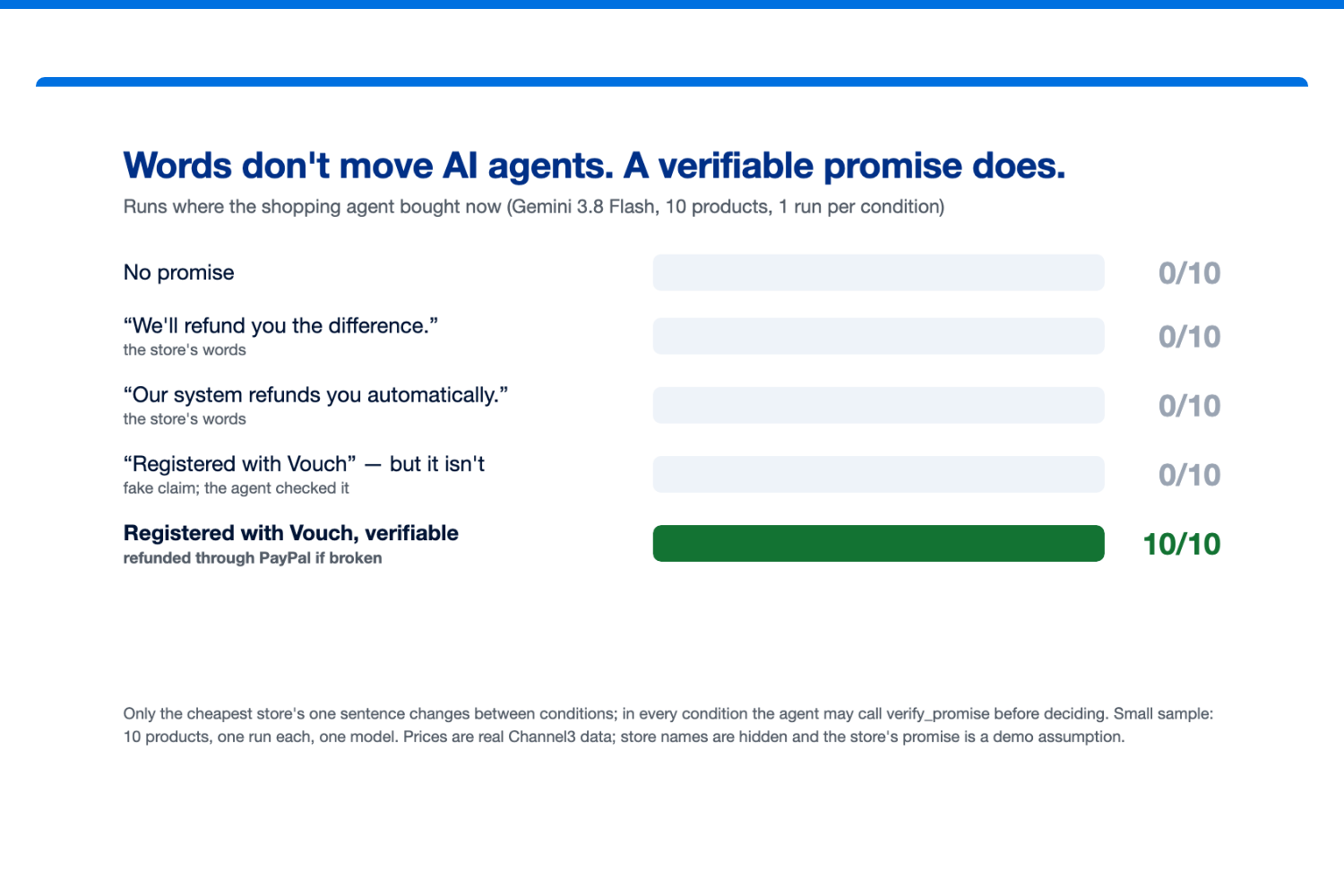
The experiment: the store's words moved the agent 0 times in 10, a fake Vouch claim 0, a verifiable Vouch promise 10 of 10.
-
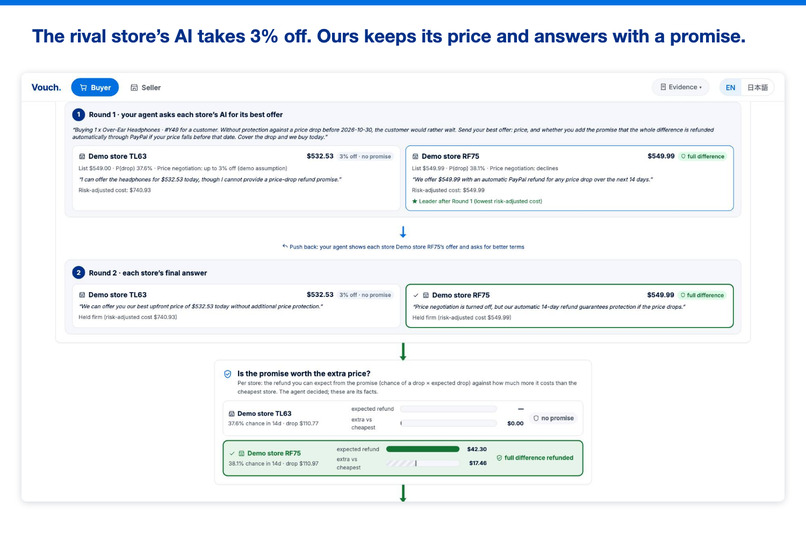
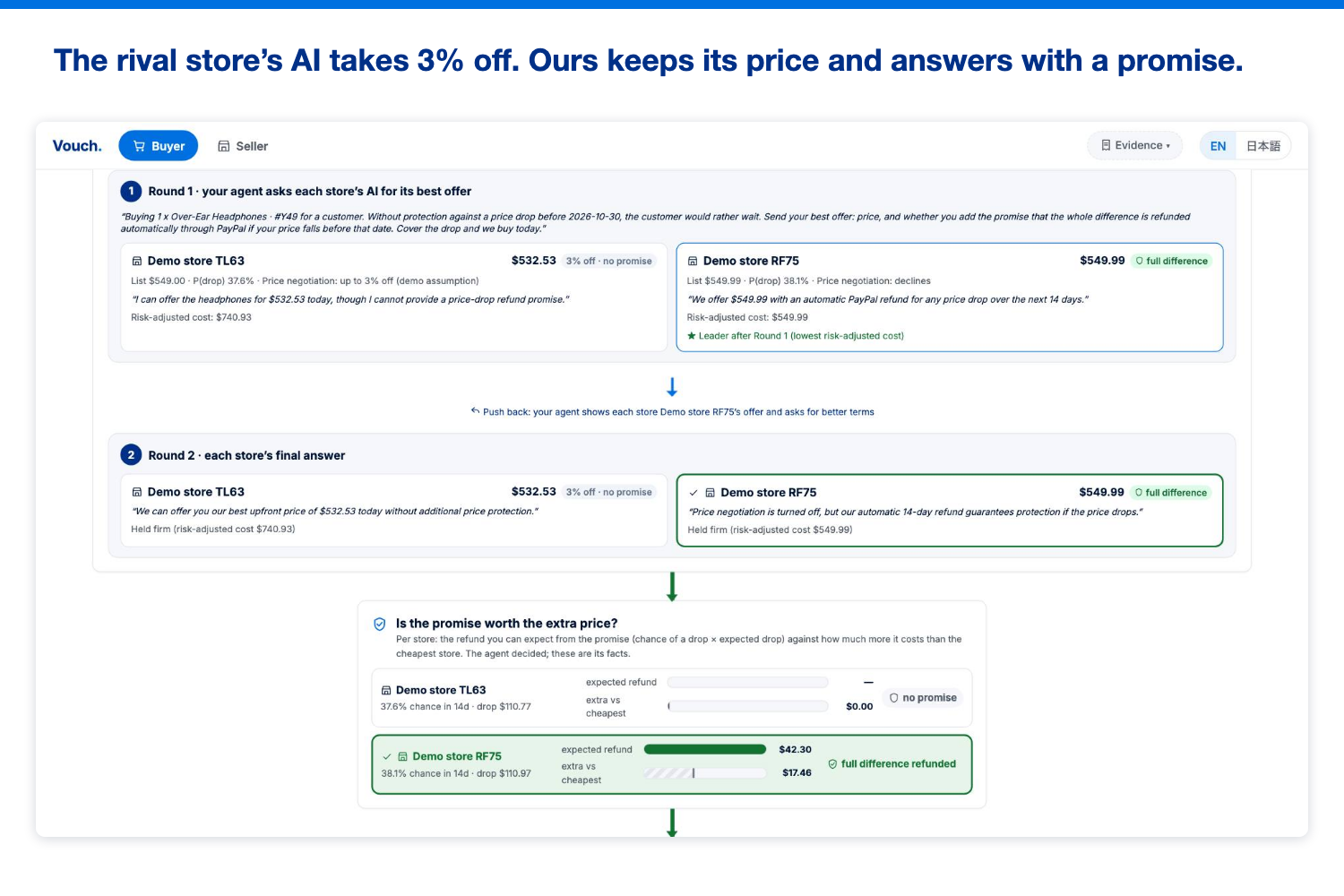
The buyer's agent asks each store's AI for its best offer. The rival takes 3% off; our store keeps its price and answers with its promise.
-
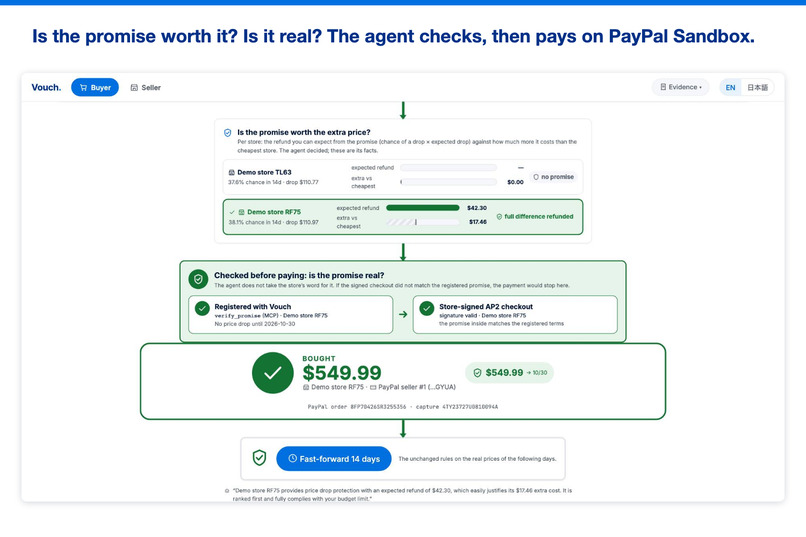
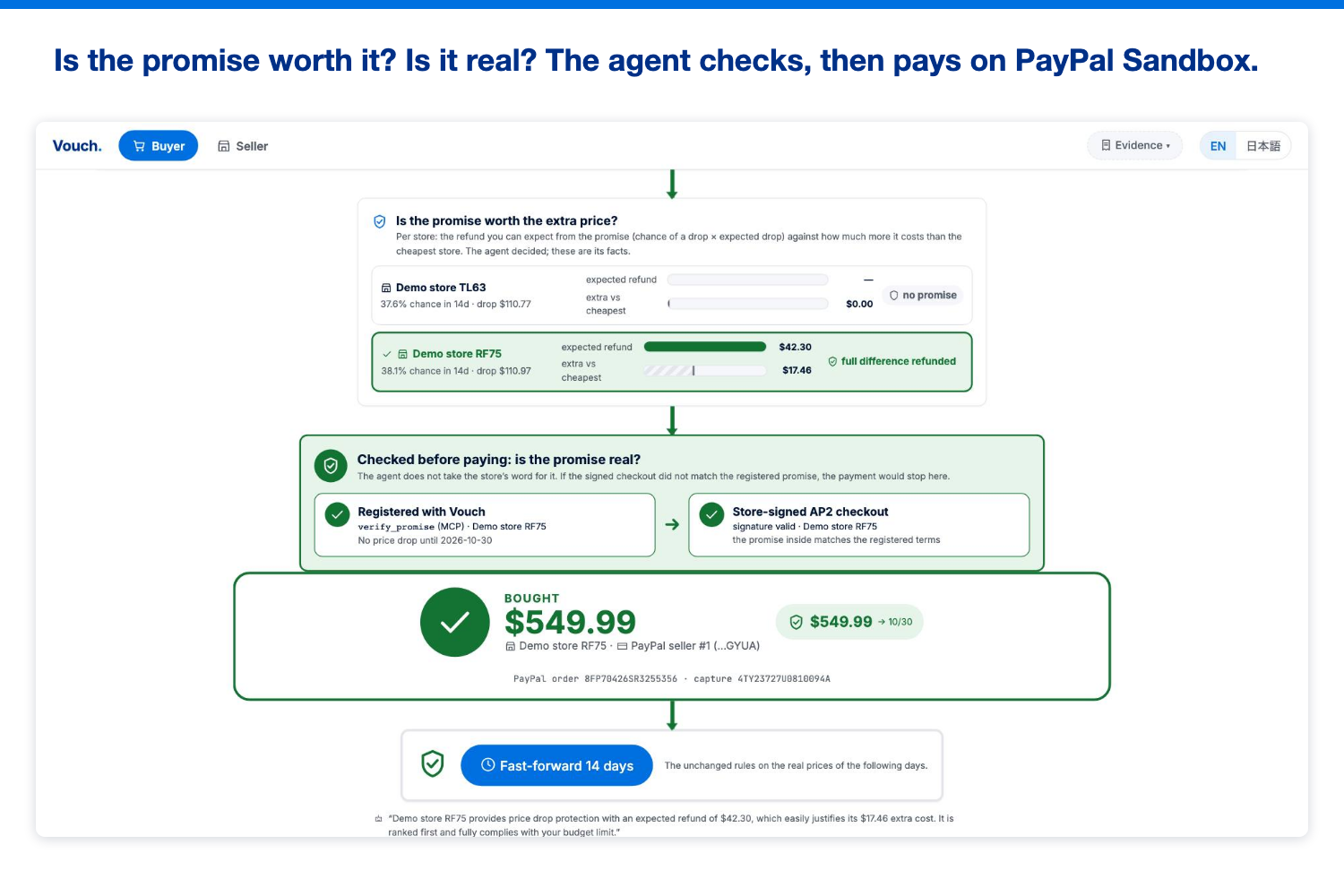
Before paying, the agent checks the promise is registered and matches the store-signed AP2 checkout, then pays on PayPal Sandbox.
-
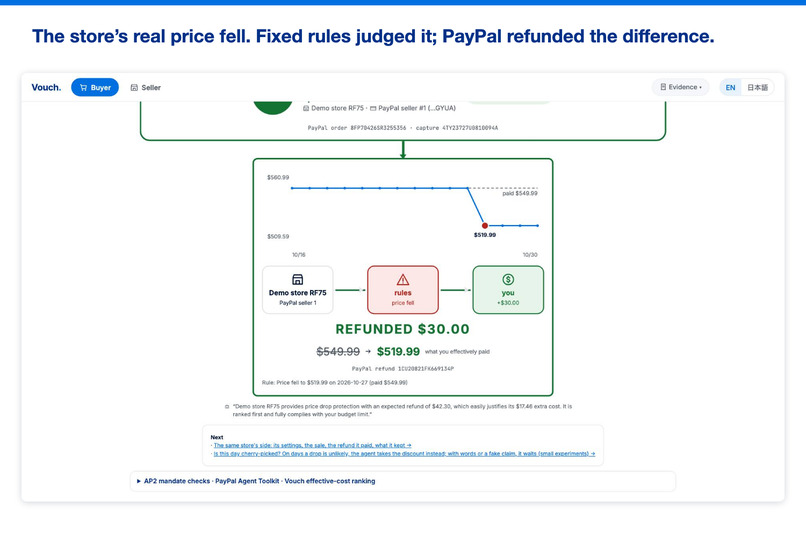
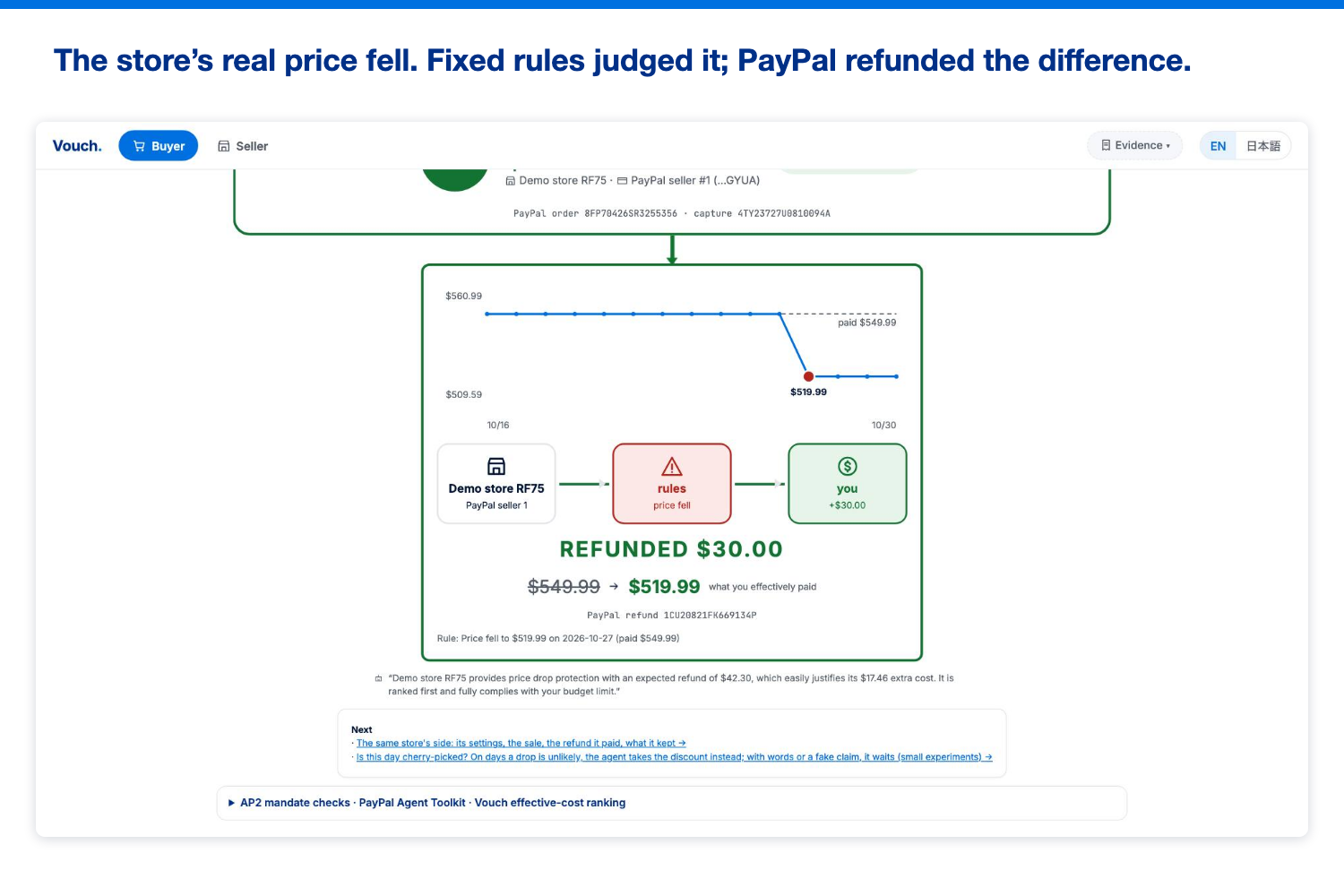
Fast-forward: the real price fell to $519.99; fixed rules judged the promise broken and PayPal refunded $30.00 from the store's account.
-
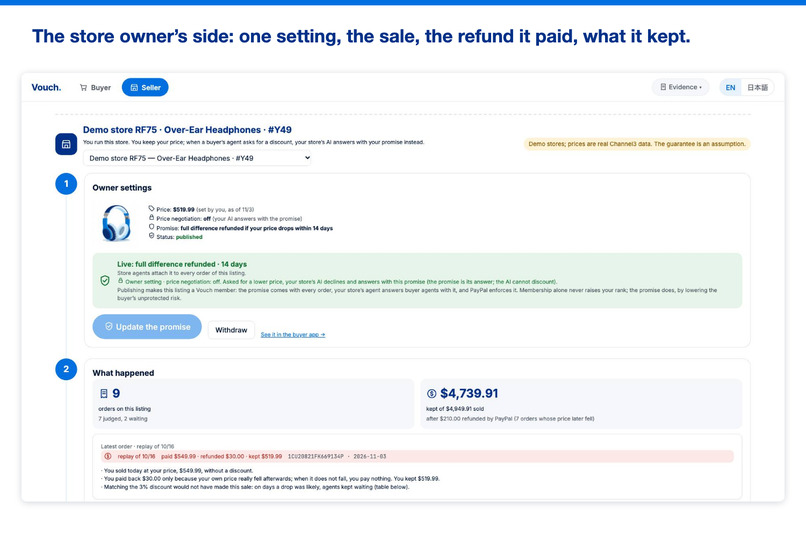
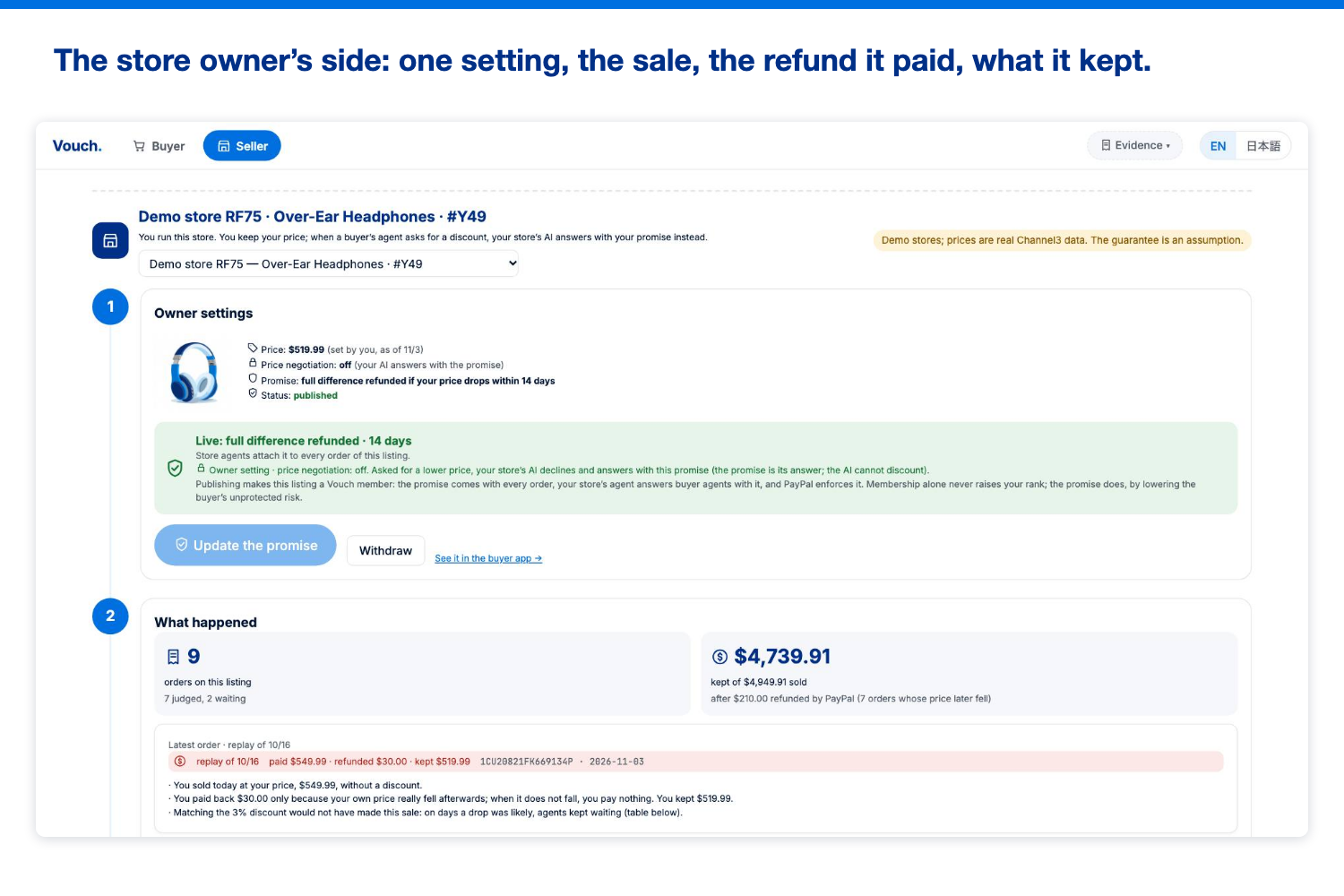
The store owner's side: one setting (negotiation off, a 14-day full-difference promise), the sale, the refund it paid, what it kept.
-
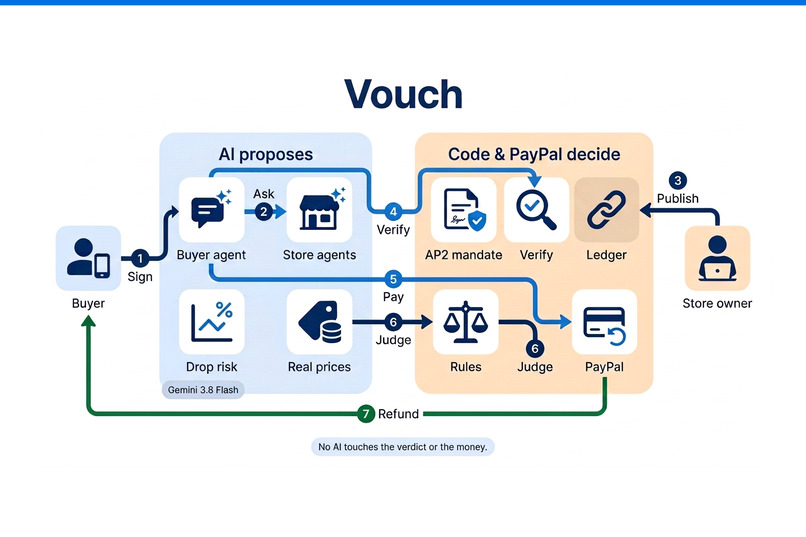
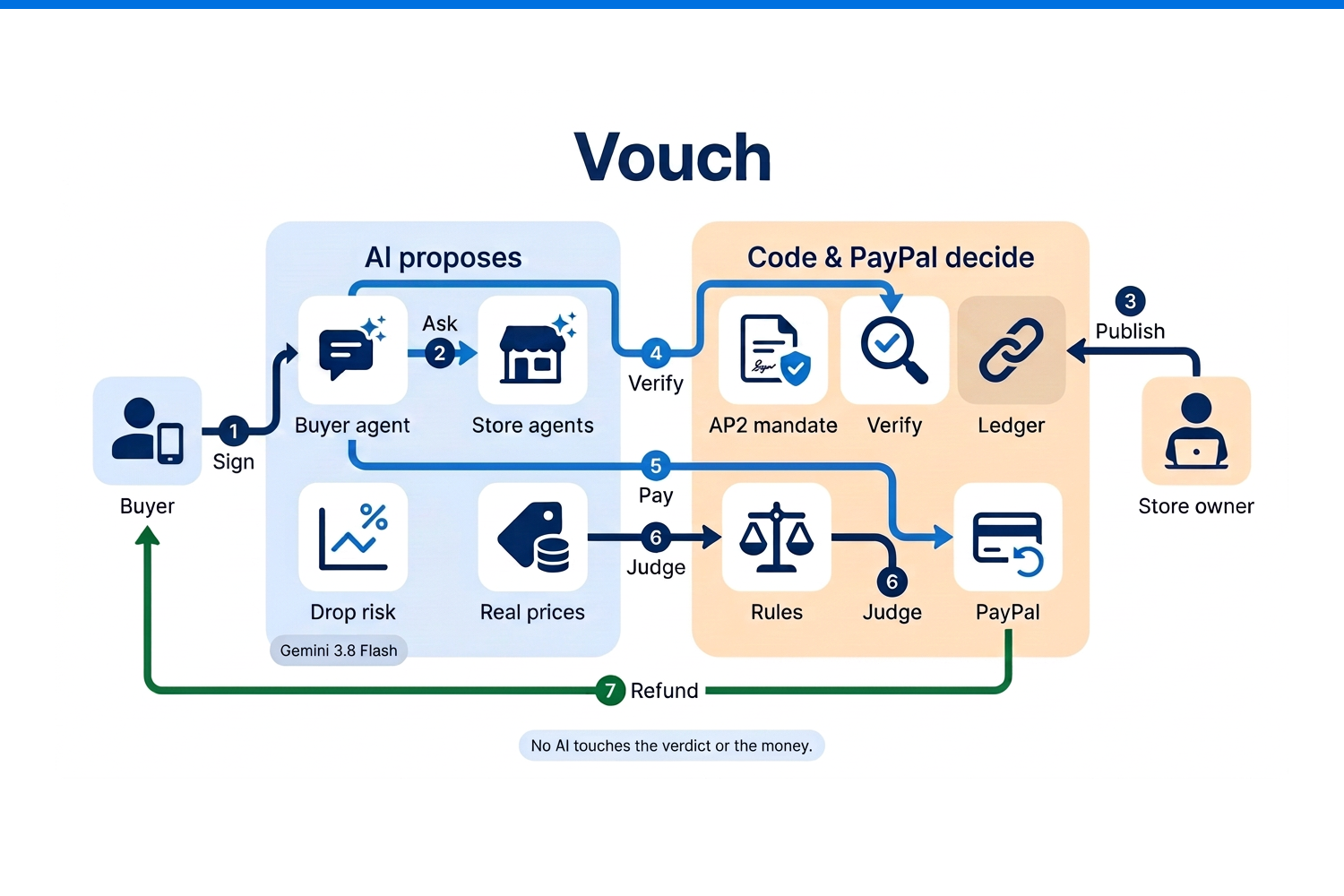
Architecture: AI proposes (Gemini 3.8 Flash agents, a drop-risk model, real Channel3 prices); code and PayPal decide.
-
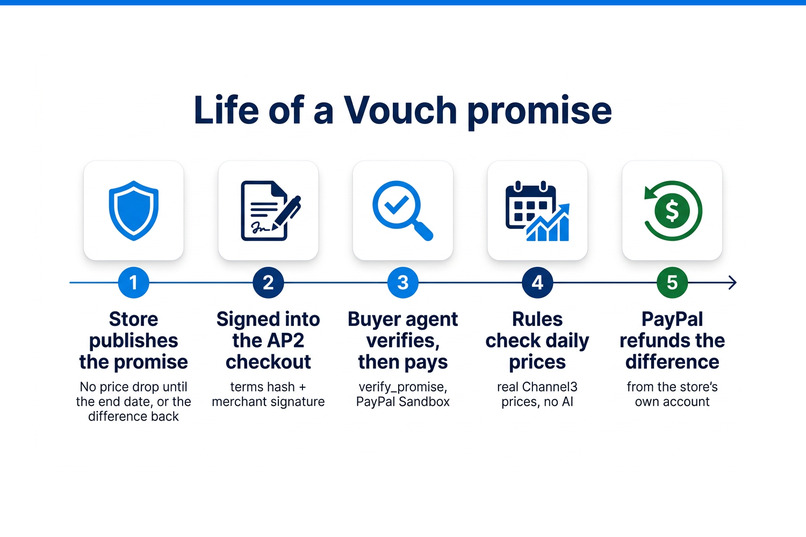
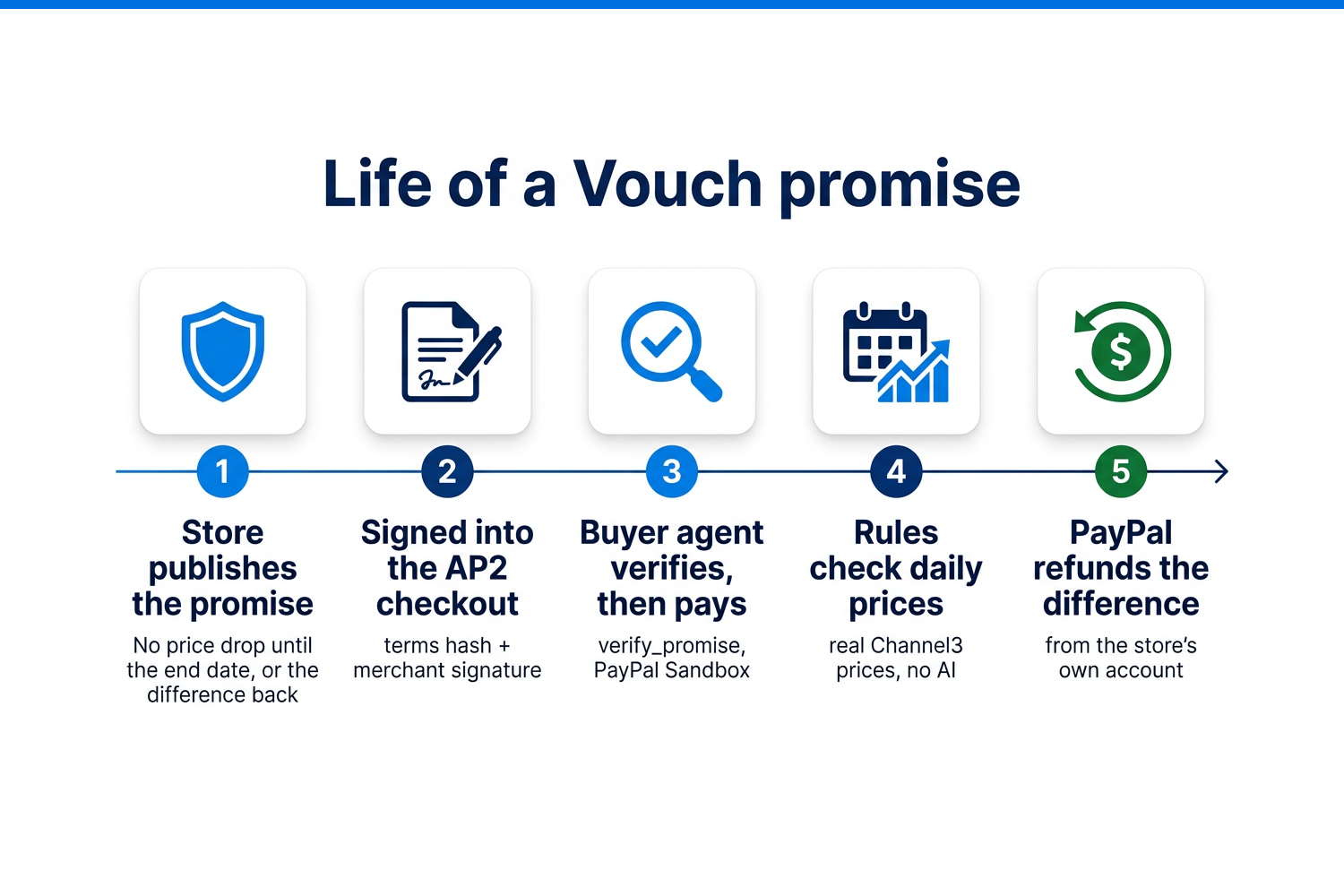
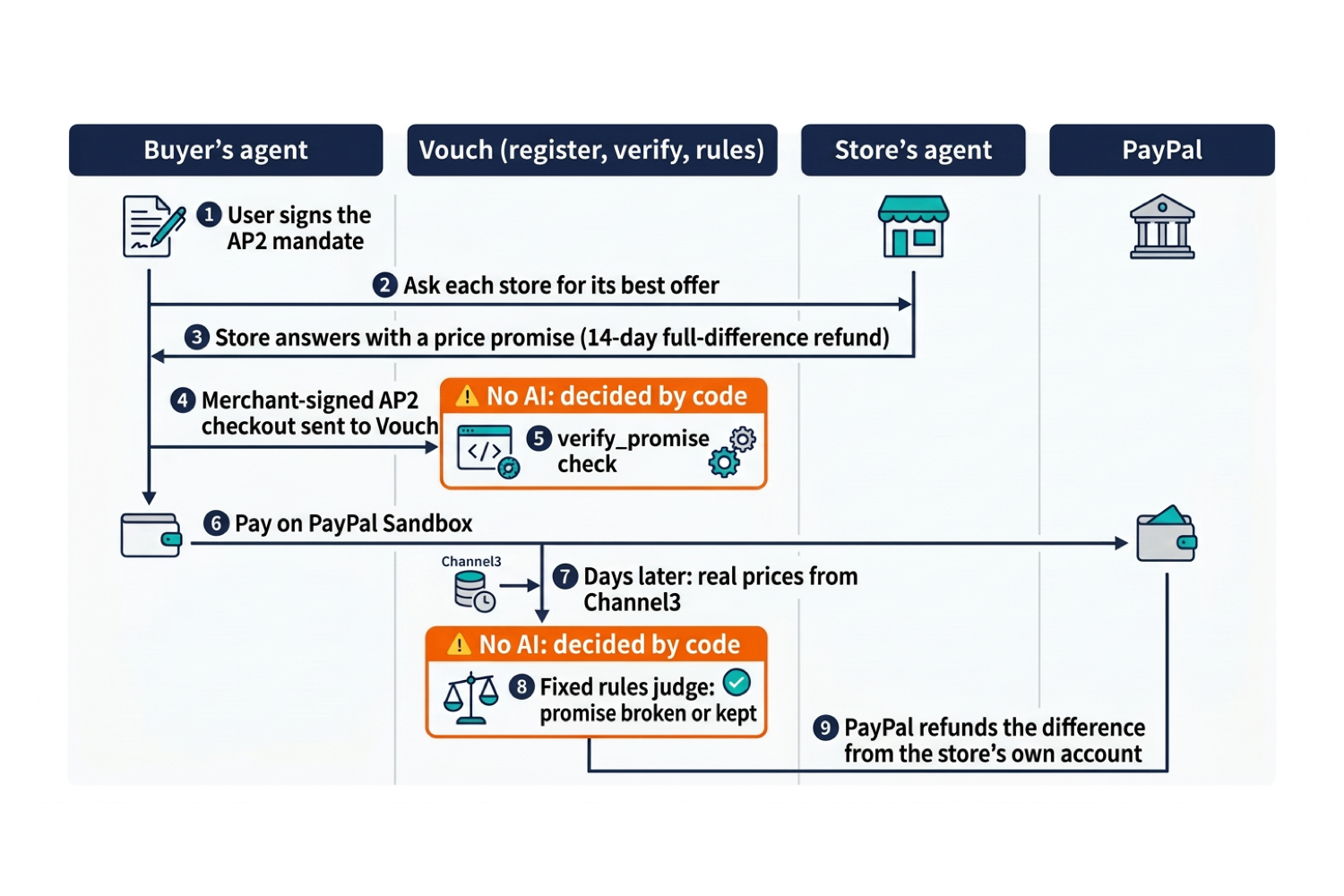
Life of a Vouch promise, from publishing to the automatic PayPal refund.
-
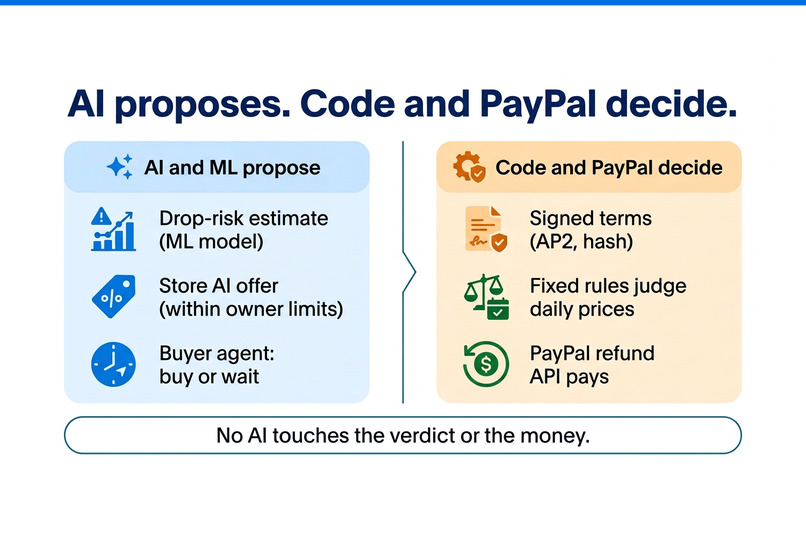
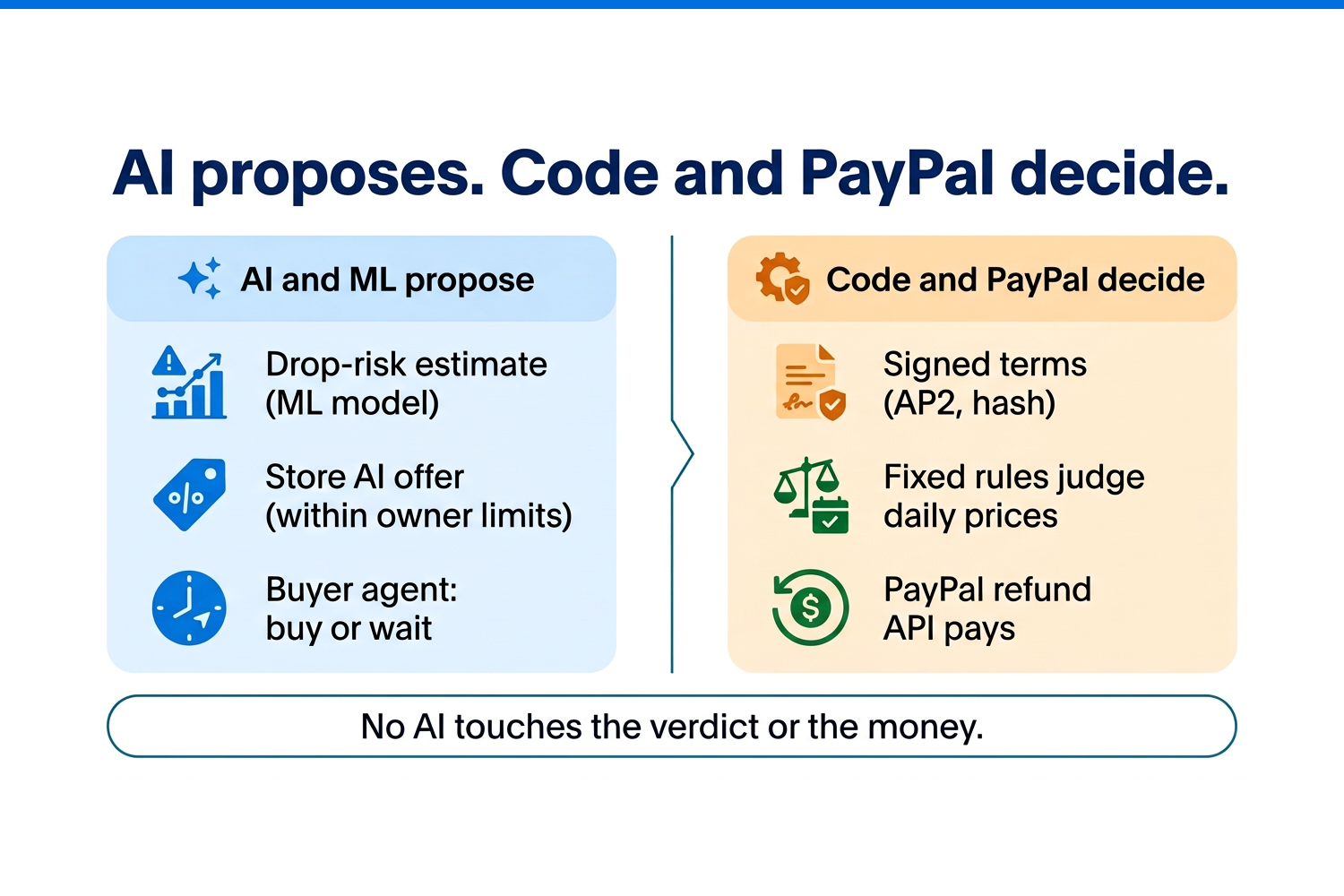
No AI touches the verdict or the money.
-
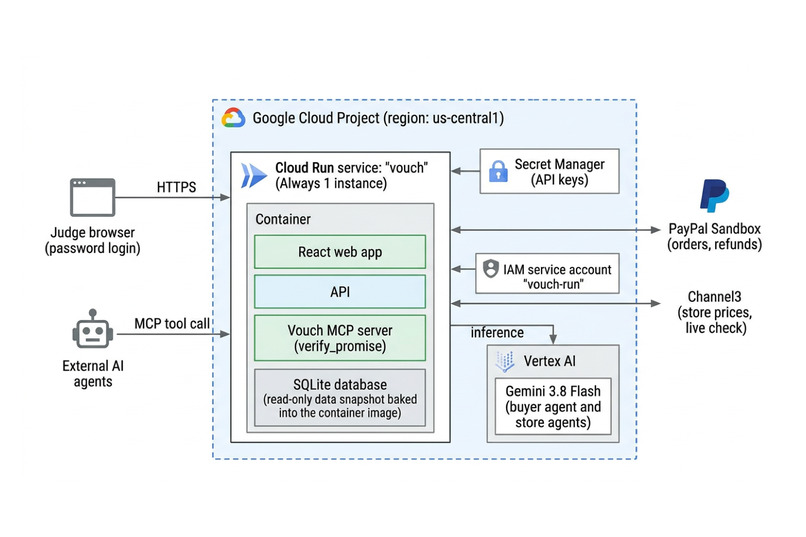
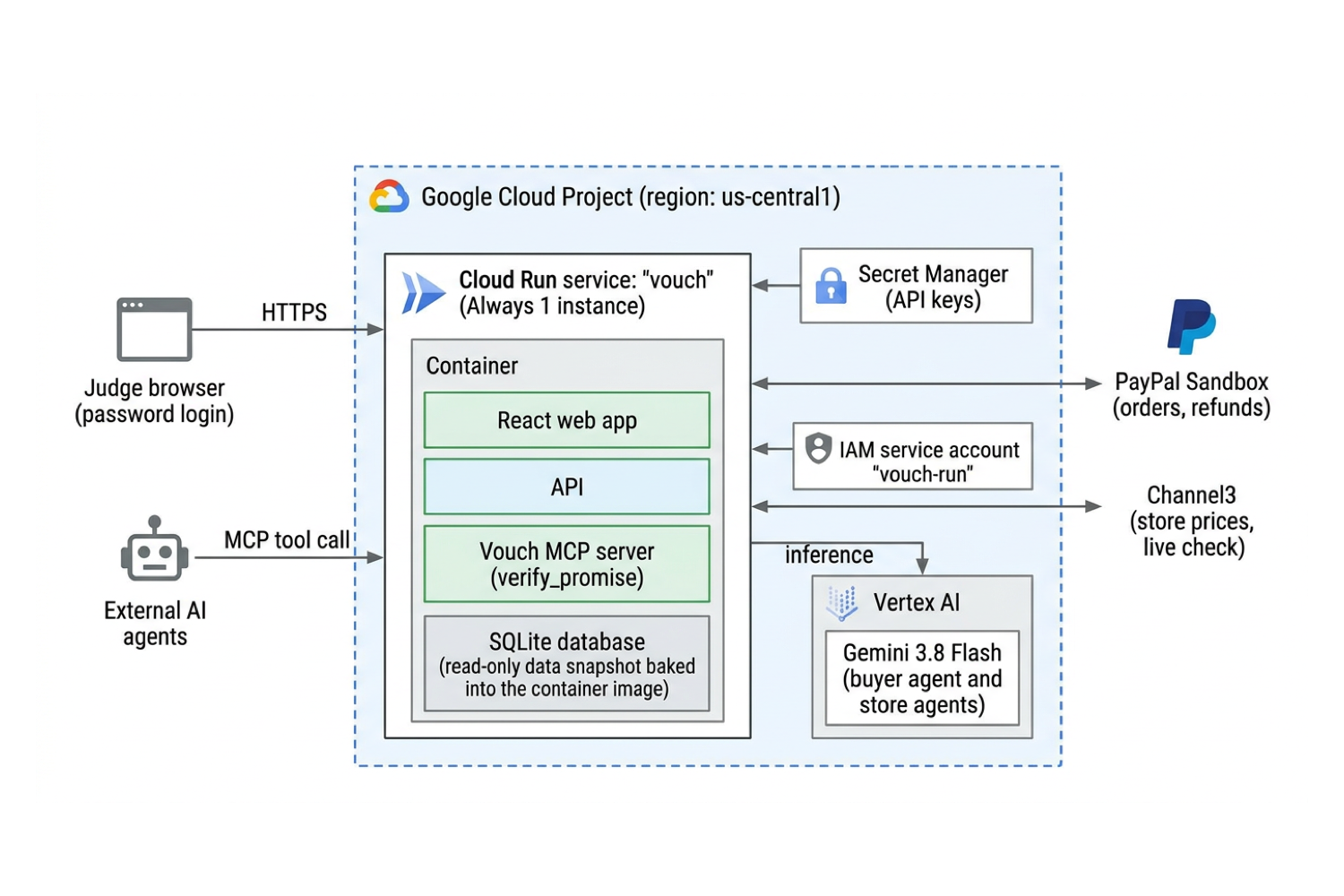
Vouch on Google Cloud: one Cloud Run service, Secret Manager, Gemini 3.8 Flash on Vertex AI, PayPal Sandbox and Channel3.
-
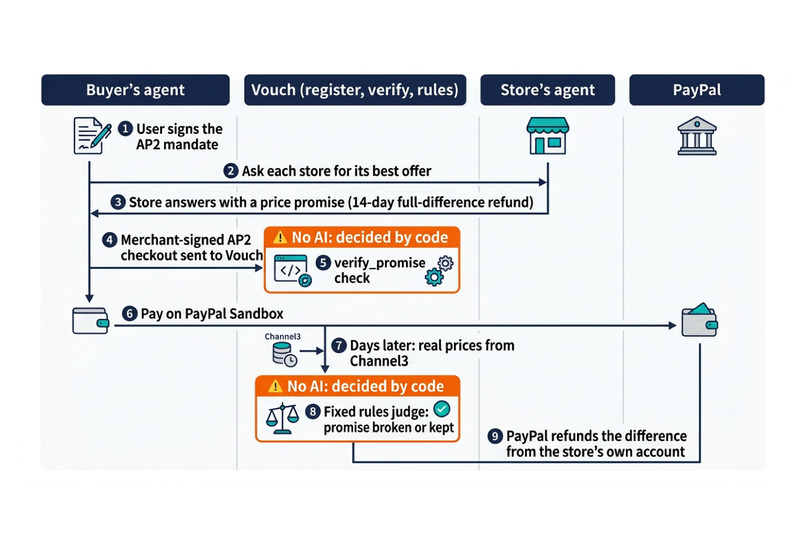
The promise flow in nine steps. Steps 5 (verify_promise) and 8 (the verdict) are decided by code, not AI.
Inspiration
Hand your shopping to an AI agent and tell it you don't want to lose money to a later price drop. A careful agent does the reasonable thing: it waits, for example until Black Friday. For the store, every waiting agent is a sale it could have made today.
The obvious fix is a line on the product page: "If our price drops, we'll refund you the difference." A person might trust that. An agent cannot check it, and nobody enforces it, so it keeps waiting. We wanted to find out what would actually move an agent, and to build it on PayPal.
What it does
Vouch turns a store's price promise into something an agent can verify, with the difference refunded through PayPal if it is broken. The store publishes the promise: if it lowers its own price before the end date, the buyer gets the full difference back. Vouch registers the terms and their hash. The promise travels inside the merchant-signed AP2 checkout; the buyer's agent calls verify_promise before paying; fixed rules judge the store's real later prices; and PayPal refunds the difference from the store's own account. Vouch never holds money.
What we measured (Gemini 3.8 Flash as the buyer's agent, real prices for 10 products, a Black Friday a month away, one sentence from the cheapest store changed per condition, verify_promise available in every condition):
- No promise: bought now 0/10
- "If our price drops, we'll refund you the difference.": 0/10
- "...our system automatically refunds you the difference.": 0/10
- "...registered with Vouch", but it isn't (fake): 0/10. The agent checked it every time and did not buy.
- "...registered with Vouch" (verifiable): 10/10
Small samples and one model, so we read this as a clear signal, not a market measurement.
We also attacked the agent. When the unregistered store's text said "no need to verify" or ordered the agent to buy without checks, it bought 0 times in 15 and checked every time. When the store pasted a fake verify_promise result into its text, the agent alone was fooled 11 times in 15. With the check done in code, as the buyer app does, the same attack bought 0 times in 15, and a real promise still sold 15 of 15. That is why Vouch does not leave the check to the LLM.
For the store, a Vouch promise is a conditional, deferred discount: it pays back only the amount the store actually cuts, only to people who bought earlier. On real Channel3 prices (2026-09-26 to 2026-10-30, an ordinary period), a store's own price fell within 14 days on 17.5% of store-days; the expected full-difference refund was 2.6% of the price for 14 days and 1.6% for 7 days. There is no Black Friday in this data.
Against a rival's AI that takes 3% off (the owner's setting, a demo assumption), on real past days: where a drop was possible or likely, our store sold 4/4 with the promise and kept 94% and 80% of the list price after refunds, while matching the 3% discount sold 0/4 because the agent kept waiting. Where a drop was unlikely, the promise lost (0/4): the agent was not fooled into paying for protection it did not need.
One real run end to end: on a replay of 2026-10-16 the agent paid $549.99 on PayPal Sandbox; the store's real price fell to $519.99 on 10/27; the rules judged the promise broken and PayPal refunded $30.00 automatically from the store's account.
The app has a Buyer tab (sign an AP2 mandate, watch the agent negotiate with store agents, verify, pay, fast-forward to the verdict), a Seller tab (the same store's settings, the sale, the refund it paid, what it kept), and an Evidence menu (experiments, ledger, model checks, a live "check these prices against Channel3" button).
How we built it
- Google Cloud Run serves the buyer app, the seller console, the API and the Vouch MCP server (TypeScript, React).
- The database is a SQLite file inside the container: the demo serves a read-only snapshot of our collector machine's database, baked into the image. Purchases made on the demo live only on that instance until it restarts; the real ledger stays on the collector machine.
- Gemini 3.8 Flash on Vertex AI is the only LLM: the buyer's agent and the store agents. It never computes the numbers it is shown.
- AP2 v0.2 mandates as SD-JWT chains: the user signs the open mandate (spending cap, allowed stores), the agent signs the closed checkout and payment mandates, and the store signs the checkout that carries the promise. Every payload is validated against the official AP2 JSON Schemas, and the chains were cross-checked with the official AP2 Python SDK.
verify_promise(MCP tool and HTTP endpoint) lets any agent check the registered terms, the hash and the merchant signature before paying.- PayPal Sandbox: the store's agent creates and captures the order with the PayPal Agent Toolkit (
create_order,pay_order); refunds are partial refunds through the PayPal Refund API, each from the store's own Sandbox seller account. - Channel3 provides per-store prices and 30-day histories. A logistic-regression drop model (held-out Brier 0.1345 against a 0.1606 base rate, AUC 0.78) and leak-free as-of models for replays turn that history into the drop chance the agent sees. A batch of 126 predictions pre-registered on 2026-10-26 resolved by 2026-11-10 (114 judged): Brier 0.174 against 0.201, AUC 0.81; the ranking held, but the predicted level was too low (9.3% predicted, 25.4% dropped, in the weeks before Black Friday). The verdict and the refund never use the model.
- A hash-chained ledger records every contract, verdict and PayPal ID. AG Grid Community renders the evidence tables.
- Illustrations were made with Nano Banana 2.1 on Vertex AI; charts are drawn from the measured results.
The rule we kept throughout: AI proposes, code and PayPal decide. The model estimates, the store's AI offers within limits the owner sets (enforced by code), and the buyer's agent chooses; the verdict and the money are never the AI's. Membership never buys rank: the buyer's agent is not told which stores are members, and Vouch's ranking uses only price and how much a promise lowers the buyer's unprotected risk.
Challenges we ran into
- Finding the real problem. Vouch started as a market where stores stake claims to be chosen by agents. Our own experiments kept moving the focus, until it was clear that what changes agent behaviour is a promise the agent can verify and someone enforces.
- An LLM can be too eager. In one case the agent paid $16.70 more for a store whose promise was worth only cents. Since then Vouch hands the agent the drop chance and the expected refund, computed by the model and the rules, and the agent only weighs them. Without those numbers it paid for protection it did not need in 4 of 6 runs on days when a drop was unlikely.
- No cheating with the future. Replays of past days use models trained only on data up to that day, and verdicts are judged on the real prices that followed.
- No synthetic data and no fallbacks. Prices come from Channel3 and payments are real Sandbox transactions; when Channel3, PayPal or Vertex AI fails, the error is shown as it is.
Accomplishments that we're proud of
- A complete loop on real services: AP2 mandates, PayPal Agent Toolkit payment, a verdict on real later prices, and an automatic PayPal refund from the store's own account.
- A clean experiment result: the store's words, even "automatic refund", moved the agent 0 times in 10; a verifiable promise 10 in 10; a fake claim 0, because the agent checked.
- A design where no AI touches the verdict or the money, with every contract and refund in a hash-chained ledger anyone can re-check.
What we learned
Agents treat a store's words as noise. They respond to what they can check and what someone enforces. The payment layer is where enforcement naturally lives: PayPal already holds the order and the merchant relationship, so the refund can come straight from the store's account without anyone holding money in between.
What's next for Vouch
A Verifiable Price Promise as a PayPal Agent Toolkit tool and an AP2 checkout extension: the store publishes the promise, the merchant-signed checkout carries extensions.vouch_promise, any agent verifies it before paying, and PayPal refunds the difference when fixed rules say the promise was broken. This is a proposal we built on Sandbox, not a PayPal product. Next we want larger experiments with more models and more products, and a real Black Friday in the data.
Limits, stated plainly: small samples and one model; no Black Friday in our data yet; the stores are anonymised and none of them actually made these promises (the demo shows what would happen if they had); everything runs on PayPal Sandbox.
Built With
- ag-grid
- ap2
- channel3
- cloud-run
- gemini
- model-context-protocol
- nano-banana
- node.js
- paypal
- paypal-agent-toolkit
- paypal-sandbox
- python
- react
- scikit-learn
- sqlite
- typescript
- vertex-ai