Inspiration
A shared assistant hears parents, children, guests, and the television. They should not all have the same permissions.
Alexa already has purchase controls and parental approvals. We built Vouch to explore household permissions for custom tools: who can request an action, when the owner must approve it, and whether that approval has already been used.
Vouch controls tools connected through its server. It does not intercept every native Alexa action.
What it does
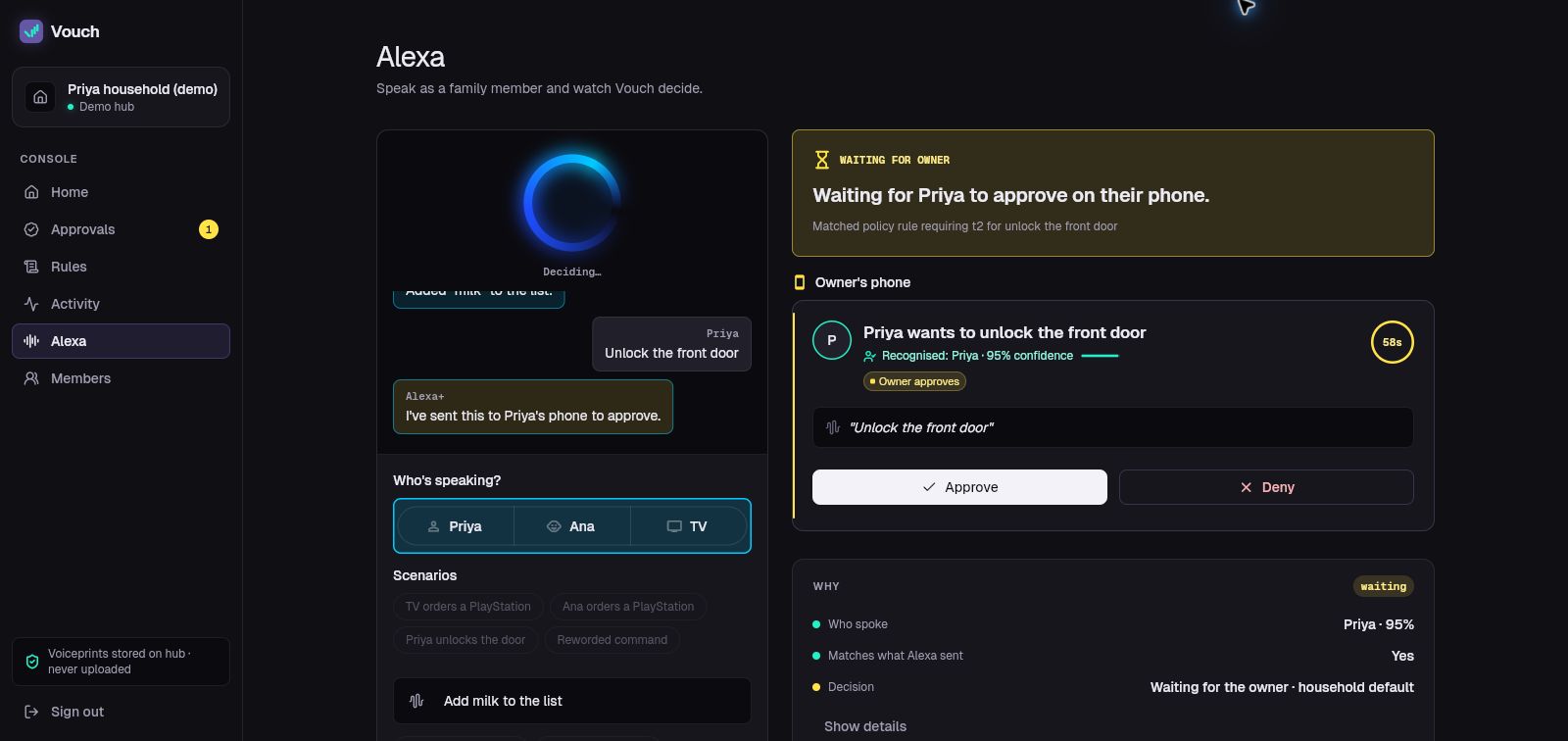
Vouch checks household rules before a connected tool runs. Our demo shows three outcomes:
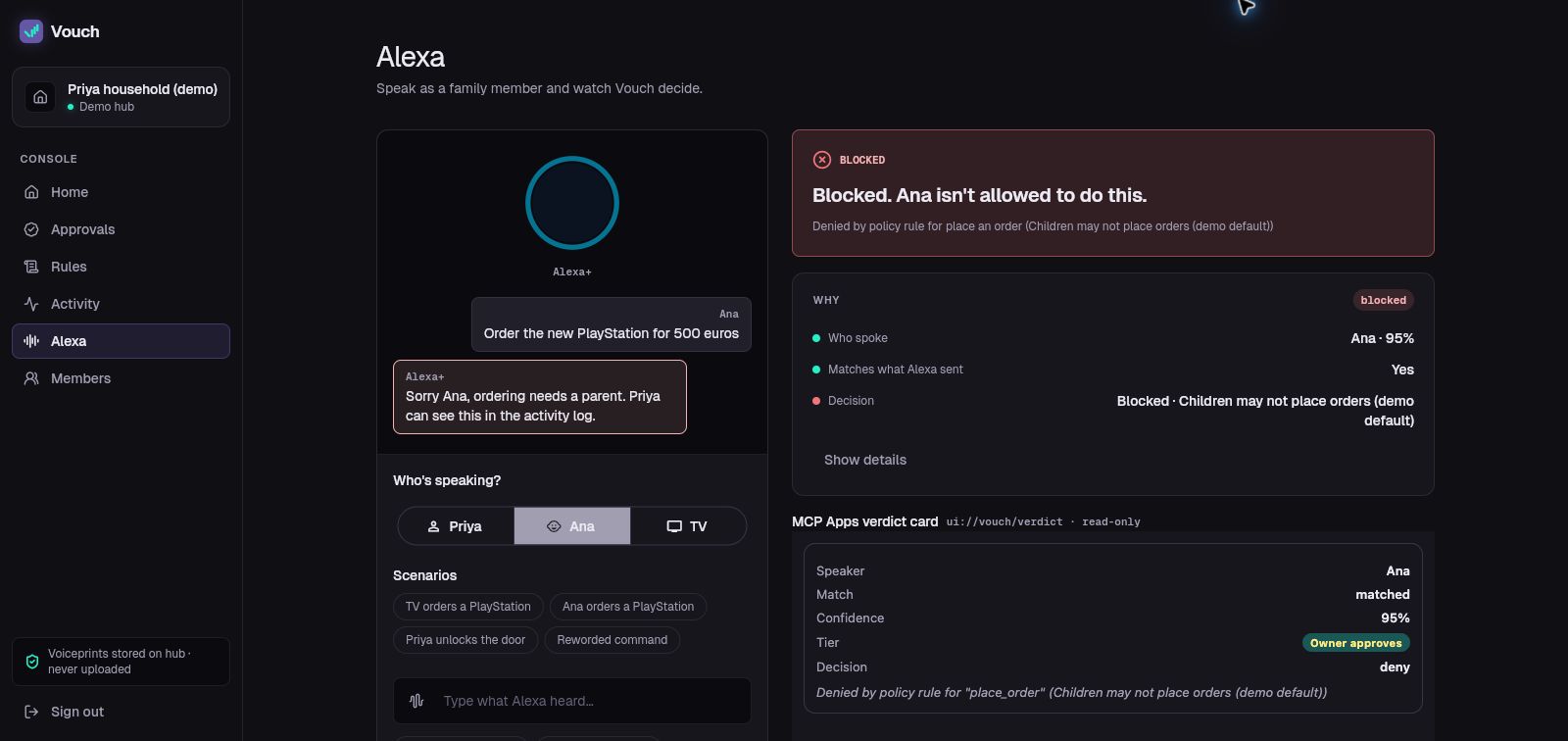
- Ana’s PlayStation purchase is blocked.
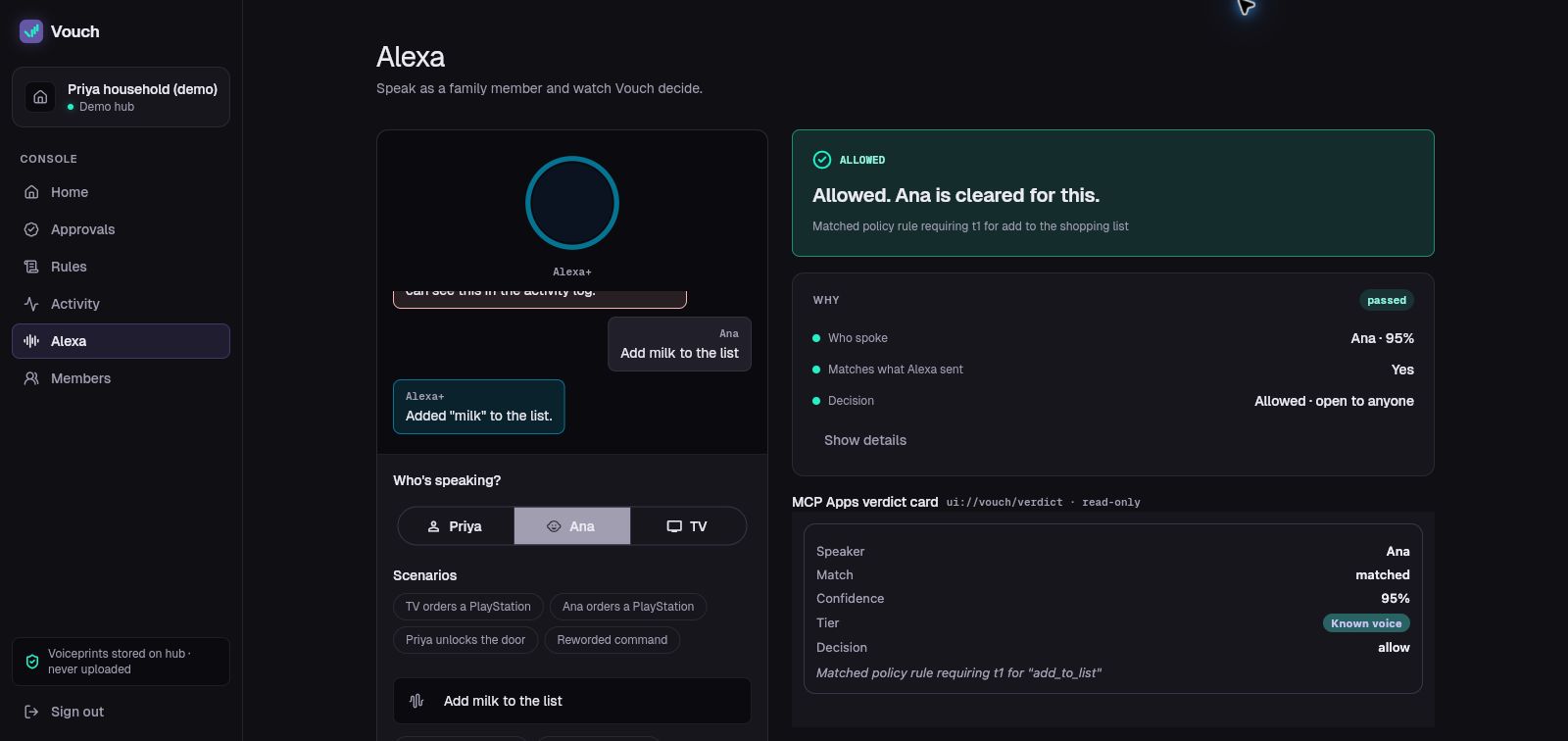
- Adding milk to the shopping list is allowed.
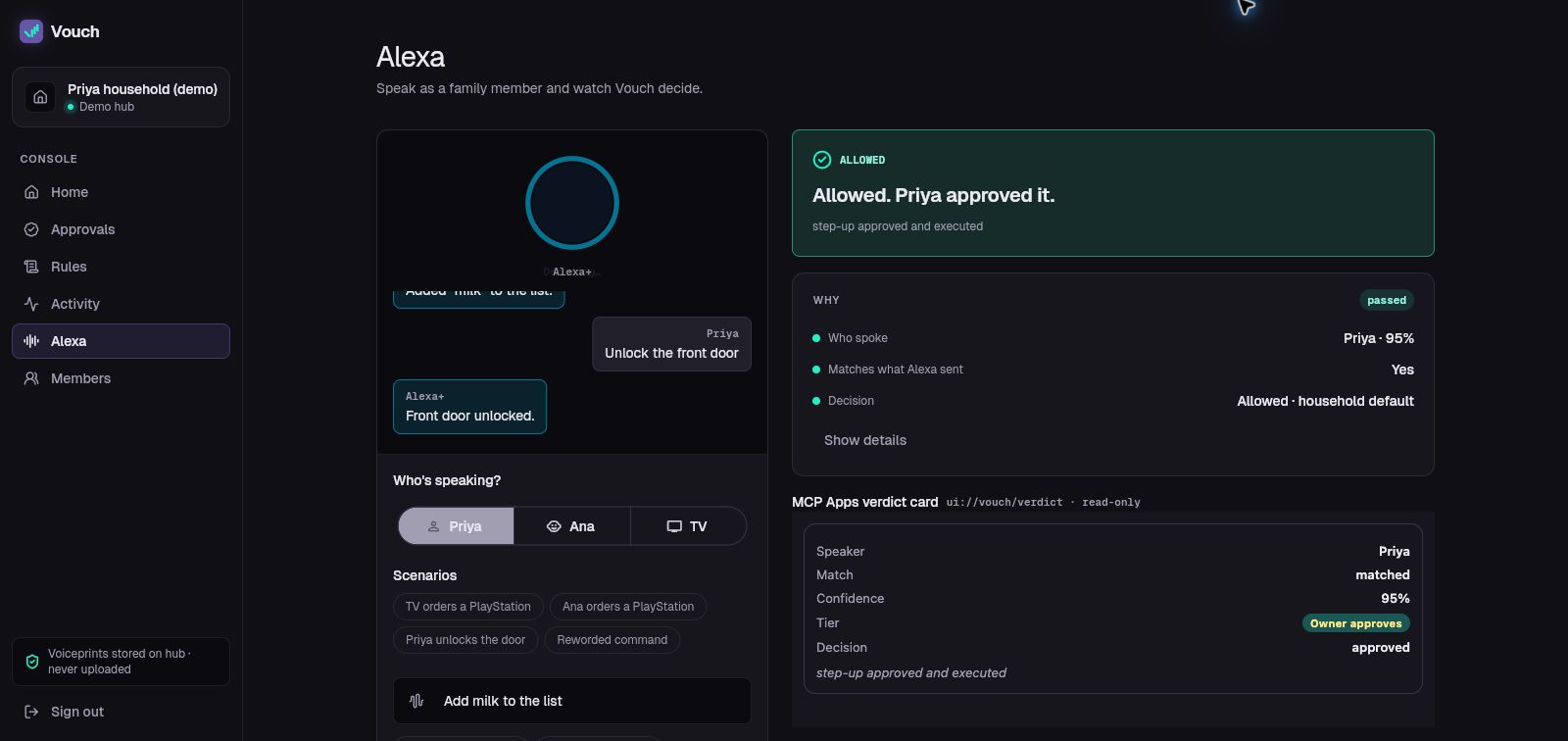
- A door request waits for Priya’s approval. Reusing that approval is rejected.
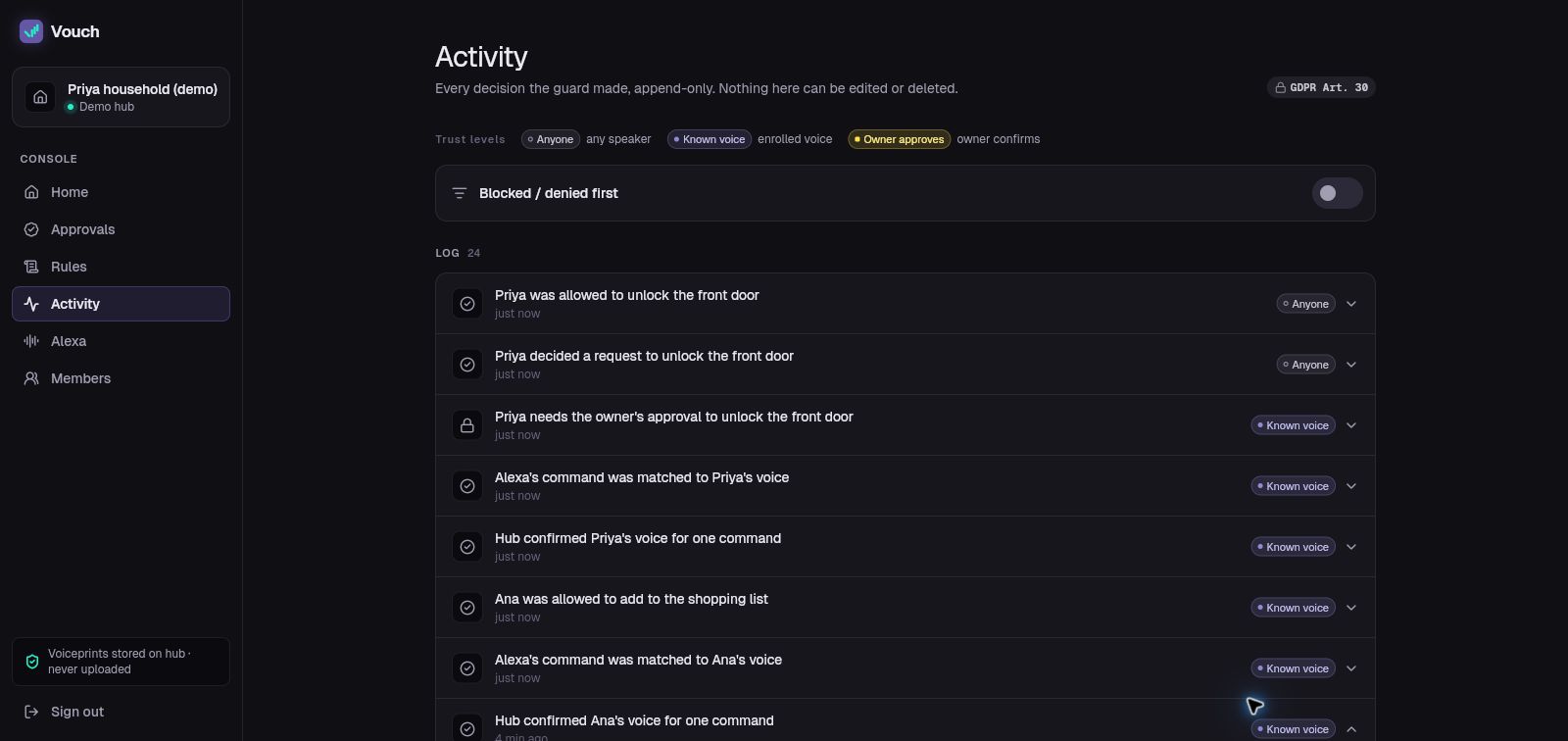
The Flutter app lets the owner manage rules and inspect each decision in Activity.
The Alexa+ client, speaker identities, and phone interface are simulated. The demo sends real MCP requests and exercises the backend’s policy and approval flow.
How we built it
- A Python hub uses NVIDIA TitaNet for speaker verification and Parakeet for transcription. Voiceprints stay local.
- The hub signs short-lived speaker evidence tied to the transcript. A Serverpod/Dart backend verifies it and checks household policy before tool execution.
- NVIDIA Nemotron on Nebius Token Factory converts plain-language instructions into proposed rules. The owner confirms them before they take effect.
- An on-demand AWS Lambda reviews sanitised audit exports and saves advisory reports in private, encrypted S3 storage. Raw utterances, audio and tokens are excluded; reports expire after seven days.
Vouch is public under MIT. Our Vouch Attest contribution provides Dart and Python helpers for checking signed identity, freshness, and a normalised command hash.
Challenges we ran into
Speaker evidence must stay attached to the correct request. We check that binding at the tool boundary and reject reused approvals.
Paraphrasing complicates transcript matching. The prototype checks normalised text and numeric tokens, but punctuation and language handling remain limited. Structured tool arguments need separate validation.
Amazon’s restricted Alexa+ tooling required a simulator. Bedrock account restrictions also blocked inference testing, so our verified AWS integration uses Lambda and S3.
Accomplishments that we're proud of
The video includes a continuous, original-speed recording of approval, execution, and replay rejection.
We verified an actual Lambda invocation and downloaded its S3 report to compare the contents and checksum. The Vouch Attest contribution passed 38 Python tests and 39 Dart tests using shared vectors.
What we learned
Recognising a voice does not grant permission. Each action still needs a policy decision.
Decision traces helped us find misleading replay-rejection wording and correct it. Synthetic voices made the demo repeatable, but do not establish accuracy in a real household. We make no deepfake-detection claim.
What's next for Vouch
Test with recorded household audio and report false acceptance and rejection rates. Validate approval across separate devices and strengthen tool-argument checks.
When Alexa+ access becomes available, test the same MCP guard against the live client.
Built With
- amazon-cloudwatch
- amazon-web-services
- aws-cloudformation
- aws-lambda
- dart
- flutter
- model-context-protocol
- nebius-token-factory
- nvidia-nemotron
- nvidia-parakeet
- nvidia-titanet
- postgresql
- python
- redis
- serverpod

Log in or sign up for Devpost to join the conversation.