-
-
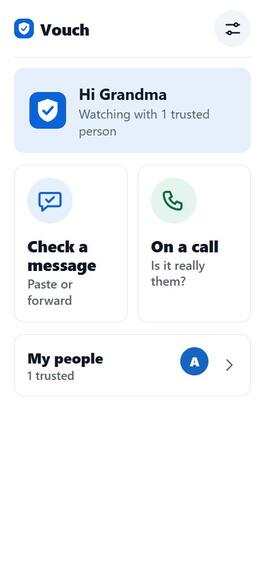
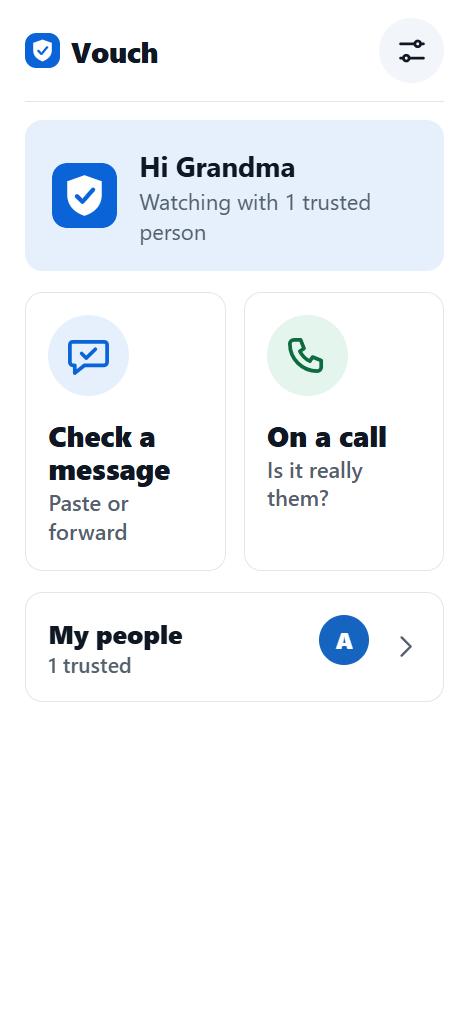
Home: Check a message, On a call, and “My people”.
-
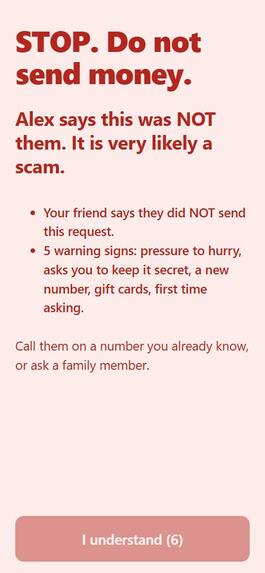
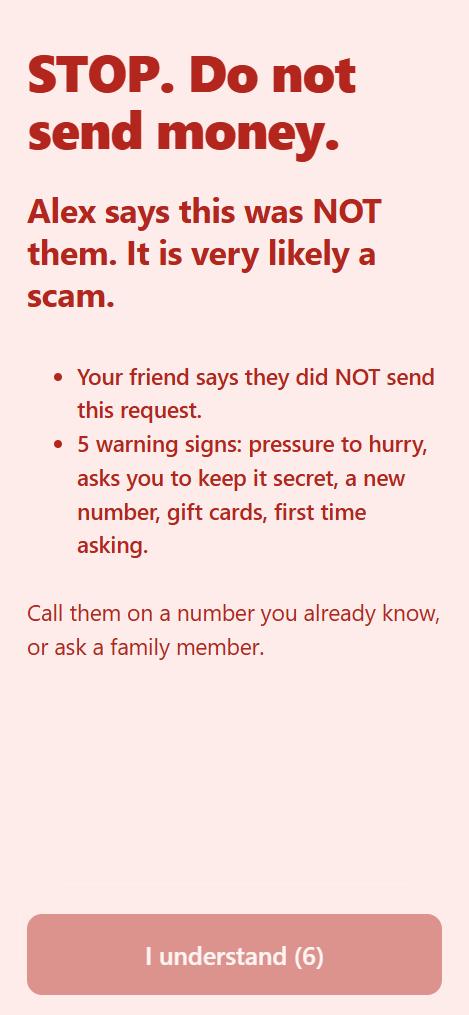
Alex’s own phone signed “this wasn’t me”. Vouch shows a full-screen STOP before any money moves.
-
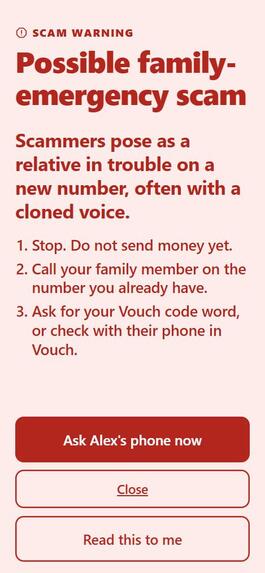
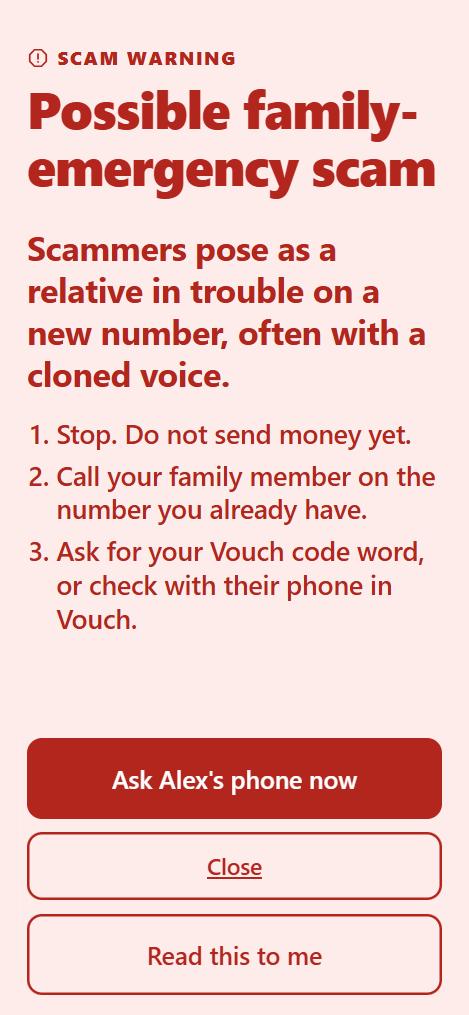
“Possible family-emergency scam”, with three steps and “Ask Alex’s phone now”.
-
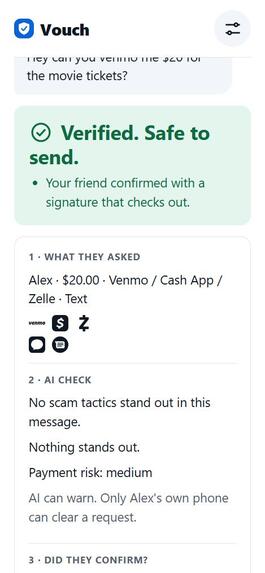
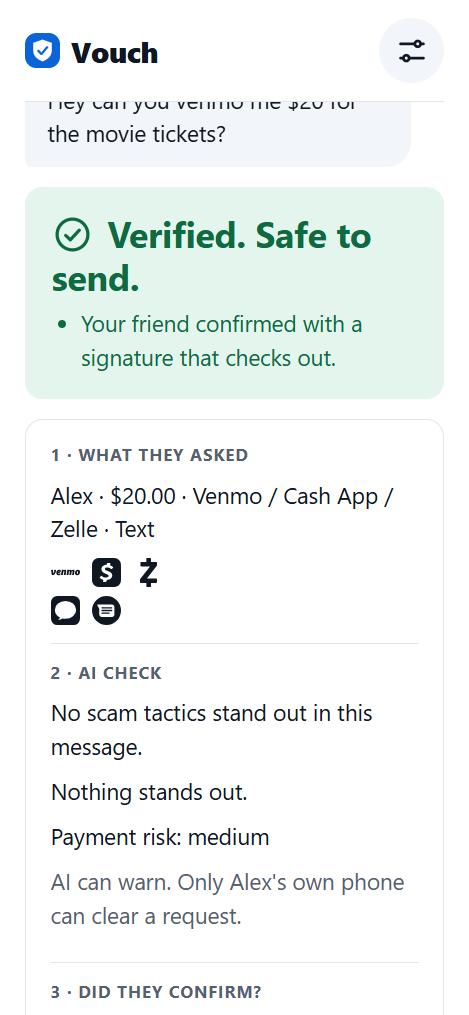
Alex’s phone confirmed with a signed Yes, and both the server and this phone checked it. Only a person can clear a request.
Inspiration
Scams work because you can't tell who is really on the other end. AI can now clone a voice in seconds, and a spoofed number or a polished message proves nothing. The FTC reported that consumers lost more than $12.5 billion to fraud in 2024, and $2.95 billion of that was imposter scams. Imposter scams often borrow a familiar voice, like a grandparent getting a call from a "grandchild in trouble". Detecting fakes is a losing arms race, so we asked a different question: what if you could check the person instead?
What it does
Vouch is two-factor authentication for people.
- Friend check. When a text or call claims to be a friend asking for money, you tap Check. Your friend's real, paired phone asks, "Did you just ask Grandma for $200?". Their Yes or Not me is signed with a key that never leaves their phone, and both our server and your phone verify the signature before showing a result. A scammer can fake a voice or a message, but not your friend's own phone.
- Rotating code word. Paired phones share a two-word phrase that changes every minute. On a live call, you ask "What's our word?" and type what they say. A wrong answer or a dodge is a red flag.
- Bigger amounts need more proof. Under $25 is a signed Yes. Up to $200 also needs the retyped amount and the code word. Over $200 needs a second trusted person. Gift cards, wires, and crypto never go green on a Yes alone.
- Warnings for scams that aren't about money. A fake bank asking for a verification code, a remote-access request, password and card-detail phishing, a fake delivery link, or an ID request gets a plain-words warning with three steps to take. On a live call, the app listens and warns as the scam unfolds, for example, when the caller asks you to read out a code.
AI can warn; only a person can clear. Rules and Gemini add warnings and a plain explanation. They never produce a verdict and can never clear a request. Everything works with no AI at all.
How we built it
- A phone web app in plain JavaScript (no build step) using Web Crypto: ECDSA P-256 signatures and ECDH shared secrets, with non-extractable private keys kept in the browser's IndexedDB.
- Node.js, Express, Socket.IO and SQLite on the server. The server is the source of truth. It stores only a SHA-256 of the normalized message text, the amount and the answer, never the message itself.
- A pure decision engine that turns the friend's signed answer, the payment method, the amount and the timing into red, amber or green. We tested it across about 4,800 input combinations.
- A risk layer of phrase rules plus Google Gemini (structured JSON, a model fallback chain, a 3-second timeout and a rule-based fallback). Gemini can only add caution.
- A call engine that scores a call as a scam script unfolding in stages, with red lines such as "read me the code".
- ElevenLabs for spoken alerts and for speech-to-text on calls and voice notes.
- An optional Telegram bot that runs on the same server, hosted on Render.
- 322 automated tests.
Challenges we ran into
- Keeping the safety rule. The AI can't be allowed to approve anything, so Gemini can only raise a warning. We ran our scenarios with a bogus key and got verdicts identical to rules-only.
- Avoiding false alarms. A real bank saying "we will never ask for your PIN" must not trigger a warning, and a friend asking for $15 for pizza must not look like fraud.
- Gemini model availability, which changed during the hackathon, so we built a fallback chain.
- Real-time call detection on phones. Echo, noise, and browser limits mean live listening depends on the phone letting a web app use the microphone. We tested it on staged calls, and we say so.
Accomplishments that we’re proud of
- A friend check that is real end-to-end: real keys, real pairing and real signatures, with nothing simulated.
- A phone that still warns you about scams with no AI and no connection. The friend check needs a connection, because it asks your friend's real phone.
- Plain, calm warnings written for someone scared in the middle of a call.
What we learned
Trust is the product. The strongest design was not a better detector but a smaller promise: only a person can clear a request.
What’s next
- Native push and a store app, so warnings can reach you without keeping a tab open.
- Persistent storage, since the free hosting tier loses pairings when it sleeps.
- Testing with real users and a proper study, including older adults.
- Automatic screening of incoming messages and calls, which needs native permissions.
- More languages.
Built With
- css
- elevenlabs
- express.js
- gemini
- html5
- javascript
- jsqr
- node.js
- render
- socket.io
- sqlite
- twilio

Log in or sign up for Devpost to join the conversation.