-
-
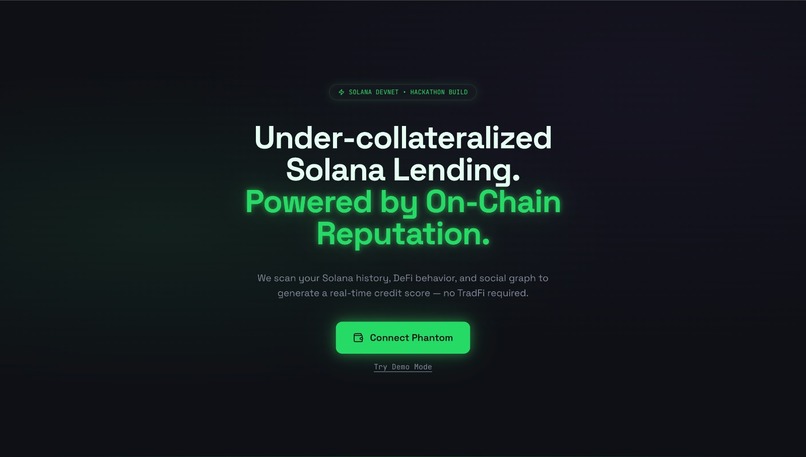
UI
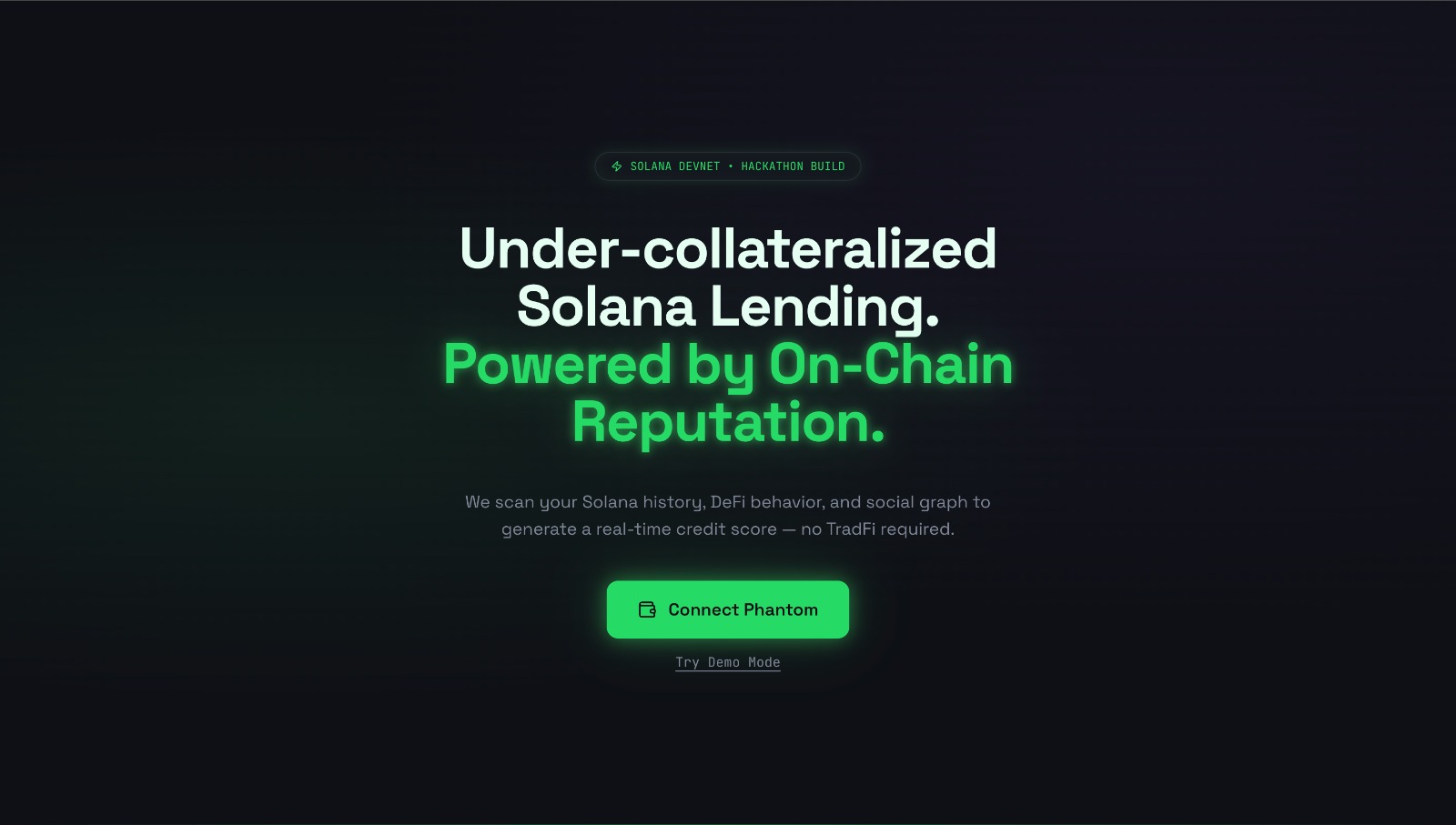
Inspiration
DeFi lending is fundamentally broken. Currently, decentralised protocols treat every user as a completely anonymous, high-risk stranger. This forces a rigid system of 150% over-collateralisation, trapping billions of dollars in unproductive capital.
Most successful developers and Web3 citizens do not suffer from a lack of capital, but from inefficient capital structuring. We realised this capital inefficiency is a data problem. We asked ourselves: Why should a developer with a 5-year-old GitHub account, high StackOverflow reputation, and a pristine on-chain DeFi history be treated the same as a bot wallet created 5 minutes ago?
We built this platform to democratise credit. We don't lend against crypto; we lend against reputation.
What it does
Our platform is an AI-powered DeFi lending protocol that issues under-collateralised loans and dynamic asset-backed guarantees by turning on-chain history and Web2 developer identity into a quantifiable, MiCA-compliant Trust Score.
When a user connects their wallet:
- Identity Aggregation: We fuse their Web3 financial history with their Web2 proof-of-work and Solana Name Service (.sol) domains.
- AI Underwriting: Crusoe's LLM evaluates this data to clear the wallet for EU MiCA Anti-Money Laundering (AML) compliance and generates a definitive Trust Score (300-850).
- Dynamic Pricing: The AI instantly generates a personalized Loan-to-Value (LTV) and risk matrix.
- Programmatic Escrow: Users pledge their collateral into a secure Rust-based protocol vault, instantly triggering an automated loan disbursement.
How we built it
To handle the distinct requirements of relational data, Web3 execution, and AI inference, we engineered a polyglot microservice architecture:
- Core Backend (Spring Boot & PostgreSQL): We utilized Java with Spring Boot to build a robust main backend service. All user state, session data, and historical underwriting records are securely persisted and managed in a PostgreSQL database.
- Web3 & AI Orchestration (Node.js): We deployed a dedicated Node.js microservice to handle asynchronous, I/O-heavy tasks. This service utilizes
@solana/web3.jsto construct transactions and orchestrates the complex prompt payloads sent to the LLM. - On-Chain Escrow Vault (Rust): To solve the stablecoin "Freeze Authority" problem securely, we built a custom Solana smart contract using Rust and the Anchor framework. This program acts as our programmatic escrow vault, securely locking and releasing collateral based on instructions from our Node.js service.
- The AI Underwriter (Crusoe Inference API): We routed our massive JSON identity payloads into Crusoe’s Inference API. Using strict prompt engineering, the LLM acts as a European RegTech officer to clear the wallet for the EU Travel Rule and outputs a strict JSON risk matrix.
- Frontend (React.js): A highly responsive React.js UI that connects to the user's wallet and interacts seamlessly with our API gateway.
The Quantitative Risk Model
To calculate the exact interest rates and collateral requirements dynamically, our AI Underwriter applies the following deterministic pricing formula:
$$C_{f}=R_{b}(t)\times F_{r}\times M_{c}$$
Where:
- C_{f}= Final Applied Commission / Interest Rate
- R_{b}(t) = Time-based Base Rate (1 MO, 3 MO, 6 MO, 12 MO)
- F_{r} = Asset Volatility Factor (e.g., 0.75x for Blue Chip ETFs vs 1.50x for volatile crypto assets)
- M_{c}= Collateral Modifier derived from the AI Trust Score
Challenges we ran into
- The "Freeze Authority" Trap: We initially attempted to lock USDC collateral directly inside the user's unhosted wallet. We quickly learned that on Solana, only the token's central issuer holds the freeze authority. We solved this by pivoting to a highly secure Programmatic Escrow Vault written in Rust, where assets are transferred to a protocol-controlled treasury.
- Microservice Synchronization: Ensuring seamless data flow between the Spring Boot state manager, the Node.js transaction builder, and the React frontend required strict CORS configurations and standardized JSON schemas.
- AI JSON Hallucinations: Open-source LLMs naturally struggle to output pure, parseable JSON without adding conversational text. We had to implement strict system prompts via the Crusoe API and build Regex failsafes in our Node.js service to ensure the React UI never crashed.
Accomplishments that we're proud of
- EU MiCA Compliance: We successfully built a "Zero-Friction Pseudo-KYC" engine. By utilizing AI to cross-reference GitHub history with on-chain data, we can confidently approve unhosted wallets for stablecoin transfers under the new strict European AML frameworks.
- Enterprise-Grade Architecture: Successfully integrating Spring Boot, PostgreSQL, Node.js, and Rust into a single cohesive DeFi application over a hackathon weekend demonstrates a massive level of technical rigor.
What we learned
- The intricacies of the Solana Token Program, specifically the crucial differences between wallet-level delegation and physical Rust Escrow Vaults.
- How to leverage Crusoe's Inference API to rapidly deploy massive LLMs with zero infrastructure overhead.
- The absolute power of treating digital identity as a verifiable liquidity asset.
What's next for TrustScore
Following our launch at HackEurope 2026, our immediate next step is integrating Zero-Knowledge (ZK) Proofs so users can prove their Web2 identity and banking history locally, without ever exposing their public GitHub usernames or data to the blockchain or our PostgreSQL database. We also plan to expand our collateral blocks to include tokenized Real World Assets (RWAs).
Built With
- cursoeapi
- java
- node.js
- postgresql
- react.js
- rust
- springboot

Log in or sign up for Devpost to join the conversation.