-
-
Transparency and credibility guaranteed
-
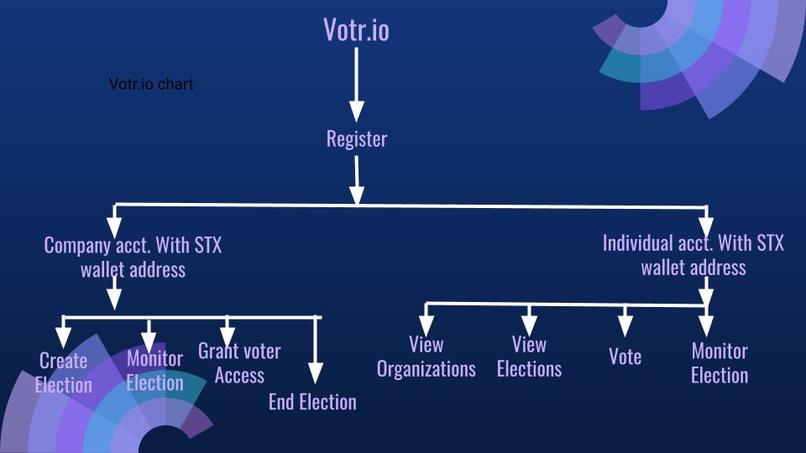
Votr.io DApp Overview
-

Test coverage result

Inspiration
In the African continent where we are from, election exercises are always incredible as the entire process is mostly under the control of the incumbent government. Over the years, young people with the vision to transform the continent are clamoring for lasting solutions to this problem. In addition to this, election exercises are laborious and expensive for all parties involved; from the government to the electoral commission, to political candidates, all the way down to the populace (voters). Hence, our desire to build a credible, transparent secured, and low cost voting platform to solve this problem.
What it does
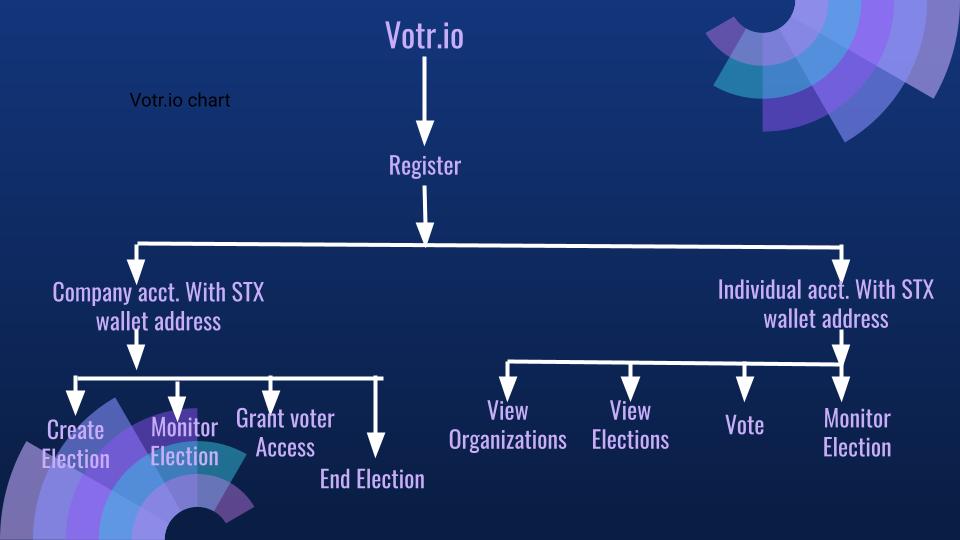
Most times when elections are carried out, the voters are left in the dark concerning the progression of the exercise, and can only see the results when they are presented by the administrators of the exercise. Hence, credibility and transparency are not guaranteed, as the administrators can alter the results at any time without the knowledge of the voters. Votr.io is a Web3 voting platform that is designed with the aim allowing companies and other organizations like Co-operative societies to conduct internal election exercises smoothly over the stacks blockchain. This platform guarantees transparency and credibility as the voters can monitor the progression of the voting exercise over the Blockchain. Furthermore, it is offering a cost effective and reliable means for organizations seeking to conduct election exercises.
How we built it
Having the drive to create a fully functional and expandable voting system on the Blockchain, we built it using Stacks Blockchain related library (clarity, which is the programming language used on the stacks Blockchain) to create and deploy the smart contract. We started very little, the contract had just four functions which were the register function, the create-election function and the vote function. From there we started expanding our ideas through the problems we faced while building.
Challenges we ran into
. One major challenge we faced was querying data from the stacks Blockchain.
. Availability of necessary equipment/facilities like computers and uninterrupted power supply for proper project development.
. We faced challenge on how to allow specific people authorized by the organization to vote for that election.
. We also faced a challenge where a contestant cannot be in more than one election, because the latest election was always overriding the former. This was because there was no way to differentiate contestant with their election-id.
Accomplishments that we're proud of
. We are pleased that we were able to create a fully functional smart contract.
. We were able to differentiate contestant with their election-id, fixing the challenge where a contestant cannot be in more than 1 election, because the latest election was always overriding the former.
. We were able to establish a good team spirit, as the project involved a number of beginner and intermediate Web3 developers. Thus, we achieved a "learn as you build" process.
. We were proud of being able to overcome obstacles like, power supply issues, and limited equipment. Therefore, we developed a resilient attitude.
. We are really proud of being able to bring and put our thoughts to reality. Building Votr.io with clarity is a huge accomplishment we are proud of.
What we learned
We were able to understand better the concept of Clarity map especially from writing the smart contract, dynamic trait passing to functions, how to work with variables outside of a function, how to use typescript to write out unit test for our smart contract, tuple, and implementation of traits; especially NFT traits.
What's next for Votr.io
. To build a responsive and efficient GUI to link with the smart contract.
. We intend to further develop the project in order to be able to handle larger election exercises like National Elections.


Log in or sign up for Devpost to join the conversation.