NYC VoteTrack
A personalized, AI-powered election portal that bridges the gap between complex political data and NYC voter interests. Built for the 2026 NYC election cycle at MHC Hackathon 2026.
Inspiration
New York City elections are notoriously confusing. Between ranked-choice voting, overlapping districts, staggered primaries, and dozens of races at every level of government, most voters don't know what's on their ballot — let alone where candidates stand on issues they care about. We wanted to build something that makes civic engagement feel effortless: enter your address, tell us what you care about, and we show you everything you need to vote informed.
What it does
VoteTrack is a full-stack election guide that personalizes the voting experience:
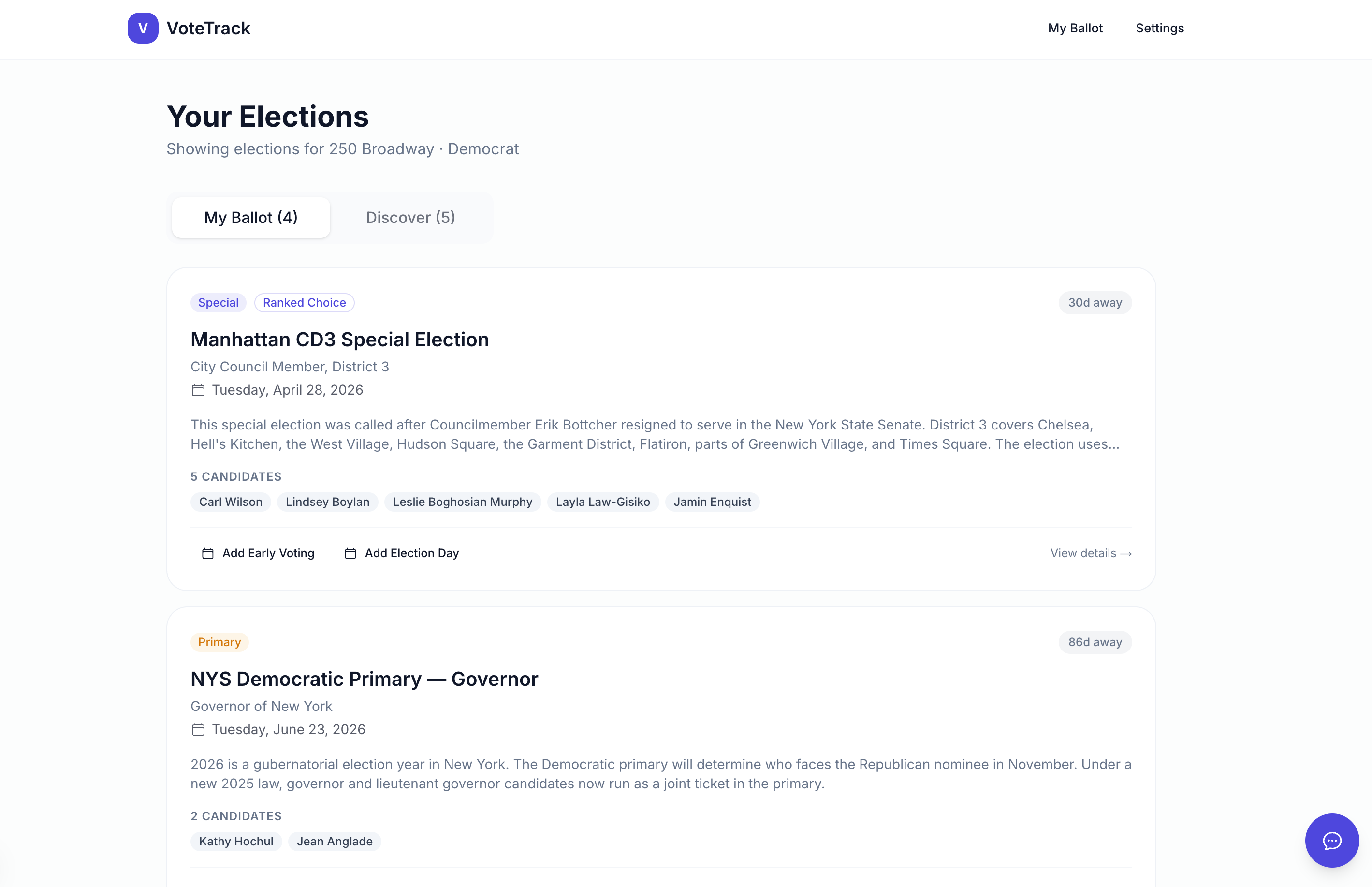
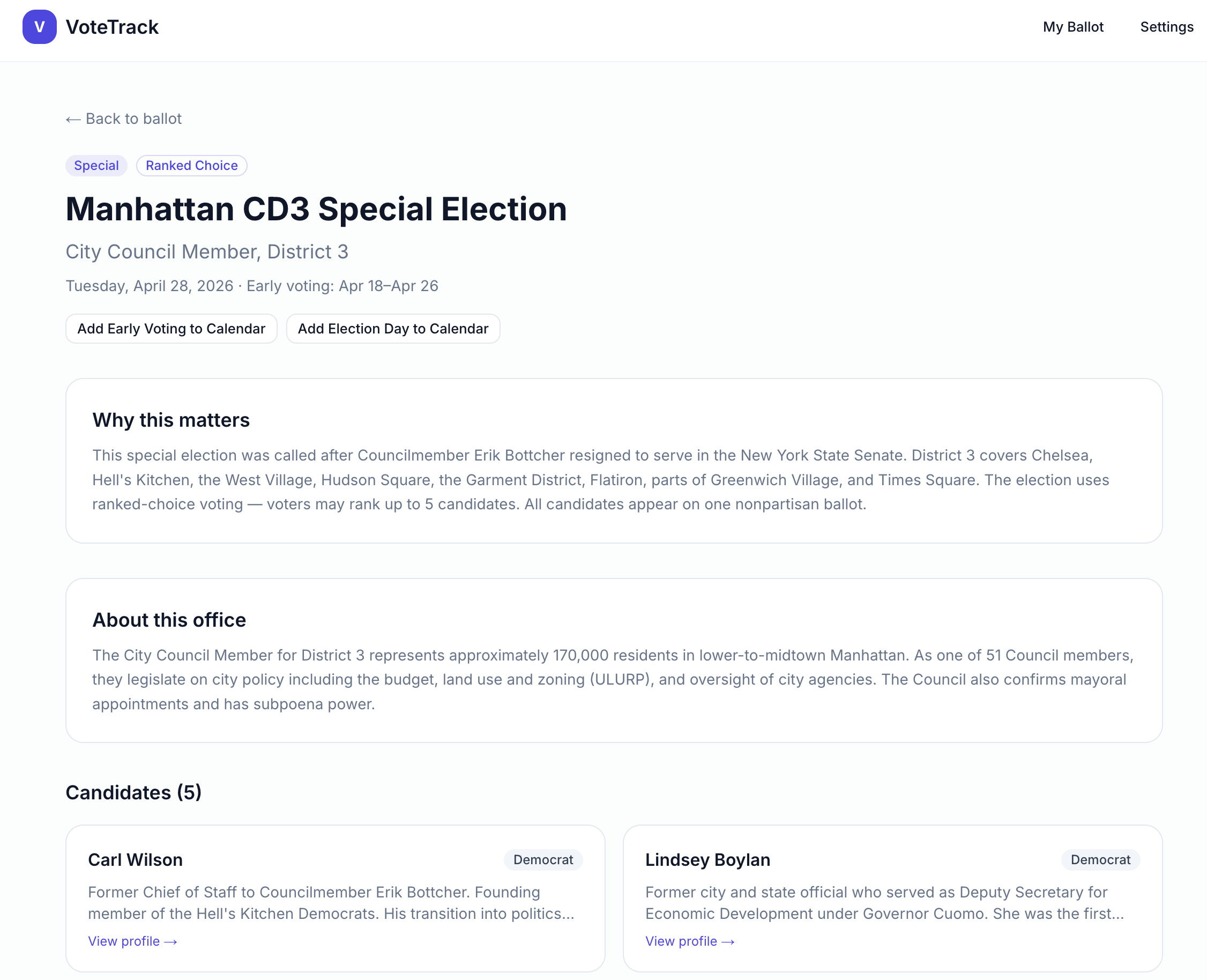
- Personalized Ballot Feed — Enter your address and we map your City Council, State Assembly, State Senate, and Congressional districts. See only the elections you're eligible to vote in, with party-based primary filtering.
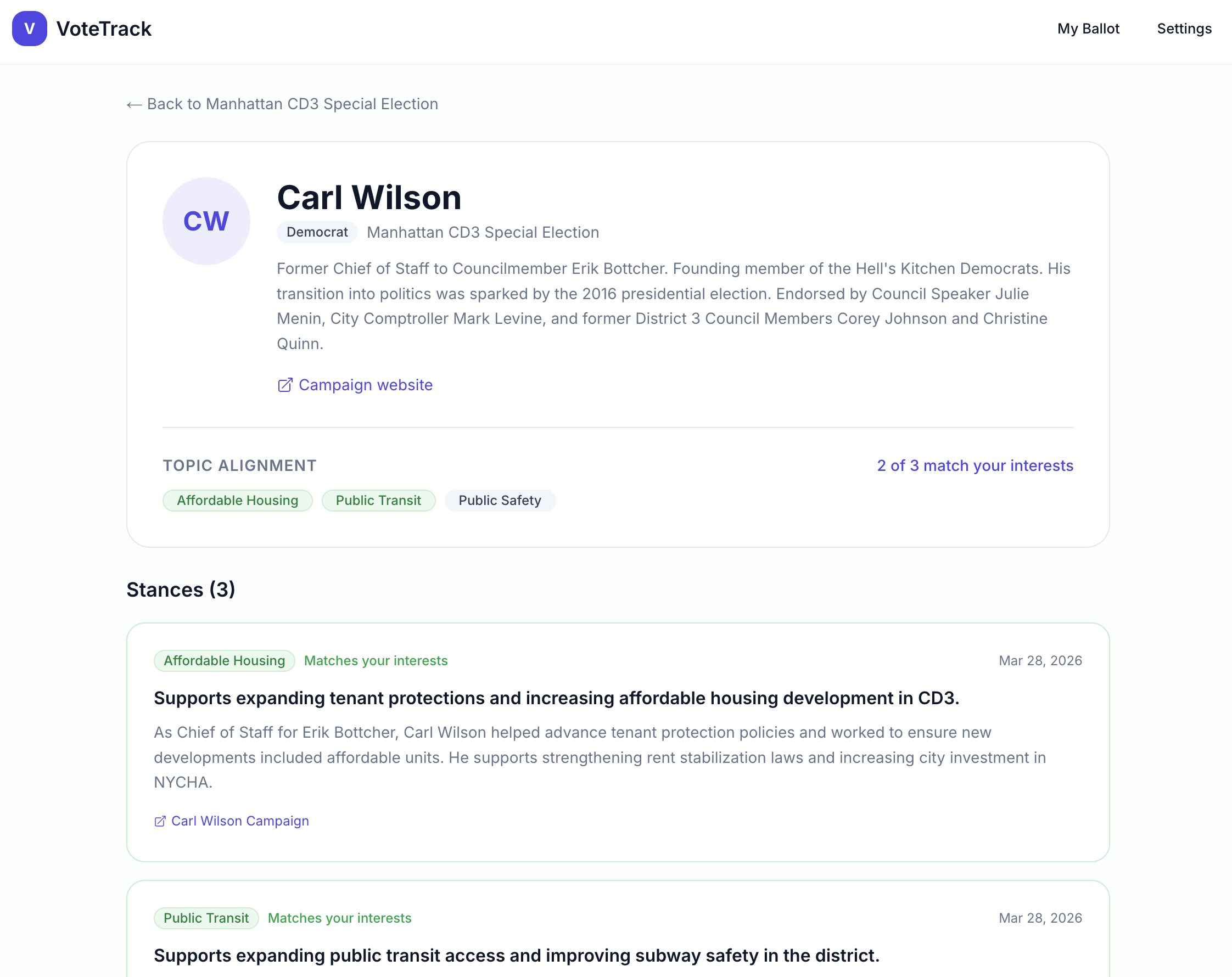
- Candidate Profiles & Alignment — Color-coded topic badges show where candidates stand on the issues you care about. Green = matches your interests. Stance timelines track positions with sourced citations.
- Side-by-Side Comparison — Compare 2-3 candidates on a topic-by-topic grid. Your interest topics are highlighted and sorted first.
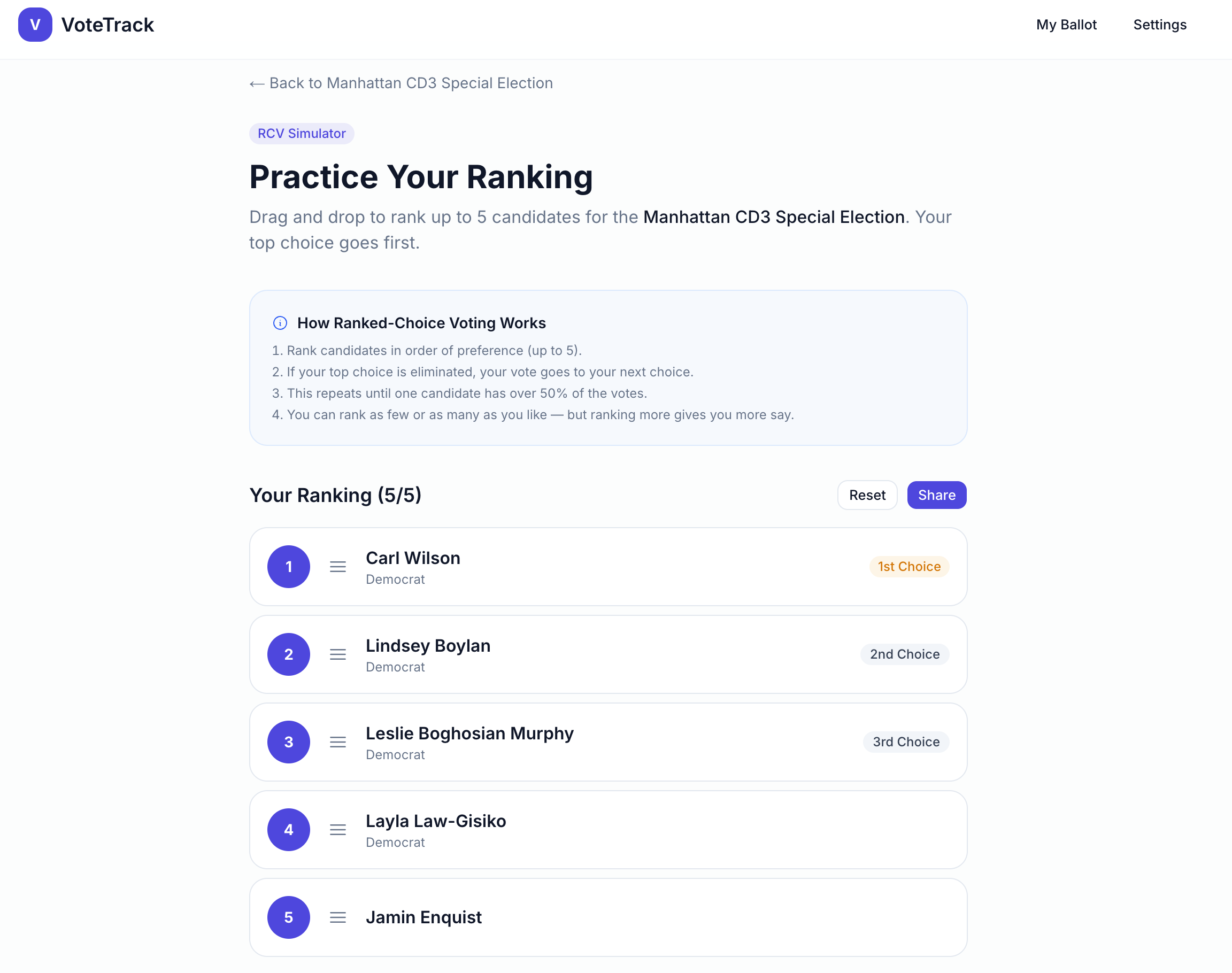
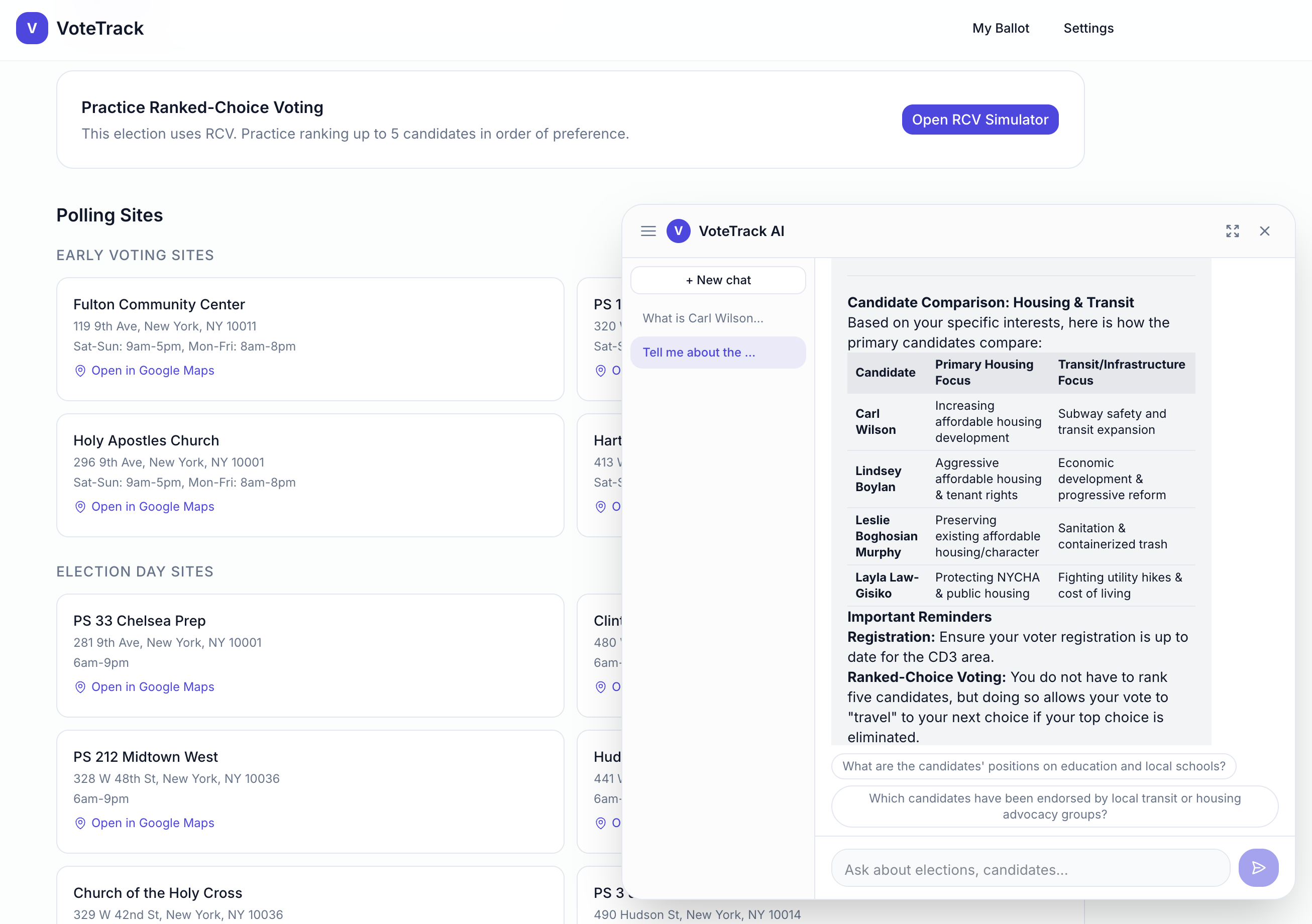
- RCV Simulator — Drag-and-drop ranked-choice voting practice tool. Rank up to 5 candidates with educational explainers.
- AI Chatbot — Gemini-powered assistant with Google Search grounding. Ask questions about any candidate or election and get sourced, non-partisan answers with streaming responses, markdown rendering, and persistent session history.
- My Representatives — See your current elected officials at every level (federal, state, local) based on your district, with contact info and party affiliation.
- AI Admin Agents — Admins can discover upcoming elections, research candidates/stances, and populate the database using Gemini with Google Search grounding — all with review-before-publish workflows.
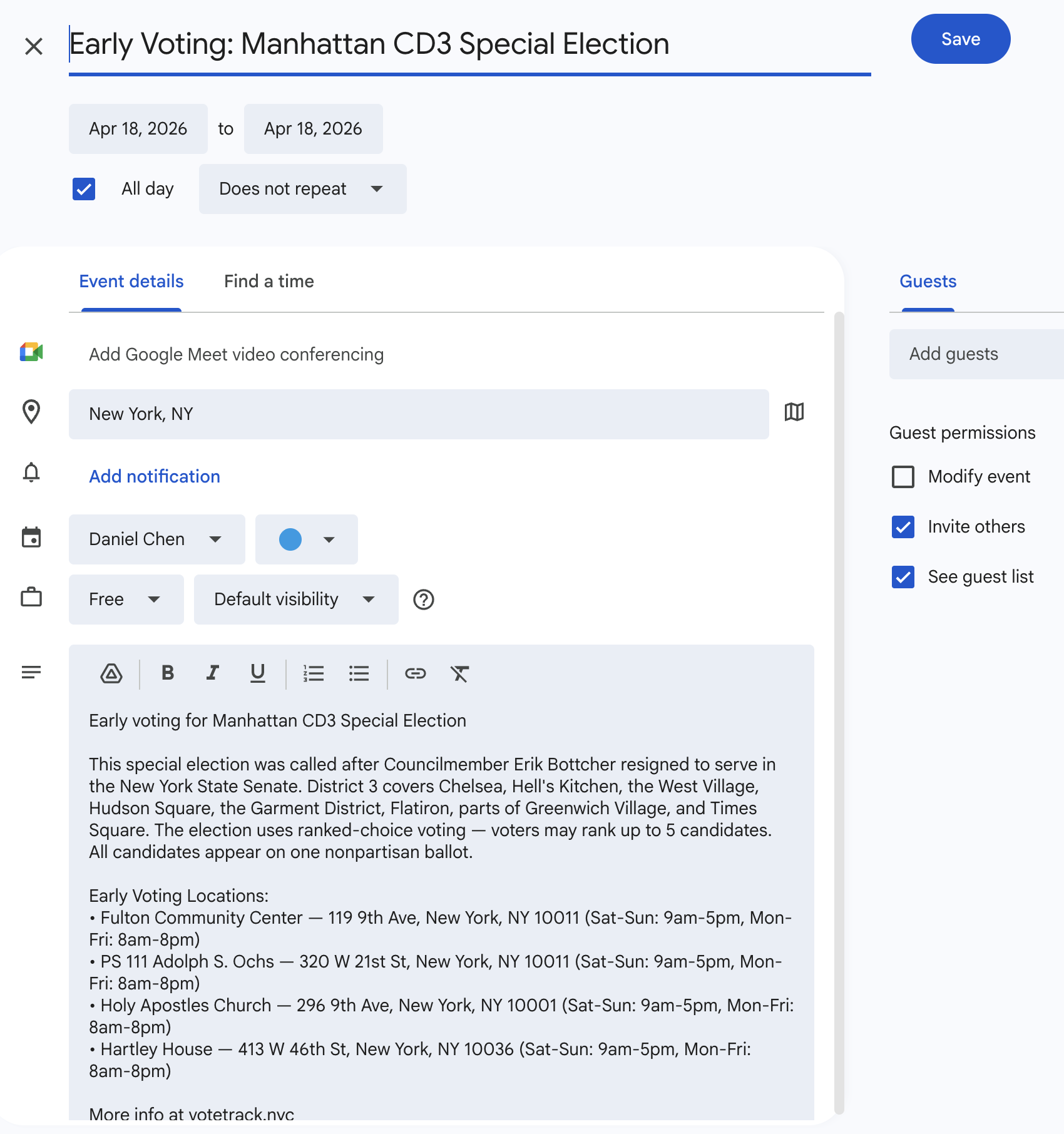
- Google Calendar Integration — One-click to add early voting and election day dates with polling locations.
How we built it
| Layer | Technology |
|---|---|
| Framework | Next.js 16 (App Router, Turbopack), React 19, TypeScript |
| Styling | Tailwind CSS 4, shadcn/ui (Base UI), Lucide icons |
| Database | Supabase (PostgreSQL) with Row Level Security |
| Auth | Supabase Auth (email + Google OAuth) |
| AI Chat | Gemini 3 Flash Preview with streaming SSE + Google Search grounding |
| AI Agents | Gemini 3 Flash Preview with structured JSON output + Google Search grounding |
| Maps | Google Places API (address autocomplete), Google Maps (polling site links) |
| Districts | Google Geocoding API + NYC GIS API + US Census Bureau geocoder |
| Drag & Drop | dnd-kit (core + sortable) |
| Markdown | react-markdown + remark-gfm + rehype-raw |
Architecture highlights:
- 12 pages, 7 API routes, 48 source files
- Client-side localStorage caching for AI responses (discovery, research, representatives) to minimize API calls
- SSE streaming for real-time research progress in admin panel
- Supabase RLS policies gate admin operations by
is_adminflag - District lookup chains 3 APIs (NYC GIS, Google Civic, US Census) with fallbacks
Challenges we ran into
- District mapping is hard. No single API covers all NYC district levels. We ended up chaining NYC's GIS API for city council, Google Civic Info for state-level, and US Census geocoder for assembly/senate/congressional — with coordinate-based fallbacks.
- Gemini structured output. Getting Gemini to reliably return valid JSON (not markdown-wrapped, not truncated) required careful prompt engineering and server-side cleanup (stripping code fences, fallback parsing).
- Google Civic Representatives API. The
representativesendpoint returned "Method not found" despite the API being enabled. We pivoted to using Gemini with Google Search grounding to look up representatives by district numbers — more reliable and richer data. - shadcn/ui on Base UI. The latest shadcn uses Base UI instead of Radix. Some components (Select, Dialog) behave differently — Select's
onValueChangecan passnull, Dialog has a hardcodedsm:max-w-smthat fights custom widths. - Rate limits. Heavy use of Gemini for discovery + research + representatives + chat can exhaust quotas quickly. We added aggressive localStorage caching (1h for discovery/research, 24h for representatives) to mitigate.
Accomplishments that we're proud of
- The AI agent pipeline actually works. An admin can click "Discover Elections," review real upcoming NYC elections found by Gemini, approve them, then click "Research" to auto-populate candidates and stances — all with a review workflow before anything goes public.
- True personalization. The ballot feed isn't just a list of elections. It filters by your exact districts and party registration, highlights candidate stances that match your interests, and the chatbot's system prompt includes your profile context.
- The RCV simulator. Ranked-choice voting is confusing. Being able to drag-and-drop candidates into ranked positions with visual feedback makes it tangible.
- End-to-end in a hackathon. Auth, onboarding, district lookup, personalized feeds, candidate profiles, comparison views, AI chat with session history, admin CRUD, AI agents, representative lookup — all wired together and functional.
What we learned
- Prompt engineering is the new API design. The quality of our AI features depended entirely on how precisely we prompted Gemini — field names, valid values, output format, grounding instructions.
- Cache everything. AI API calls are slow (5-15s) and rate-limited. localStorage caching transformed the UX from painful to instant on repeat visits.
- Supabase RLS is powerful. Row Level Security let us gate admin operations at the database level without writing authorization middleware — admin checks happen in SQL policies.
- NYC open data is fragmented. District boundaries, election info, and representative data are spread across dozens of incompatible APIs. Unifying them into a coherent user experience was the hardest infrastructure problem.
What's next for VoteTrack
- Email & SMS alerts — Opt-in reminders for early voting, election day, and new candidate stances
- Polling site maps — Interactive map view of nearby polling locations with walking directions
- Multi-language support — NYC has 8 official ballot languages
Built With
- gcp
- gemini
- next.js
- supabase
- typescript


Log in or sign up for Devpost to join the conversation.