-
-
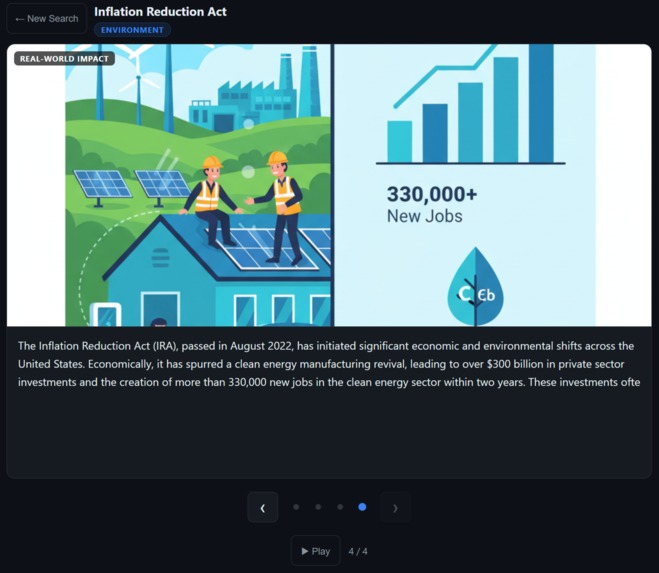
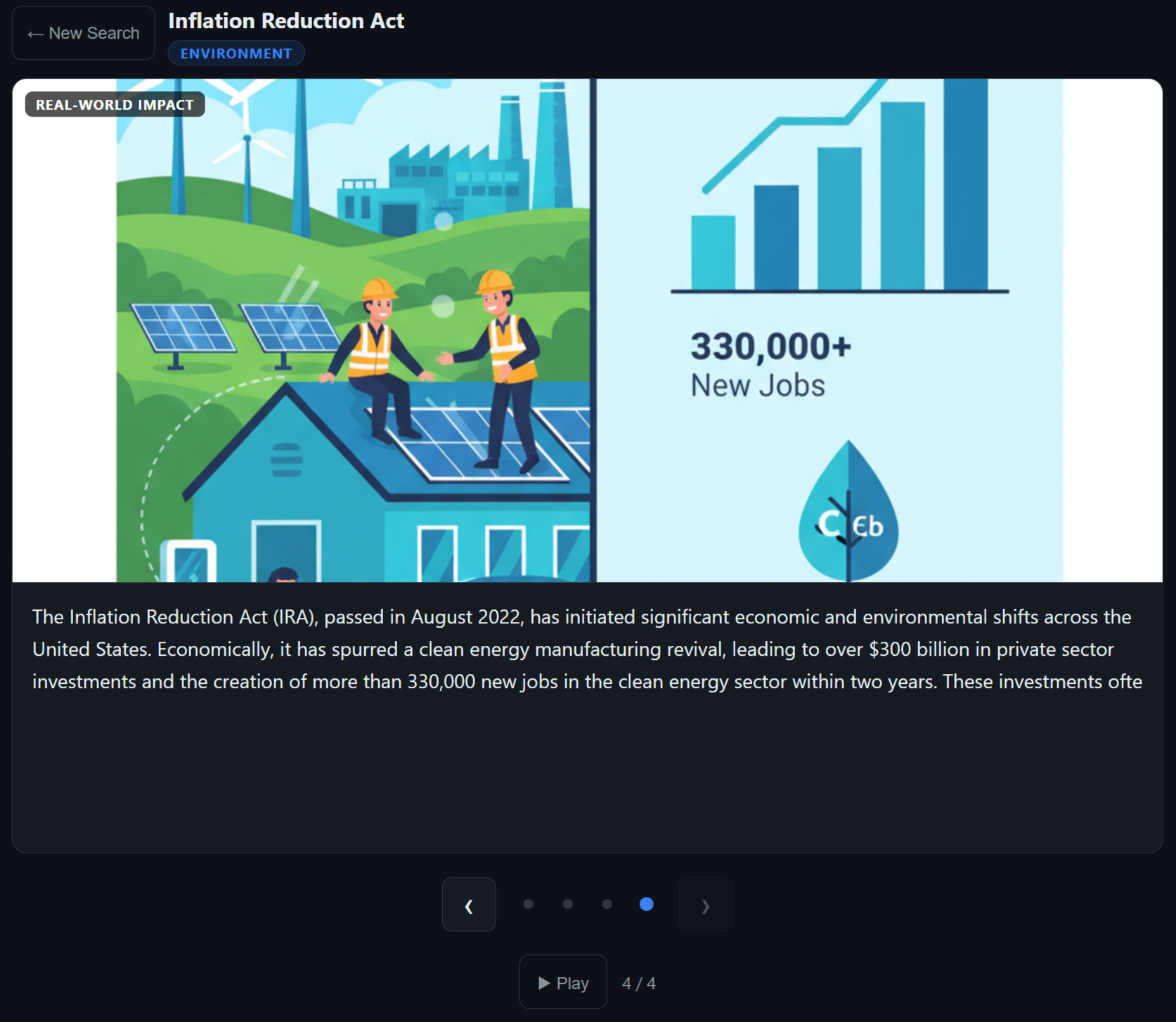
Screenshot from VoteVerdict
Inspiration
Americans are increasingly polarized or tuned out from the legislation that shapes their daily lives, and I wanted to make civic information visceral — not a wall of text, but a narrated story with faces, votes, and real-world impact.
What it does
VoteVerdict produces a multimedia story that explains how a given bill becomes law and the impacts of that law in society and the user's community, via a four-pane narrative with audio and imagery, all generated by Gemini AI.
How we built it
VoteVerdict uses Google ADK to orchestrate a Gemini 2.5 Flash research agent that maps any voice or text query to landmark US legislation via Wikipedia and Google Search, pipes the output through a deterministic story composer, and then generates all $n = 4$ slides in a single interleaved response_modalities=["TEXT", "IMAGE"] call, followed by concurrent per-slide TTS narration.
Challenges we ran into
The hardest part was coordinating the full media pipeline — research JSON → story structure → illustrations → audio — as a single coherent sequence: the interleaved image API required a per-slide healing pass for missed images, Gemini's restriction on mixing built-in google_search with custom function-calling tools forced a dedicated sub-agent workaround, and getting the agent to return structured research JSON (rather than answering from training data and skipping tool calls entirely) required careful instruction design.
Accomplishments that we're proud of and Learnings
The most important thing I learned is that observability is non-negotiable for generative pipelines — without Opik traces on every LLM call, it was nearly impossible to tell whether poor output was an agent instruction problem, a model capability limit, or a parsing bug downstream.
What's next for Vote Verdict
Possible integrations into vote tabulation APIs, experiments in civic engagement.

Log in or sign up for Devpost to join the conversation.