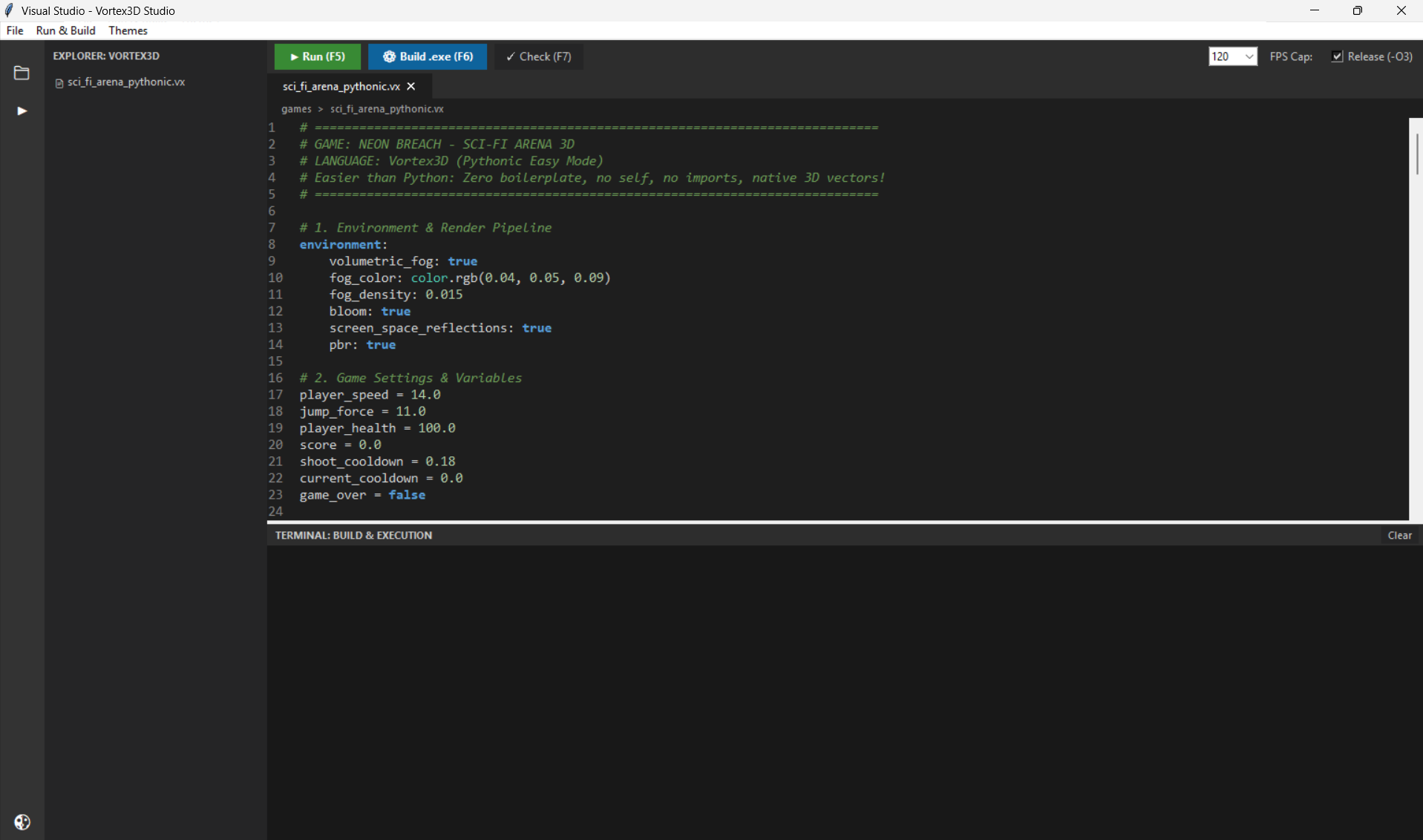
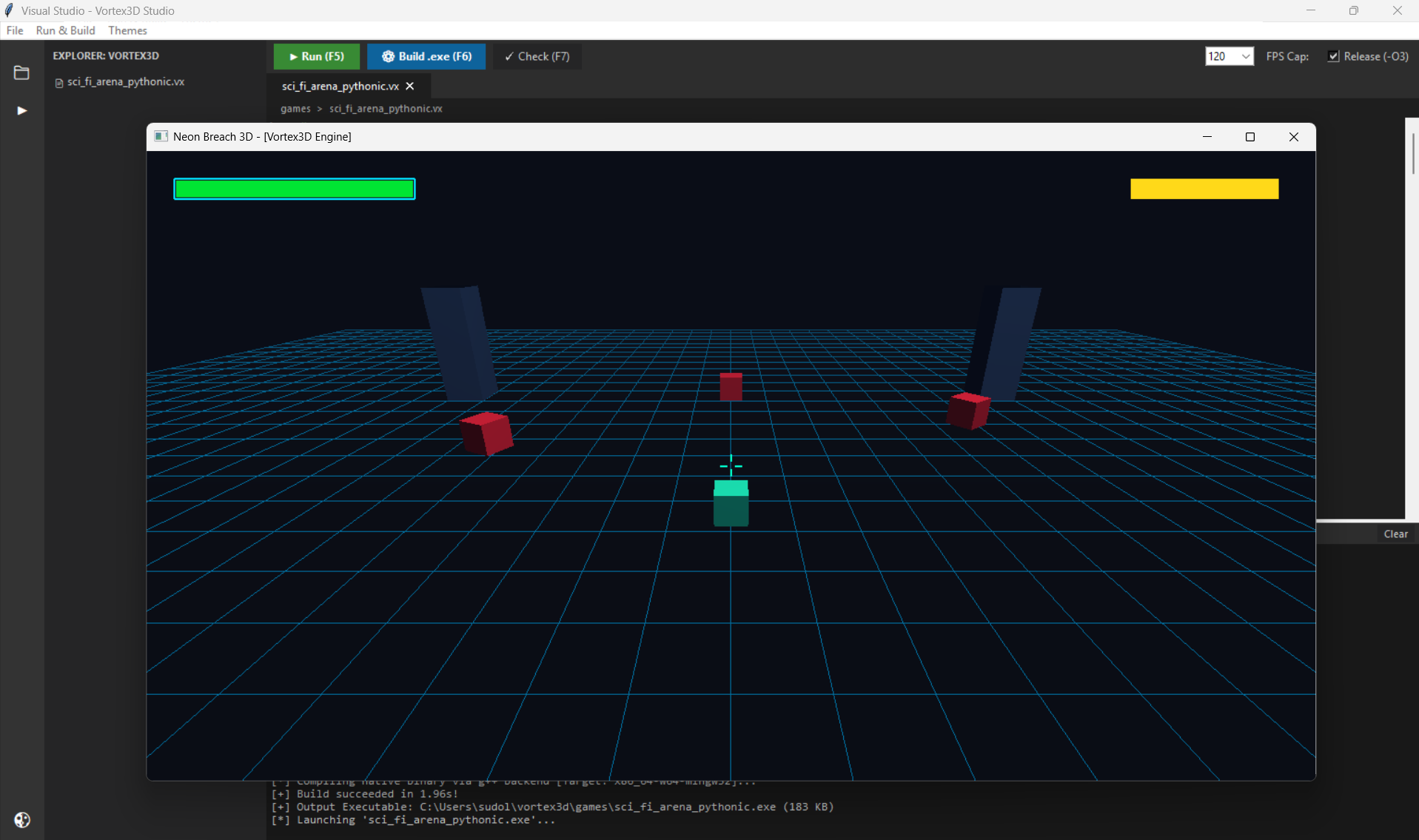
Making 3D games is notoriously hard. Traditional game engines and graphics libraries require thousands of lines of boilerplate code, complex memory setups, and heavy configuration just to display a simple lit object.We created Vortex3D to solve this problem. Our goal was simple: What if writing a 3D game was as easy as typing plain English? We wanted to eliminate engine clutter so developers, students, and rapid prototypers could turn their ideas into playable 3D worlds in minutes instead of weeks.How We Built ItVortex3D is an all-in-one game creation workspace made up of three core components:The Custom Language (.vtx): A human-readable language that replaces complex 3D matrix math ($\mathbf{P}{screen} = \mathbf{M}{projection} \cdot \mathbf{M}{view} \cdot \mathbf{P}{local}$) with intuitive keywords like mesh, light, rigidbody, and on collision.The Compiler: A Python parser built using lark that reads .vtx code, translates it into an Abstract Syntax Tree (AST), and transpiles it into optimized, runnable target code.The Custom IDE: A lightweight code editor featuring syntax highlighting, an integrated build console, and a 1-click "Compile & Run" button that compiles code and launches the 3D game instantly.Challenges We FacedBalancing Simplicity and Control: Designing syntax that felt effortless without stripping away creative freedom. Keywords like spawn enemy needed to be simple while still allowing custom speed and movement controls.Linking the IDE to the Compiler: Connecting our custom editor directly to the backend compiler so that syntax errors pop up in real time and compiled games launch seamlessly with a single click.What We LearnedBuilding Vortex3D gave us a deep understanding of compiler engineering—how text turns into tokens, how ASTs structure logic, and how high-level code converts into fast executables. Most importantly, we learned that reducing developer friction through clean language design opens up game creation to everyone.
vortex3d
Vortex3D pairs a compiled DSL with a custom IDE to make 3D game creation simple. Turn clean .vtx code into high-performance native 3D games in one click, without heavy engine boilerplate.
Updates

Leave feedback in the comments!