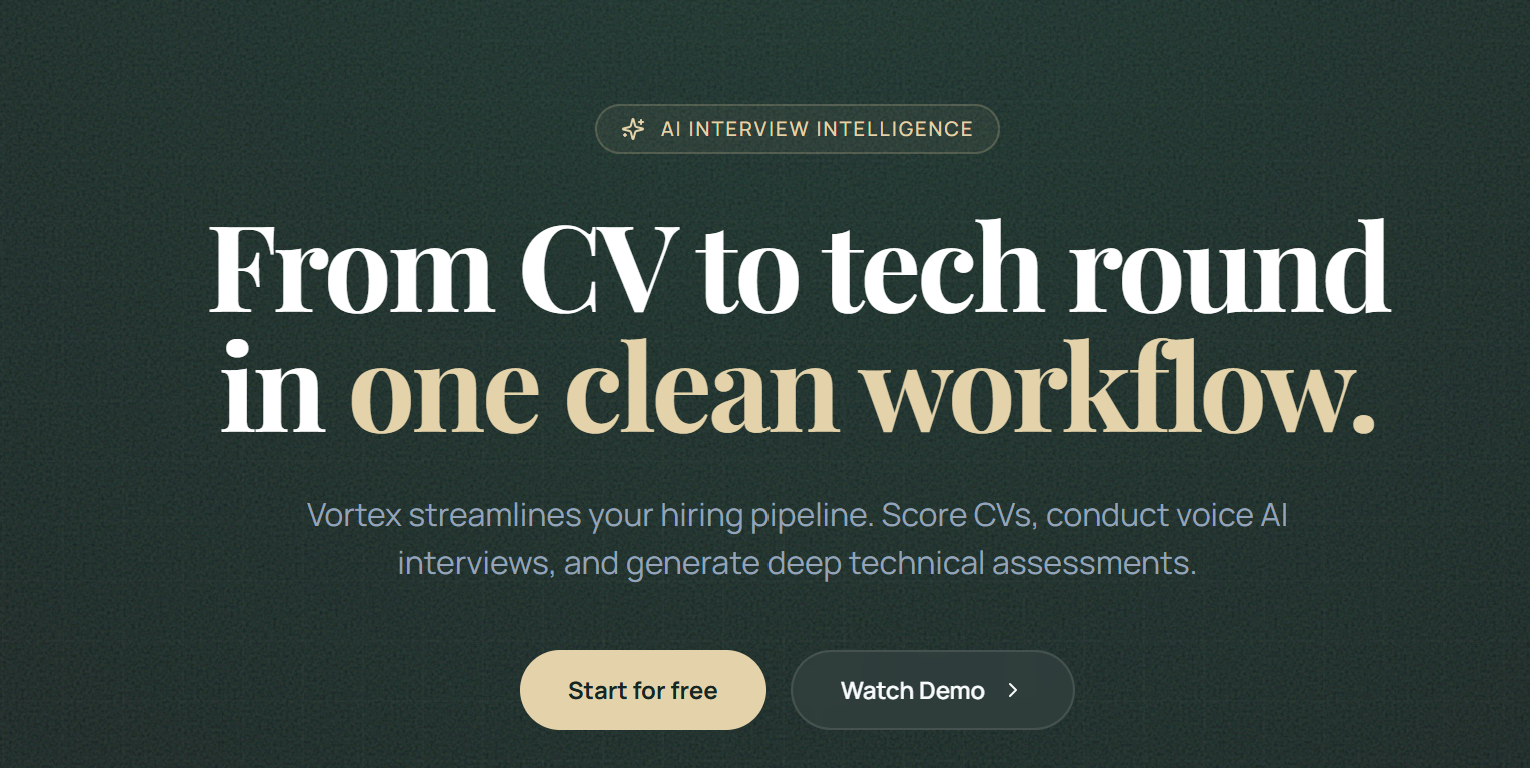
What is Vortex? Vortex is a premium, three-stage AI-powered interview preparation platform built to help users practice the full hiring journey in one connected workflow.
Stage 1 is Automated CV Screening. Users upload their resume and provide a target role plus job description. Vortex analyzes the CV, scores role fit, and generates structured feedback on strengths, risks, and improvement areas.
Stage 2 is The Recruiter Interview. This is a live voice-to-voice behavioral round where Vortex simulates a recruiter-style conversation and evaluates the user’s spoken responses for clarity, communication quality, relevance, and overall interview presence.
Stage 3 is The Technical Interview. Users enter a live coding and technical assessment environment where Vortex generates role-aware technical questions and coding tasks, then evaluates both their written reasoning and code quality.
All of this is wrapped in a polished, premium interface designed to make interview practice feel structured, calm, and high-quality rather than stressful or generic.
How we built it We built Vortex as a full-stack AI interview workflow focused on speed, usability, and structured feedback.
Frontend: Built with React and Vite, styled with Tailwind CSS, and designed around a modern, premium UX. We integrated @monaco-editor/react for the live coding experience and @elevenlabs/client for real-time voice interview sessions.
Backend: A modular Node.js and Express server powers secure API routing, CV analysis, prompt orchestration, technical question generation, and interview evaluation.
Database & Auth: We use Supabase for authentication and PostgreSQL-backed application data, with client-side interview flow managed through Zustand for a smooth multi-stage experience.
The AI Layer: OpenAI powers CV analysis, technical question generation, structured scoring, and interview feedback. ElevenLabs powers the real-time voice interview experience.
Challenges we ran into One of the biggest challenges was making a three-stage pipeline feel connected instead of fragmented. The CV screening needed to generate useful context that could carry forward into both the behavioral and technical stages. Another challenge was getting AI outputs into a consistent JSON structure so the frontend could reliably render scorecards, feedback panels, and summaries without breaking. We also had to make the voice interview experience feel responsive and stable enough to support realistic practice.
Accomplishments that we’re proud of We’re especially proud of the way Vortex keeps context across the entire workflow. Instead of treating CV review, voice practice, and technical evaluation as separate tools, Vortex connects them into one coherent interview simulation. We’re also proud of the product design direction: the interface feels intentional, premium, and much closer to a polished platform than a prototype.
What we learned We learned a lot about orchestrating multi-step AI workflows, especially how important predictable structured outputs are when AI directly powers user-facing product features. We also learned how much product quality comes from continuity: users get more value when each stage builds naturally on the previous one rather than resetting context.
What’s next for Vortex Our next step is to make Vortex even more adaptive and role-aware. We want to improve interview personalization, deepen technical evaluation, and build richer progress analytics across attempts so users can clearly see how they’re improving over time. Long term, we want Vortex to feel less like a single simulator and more like a complete interview operating system.
Built With
- elevenlabs
- express.js
- jigsawstack
- manus-ai
- node.js
- openai
- pgvector
- postgresql
- railway
- react
- supabase
- tailwind-css
- vercel


Log in or sign up for Devpost to join the conversation.