-
-
Architecture Diagram
Inspiration
Vortex AI was born out of the need to streamline and enhance code reviews using the power of AI. We wanted to build a tool that could help developers quickly understand, review, and act on code changes especially in large, fast-moving projects. By integrating GitHub workflows with modern AI models and AWS infrastructure, we aimed to remove the bottlenecks in traditional code review processes.
What it does
Vortex AI is a GitHub-integrated application that listens to events like pull requests and commit pushes. When a developer opens or updates a pull request, Vortex AI automatically analyzes the code changes using an AI model and generates an intelligent review. This review is then turned into a clean, well-formatted PDF and sent directly to the developer or reviewer via email, making it easy to track changes, identify issues, and maintain high code quality.
How we built it
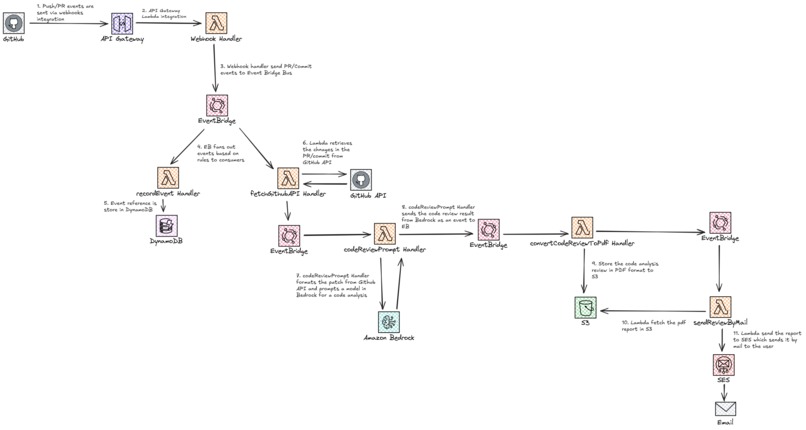
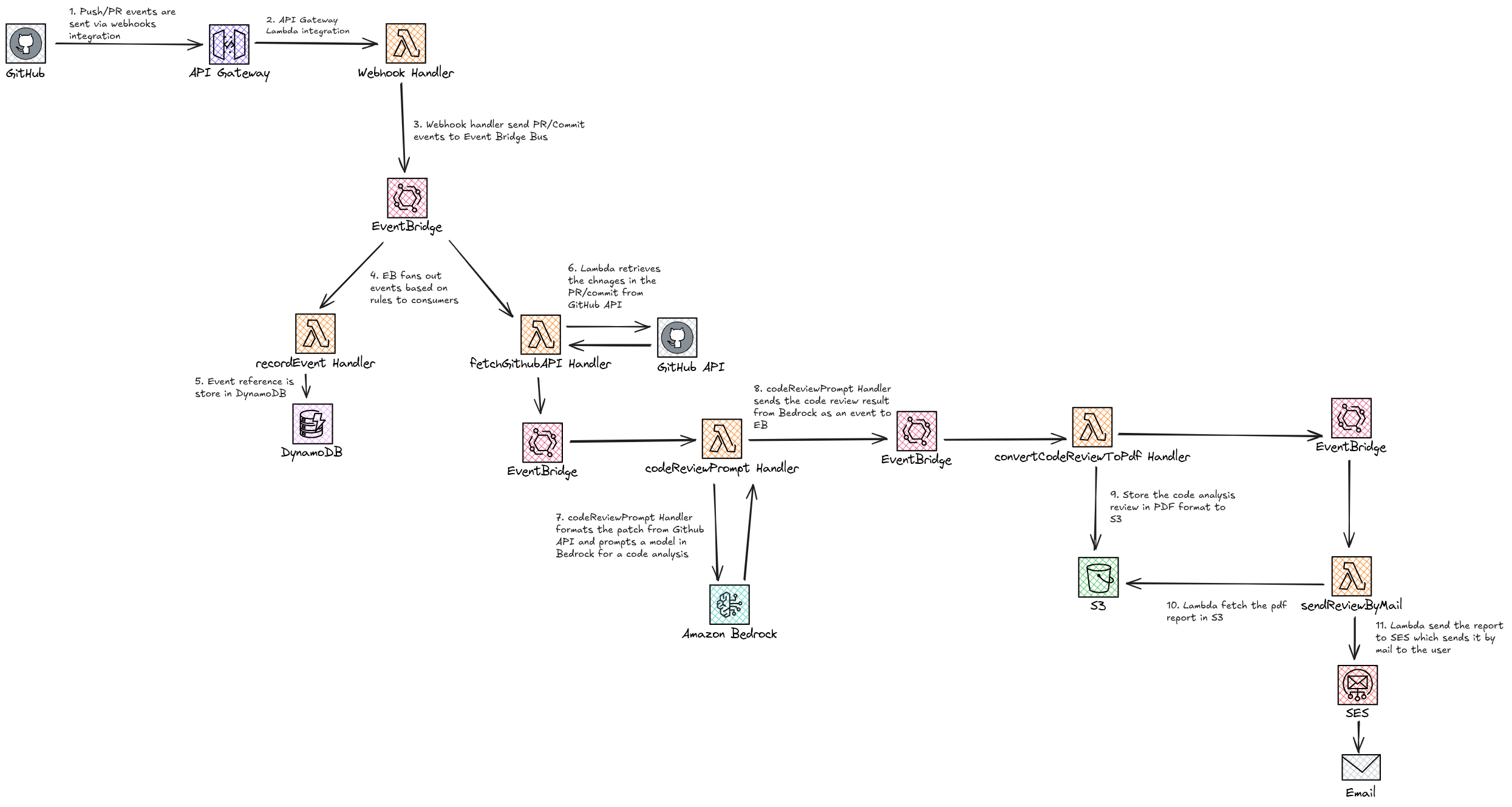
We built Vortex AI using a modern, event-driven architecture on AWS:
GitHub App: Installed on repositories to listen for pull request and commit events.
EventBridge: Routes GitHub webhook events to appropriate Lambda functions.
Lambda Functions: Handle various tasks—fetching diffs from GitHub, invoking Bedrock AI models for code analysis, generating PDFs, and emailing results via SES.
DynamoDB: Used for lightweight metadata storage and deduplication.
Amazon Bedrock: Powers the intelligent code review using foundation models like Claude 3.
S3: Stores the generated review PDFs.
SES: Sends the final report to users. We developed everything using TypeScript and the AWS CDK to ensure reproducible infrastructure and seamless deployment.
Challenges we ran into
GitHub App Authentication: Managing JWT and installation tokens securely and correctly was tricky.
Diff Parsing: Generating accurate diffs that work across different event types required careful handling of GitHub’s API edge cases.
Event Coordination: Ensuring that downstream steps (like AI analysis and email delivery) only occur after all necessary upstream data is ready.
Bedrock Integration: Tuning prompts and managing timeouts to get high-quality, consistent responses from the AI model.
Accomplishments that we're proud of
Built a full, production-ready GitHub App workflow using serverless infrastructure.
Successfully integrated with Amazon Bedrock to leverage state-of-the-art AI models.
Automated a formerly manual and error-prone task (code review) in a way that is developer-friendly and scalable.
Achieved clean separation of concerns between event ingestion, analysis, and notification workflows.
What we learned
How to build event-driven applications using AWS EventBridge and Lambda.
The best practices for integrating with GitHub Apps, including authentication and permissions handling.
How to generate and style dynamic PDFs programmatically.
Techniques for prompting and working with foundation models like Claude 3 for code analysis.
What's next for Vortex AI
UI Dashboard: Build a web interface for viewing past reviews, configuring the app, and tracking review history.
Custom Review Policies: Allow teams to define their own linting or security rules via a config file.
Real-time Review Chatbot: Use AI to enable interactive feedback inside GitHub PR threads.
Marketplace Launch: Package Vortex AI for public release on the GitHub Marketplace.
Built With
- cdk
- nextjs
- typescript


Log in or sign up for Devpost to join the conversation.