Inspiration
Teachers constantly collect clues about what students understand, but rarely have enough time to turn every quiz, homework response and classroom activity into useful, outcome-linked evidence.
Competitive classroom quizzes are engaging, but usually end with a score. Homework can reveal deeper misconceptions, yet manually marking it often means the insight arrives too late to change the next lesson. A normal teacher cannot continuously diagnose every curriculum outcome for every learner while also planning, teaching and providing meaningful feedback.
We built Voppo to close that gap.
What it does
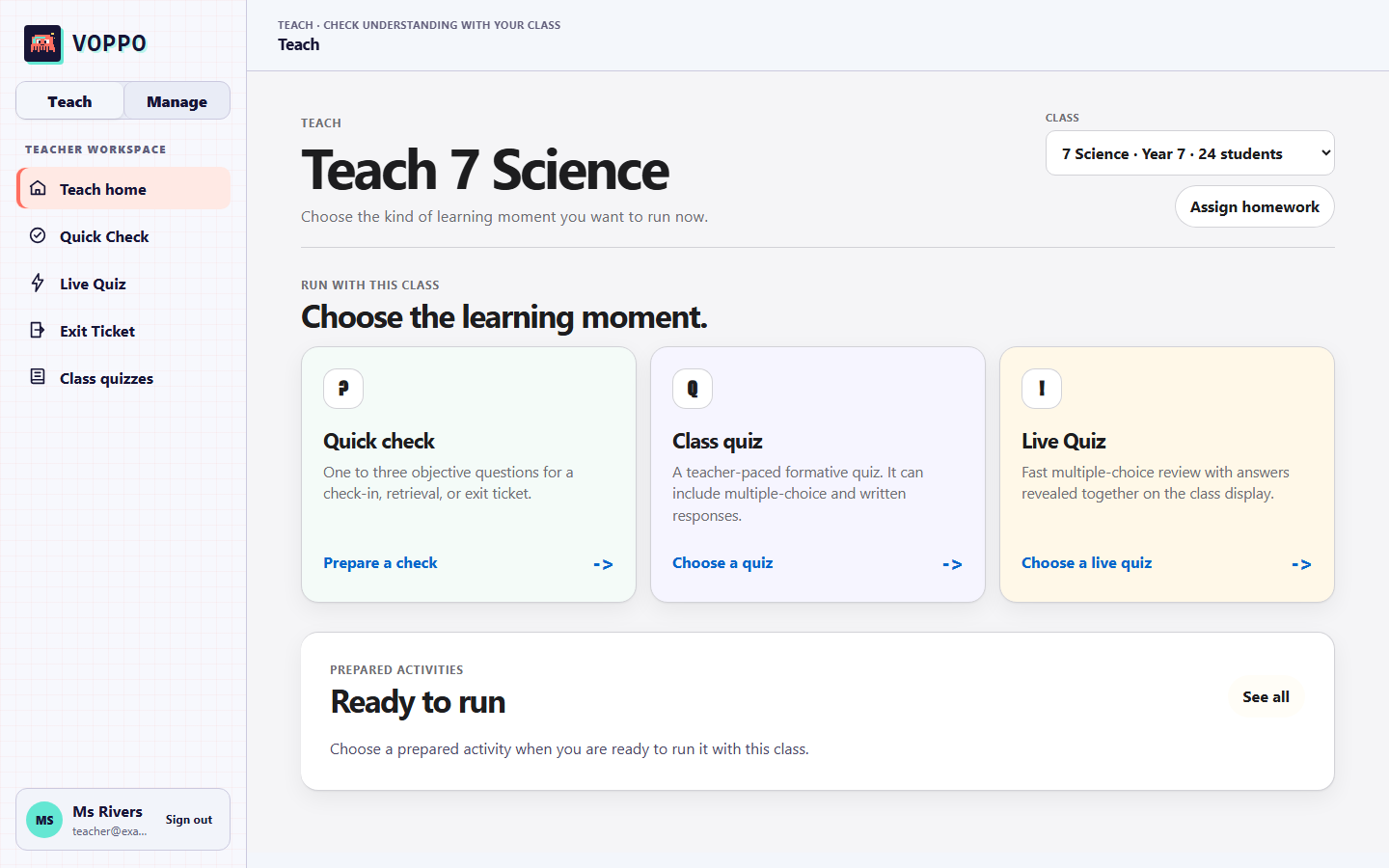
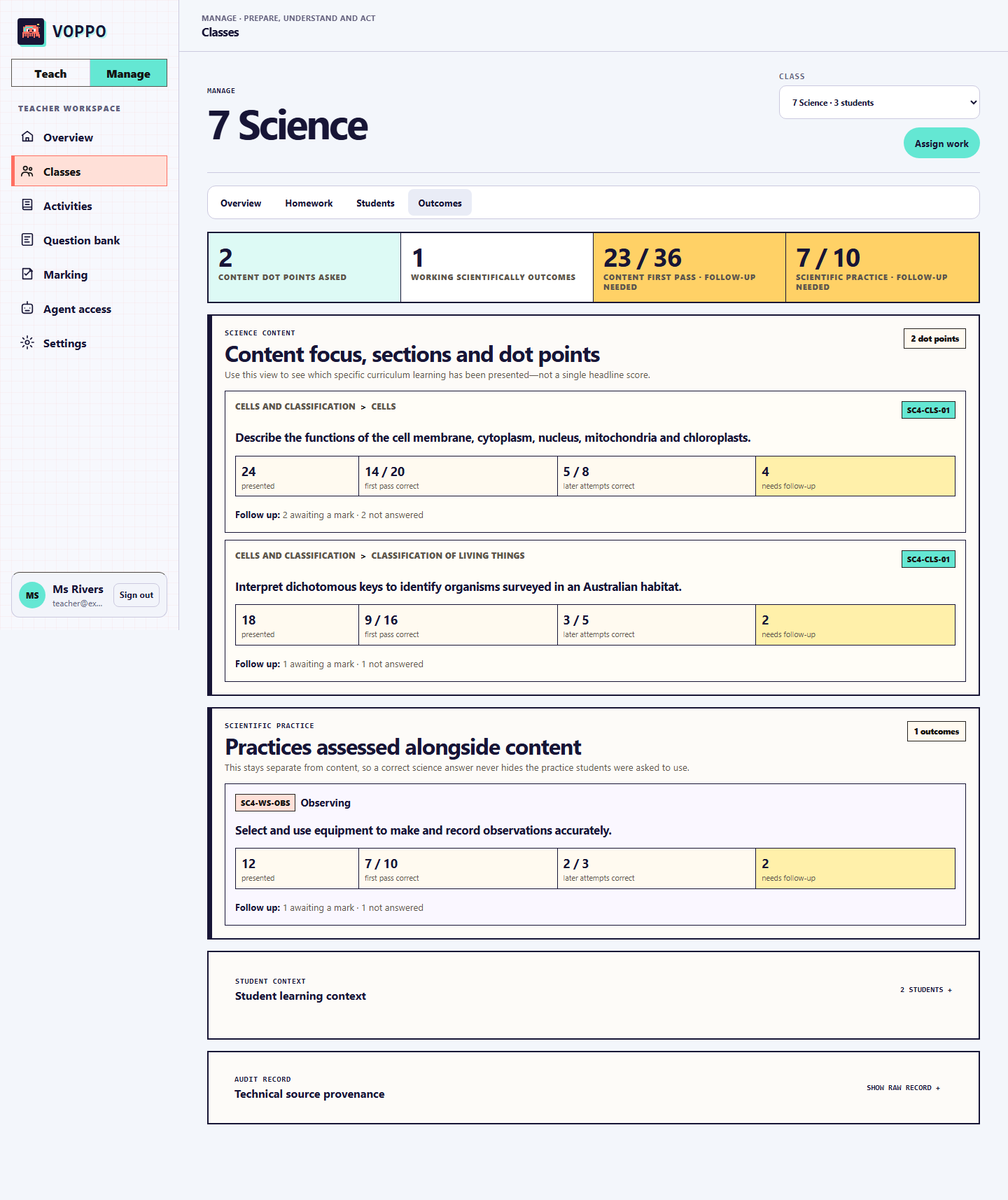
Voppo combines the energy of a live classroom quiz with homework, quick checks, teacher-paced class quizzes and controlled formal assessment. Every question can be linked to a curriculum outcome, so student responses build a picture of what the class—and each individual learner—actually understands.
A teacher can move between distinct learning modes:
- Quick Check for a short classroom pulse;
- Live Quiz for fast, competitive participation;
- Class Quiz for teacher-paced formative assessment;
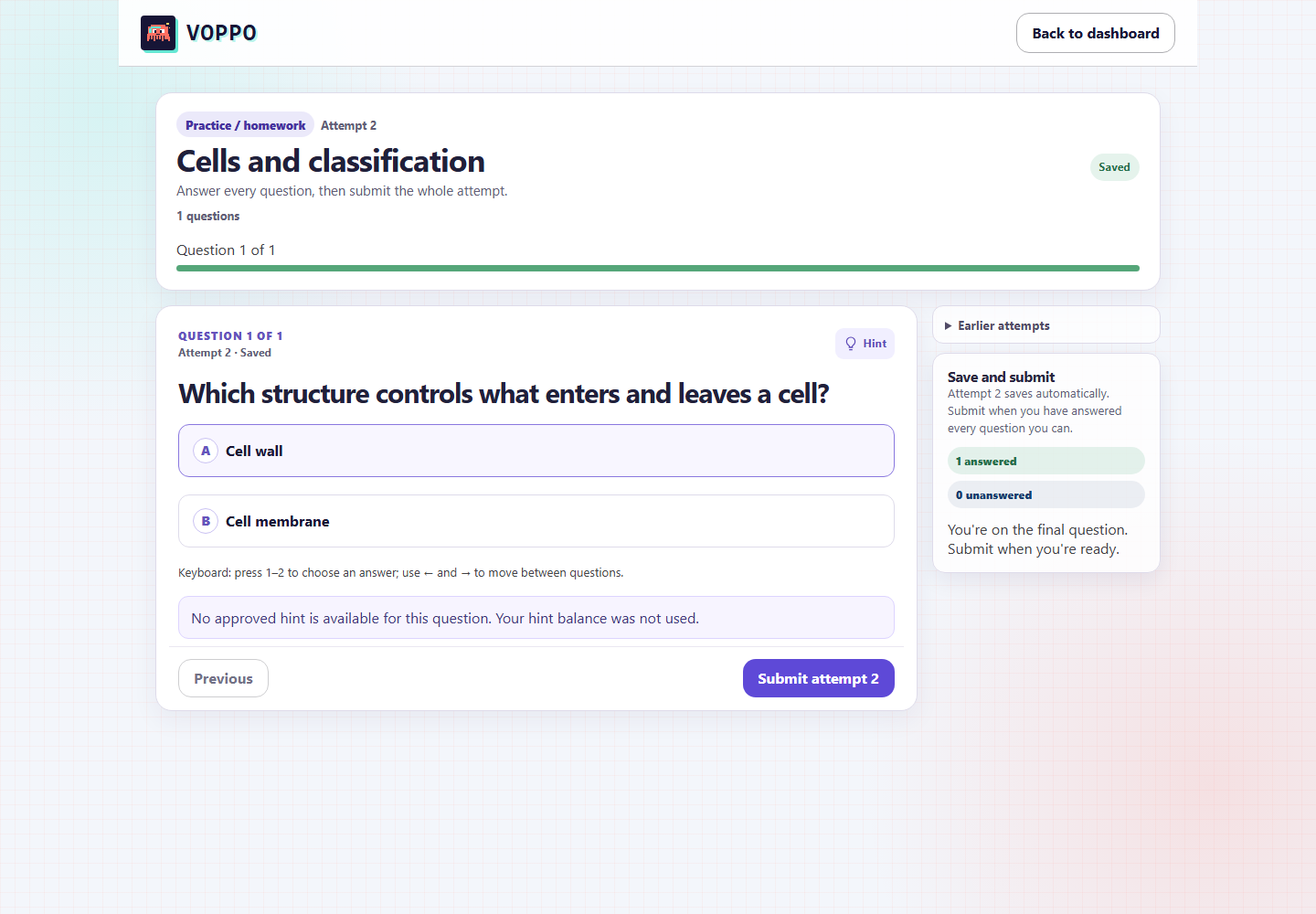
- Homework for deliberate whole-attempt practice and follow-up;
- Formal assessment with controlled submission, withholding and release.
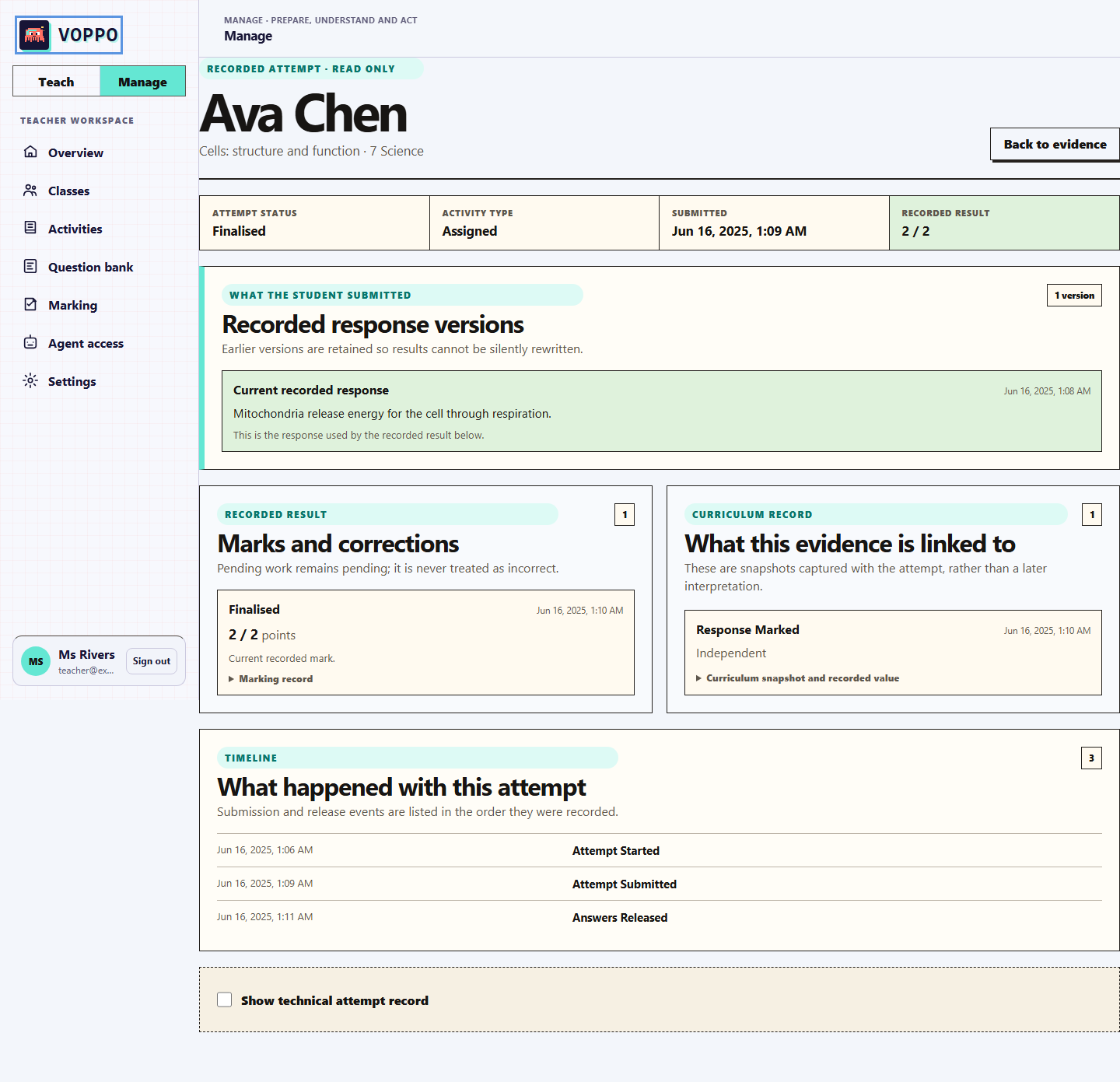
Each mode has its own retry, marking and feedback policy, but every response can contribute to the same versioned curriculum-evidence model.
Configured AI models can assess short answers against a frozen rubric and focus on subject meaning when spelling and grammar are not the assessed skills. Uncertain decisions fail closed for teacher review rather than being confidently marked incorrectly. Teachers remain responsible for marks, corrections, feedback and release.
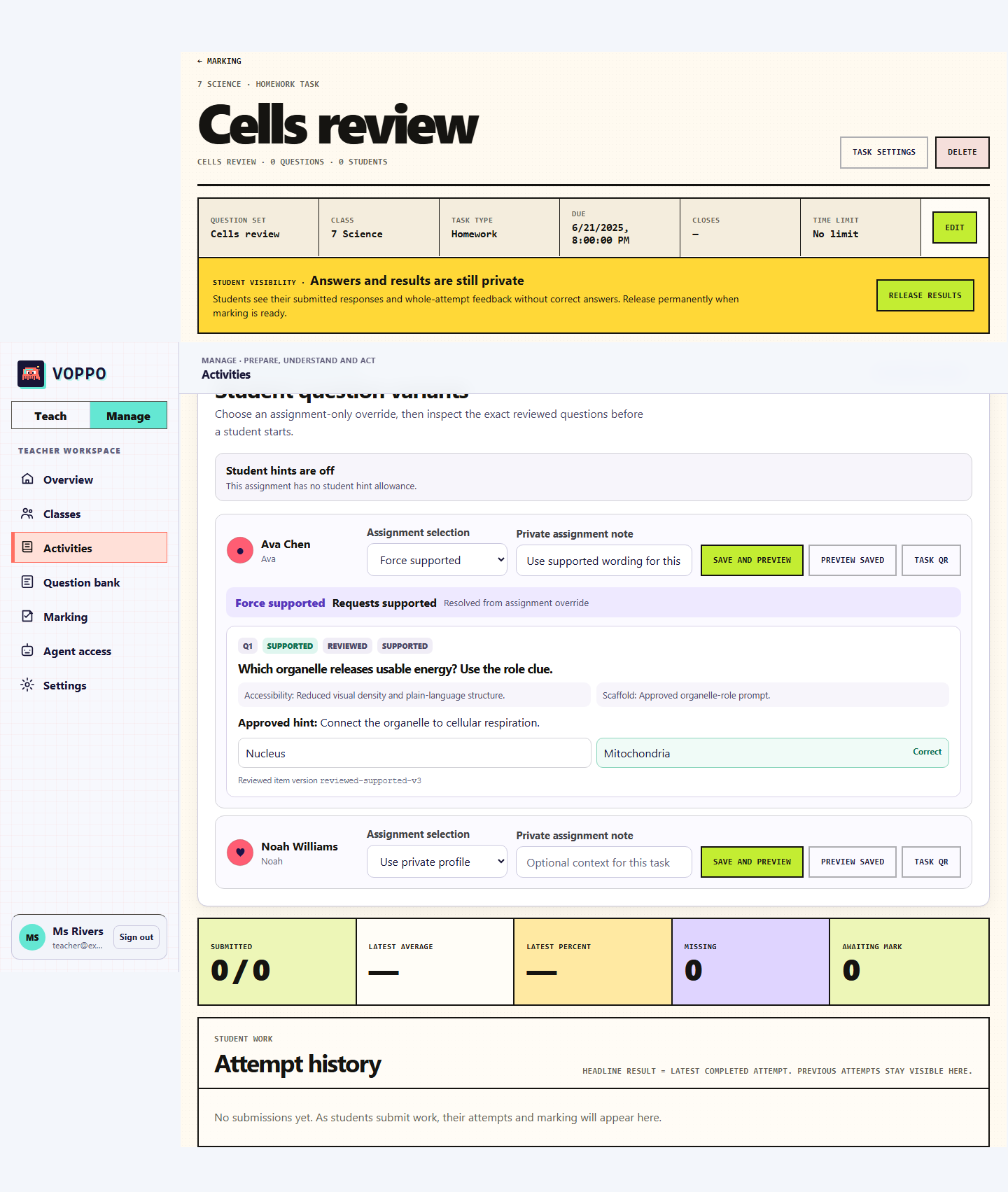
Differentiation is built into the assessment itself. Students can receive core, supported or stretch questions, approved hints and private scaffolding without being publicly labelled. Voppo records which pathway and support were used, keeping the resulting evidence honest.
Why it matters
The most important result is immediate teaching action.
If half the class misunderstood a concept in last night's homework, the teacher can see that pattern before the next lesson and reteach it today. If one learner is struggling—or ready for greater challenge—the teacher can respond discreetly before the gap grows.
Voppo turns assessment from a record of what already happened into information that changes what happens next.
How we built it
Voppo is a React and Vite single-page client served by a Fastify and TypeScript application. It uses SQLite for the local-first pilot data model and WebSockets for live delivery.
The assessment model stores versioned activities, curriculum mappings, differentiation context and immutable evidence snapshots. Starting an attempt freezes the exact question, rubric, feedback policy, marking policy and curriculum mapping used for that learner. Later content edits cannot silently rewrite historical evidence.
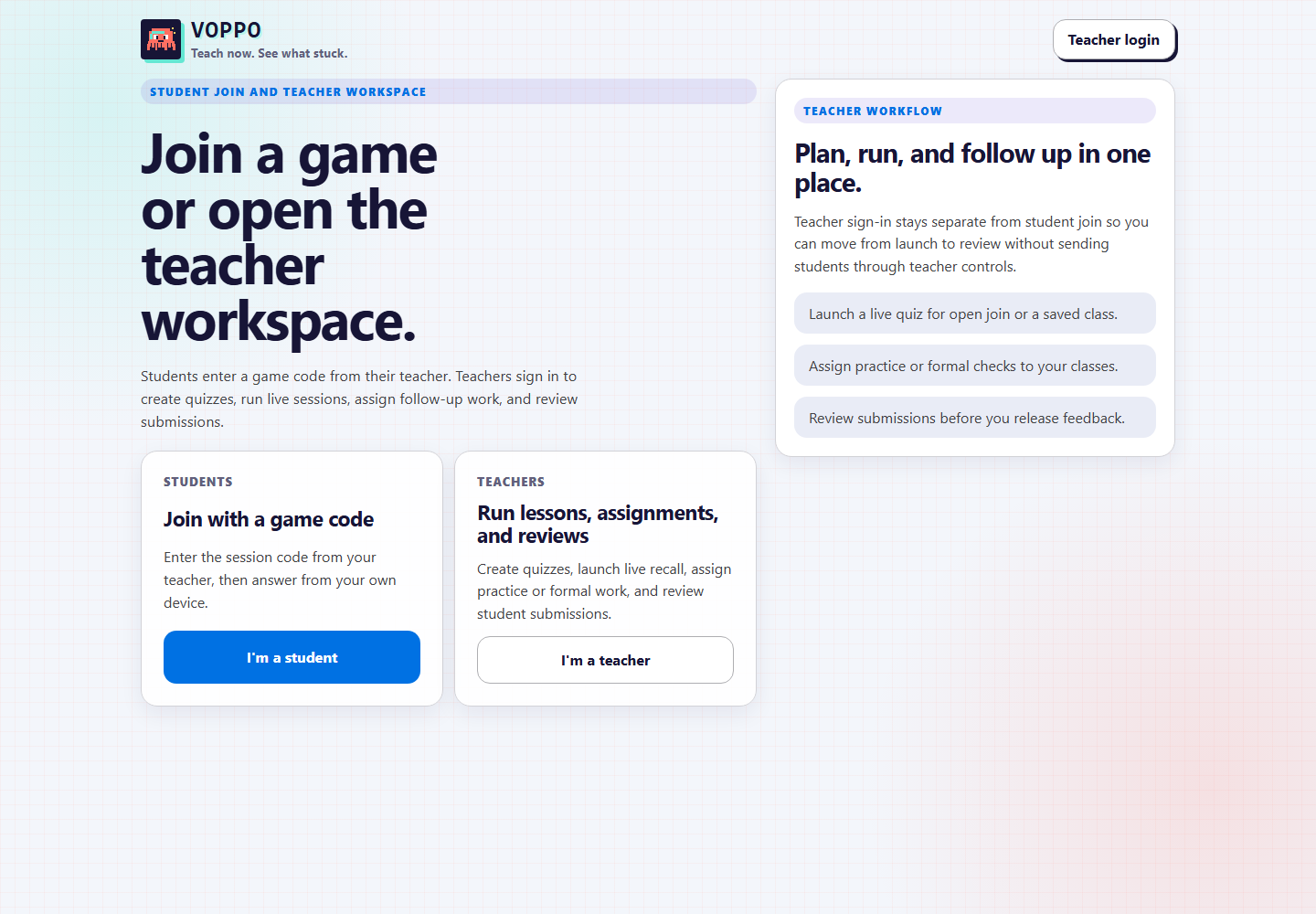
Teacher, student, live host and public projector surfaces have separate authority and disclosure boundaries. Answers, response ownership and distributions remain private until the teacher-controlled release point.
The submitted demonstration runs from a fresh synthetic Year 7 Science fixture and does not require a production database, real roster or external model provider.
How Codex and GPT-5.6 accelerated the work
Voppo began as an existing self-hosted classroom quiz project. During OpenAI Build Week, we used Codex with GPT-5.6 as an iterative engineering partner to transform it into a broader outcome-linked assessment platform.
Codex explored the existing React, Fastify, SQLite and WebSocket codebase; traced policies across teacher, student, host, projector and API surfaces; implemented and refined TypeScript and SQL changes; and produced focused automated tests and submission documentation.
It was especially valuable for finding places where a seemingly small product decision had system-wide consequences. With Codex, we could trace release policy, identity, immutable attempts, curriculum evidence, differentiation and semantic marking across persistence, authorization, user experience and tests without losing the existing pilot work.
The final candidate passed the complete verification chain and 76 Playwright browser tests. The linked Git history and Codex session provide the dated evidence for this work.
Challenges
- Designing genuinely different assessment modes instead of applying cosmetic labels to one quiz flow.
- Preserving evidence across later content edits, retries and teacher corrections.
- Keeping teacher controls private from student and projector views during live delivery.
- Making AI marking useful without treating model output as an unquestionable markbook decision.
- Supporting private differentiation without publicly labelling students or hiding scaffold use from the evidence.
- Keeping the deployment claim honest: one teacher and their classes on a local-first Windows pilot, not an unverified school-wide service.
Accomplishments
- A shared evidence model that keeps the assessed version, response, marking, feedback and curriculum record together.
- Outcome-linked reporting that can turn last night's homework into today's reteaching decision.
- Fail-closed semantic marking for short responses, including spelling-error calibration and teacher review.
- Private core, supported and stretch variants with bounded approved hints.
- Mode-aware feedback and release policies across homework, classroom, live and formal assessment.
- A reproducible synthetic evaluator path spanning teacher preparation, student work, evidence review and live delivery.
- Scoped agent credentials for permitted authoring and reporting, separate from marking and finalization authority.
What we learned
Assessment UX is policy UX. Retry rules, release timing, scaffolding and feedback cannot be added as an afterthought once a quiz screen exists.
We also learned that the most valuable AI feature is not automated scoring by itself. It is shortening the path from a student response to a trustworthy, outcome-linked teaching decision. That still requires visible authority boundaries: a model suggestion is not a teacher decision, and an authoring capability is not permission to alter a markbook.
What's next
The next step is a controlled single-teacher Windows classroom pilot using synthetic rehearsal first, followed by approved school data only after the operational and governance checks are complete. We will continue refining the teacher, student and projector workflow from real classroom feedback before considering any broader deployment.
Voppo: Assessment that changes tomorrow's lesson.
Built With
- codex
- fastify
- gpt-5.6
- mcp
- node.js
- playwright
- react
- sqlite
- typescript
- vite
- websockets
- windows-dpapi

Log in or sign up for Devpost to join the conversation.