Inspiration
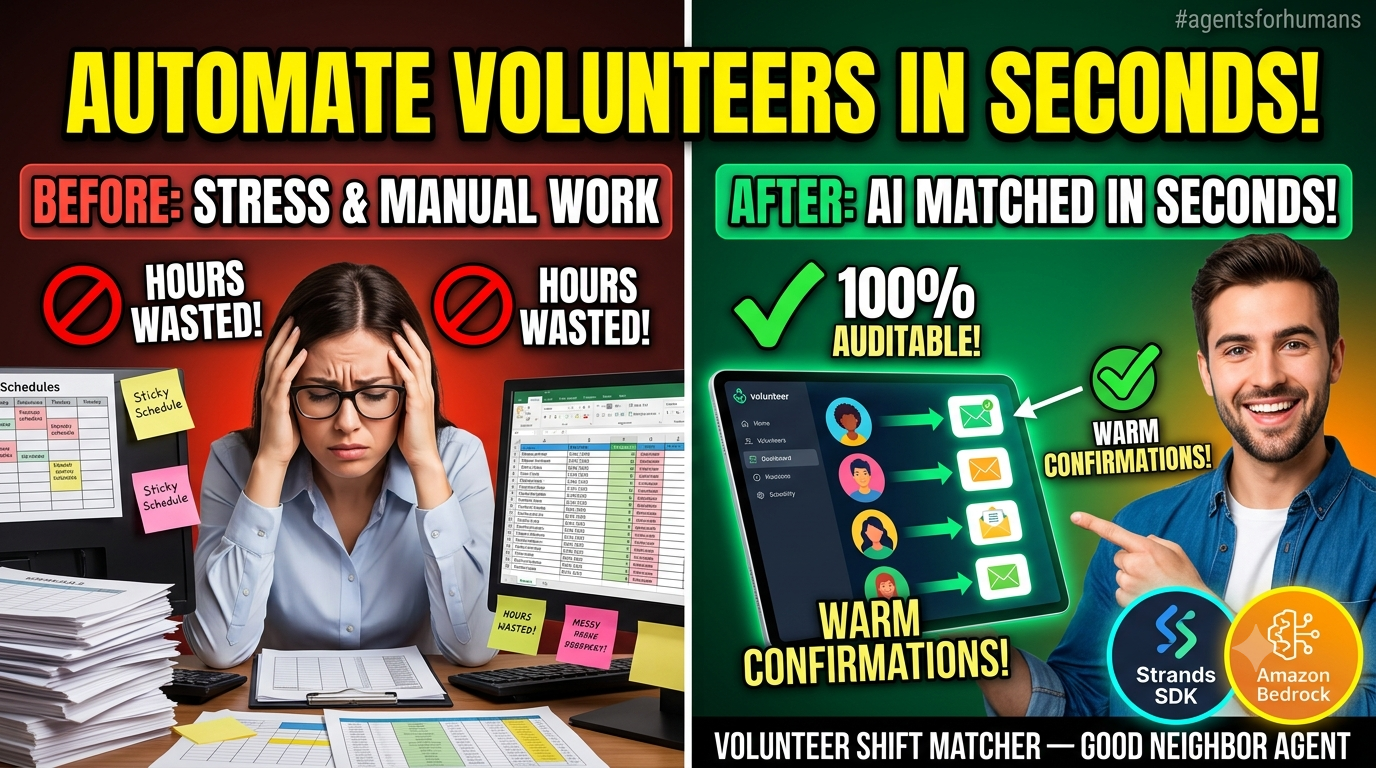
I didn't start with an AI idea — I started with a person. Picture the volunteer coordinator at a small food bank: a spreadsheet of who's free when, a list of shifts that need covering this weekend, and a group chat that never stops buzzing. Every week she cross-references availability against skills against shift times, in her head, while doing five other jobs. Shifts fall through the cracks — and an unfilled shift means food doesn't get sorted and neighbors don't get served. The Good Neighbor Agents track names this exact pain: "matching volunteers to the shifts a food bank actually needs."
What it does
Given a list of open shifts (role, date, time, how many people are needed) and a pool of volunteers (skills + availability), the agent:
- Produces an auditable match plan — who is assigned to each shift.
- Drafts a warm confirmation message for every assigned volunteer.
- For any shift it can't fully fill, drafts a ready-to-send "help needed" broadcast describing the exact gap (e.g. "need 1 more driver for Saturday, 10am–1pm").
- Outputs both structured JSON and a clean, colour-coded visual summary.
Crucially, it's honest about the shifts it can't fill — instead of hiding a gap, it surfaces it and writes the outreach to close it.
How we built it
It's built with the Strands Agents SDK. The design splits the work in two:
- A deterministic Python
@tool(match_shifts) computes the assignments — role eligibility, full time-window coverage, no double-booking, and gap flagging. Because it's plain Python, the "who goes where" decision is reproducible and auditable, not an LLM guess. - The agent's LLM (Amazon Bedrock, Claude Sonnet 4) turns that verified plan into the warm, natural-language confirmation and broadcast messages.
We wrapped the same agent in a Streamlit UI and deployed it free on Streamlit Community Cloud so anyone can try it. The public demo runs keyless (offline-safe default); an optional panel lets a visitor run the live Bedrock agent with their own temporary STS credentials — session-only, never stored.
Challenges we ran into
- Making the demo honest. Our first sample data filled every shift perfectly — which was misleading. We deliberately engineered the data so one shift (a Saturday driver slot needing two people) stays partially filled, so the demo shows the feature that matters most: flagging and broadcasting real gaps.
- Public demo security. A public app with our AWS keys would let anyone spend our Bedrock budget. We solved it with a keyless default plus optional bring-your-own temporary credentials, so no keys are ever exposed.
- Keeping matching trustworthy. We kept assignment logic in deterministic Python (with a full pytest suite) rather than trusting the LLM to schedule.
What we learned
Let deterministic code own the decisions that must be correct, and let the LLM own the language. That division is what makes an agent trustworthy — and Strands made wiring a custom tool to a model almost trivial, freeing us to focus on correctness, honesty about gaps, and a warm voice.
What's next for Volunteer Shift Matcher
Two-way SMS/Slack integration to send confirmations and ingest replies, recurring shifts, volunteer reliability history, and an optional Amazon Bedrock AgentCore deployment for a managed endpoint.
Note on data
This project uses only synthetic sample data — no real personal information — and no API keys are committed anywhere.
Built With
- ai-agents
- amazon-bedrock
- amazon-web-services
- claude
- generative-ai
- python
- strands-agents-sdk
- streamlit

Log in or sign up for Devpost to join the conversation.