-
-
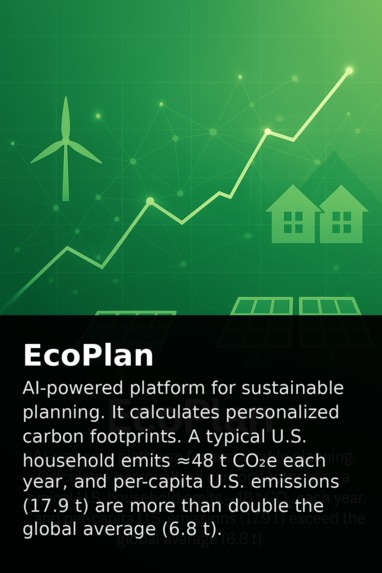
EcoPlan – personalized carbon footprints; typical U.S. household ≈48 t CO₂e/yr; per‑capita emissions > global average.
-
AI-generated depiction of wind turbines and solar panels with realistic details
-
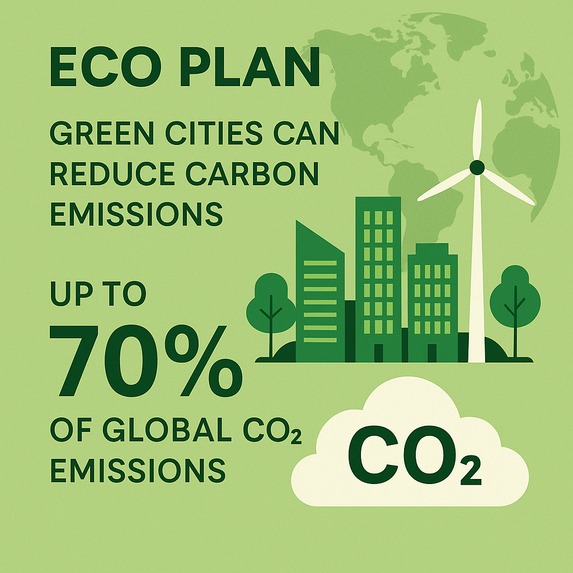


Inspiration
Climate change is one of the most pressing challenges of our time, yet most of us don't have a clear picture of how our everyday choices contribute to global emissions. We were inspired by the idea that data and technology can empower individuals and communities to make smarter choices, take ownership of their carbon footprint, and advocate for systemic change.
What it does
EcoPlan is an AI‑powered platform that turns household and community‑level consumption data into insight and action. Users answer a few simple questions about their energy usage, transportation habits, diet and purchasing patterns. Behind the scenes, EcoPlan matches those responses with up‑to‑date emissions factors to calculate a personalized footprint and highlights the biggest contributors. Interactive charts break down emissions by category, while an intelligent recommendation engine suggests tailored actions—from switching to green energy providers to reducing food waste—that balance impact, cost and feasibility. The goal is not only to inform, but to motivate behavioural change through transparency and achievable next steps.
How we built it
Our prototype combines Python, pandas and matplotlib for data analysis and visualization. We assembled a sample dataset of emissions factors for electricity, fuel, travel, food and more, then wrote scripts to estimate a user’s footprint and generate bar charts. This hackathon version runs in a Jupyter notebook and demonstrates the core calculation logic and visualization. In a full implementation, user data would be collected via a web/mobile interface, persisted in a database, and processed by a machine‑learning model that learns from anonymized community data to improve its recommendations over time. We also plan to leverage API integrations (e.g., OpenAI for natural‑language explanations) to make the experience engaging.
Challenges we ran into
Normalizing diverse data sources and presenting them in a way that is both accurate and easily understood proved tricky. Emissions factors vary by geography and over time, so sourcing reliable, up‑to‑date data was a challenge. We also wrestled with the question of how to recommend changes that are impactful but not overwhelming—climate action should feel empowering, not discouraging.
Accomplishments that we're proud of
We delivered a clear, intuitive visualization of a household’s emissions and designed a structured plan for expanding the tool. Our concept aligns perfectly with the hackathon’s "Tech Innovation For Good" theme by leveraging AI and analytics to drive measurable social impact. We also developed a roadmap for scaling EcoPlan from a proof‑of‑concept to a public product.
What we learned
This project taught us how to translate complex environmental datasets into accessible, user‑friendly insights. We deepened our understanding of carbon accounting methods and learned how AI can nudge people toward sustainable behaviours without guilt‑tripping them. Building with a social impact mindset also challenged us to think about equity and accessibility at every step.
What's next for EcoPlan
Next steps include building a responsive web or mobile app for data collection and visualization, integrating more granular and geographically‑specific emissions datasets, and developing machine‑learning models to personalize recommendations as the user base grows. We'd also like to collaborate with environmental NGOs and public institutions to expand the dataset and turn EcoPlan into a community‑driven platform that helps cities and regions meet their climate targets. Ultimately, we hope EcoPlan inspires individuals and communities to take meaningful, data‑informed steps toward a sustainable future.
Built With
- ai
- analysis
- machine-learning
- matplotlib
- pandas
- python

Log in or sign up for Devpost to join the conversation.