Inspiration# About VoltWise
The Problem
Energy consumption is everywhere, but understanding it is surprisingly difficult.
Most people only see the final number on their electricity bill. They know how much they paid, but they don't know exactly where that energy went, when unusual consumption happened, or what actions could actually reduce their costs.
Traditional energy monitoring systems often focus on showing data rather than explaining it.
We wanted to build something different.
Instead of simply telling users how much energy they are using, we wanted to help them understand:
- Where is my energy going?
- Is something consuming more than normal?
- What will my future consumption look like?
- Why is my consumption increasing?
- What can I do today to save energy and money?
This idea became VoltWise.
Our Idea
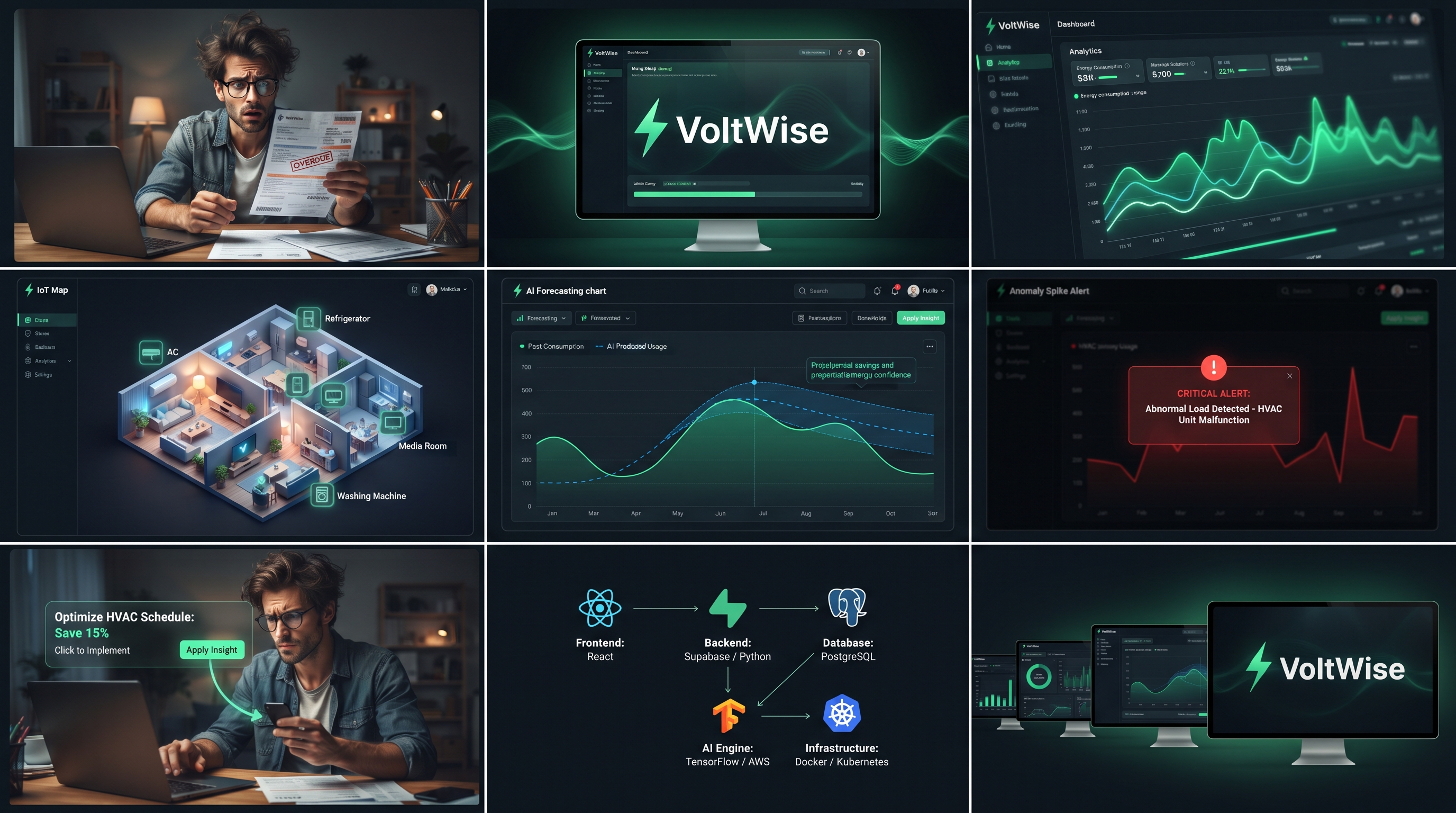
VoltWise is an AI + IoT smart-energy monitoring platform that transforms raw energy readings into understandable insights and actionable recommendations.
The goal is simple:
Turn energy data into better decisions.
VoltWise combines simulated IoT sensor data, backend analytics, machine learning, and an interactive dashboard to create a complete smart-energy experience.
Instead of showing users a complicated stream of numbers, VoltWise analyzes those numbers and explains what they mean.
How VoltWise Works
The system starts with energy readings generated by our simulated IoT sensor layer.
These readings represent electricity consumption from different sources and devices.
The data is sent through our Express REST API, where it is validated, processed, and analyzed.
From there, VoltWise can use its AI services to perform three important tasks:
1. Energy Forecasting
VoltWise analyzes historical consumption patterns to estimate future energy usage.
This helps users understand whether their consumption is likely to increase or decrease and prepare for potential higher costs.
2. Anomaly Detection
Not every increase in energy consumption is normal.
VoltWise looks for unusual patterns and identifies potential anomalies.
For example, if a device normally consumes a relatively stable amount of energy but suddenly consumes significantly more, VoltWise can flag that behavior.
3. Savings Recommendations
This is where VoltWise goes beyond traditional dashboards.
Instead of simply saying:
"Your energy consumption is high."
VoltWise attempts to explain why and provide an actionable recommendation.
The goal is to turn analytics into something users can actually act on.
Building the Dashboard
We wanted the experience to feel like a real modern energy platform rather than a technical prototype.
The frontend was built using:
- React
- Vite
- Tailwind CSS
- Recharts
- Framer Motion
The dashboard provides interactive energy charts, metrics, forecasts, insights, notifications, settings, authentication, and responsive navigation.
We also designed the interface to work across desktop and mobile devices.
Dark and light modes were included so users can interact with the platform comfortably in different environments.
The Backend
The frontend communicates with an Express.js REST API.
The backend is responsible for:
- Authentication
- Energy data
- Sensor simulation
- Analytics
- Notifications
- User settings
- API validation
- Error handling
- Communication with the AI service
We wanted the backend to be reliable enough to support both a live demonstration and a future real IoT deployment.
The AI Layer
For the AI component, we created an optional FastAPI inference service using scikit-learn.
The architecture allows AI functionality to operate as a separate service rather than tightly coupling the machine-learning layer to the main application.
This makes the system easier to extend in the future.
For example, future versions could replace the current models with more advanced forecasting or anomaly-detection models without redesigning the entire application.
We also implemented a resilient local fallback.
This was especially important for a hackathon project because an external AI service should not be able to completely break the demo.
If the AI inference service is unavailable, VoltWise can fall back to local analytics so the core experience continues working.
IoT Without Expensive Hardware
One of the challenges of building an IoT project for a hackathon is hardware availability.
We wanted to demonstrate the complete IoT workflow without requiring participants or judges to connect physical sensors.
Therefore, we created a simulated IoT sensor layer that generates realistic energy readings.
Conceptually, the architecture looks like this:
IoT Sensors ↓ Energy Data ↓ Express API ↓ Analytics + AI ↓ VoltWise Dashboard ↓ Insights + Recommendations
The simulator can later be replaced by real IoT hardware without fundamentally changing the rest of the architecture.
This means VoltWise is designed with a path from prototype to real-world deployment.
Data and Security
We integrated Supabase for authentication and database functionality.
The project includes:
- Authentication support
- Database schema
- Row Level Security (RLS)
- User-specific data access
- Supabase migrations
Security was an important consideration because an energy-monitoring platform can eventually contain sensitive information about a user's home, business, or consumption patterns.
We therefore designed the system so that users can access their own data while maintaining database-level protection.
Demo Mode
Another important part of the project was making VoltWise easy to demonstrate.
A hackathon project should not require a complicated setup just to show its main idea.
That's why we implemented a zero-configuration demo mode.
This allows judges to explore the dashboard and understand the product without needing to configure a complete production infrastructure.
The project also includes environment configuration examples so external services can be connected when needed.
The Biggest Challenge
The biggest challenge was not building a single feature.
It was making many different technologies work together as one reliable product.
VoltWise combines:
- React
- Vite
- Tailwind
- Express
- Supabase
- IoT simulation
- FastAPI
- scikit-learn
- REST APIs
- Authentication
- Database security
- AI analytics
Each component can work independently, but the real challenge was connecting them into one coherent experience.
We had to think about what happens when:
- the AI service is unavailable,
- a request contains invalid data,
- authentication is missing,
- an external service cannot be reached,
- the user is running the project locally,
- or a judge wants to explore the demo immediately.
This led us to implement validation, error handling, fallbacks, demo authentication, and a modular architecture.
What We Learned
Building VoltWise taught us that AI is only one part of a successful intelligent application.
A useful AI product needs reliable data, good APIs, a clear interface, security, and understandable outputs.
We learned how to connect frontend applications with backend services, build REST APIs, work with Supabase authentication and RLS, integrate machine-learning services, simulate IoT data, and design resilient systems.
Most importantly, we learned that AI insights are much more valuable when users can understand why the system is making a recommendation.
A prediction alone is not enough.
Users need context.
What We Would Build Next
VoltWise is designed to grow beyond the hackathon prototype.
The next stage would be connecting the platform to real IoT hardware such as smart meters, current sensors, or smart plugs.
We would also like to improve the AI models using larger real-world datasets and personalize recommendations based on individual usage patterns.
Future versions could include:
- Real-time IoT device connectivity
- Appliance-level energy monitoring
- More accurate consumption forecasting
- Personalized energy-saving plans
- Carbon footprint tracking
- Electricity price optimization
- Automated smart-device control
- Mobile applications
- More advanced anomaly detection
This would allow VoltWise to evolve from an energy-monitoring prototype into a complete intelligent energy-management platform.
The Result
VoltWise started with a simple question:
What if an energy dashboard could actually explain your electricity usage?
We built a platform that combines IoT, AI, analytics, and a modern user experience to explore that idea.
VoltWise doesn't just show users how much energy they are consuming.
It tries to help them understand:
Where is my energy going?
What is unusual?
What will happen next?
What can I do to save?
That is the vision behind VoltWise:
Make energy consumption understandable, predictable, and actionable.
What it does
How we built it
Challenges we ran into
Accomplishments that we're proud of
What we learned
What's next for VoltWise
Built With
- artificial
- css
- docker
- express.js
- fastapi
- intelligence
- iot
- learning
- machine
- node.js
- postgresql
- python
- react
- scikit-learn
- supabase
- tailwind
- vite

Log in or sign up for Devpost to join the conversation.