-
-
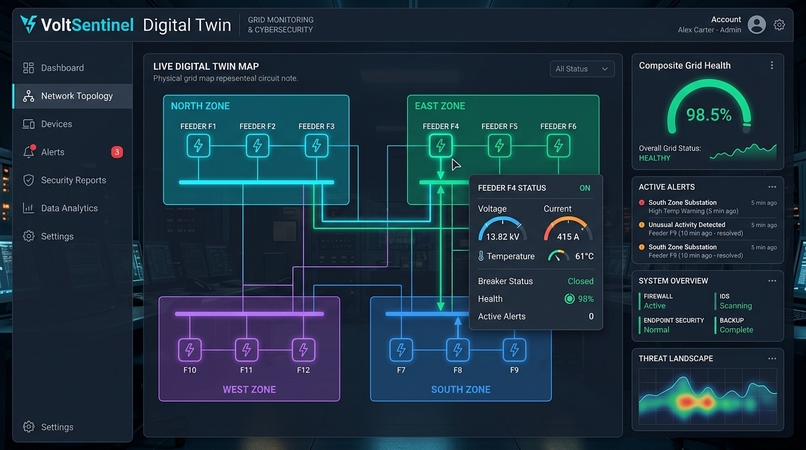
digital twin
-
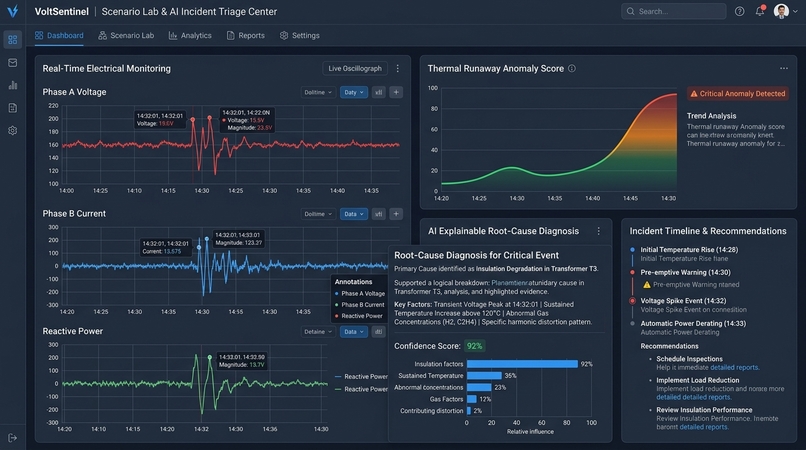
scenario lab
-
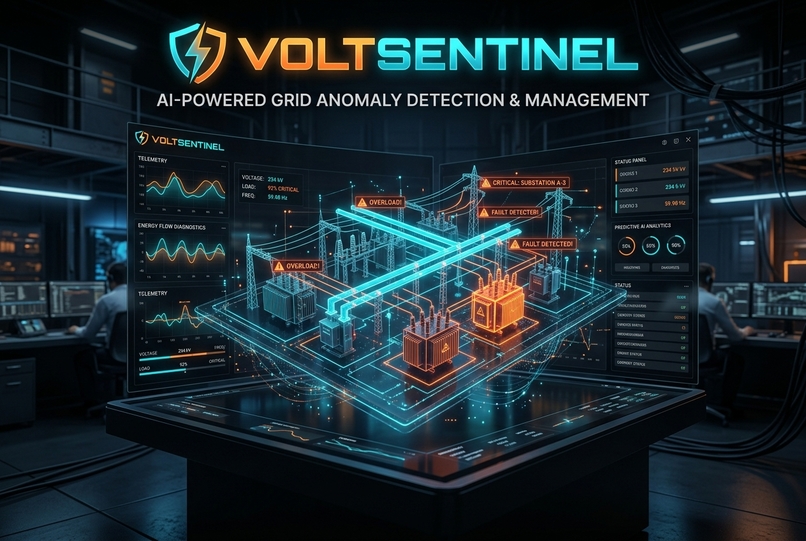
voltsentinel thumbnail
Inspiration
Traditional electrical grid and industrial infrastructure monitoring is fundamentally reactive. In existing substations and factory plants, operators typically discover electrical faults only after a circuit breaker trips, machinery sustains costly damage, or severe arcing/fires erupt.
We wanted to rethink electrical monitoring from the ground up by asking: What if an AI-powered digital twin could detect the subtle, compound warning signs hours before failure occurs?
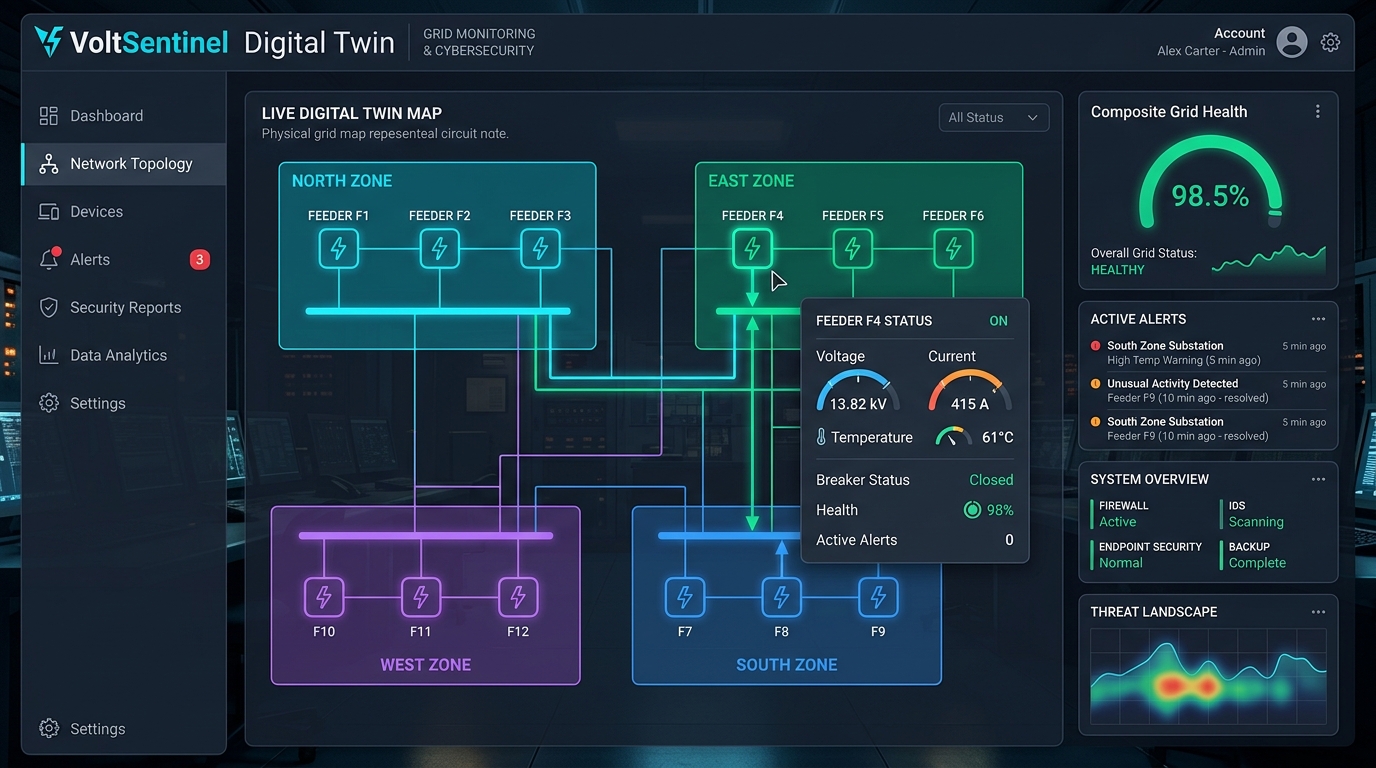
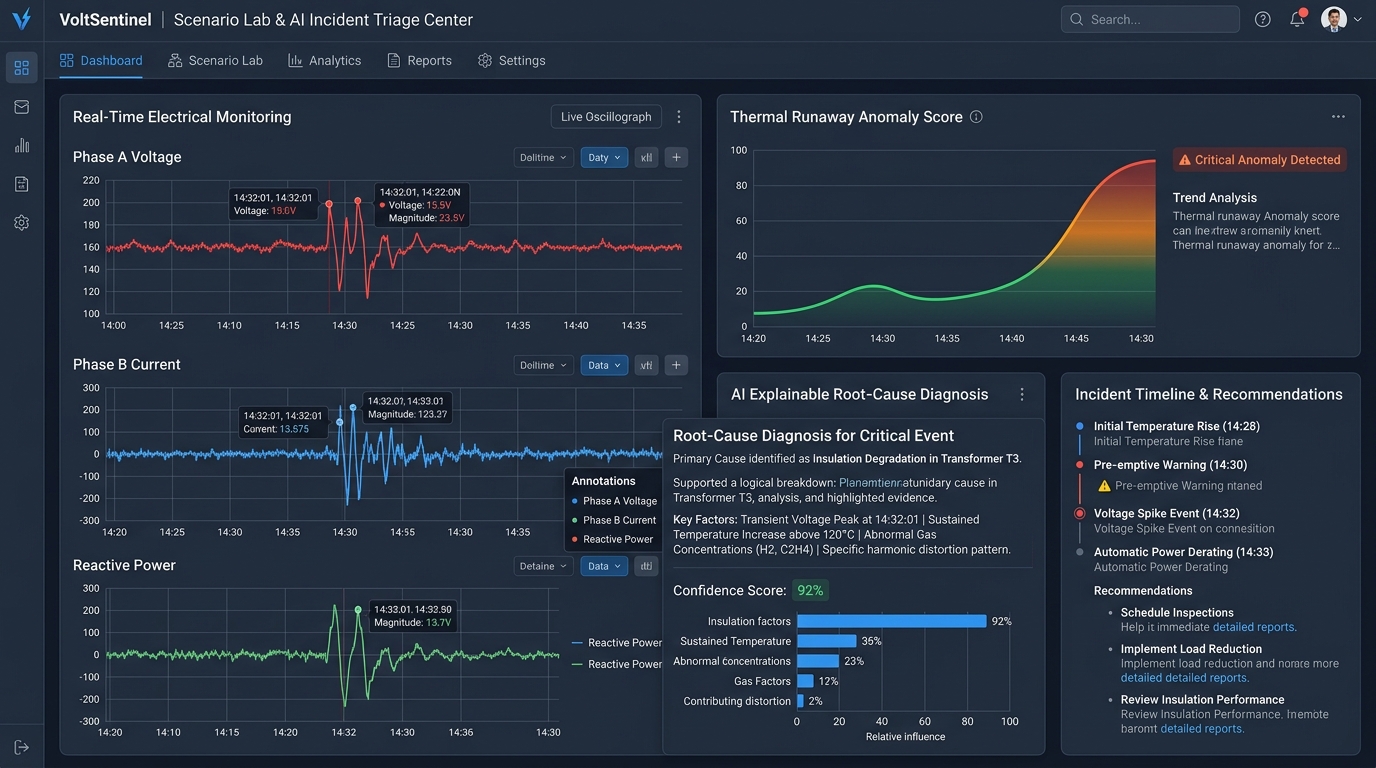
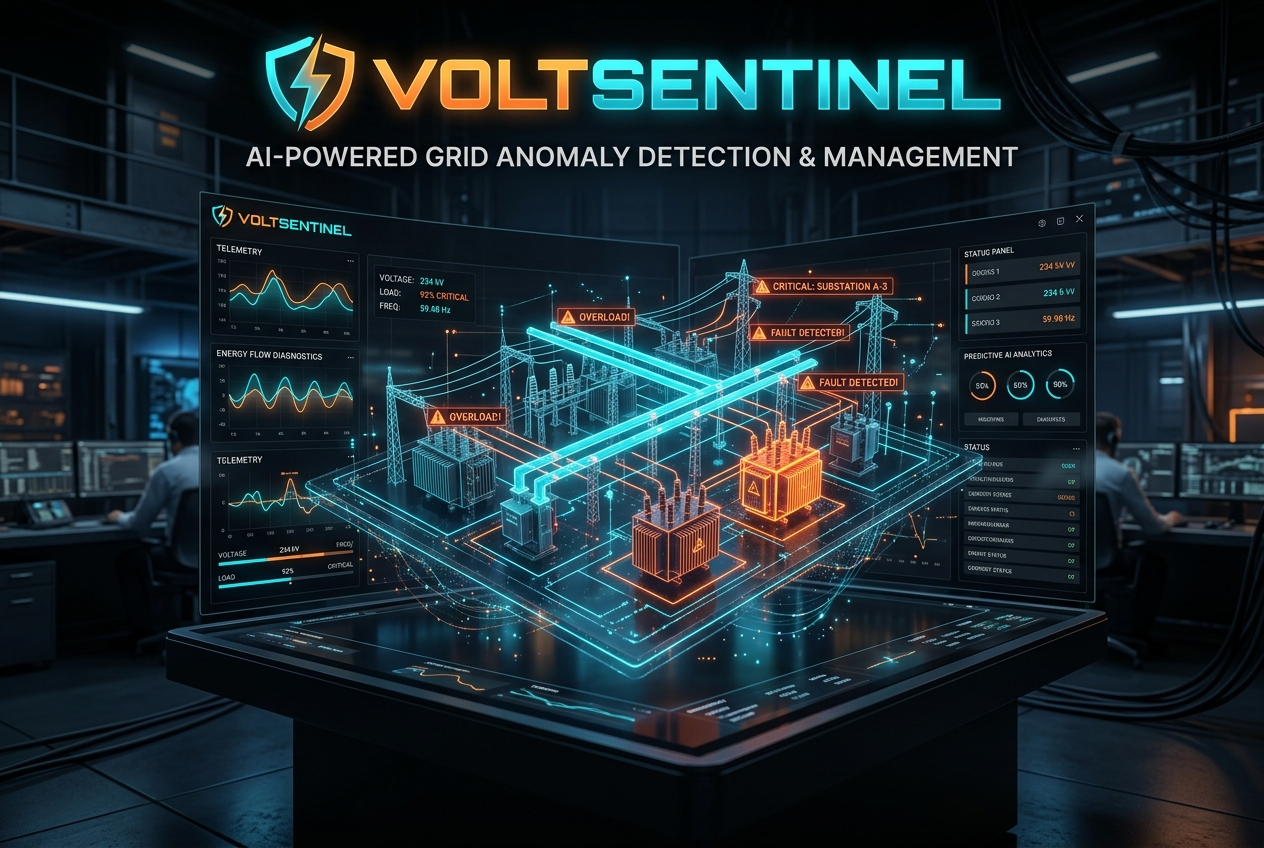
That vision became VoltSentinel—a real-time predictive digital twin combining physics-based thermal modeling, machine learning anomaly detection, and deterministic explainability.
What It Does
VoltSentinel monitors live telemetry across 12 electrical feeder circuits grouped into 4 distinct operational zones:
- North Zone: Residential & Municipal infeed.
- South Zone: High-load EV charging hubs & tech campuses.
- Industrial Zone: Heavy induction motor banks & chiller plants.
- Commercial Zone: Edge data center racks & logistics facilities.
Key Capabilities:
- Interactive 2D Digital Twin: A hierarchical topology visualization (Utility Substation → 4 Zones → 12 Feeders) with live status indicators, glowing busbars, and circuit health metrics.
- 3-Layer Hybrid AI Anomaly Engine:
- Layer 1 (Statistical): Rolling $3\sigma$ Z-scores tracking voltage, current, and temperature deviations.
- Layer 2 (ML Outlier Detection): Scikit-Learn Isolation Forest evaluating multidimensional feature vectors ($V, I, T, \text{PF}, P, \frac{\Delta T}{\Delta t}$).
- Layer 3 (Engineering Rules): Deterministic IEC/IEEE thermal ($75^\circ\text{C}$), overcurrent, and power factor bounds.
- Deterministic Risk Scoring ($0 - 100$): Classifies severity into
NORMAL,WATCH,WARNING, orCRITICALwith automated failure mode categorization (THERMAL_OVERLOAD,VOLTAGE_INSTABILITY,COOLING_FAILURE,SUSTAINED_OVERCURRENT,INTERMITTENT_FAULT). - Offline Explainable AI: Every alert provides a structured root-cause explanation ("Why this alert?") and practical operator mitigation steps ("Recommended Action").
- Scenario Simulation Lab: An interactive control room allowing engineers to inject physical fault trajectories (
Thermal Runaway,Feeder Overload,Voltage Surge,Cooling Failure,Micro-Arcing) with accelerated time multipliers ($1\times, 2\times, 5\times, 10\times$). - Hardware-Ready Telemetry Ingestion: Canonical
POST /api/telemetrycontract built to interface with real ESP32 microcontrollers with non-invasive current transformers (CTs) and isolated thermistors.
How We Built It
- Backend & ML Pipeline: Built with FastAPI, Pydantic v2, and SQLAlchemy on SQLite with bounded ring-buffer telemetry retention. The anomaly engine combines rolling Z-score baselines with a pre-trained Scikit-Learn Isolation Forest.
- Real-Time Streaming: High-throughput WebSockets broadcast live 1 Hz multi-circuit telemetry frames (
/ws/telemetry) and immediate incident alerts (/ws/events). - Frontend & Digital Twin: Developed with Next.js 14+ (App Router), TypeScript, React, and Tailwind CSS, featuring custom SVG topology layouts and Recharts multi-channel oscillographs.
- Physics Simulator: Modeled Joule-heating thermal mass inertia ($T_t = f(I_t^2)$) and autoregressive electrical noise (AR(1)) to ensure measurements exhibit realistic temporal continuity.
Challenges We Ran Into
- Modeling Physics-Based Telemetry Continuity: Unlike synthetic dashboards with independent random numbers, real electrical systems have physical inertia—conductors take time to heat up and cool down based on current squared ($I^2R$). We implemented a discrete thermal time-constant differential equation to model gradual thermal buildup.
- Sub-Second Hybrid ML Inference: Combining statistical baselines, scikit-learn tree ensembles, and deterministic risk rules for 12 simultaneous circuits at 1 Hz required optimizing feature extraction vectors to prevent WebSocket event loop lag.
- Deterministic Explainability: Ensuring diagnostic root-cause text and actionable recommendations are 100% deterministic and available offline without relying on expensive, high-latency cloud LLMs.
Accomplishments That We're Proud Of
- 100% Hardware-Independent Intelligence Layer: Real ESP32 microcontrollers can seamlessly stream to
POST /api/telemetryusing the exact same API contract without altering the intelligence pipeline. - Flawless End-to-End Demo Sequence: Injecting thermal runaway on Circuit 07 visibly demonstrates the entire pipeline in under 15 seconds: telemetry changes → ML flags anomaly → Risk crosses Critical → Digital Twin pulses red → Incident generates explainable advice → System recovers on reset.
- 12/12 Automated Tests Passing: Comprehensive pytest coverage across API endpoints, anomaly detection thresholds, risk scoring, and simulator state transitions.
What We Learned
- How to combine statistical process control with machine learning tree ensembles for high-reliability industrial IoT monitoring.
- Designing high-density dark UI/UX for industrial control rooms that balances information hierarchy without cognitive overload.
- Structuring hardware ingestion APIs to facilitate rapid prototyping before deploying physical split-core CT sensors.
What's Next for VoltSentinel
- Physical ESP32 Pilot Deployments: Field-testing non-invasive split-core CT clamps (SCT-013) on real-world multi-phase distribution panels.
- Transformer DGA (Dissolved Gas Analysis) Extension: Incorporating acoustic and gas sensor features into the ML isolation forest.
- Edge ML Deployment: Porting the Isolation Forest model directly to microcontrollers using TensorFlow Lite for Microcontrollers (TFLite Micro).
Built With
- docker
- esp32
- fastapi
- iot
- machine-learning
- next.js
- pytest
- python
- react
- recharts
- scikit-learn
- sqlalchemy
- sqlite
- tailwindcss
- typescript
- websockets

Log in or sign up for Devpost to join the conversation.