Inspiration
Voltra — DevPost Story
Inspiration
There is a moment every junior electrician knows.
You are on-site, often alone, standing in front of a panel or a dead circuit with only a multimeter in hand. You have to make a decision immediately. Choose the wrong breaker, and the circuit may remain unprotected. Select the wrong wire gauge, and the issue may not appear until months later—sometimes as overheating or even a fire. Misdiagnose a fault, and you could put yourself in serious danger.
Experienced electricians rely on years of intuition built in the field. But every expert started as a beginner, and during those early years, the available tools are often either too complicated for field use or too simplistic to trust.
Professional software like LTspice and KiCad is incredibly powerful, but it assumes you already have a clean schematic, exact component values, and access to a computer. That is not how real field work happens. On-site, information is incomplete, measurements are noisy, and decisions need to be made quickly—often using only a phone.
The problem is not a lack of tools. It is a lack of tools designed for how field work actually happens.
Voltra was built to close that gap.
What We Learned
The biggest lesson was that uncertainty matters.
A tool that gives a junior electrician a confidently wrong answer can be more dangerous than no tool at all. That insight shaped the design of our ML engine, FieldSurge. It is built not only to make predictions, but also to communicate how trustworthy those predictions are.
Using Gaussian Process uncertainty quantification, Voltra can tell when it is operating in familiar territory and when an input falls outside its most reliable range. In well-understood cases, confidence intervals are tight. In unusual or noisy situations, they widen. This helps users know when to trust the recommendation and when to proceed with extra caution.
We also learned that high-quality synthetic data can be incredibly powerful when real-world datasets are unavailable. Instead of waiting months to collect field measurements, we built a physics-based simulation engine grounded in IEC standards and first-principles electrical equations. That engine generated over 6,000 training samples across multiple scenarios, allowing us to train a model on physically valid, standards-compliant data.
How We Built It
Voltra consists of two tightly integrated layers.
The first is a physics engine written in Python. It implements the core electrical engineering principles needed in the field, including:
- Ohm's Law
- Kirchhoff's Laws
- IEC 60228 wire sizing with thermal derating
- IEC 60898 breaker selection
- Signature-based fault diagnosis for common electrical failures
This engine serves as the system's ground truth. It both generates training data and validates predictions during inference.
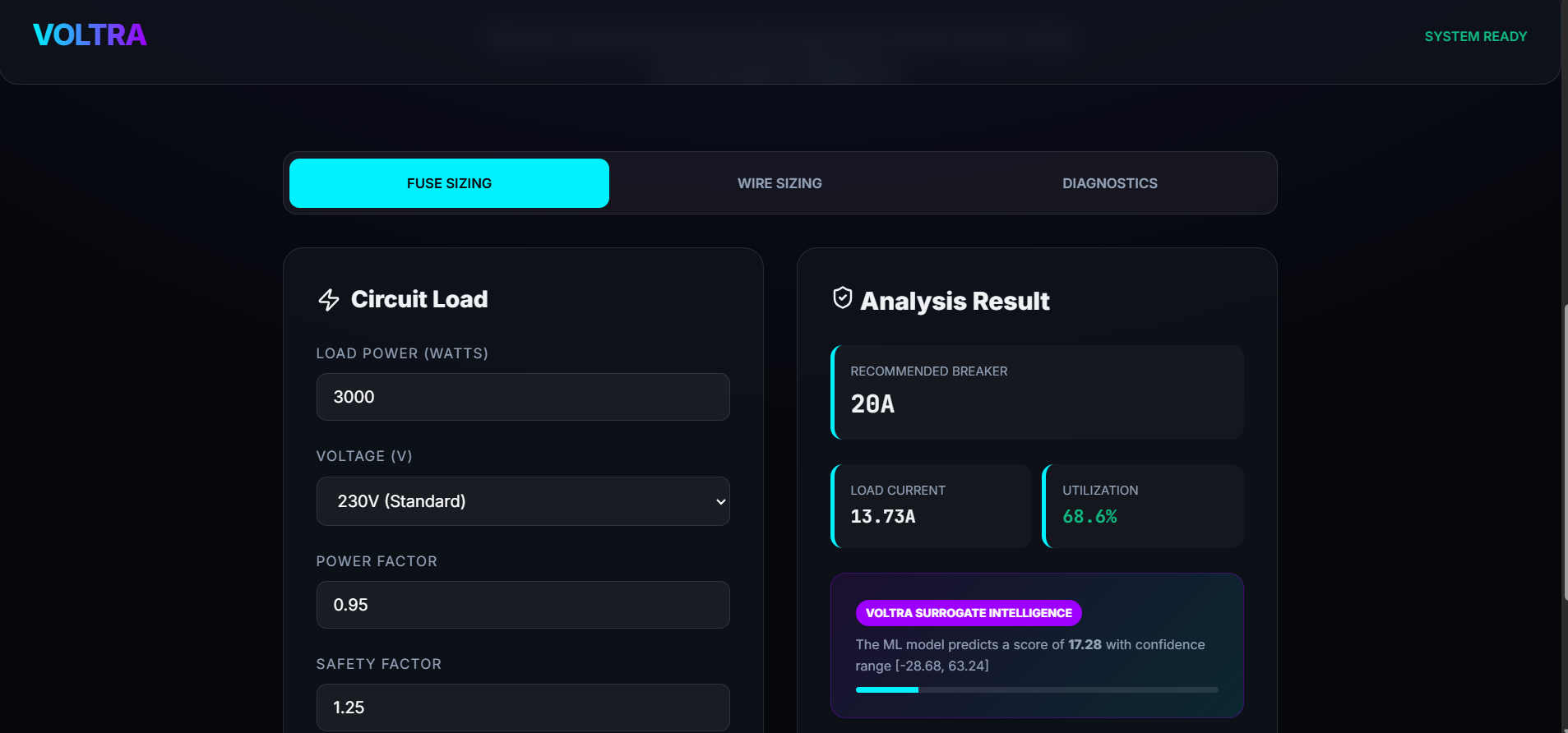
The second layer is FieldSurge, our machine learning surrogate model. It uses XGBoost for fast predictions and a Gaussian Process model for uncertainty estimation.
When a user enters field measurements:
- the physics engine computes the standards-compliant answer,
- FieldSurge predicts the likely outcome,
- and the Gaussian Process provides a 95% confidence interval.
This gives users both a precise recommendation and a clear sense of how reliable that recommendation is.
The backend is built with FastAPI and exposes three dedicated endpoints:
- fuse sizing,
- wire sizing,
- and fault diagnostics.
The frontend is built entirely with vanilla HTML, CSS, and JavaScript. It is mobile-first, lightweight, and designed to run instantly in any browser—critical for on-site field use.
With a single command, python start.py, the backend launches and the interface opens automatically.
Challenges We Ran Into
The most difficult component was fault diagnosis.
Unlike wire or breaker sizing, which are largely deterministic, fault diagnosis is inherently probabilistic. The same readings can often point to multiple possible issues. For example, a tripped breaker without visible damage could indicate either an overload or a short circuit. Partial load voltage could suggest a ground fault, a loose connection, or a high-resistance joint.
To address this, we built a physics-informed scoring system. It compares observed measurements against the expected signatures of multiple fault types, then uses softmax normalization to generate a probability distribution across likely causes.
Instead of presenting a single answer, Voltra provides a ranked list of probable faults. This mirrors how experienced electricians actually troubleshoot in the field.
Another major challenge was usability. We wanted Voltra to work instantly on any phone, without installation, accounts, or dependencies. That meant avoiding heavy frameworks and build tools entirely. By keeping the frontend lightweight and dependency-free, we ensured that any electrician can open and use Voltra immediately from a browser.

Log in or sign up for Devpost to join the conversation.