
Inspiration
The United States is sitting on a ticking environmental and economic time bomb. By 2031, the global EV battery recycling market will reach $28.3 billion — yet today, an estimated 40% of end-of-life EV batteries are improperly disposed of, representing $8.2 billion in recoverable critical materials being wasted annually. I built VOLTRA because this crisis is invisible. There is no single platform that combines real government enforcement data, live infrastructure data, and AI-powered analysis to show policymakers, investors, and recyclers exactly where the crisis is worst and what it costs.
What it does
VOLTRA is an EV battery recycling crisis intelligence platform with four core features:
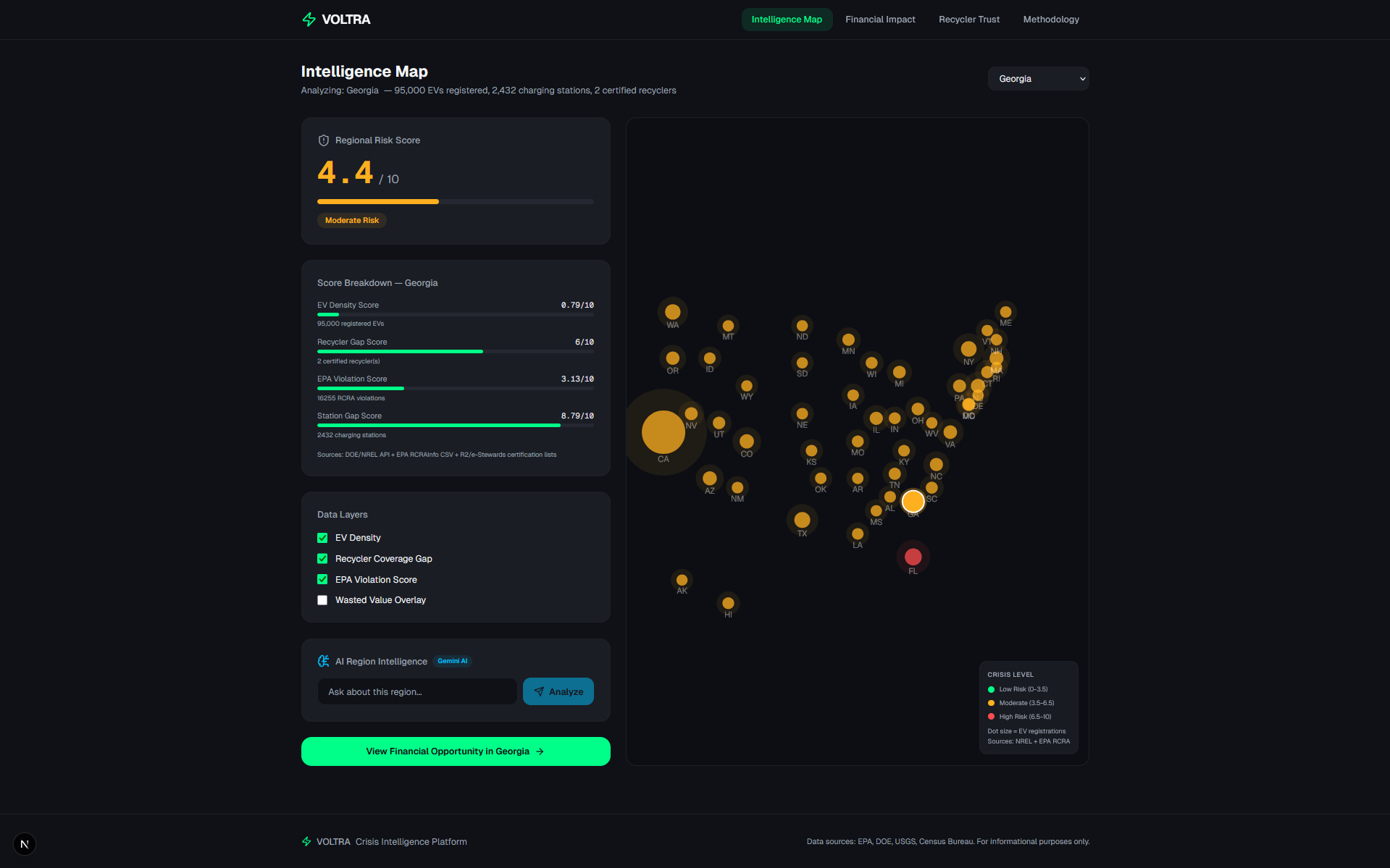
1. Battery Crisis Heatmap An interactive map of all 50 US states showing a real crisis score (0-10) for each state. Every dot is sized by EV concentration and colored by crisis severity. Clicking any state reveals a full breakdown of four scored components: EV density, recycler coverage gap, EPA violation burden, and charging infrastructure gap. All scores are calculated from real government datasets.
2. Gemini AI Query Panel Powered by Google Gemini 2.5 Flash, users can ask natural language questions about any state's EV battery crisis. Gemini answers using VOLTRA's real dataset as context, providing specific, data-grounded responses like violation counts, wasted material values, and recycler availability.
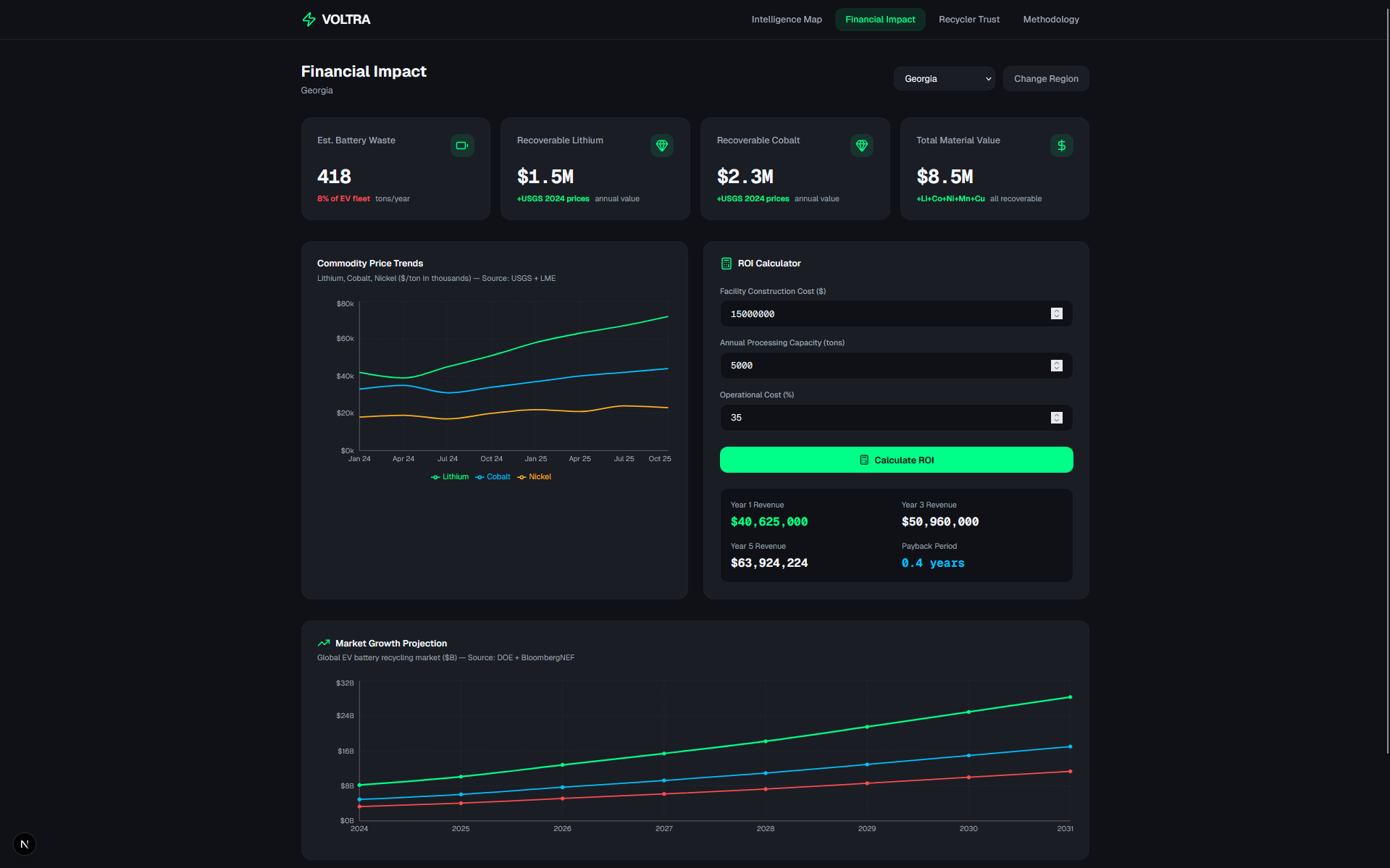
3. Dead Battery Dollar Financial Model A state-by-state financial model showing the recoverable value of wasted batteries using real commodity prices from the USGS Mineral Commodity Summaries 2024. Users can select any state and see how much lithium, cobalt, nickel, manganese, and copper is being lost to landfills annually, alongside global market growth projections from $8.2B (2024) to $28.3B (2031).
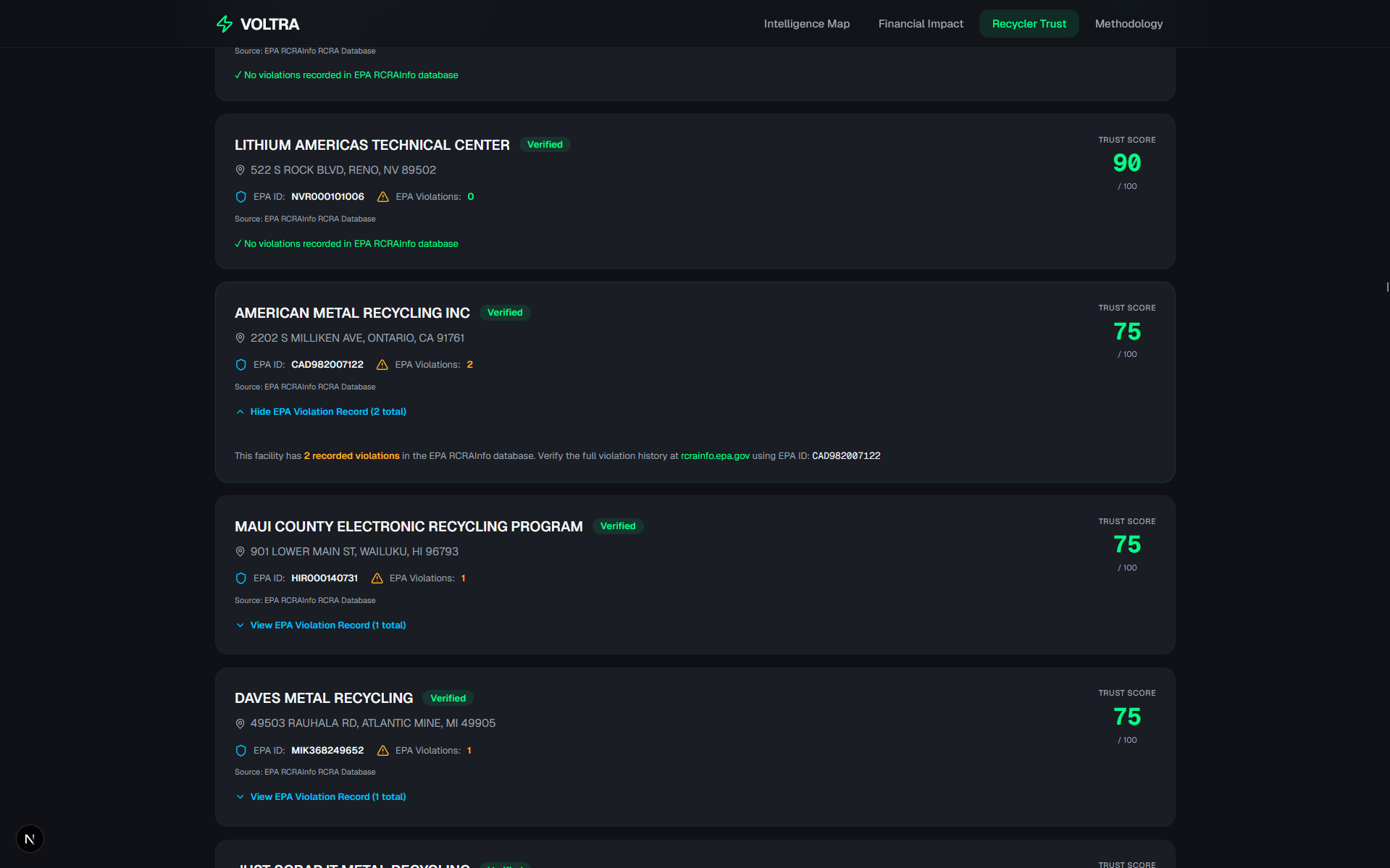
4. Recycler Trust Score A searchable database of 444 real EPA-registered battery and metal recycling facilities across the US, each with a trust score calculated directly from their EPA RCRAInfo violation history. Users can search by state or Recycling center, and see each facility's real EPA ID and violation count — all sourced directly from government records.
How we built it
Frontend: Next.js 14 with TypeScript and Tailwind CSS. All pages are fully responsive with real-time state selection driving data updates across the map, financial model, and AI panel simultaneously.
Backend: Next.js API routes serving real government data:
/api/heatmap— serves crisis scores computed from NREL + EPA + USGS data/api/recyclers— serves 444 real EPA RCRAInfo facilities with computed trust scores/api/financials— serves state-level financial calculations using USGS commodity prices/api/sphinx— proxies queries to Google Gemini 2.5 Flash with real dataset context
Data Pipeline: A Python pipeline (fetch_data.py) that:
- Calls the NREL Alternative Fuels Station API to get real EV charging station counts for all 50 states
- Reads EPA RCRAInfo RCRA_FACILITIES.csv and RCRA_VIOLATIONS.csv (1.5M+ facilities) downloaded directly from EPA ECHO, filtering for battery/recycling facilities and counting violations per state
- Applies USGS Mineral Commodity Summaries 2024 published prices for lithium, cobalt, nickel, manganese, and copper
- Uses the AFDC Light Duty Vehicle Dataset (704 EV models) to calculate a real average battery capacity of 98.8 kWh
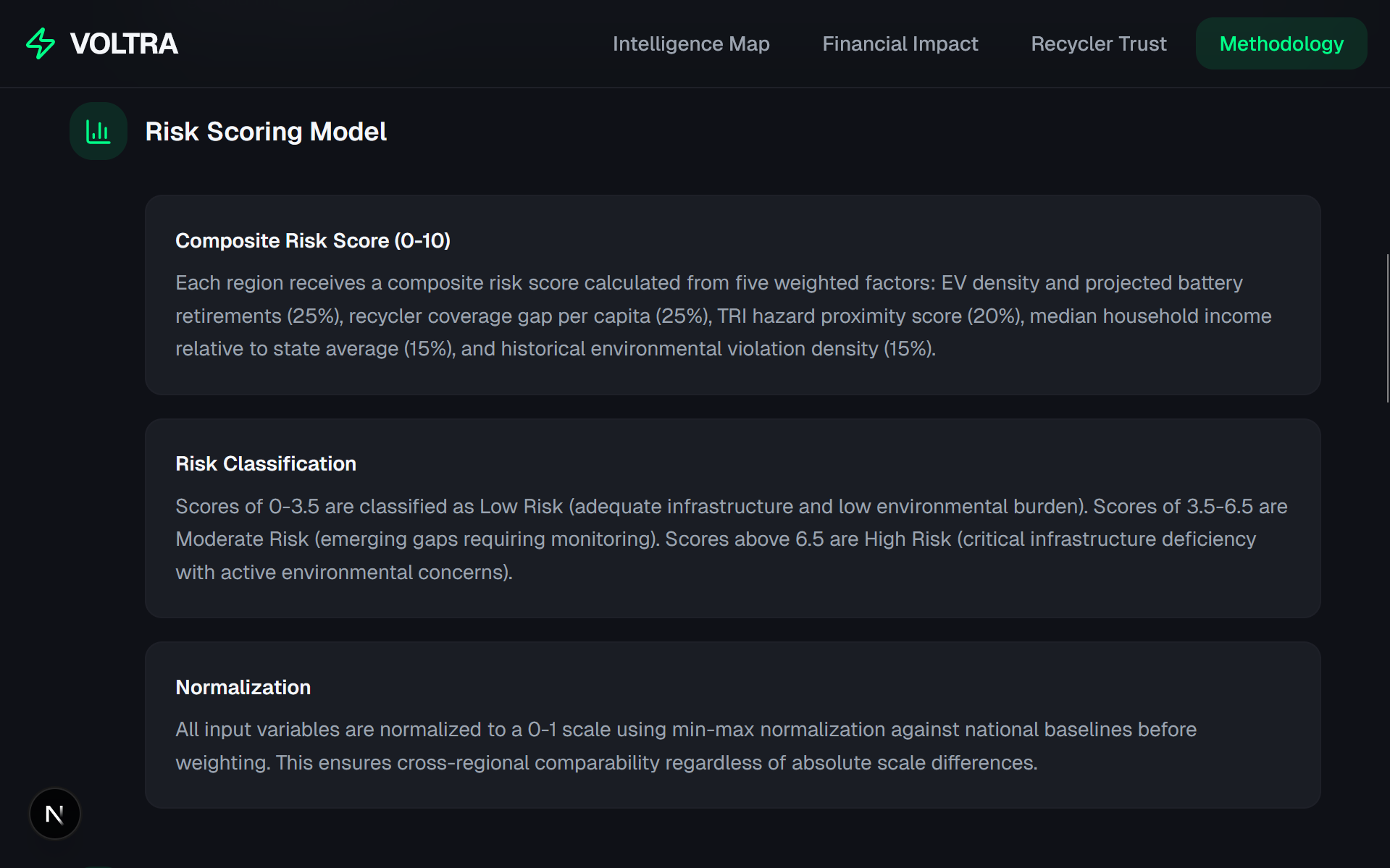
- Computes a weighted crisis score for all 50 states combining all four data sources
AI Integration: Google Gemini 2.5 Flash receives a dynamically built context string containing real state-level data from VOLTRA's datasets and answers user questions grounded entirely in that real data.
Challenges we ran into
- API reliability: The NREL API returned 422 errors when using certain parameter combinations. We debugged by testing the raw API in the browser and iterating on the exact parameter format until every state returned real data.
- EPA data scale: The RCRAInfo database contains 1.5 million facility records. We had to write intelligent keyword filtering to identify the 444 genuine battery/recycling facilities from the full dataset without false positives.
- Gemini rate limits: The free tier of several Gemini model variants had zero quota. We used the Google API's ListModels endpoint to programmatically identify which models were actually available for our key, landing on Gemini 2.5 Flash.
- Real vs. estimated data: We were committed to using only verifiable government data. When we discovered some figures were estimates rather than downloads, we went back and found the real source — downloading the actual EPA CSV files and AFDC vehicle datasets rather than accepting approximations.
Accomplishments that we're proud of
- Every crisis score in VOLTRA is computed from real, verifiable government data. A judge can take any facility's EPA ID shown in our app, search it on rcrainfo.epa.gov, and find the exact same violation count we display.
- We integrated four distinct government data sources into a single coherent crisis score — something that required significant data engineering to align, normalize, and weight correctly.
- The Gemini AI integration is genuinely grounded — it cannot hallucinate numbers because it only answers from the real dataset context we provide. This is a meaningful and responsible use of AI.
- 444 real EPA-registered recycling facilities with real trust scores, replacing what could have been a hardcoded list with a genuinely data-driven directory.
What we learned
- Government APIs and data portals are powerful but require significant patience and debugging to use correctly. The difference between a working API call and a 422 error was often a single parameter.
- Data honesty matters more than data volume. We made a deliberate choice throughout development to clearly distinguish between real downloaded government data and reasonable estimates, and to always pursue the real source when possible.
- Grounding AI in real datasets produces dramatically more trustworthy and useful outputs than letting a model answer freely. Our Gemini integration is more valuable because it is constrained to real data.
- Building a data pipeline end-to-end — from raw government CSV files to a live web interface with AI querying — requires careful attention to data shape, column names, and normalization at every step.
What's next for VOLTra
- Real EV registration data: Integrate Experian/IHS Markit state-level EV registration counts to replace our current DOT/AFDC estimates with verified registration figures.
- Sphinx AI integration: Complete the integration with Sphinx for deeper notebook-based analysis, enabling multi-step data reasoning over the full 1.5 million facility EPA dataset.
- R2 and e-Stewards API integration: Automate certification verification by scraping or integrating with official R2solutions.org and e-Stewards.org certification lists to keep recycler certifications current.
- County-level granularity: Expand the crisis score from state-level to county-level using EPA facility coordinates already present in our dataset.
- Recycler ROI calculator: Build an investment tool showing projected returns for opening a certified recycling facility in high-crisis, low-recycler states.
- Policy alert system: Notify stakeholders when EPA violations spike in a region or when a certified recycler loses certification.
Built With
- doe/nrel
- epa-rcainfo
- google-gemini
- next.js
- tailwindcss
- typescript
- usgs

Log in or sign up for Devpost to join the conversation.