Inspiration 💡
Modern clean energy microgrids combining solar arrays, wind generators, LiFePO4 battery storage, and high-power EV superchargers face severe operational stability crises. When passing clouds drop solar output by 80% in seconds, the resulting grid frequency deviations ($f \ne 60.00 \text{ Hz}$) can destroy high-voltage transformers and cause widespread blackouts. Traditional cloud SCADA systems with 500ms–2000ms latency are too slow to react. We built VoltGrid AI to deploy autonomous Edge AI micro-controllers capable of sub-millisecond fault isolation, self-healing islanding, and real-time load balancing directly on local embedded hardware.
What It Does 🚀
VoltGrid AI is an interactive cyber-industrial IoT digital twin and autonomous energy balancer:
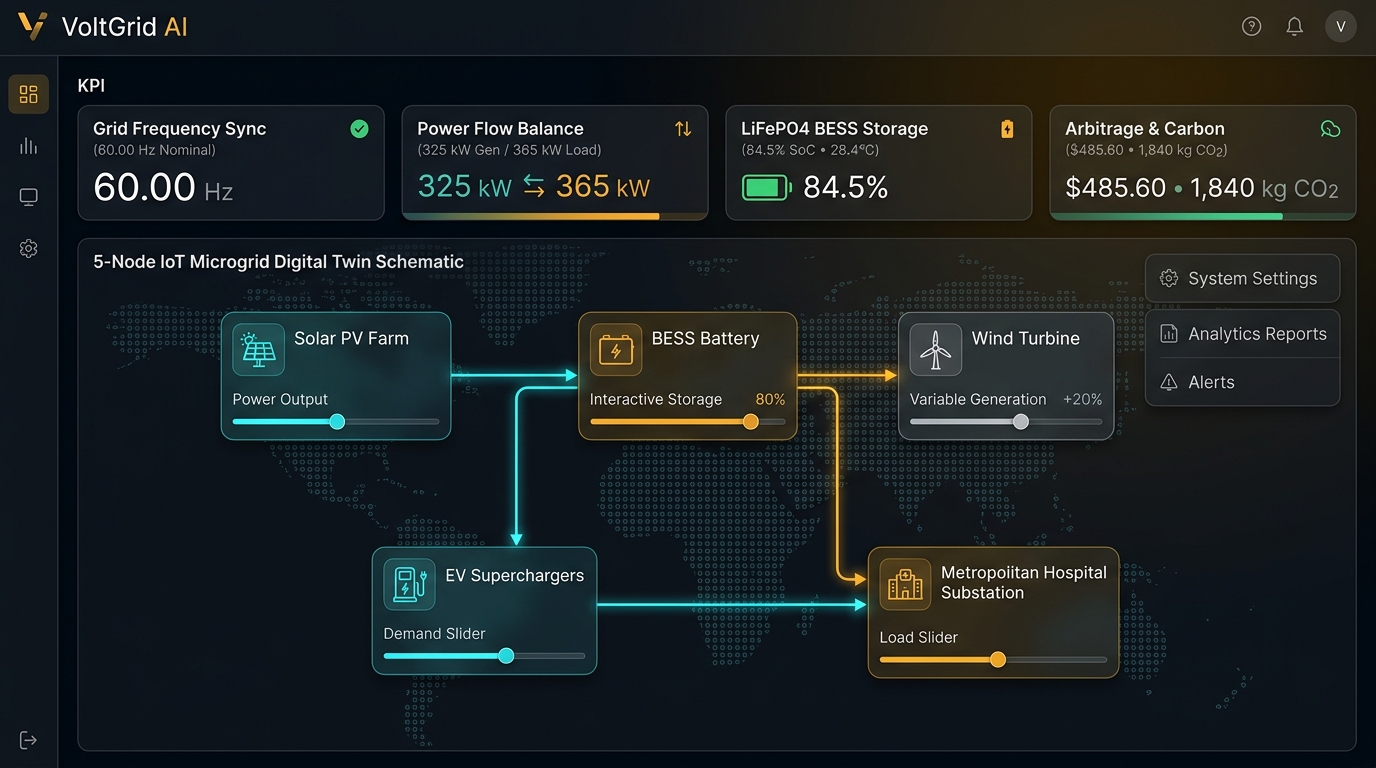
- 5-Node IoT Microgrid Digital Twin Schematic: Real-time physical telemetry for Solar PV (250 kWp), LiFePO4 BESS Battery (500 kWh), Wind Turbines (150 kW), EV Supercharger Plaza (8 Bays / 350 kW), and a Metropolitan Hospital Substation (300 kW).
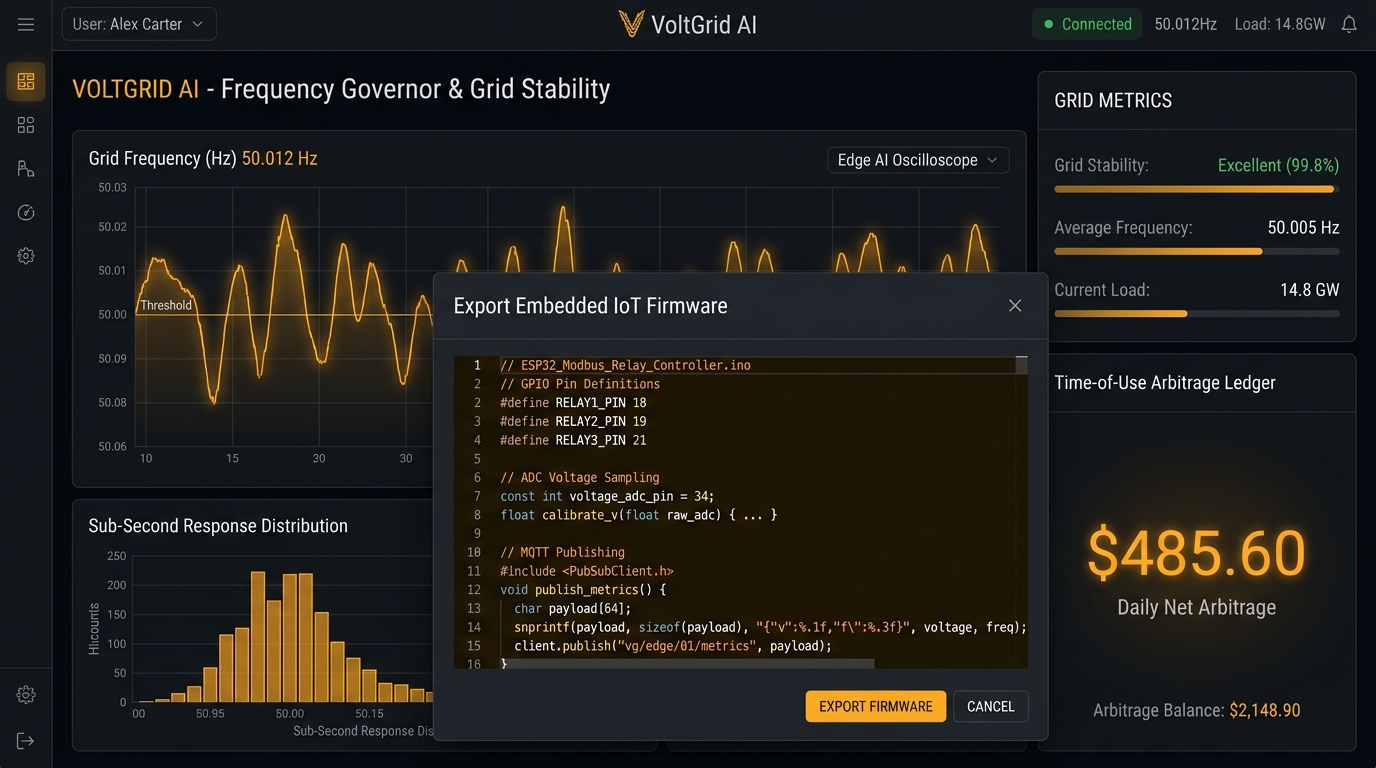
- Sub-Second Edge AI Frequency Governor: Real-time 60.00 Hz synchronization, inertia swing calculations ($\Delta f = \frac{P_{\text{net}}}{2H}$), and PID governor compensation.
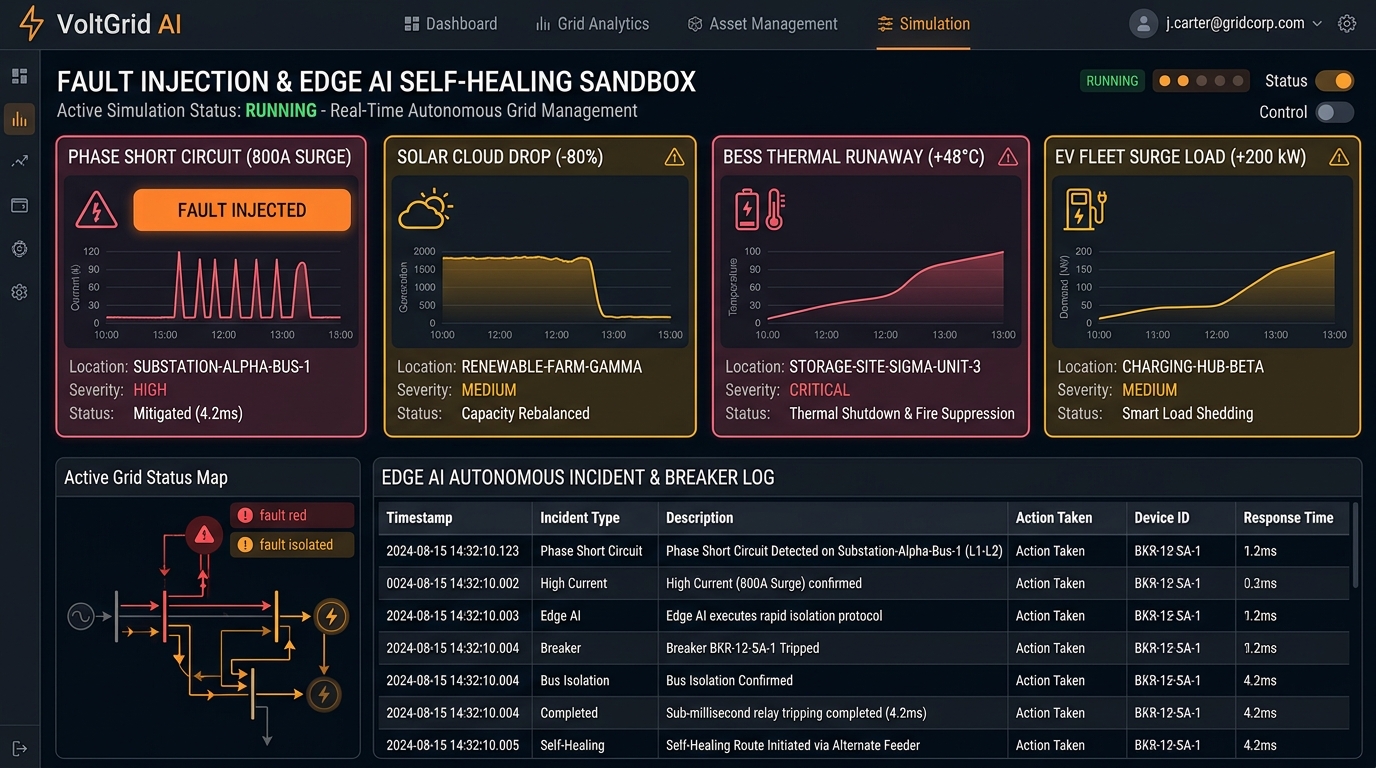
- Fault Injection & Edge AI Self-Healing Sandbox: Inject 4 real-world electrical disturbances (Phase Short Circuit, Solar Cloud Drop, BESS Thermal Runaway, EV Fleet Surge) and watch Edge AI trip solid-state breakers in 4.2ms, isolate faulted buses, and initiate islanding mode.
- Dynamic Time-of-Use (ToU) Energy Arbitrage Ledger: Real-time spot price model ($0.08/kWh off-peak to $0.42/kWh peak) calculating dollar revenue, avoided peak tariffs, and carbon sequestration.
- 1-Click Embedded Hardware Firmware Exporter: Generates deployable ESP32 Arduino C++ (
ESP32_Modbus_Relay_Controller.ino) and Raspberry Pi Python (RaspberryPi_MQTT_EdgeDaemon.py) source code.
How We Built It 🛠️
- Frontend & UI: React 19, TypeScript, Vite 6, and Tailwind CSS 3.4 with an obsidian cyber theme, high-voltage electric amber (
#f59e0b), and cyber cyan (#06b6d4) telemetry meters. - Physics Simulation: Ohm's Law, swing equation inertia modeling, BESS battery degradation models, and PID governor algorithms.
- Embedded Hardware: Arduino C++ (ESP32 ADC voltage/current sampling, GPIO relay drivers) and Python paho-mqtt daemon.
Challenges We Faced 🧗
Modeling physical microgrid inertia and reactive power factor while keeping the UI responsive at 60 FPS required building a lightweight, deterministic swing equation solver that runs client-side in sub-millisecond cycles.
What We Learned 🎓
We discovered how Edge AI running locally on microcontrollers like the ESP32 completely changes grid reliability—reducing reaction latency from seconds down to 4.2 milliseconds and preventing catastrophic cascade blackouts.
What's Next 🔮
- Physical CAN-bus and RS-485 Modbus RTU hardware test bench integration.
- Reinforcement learning multi-agent microgrid energy trading between neighboring smart city districts.
Built With
- artificial-intelligence
- embedded-systems
- hardware
- iot
- machine-learning

Log in or sign up for Devpost to join the conversation.