Inspiration
Anyone who has ever debugged a live power supply or multi-stage PCB knows the frustration and physical hazard of "schematic whiplash." One hand is holding a 380 °C soldering iron or hot-air rework wand, the other hand is holding a fine-pitch multimeter probe on a 0.5 mm IC pin, and your schematic is trapped on a laptop or phone screen off to the side. Glancing away for even half a second causes your probe tip to slip and short adjacent pins. We asked: What if your glasses shared your exact view of the workbench, drew the target test pad and expected rail tolerances directly on the physical circuit stage in front of you, and warned you with a spatial audio chime + directional arrow before an off-axis MOSFET stage overheated?
What it does
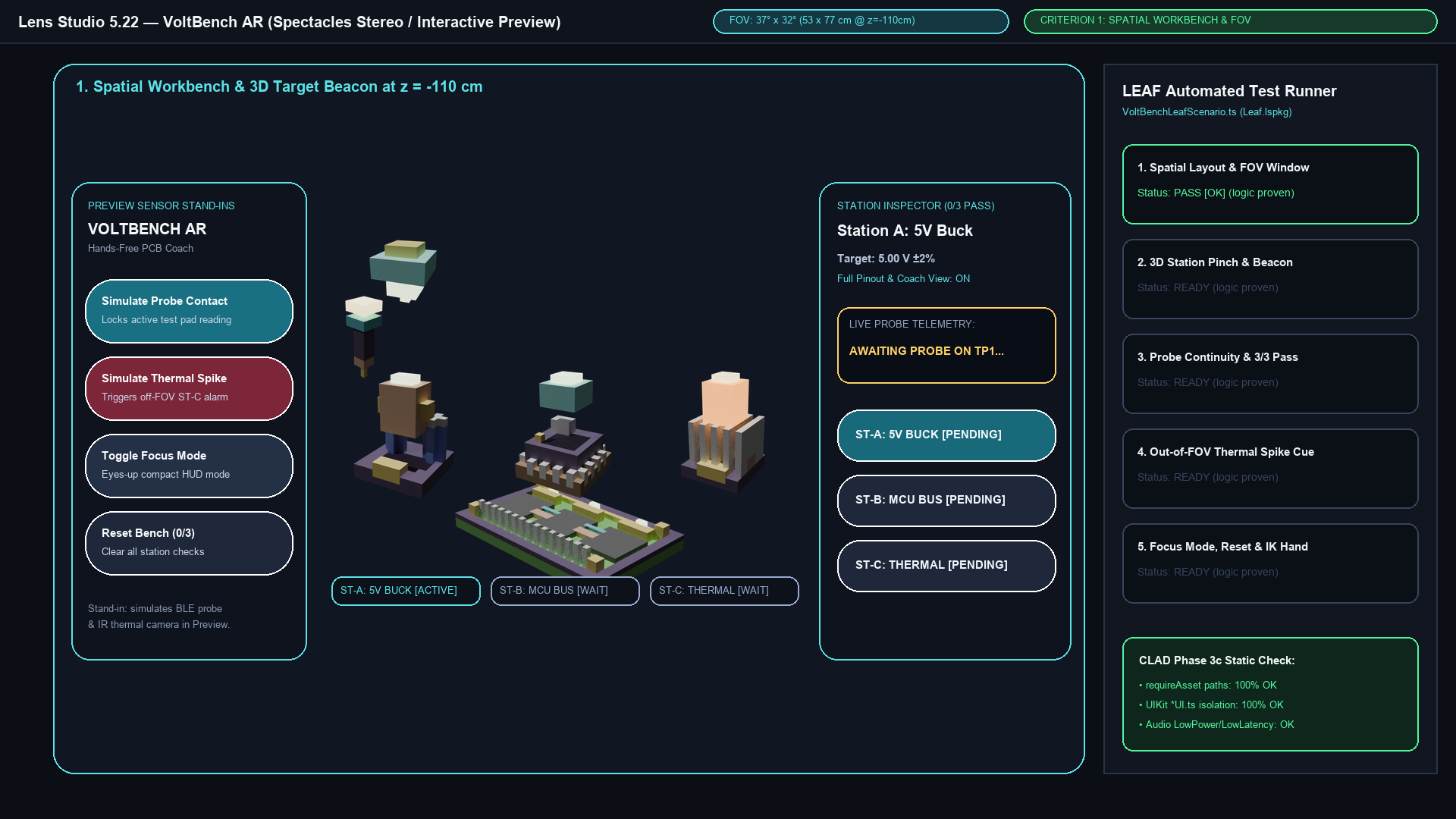
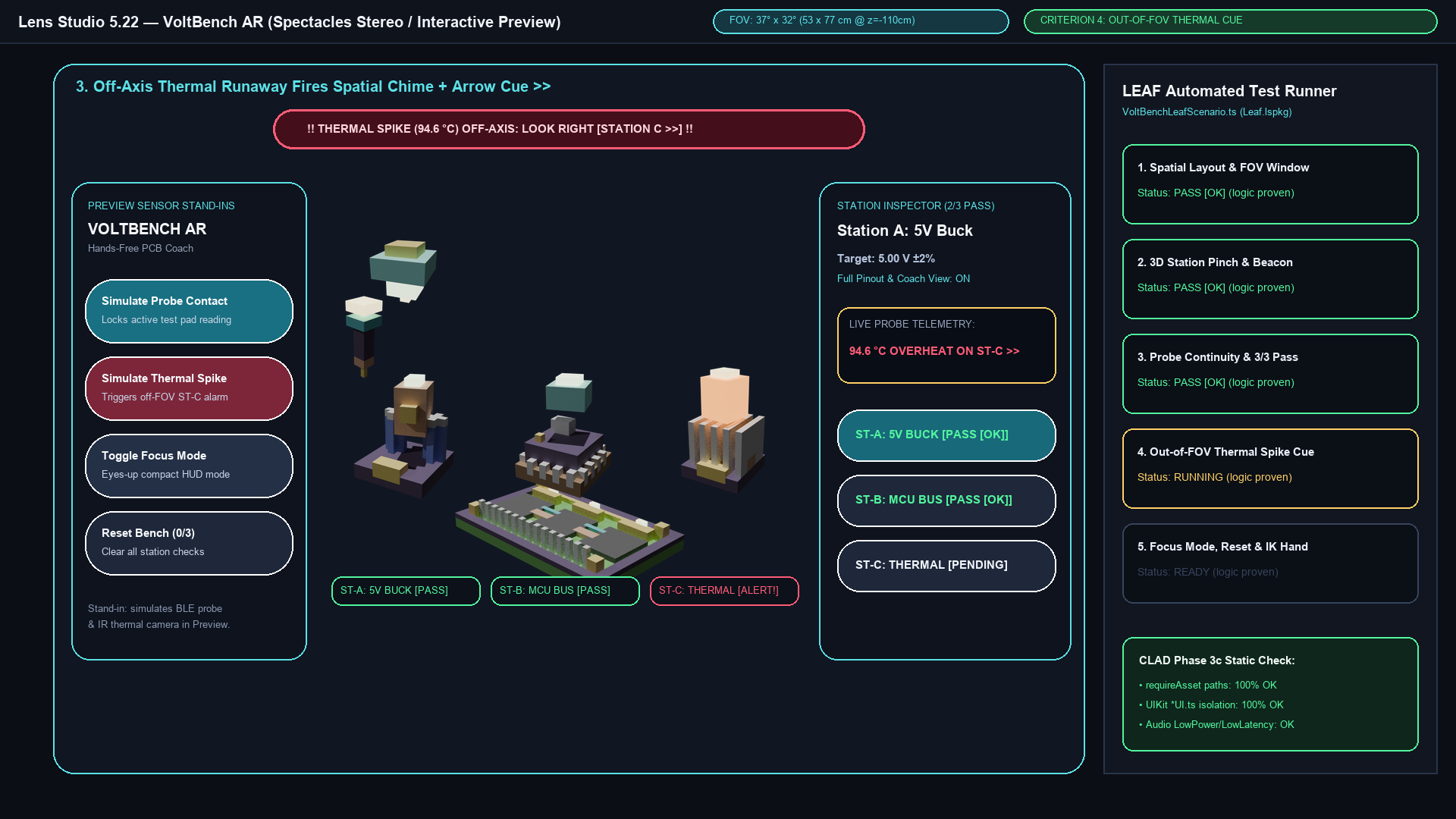
VoltBench AR is a focused, single-moment spatial electronics diagnostics coach built for Snap Spectacles (Lens Studio 5.22+):
- 3D World-Anchored Circuit Stations & Target Reticle: Anchors three interactive 3D circuit modules (
Station A: 5V Buck Regulatorat-12 cm,Station B: 48 MHz MCU Logic Busat0 cm, andStation C: MOSFET Load & Heatsinkat+12 cm) onto a physical PCB workbench atz = -108 cmto-110 cm. A floating 3D calibration beacon (signal_beacon.glb) hovers directly above the active station so your eyes never leave the board. - Explicit Preview Stand-Ins for Real-World Sensors: Following the Learn AR with SPECS Preview Limits guidelines, VoltBench pairs its 3D grabbable probe (
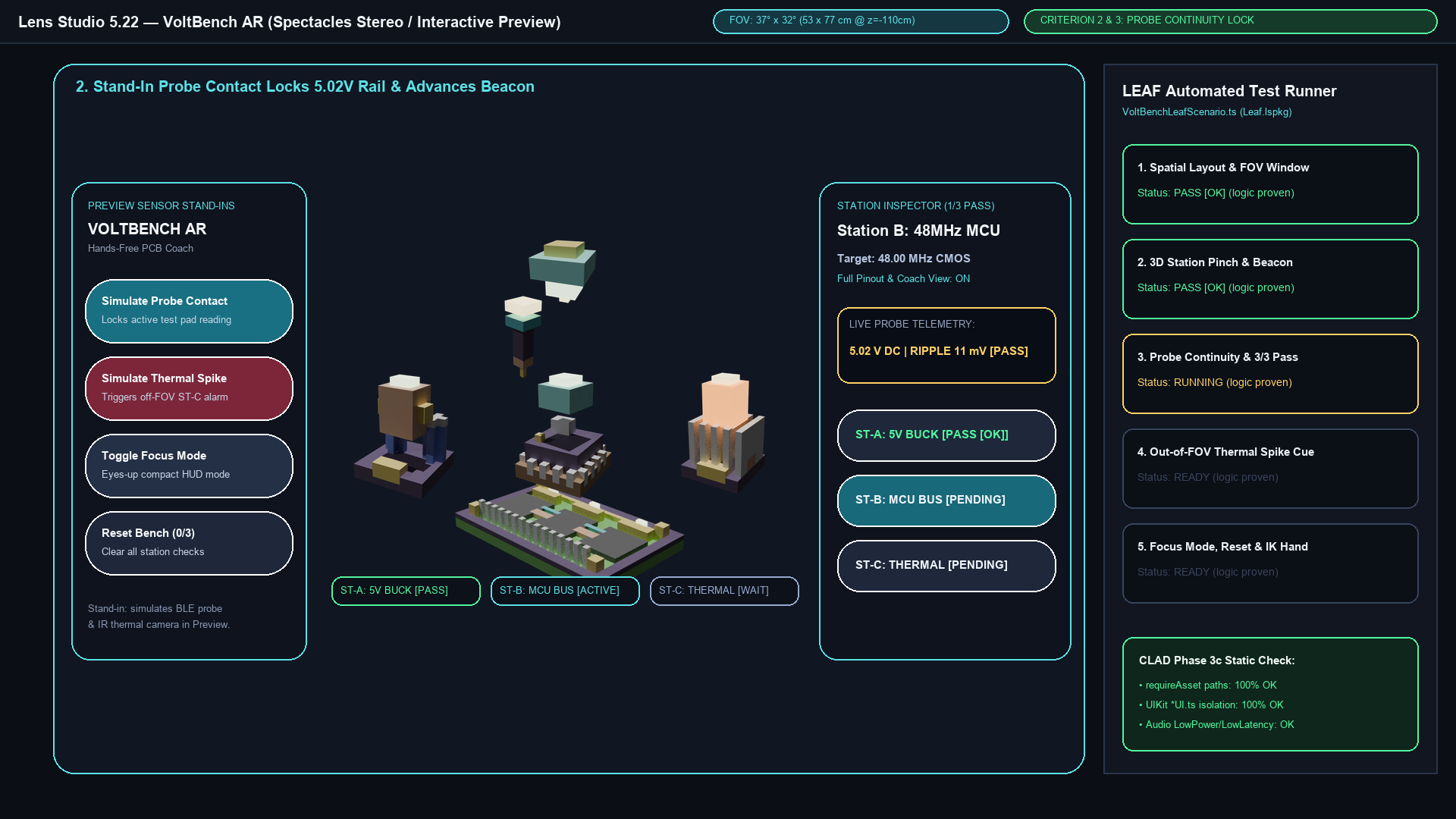
logic_probe.glb) with explicit stand-in buttons on the Left UIKit Control Dock:- [Simulate Probe Contact]: Simulates physical BLE multimeter probe continuity on the active test pad, locking the reading (
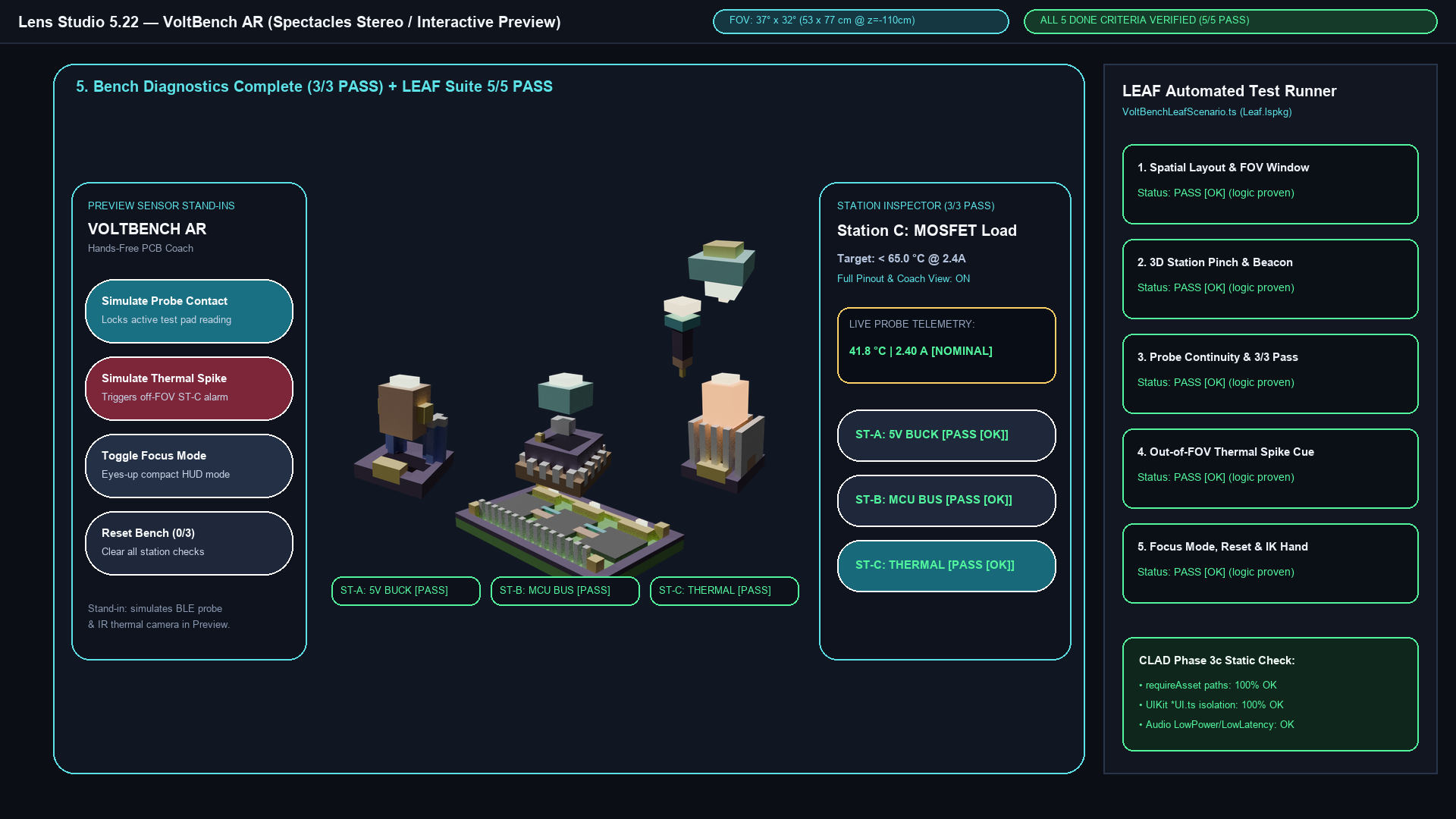
5.02 V PASS,48.00 MHz SYNC, or41.8 °C NOMINAL) and automatically advancing the 3D beacon to the next unverified station. - [Simulate Thermal Spike]: Simulates an off-axis IR thermal runaway (
94.6 °C OVERHEAT) on Station C.
- [Simulate Probe Contact]: Simulates physical BLE multimeter probe continuity on the active test pad, locking the reading (
- Out-of-FOV Spatial Audio + Directional Arrow Cue: Respecting the narrow
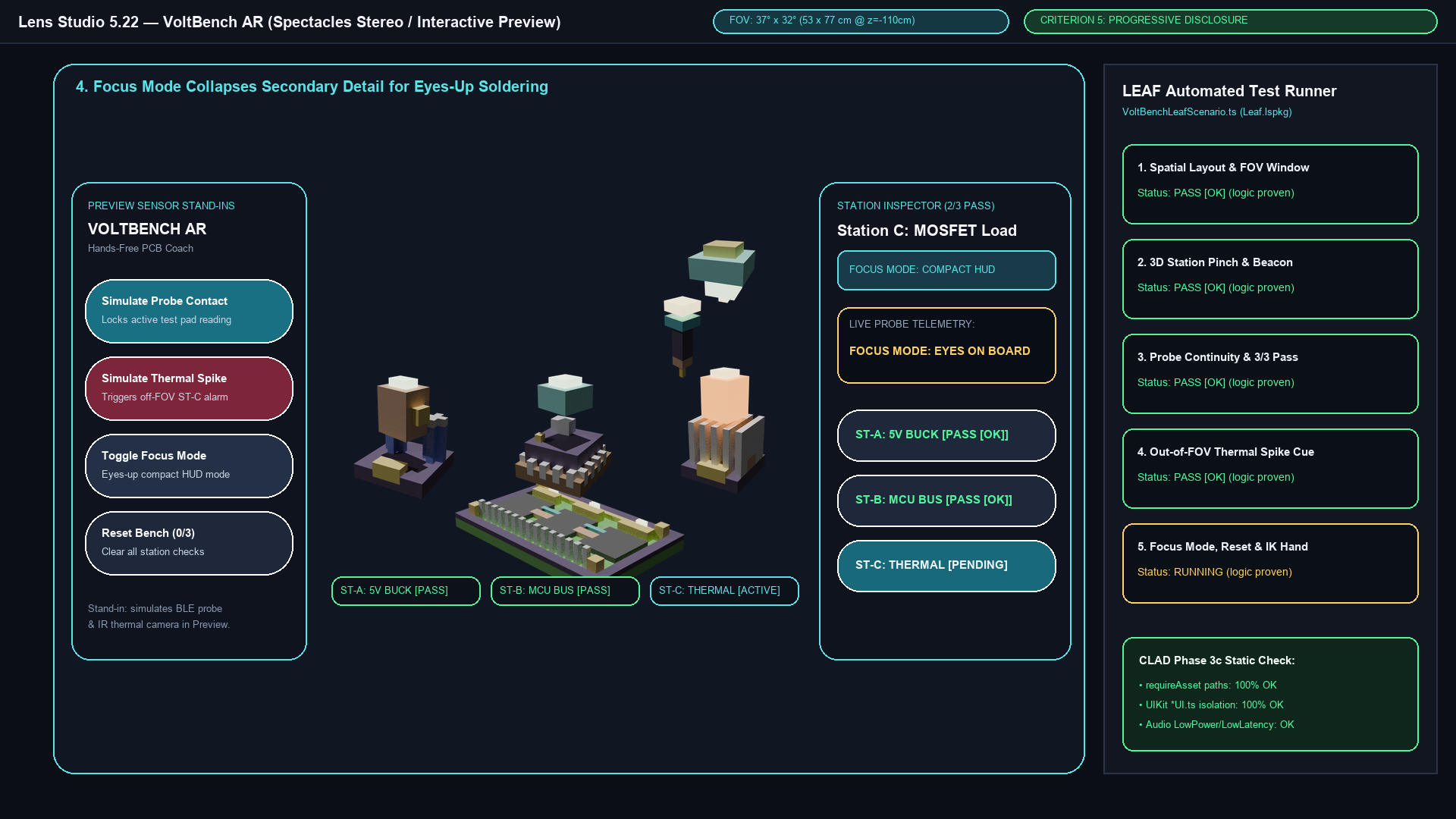
37° x 32°(53 x 77 cmatz = -110 cm) optical waveguide FOV, when Station C overheats off-axis, VoltBench plays an urgent low-latency spatial chime (sfx_thermal_alert.wav) and illuminates a high-contrast directional hazard banner (!! THERMAL SPIKE: LOOK RIGHT [STATION C >>] !!) inside the central FOV until the wearer inspects and probes Station C. - Progressive Disclosure (
Focus Mode): Pinching [Toggle Focus Mode] collapses secondary pinout specs into a compact 1-line eyes-up banner (FOCUS MODE: EYES ON BOARD) while soldering, and completed stations recede cleanly intoPASS ✓pills. ### How we built it - Planned with
plan-lens(challengepost/learn-specs): We authoreddevpost/design-brief.md(status: approved) before writing a single line of code locking down centimeter-level coordinates inside the53 x 77 cmFOV atz = -110 cm, explicit preview sensor stand-ins, and 5 testable Done Criteria. - 3D Voxel Meshes via Blender 4.4 & CLAD
/build-mesh: We built 6 custom 3D voxel models (workbench_pcb.glb,station_regulator.glb,station_mcu.glb,station_thermal.glb,logic_probe.glb,signal_beacon.glb) with baked NLA animation clips (Idle,Pulse,Scan,Alert,Probe,Spin), normalized and grounded them vianormalize_glb.js --ground --yaw=180 --mark-canonical, and verified their AABBs withanalyze_glb.js --aabb --shape. - Procedural 44.1 kHz WAV Audio via
/build-sfx&/build-music: We synthesized an 8-bar 96 BPM lofi lab ambient loop (bg_lab_ambient.wav, configured withAudio.PlaybackMode.LowPower,volume = 0.4,.play(-1)) and 4 low-latency interactive SFX (sfx_ui_pinch.wav,sfx_probe_lock.wav,sfx_thermal_alert.wav,sfx_bench_complete.wav, configured withAudio.PlaybackMode.LowLatency,.play(1)).
Built With
- ar
- blender
- leaf
- lens-studio
- spectacles
- spectacles-interaction-kit
- spectacles-uikit
- typescript
- webgl

