Inspiration
As the world shifts towards renewable energy, many homeowners with solar panels struggle with a critical question: "Should I sell my energy to the grid now or store it for later?" In Lisbon, where weather conditions vary, making the wrong choice leads to wasted energy and financial loss.
We created VoltaShare not just to be a dashboard, but to be the "intelligent financial brain" of the home. Our goal is to solve the misalignment between peak generation and peak consumption, helping users maximize their ROI while supporting the wider Green Energy transition.
What it does
VoltaShare is an AI-powered energy advisor that combines deep tech with a massive market opportunity:
- Market Scale: VoltaShare targets the €42B+ European residential solar market, launching in Portugal to capitalize on its high solar penetration and aggressive 2030 renewable targets.
- Financial Optimization: Expected to reduce monthly energy bills by 18–25% and increase solar hardware ROI by 15% through smarter selling at peak rates.
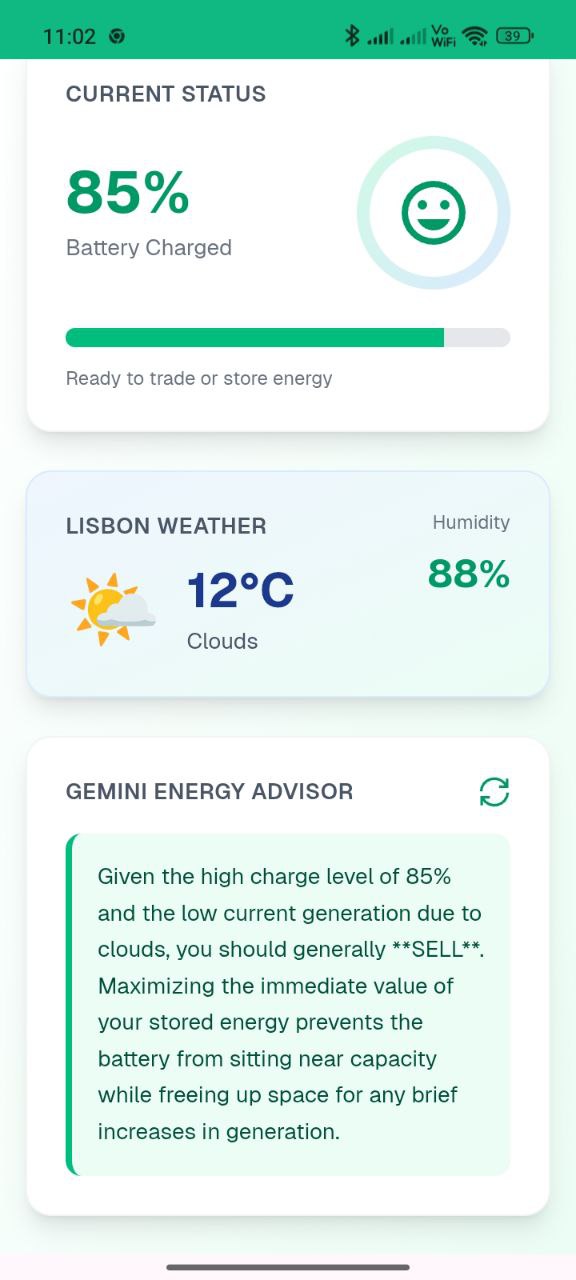
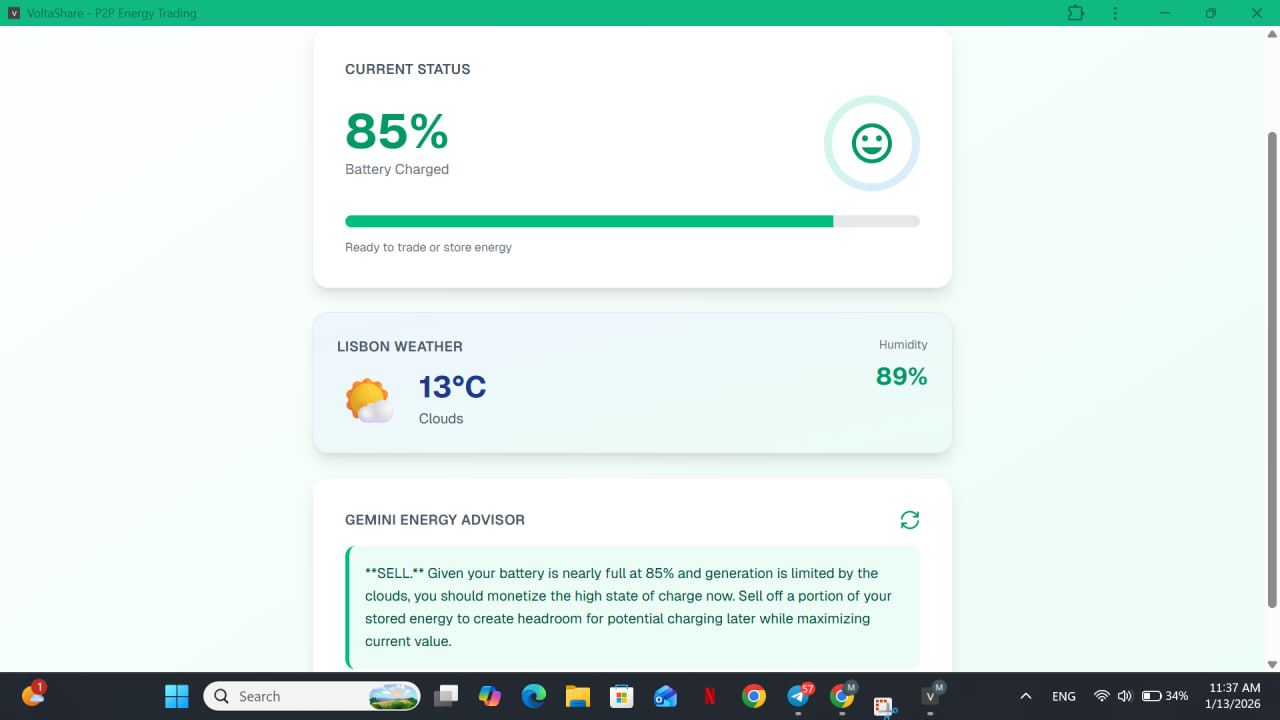
- AI Decision Making: Uses Gemini 2.5 Flash to process live context (Temp, Rain, Battery SoC) and provide instant, deterministic advice (SELL vs. STORE).
- Grid Stability: By encouraging storage during low-demand periods, we help balance the local grid load.
How we built it
We built a scalable, high-performance system combining Generative AI with IoT simulation:
- Intelligence: Integrated Google Gemini 2.5 Flash for lightning-fast, context-aware reasoning.
- Mock Inverter Integration: We implemented a Mock Inverter layer that simulates real-time hardware control, allowing the AI to theoretically "trigger" battery actions, proving the system's readiness for real-world deployment.
- Data Stack: Real-time weather integration via OpenWeatherMap API combined with simulated Battery Management System (BMS) data.
- Frontend: Next.js 14 and Tailwind CSS for a sleek, mobile-first PWA (Progressive Web App) hosted on Vercel.
Challenges we faced
One of our main challenges was finding an AI model fast enough to provide real-time energy advice without lag. We initially experimented with older models, but pivoting to Gemini 2.5 Flash was the game-changer—it provided the perfect balance of speed and reasoning. We also had to ensure our "Mock Integration" logic accurately reflected real-world inverter constraints.
What we learned & Future Roadmap
We learned how to bridge the gap between abstract AI reasoning and concrete IoT actions.
Next Steps:
- Hardware Connection: Moving from Mock to direct API integration with inverters (like Huawei or Fronius).
- Community Energy Sharing: Evolving VoltaShare into a decentralized trading platform where neighbors can buy/sell excess energy, ensuring no green kilowatt goes to waste.
- Predictive Analytics: Using AI to forecast energy needs for the next 24 hours based on user habits.
Built With
- gemini-api
- google-gemini-2.5
- next.js
- node.js
- openweathermap-api
- pwa
- react
- tailwindcss
- typescript
- vercel


Log in or sign up for Devpost to join the conversation.