-
-
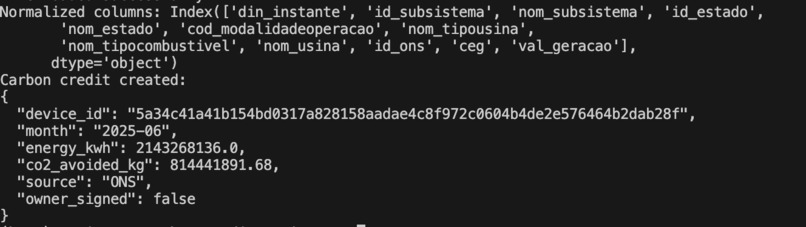
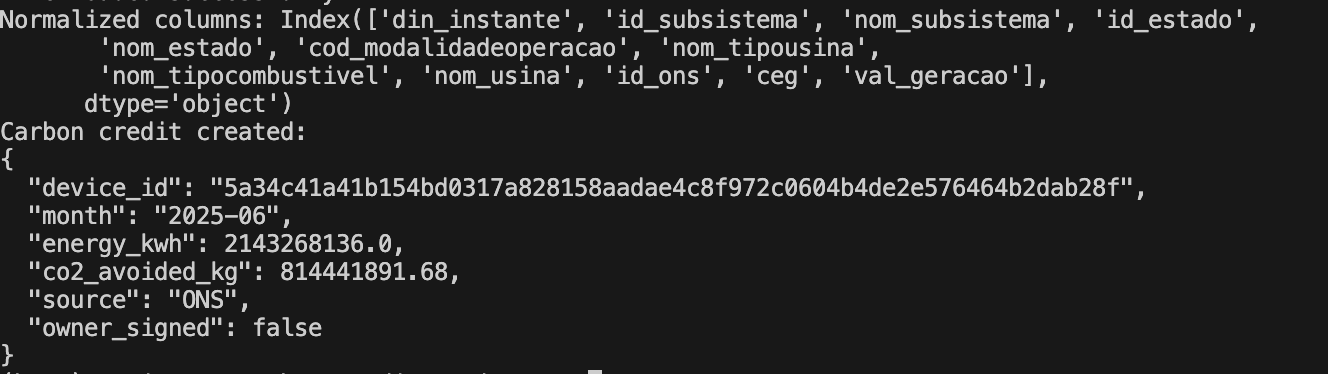
Output for the Carbon Credit
InspirationCarbon
Facing a climate crisis, we wanted to create something that bridges real-world environmental impact with blockchain transparency. Inspired by the need for accurate, verifiable carbon credit systems, we built a project that uses Brazil’s official energy data to calculate emissions offsets and tokenize carbon credits.
What it does
- Fetches real monthly power generation data from Brazil’s ONS (Operador Nacional do Sistema Elétrico)
- Filters and calculates renewable energy output (in MWh) from a chosen power plant
- Converts that output into an estimate of avoided carbon emissions
How we built it
- Data is sourced from this public dataset: https://dados.ons.org.br/dataset/geracao-usina-2
- We use Python and Pandas to clean, parse, and aggregate the CSV data
- Emission savings are calculated by multiplying the total MWh by a CO2 factor
- We used a CLI-based approach to pass plant names and time ranges
Challenges we ran into
- Monthly CSV files are too large to upload directly to GitHub and must be downloaded manually
- The dataset changes column names between months, requiring flexible handling of fields like date and energy
- Some plant names are inconsistent, making filtering unreliable without normalization
Accomplishments that we're proud of
- We calculated carbon credits from real national-scale energy data
- Built a modular pipeline that could scale to include more power plants or additional months
What we learned
- Working with public data means being ready to handle inconsistencies and manual edge cases
- Real-time carbon credit systems depend on reliable energy input, which is not always standardized
What's next for Voltanex-Carbon-Credit-Calculator
- Automate CSV downloads from the ONS platform using scripts or their API (if exposed)
- Add dynamic plant selection and validation via UI or metadata lookup
- Deploy credit tokens fully on Avalanche and publish a smart contract interface
- Add historical tracking and a visualization dashboard for plant-by-plant or region-by-region analysis

Log in or sign up for Devpost to join the conversation.