-
-
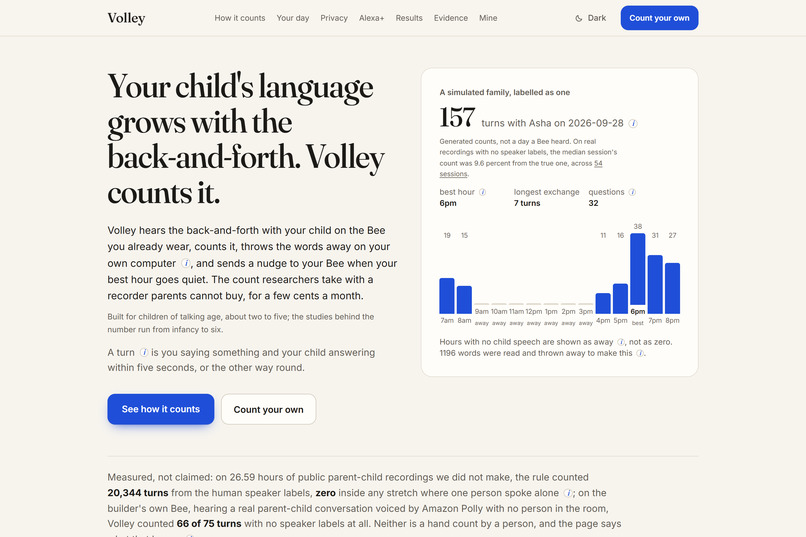
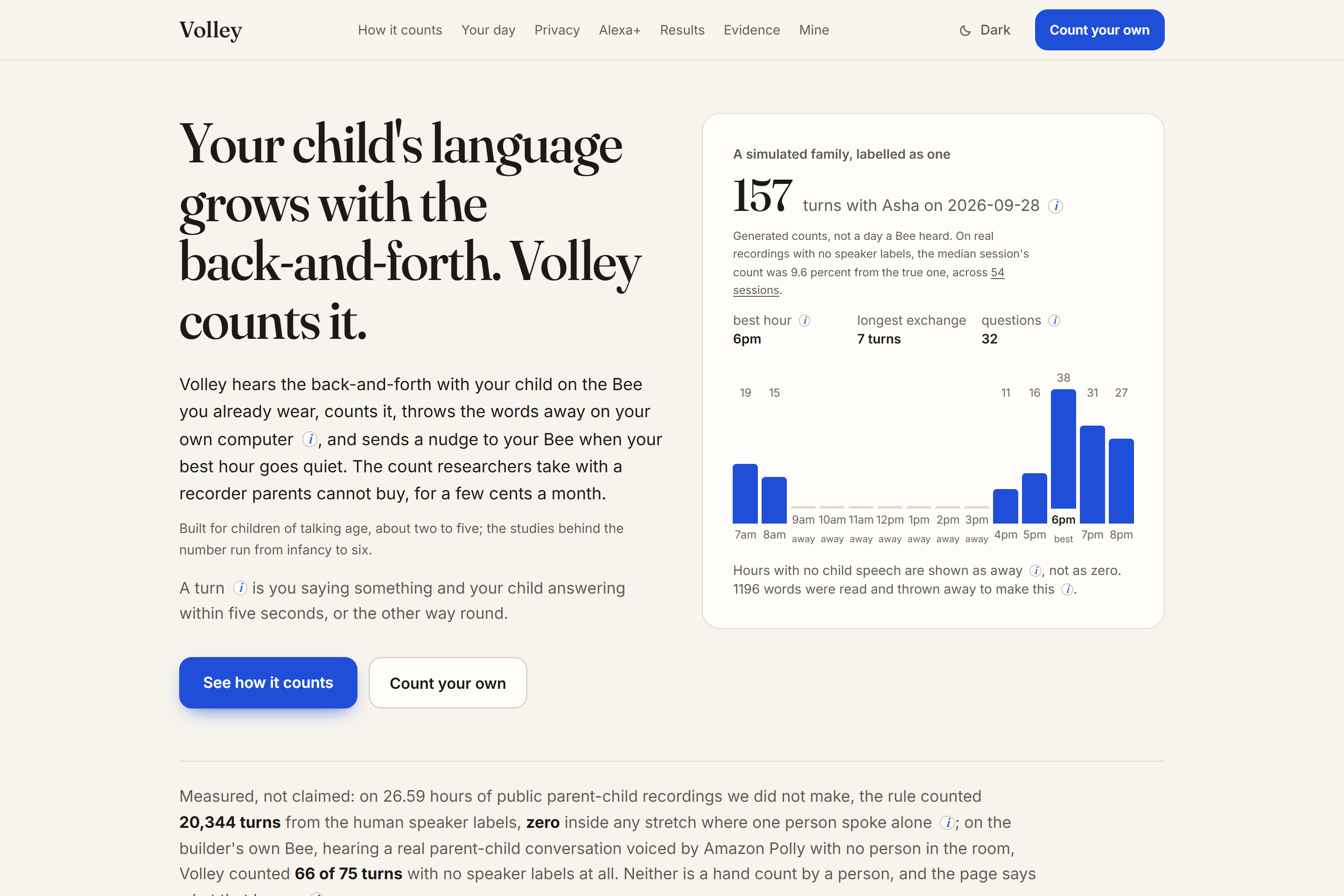
Your day, an hour at a time. The count, your best hour, and one thing to try tomorrow.
-
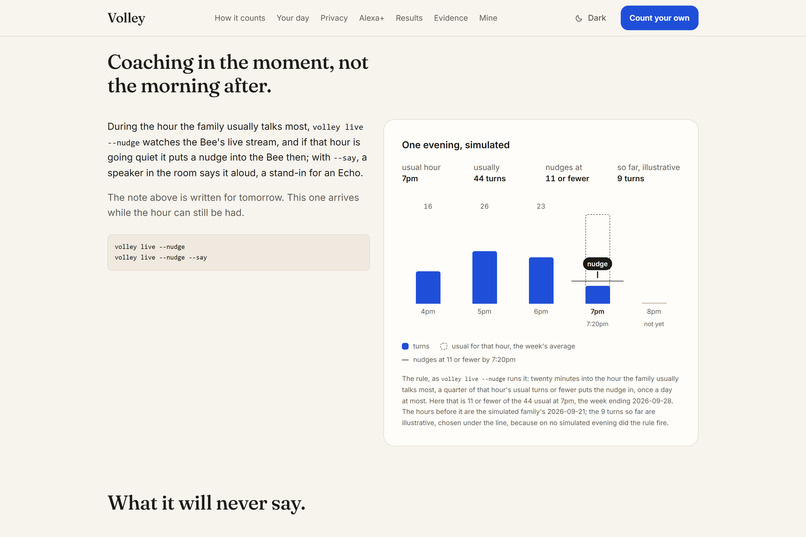
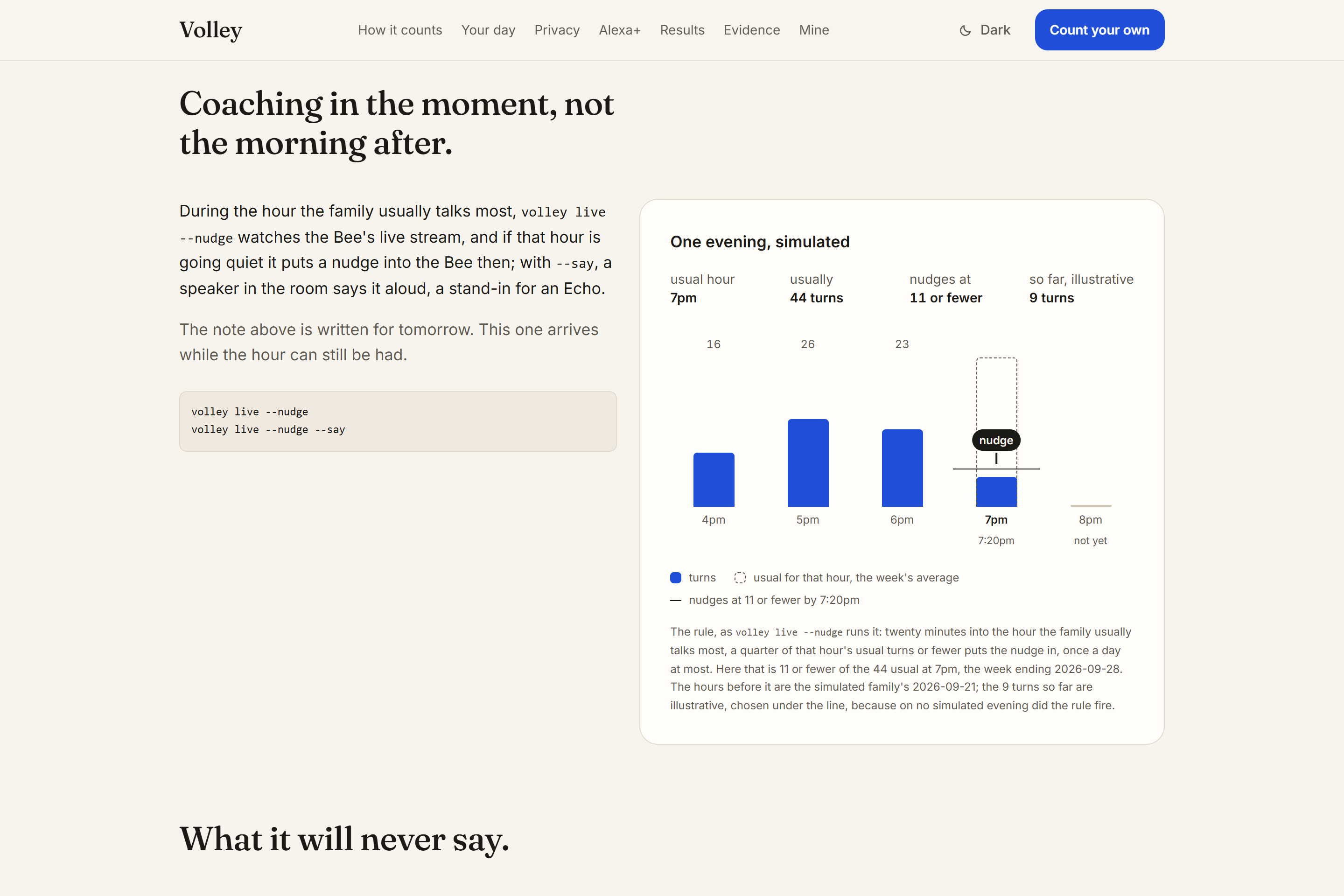
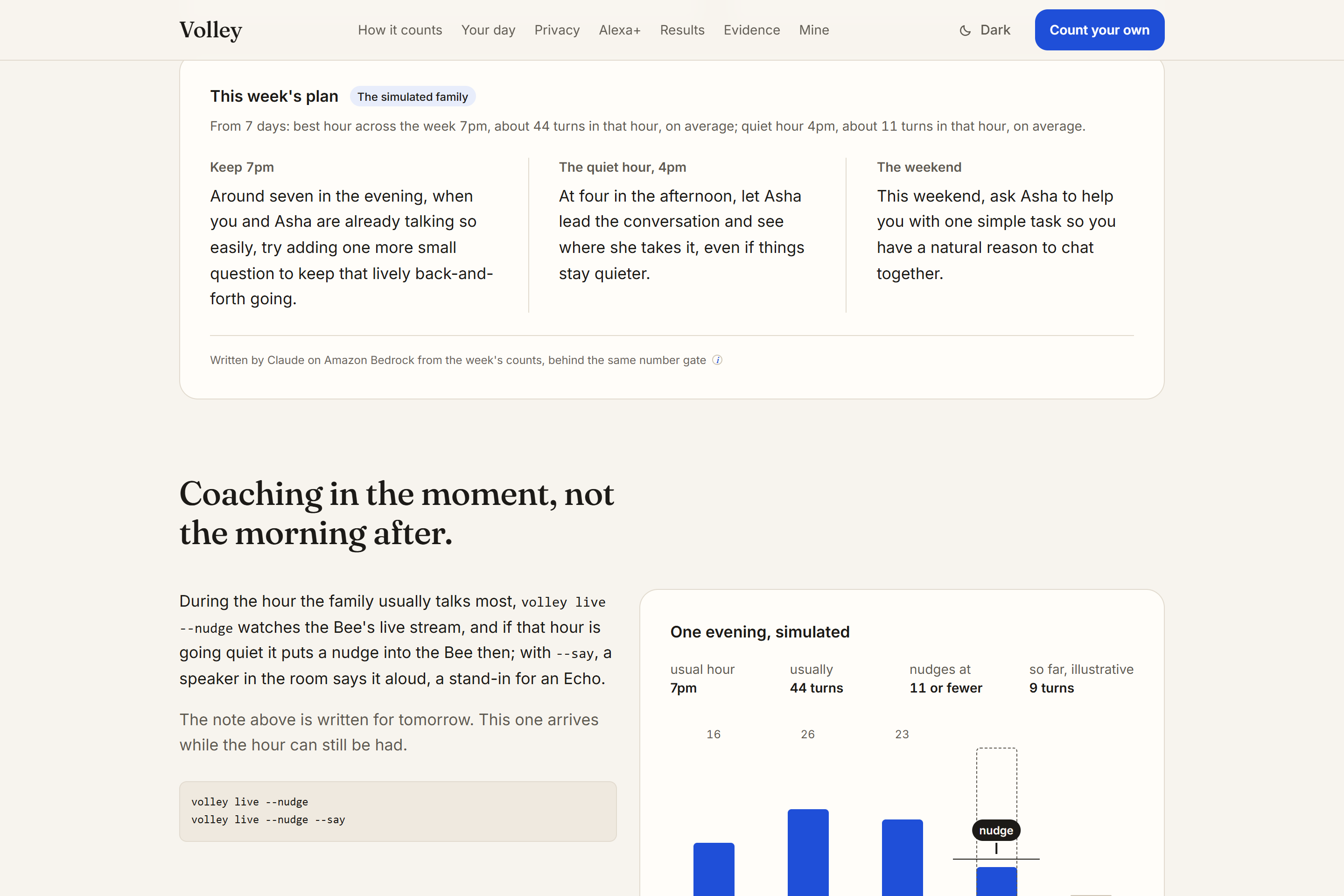
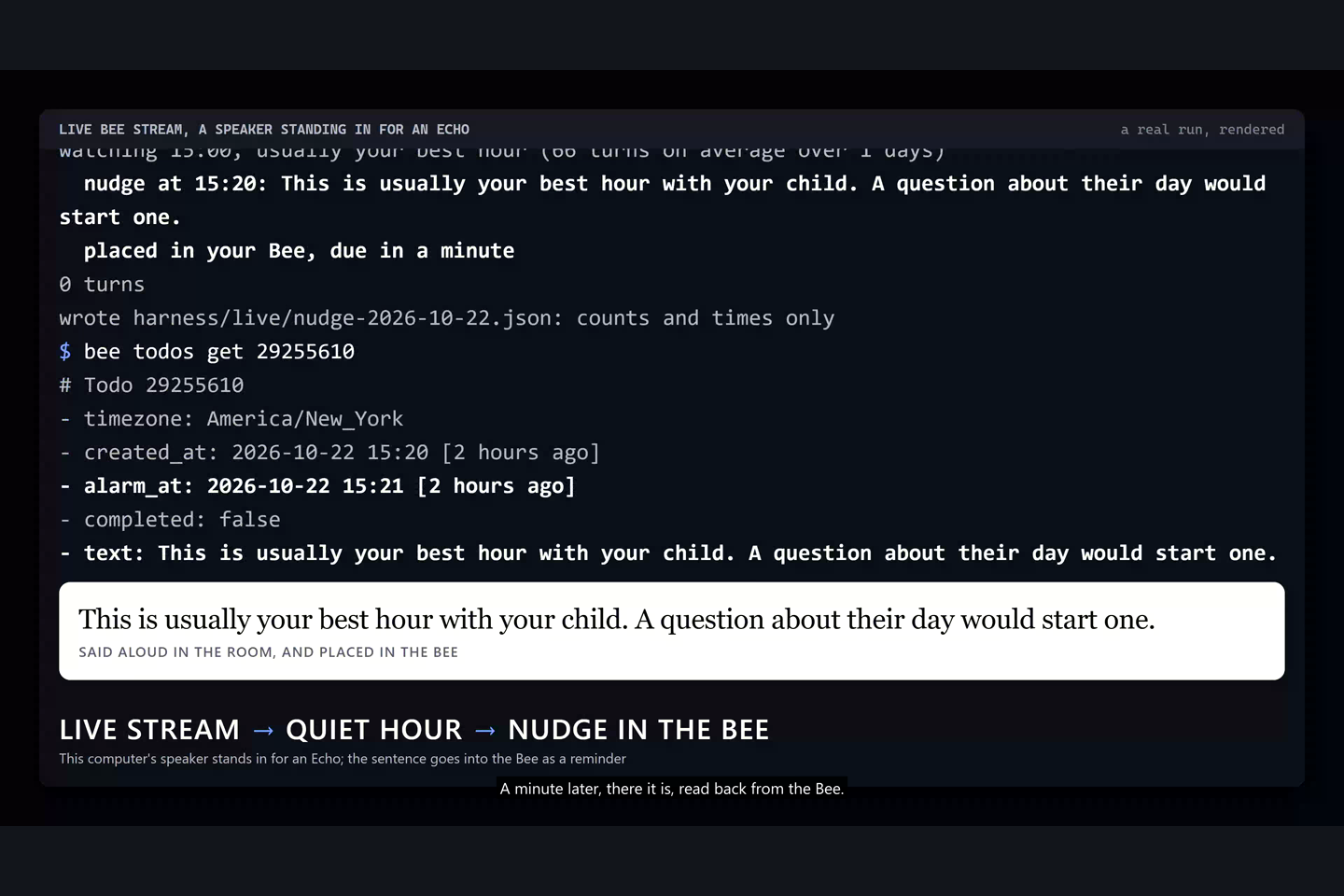
When your best hour goes quiet, one sentence reaches your Bee, and a speaker in the room says it.
-
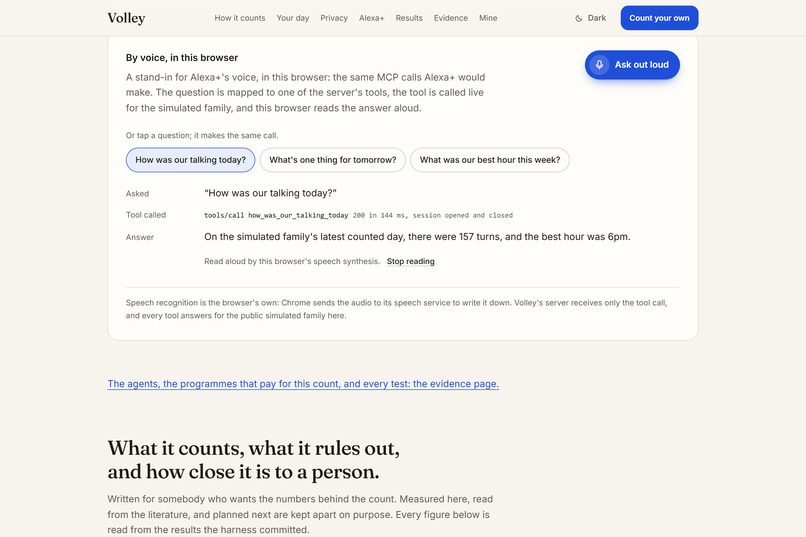
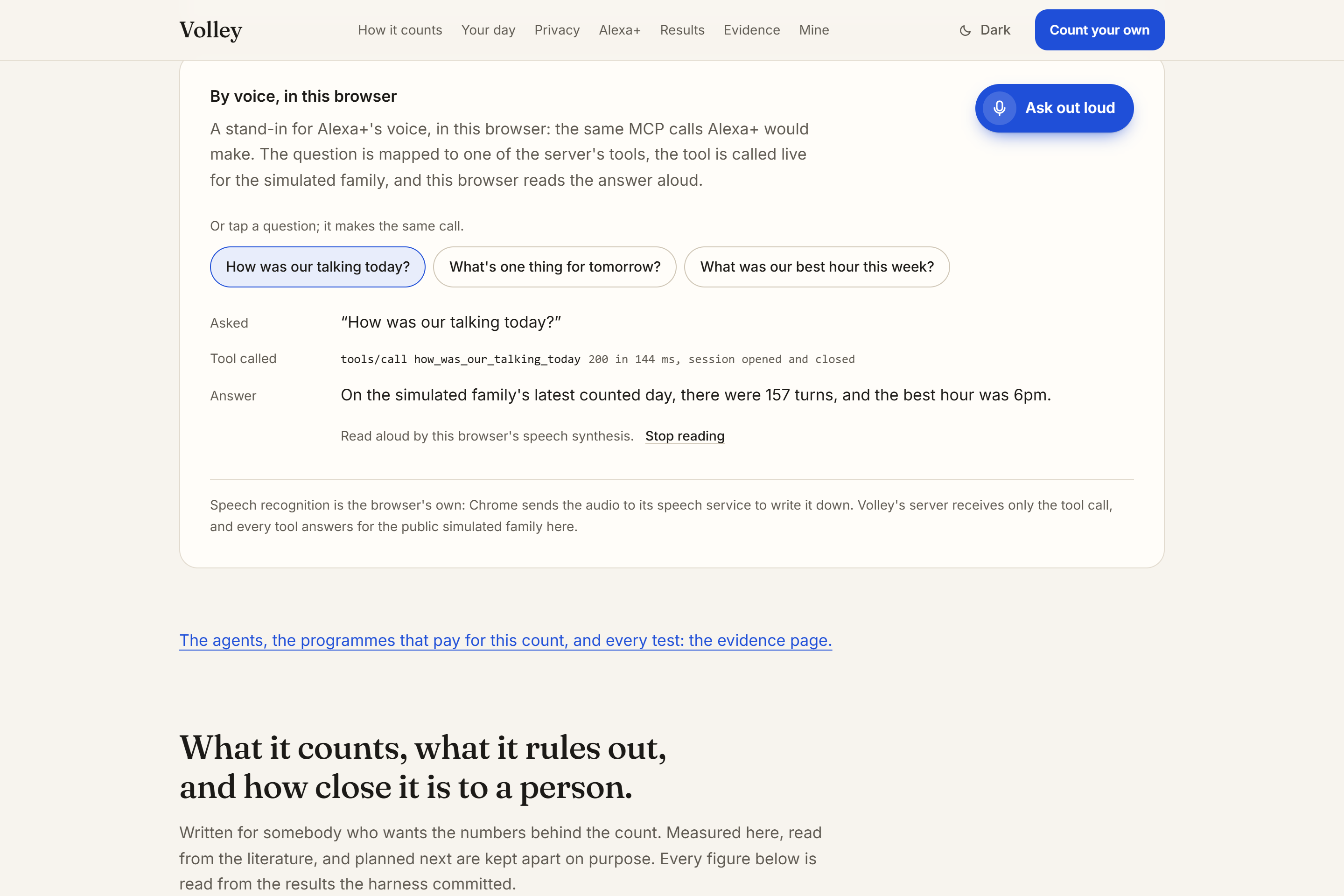
Ask out loud. The same MCP call Alexa+ makes, answered from the counts alone and read aloud.
-
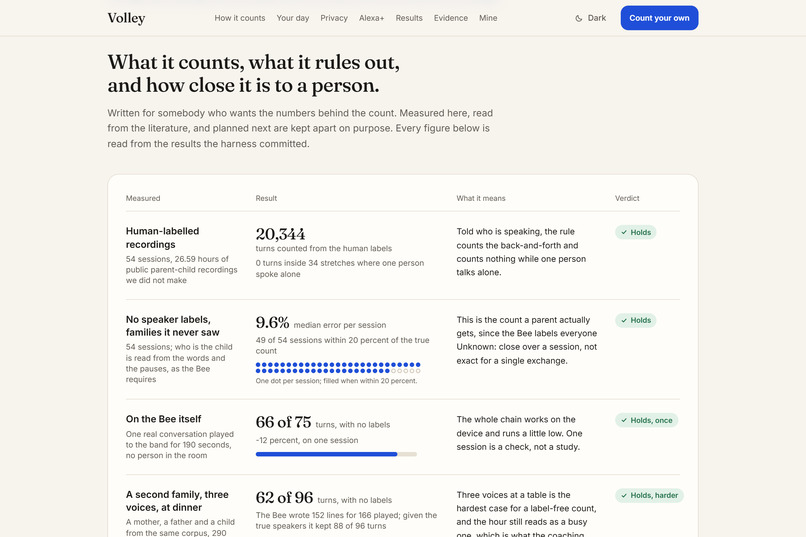
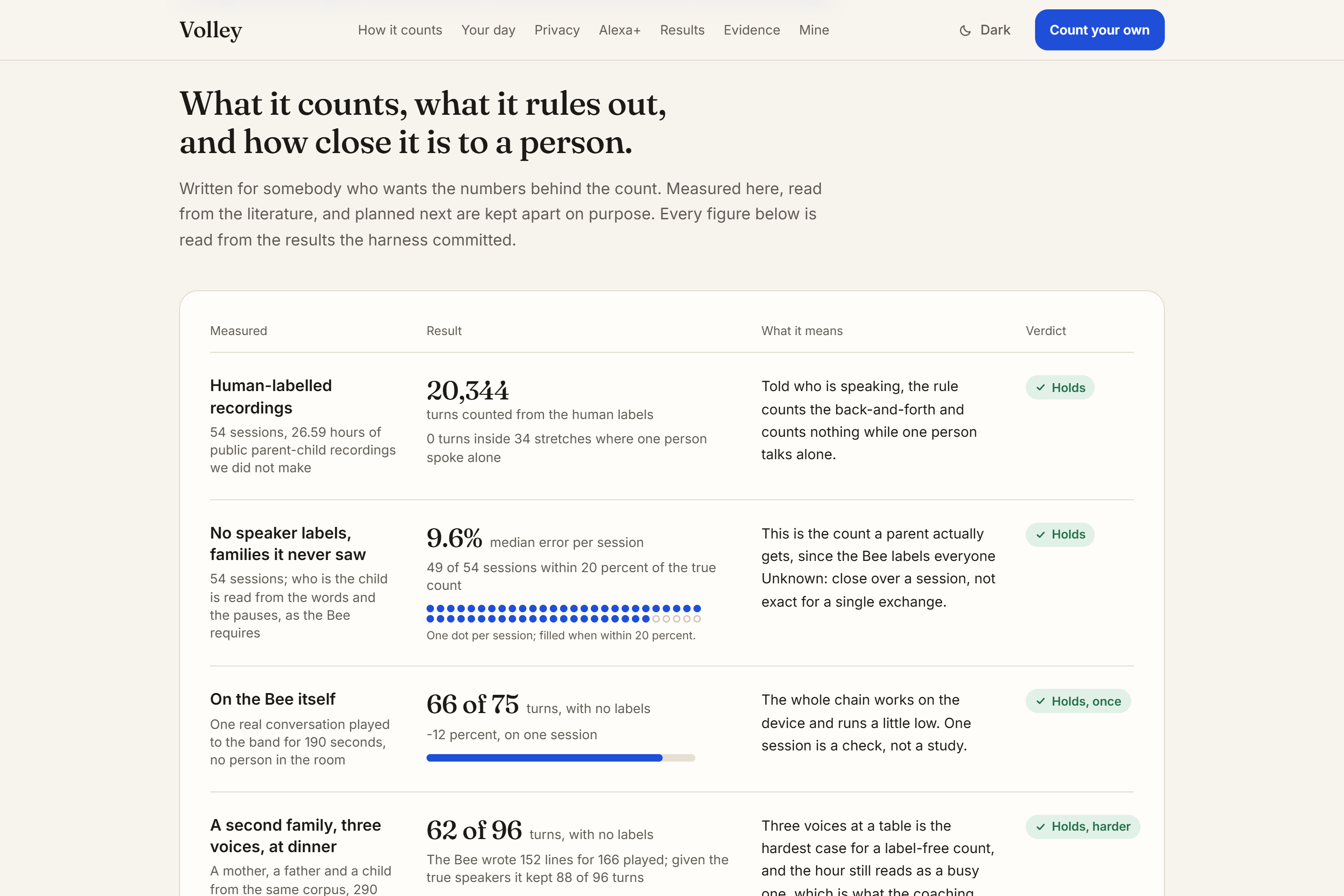
Every result on one page: what it counts, what it rules out, and how close it is to a person.
-
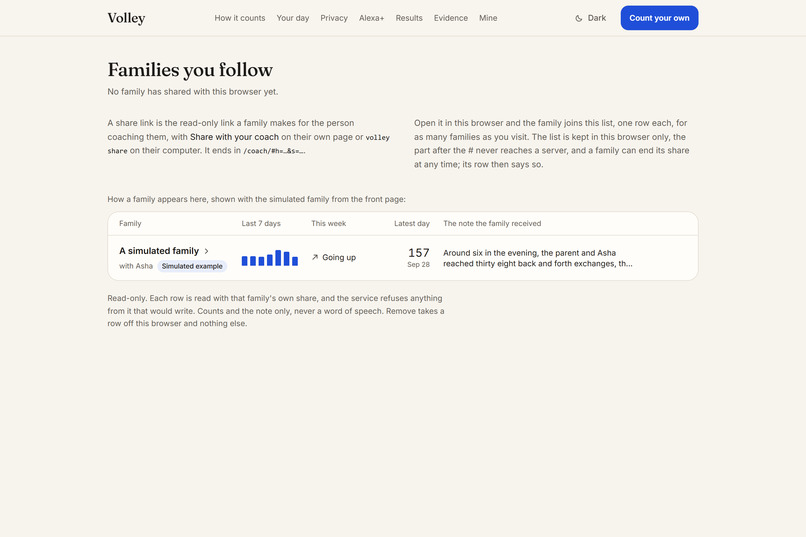
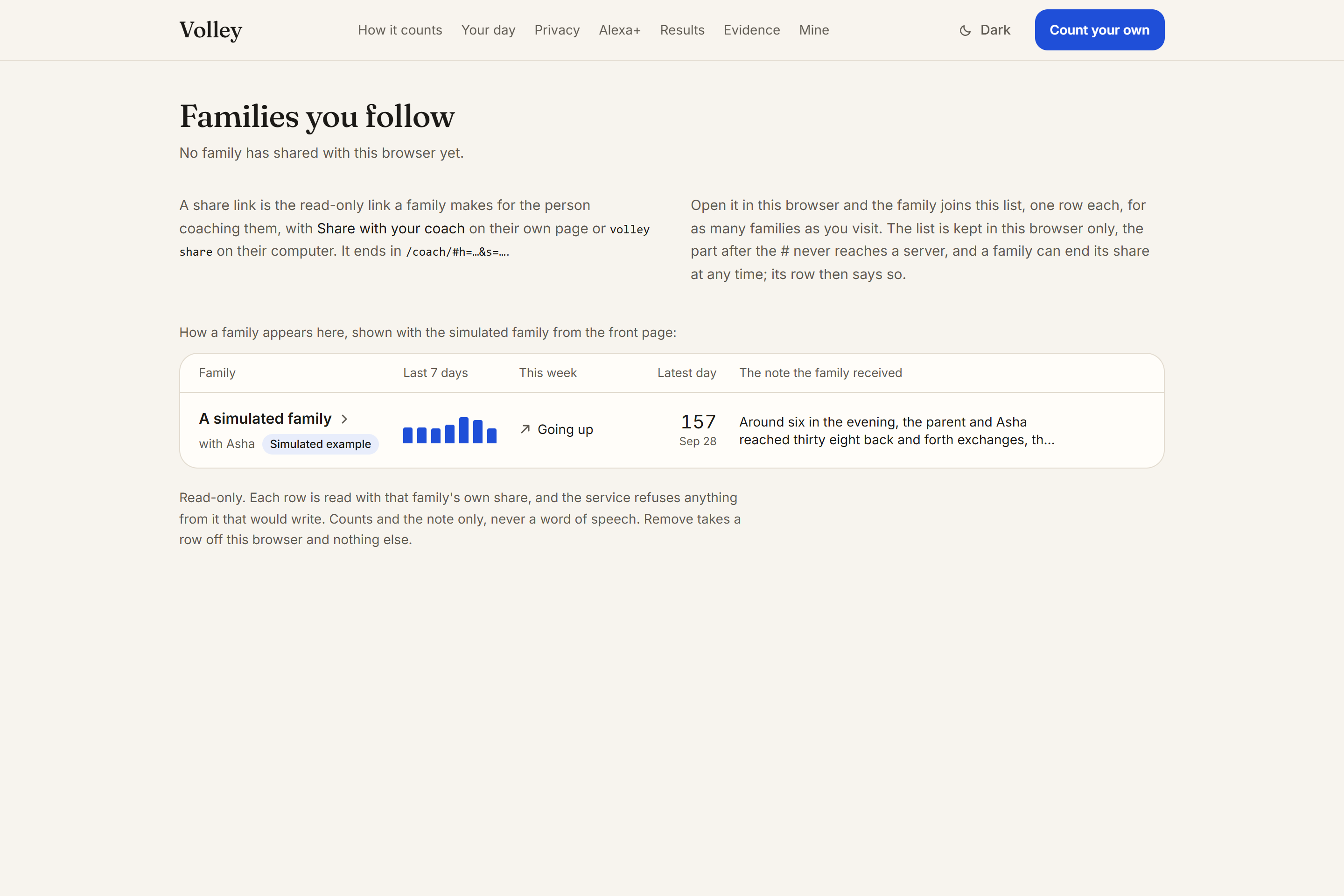
The home visitor's view: the families who shared, read-only, between visits.
-
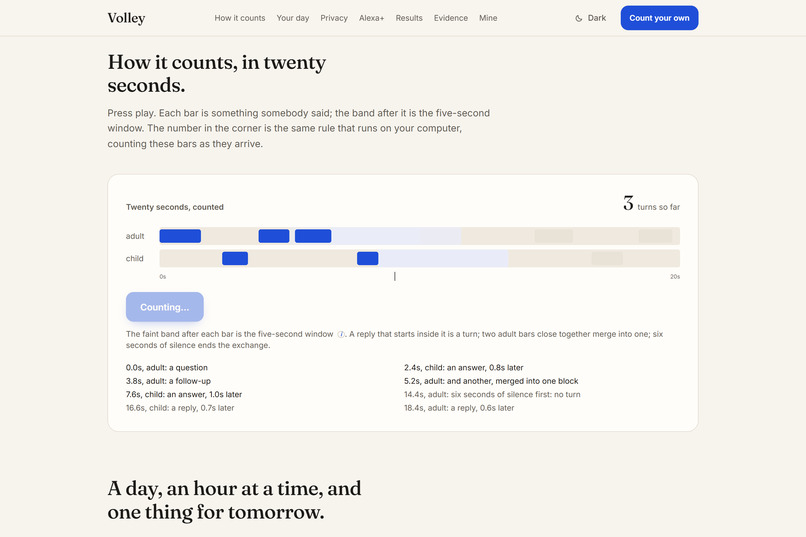
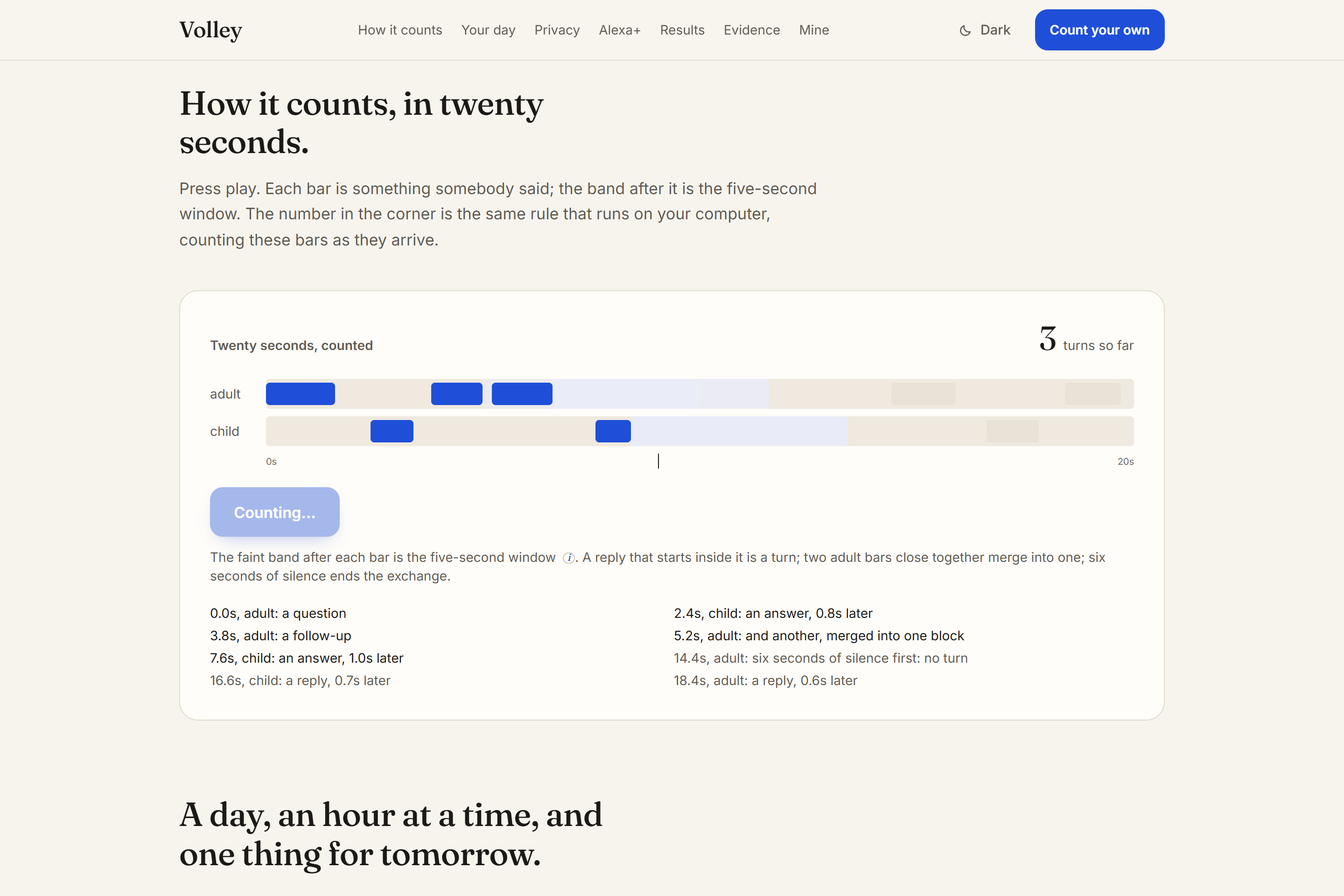
How it counts. A parent speaks, the child answers inside five seconds. That is one turn.
-
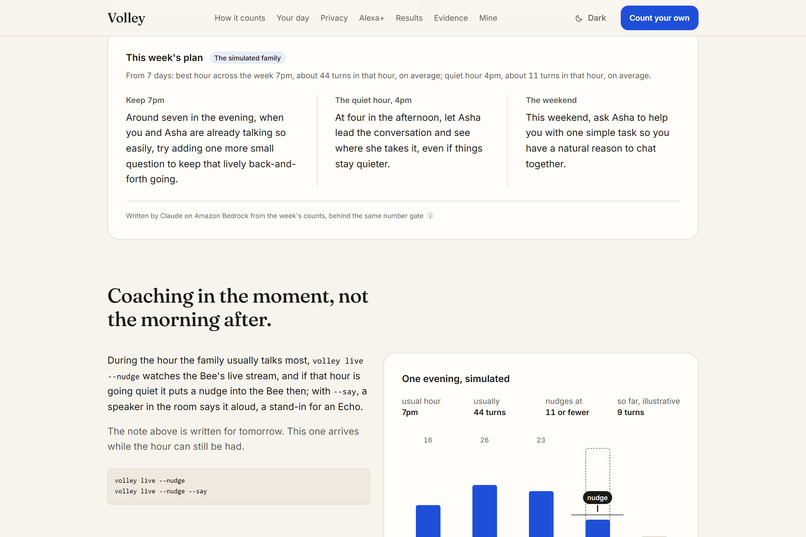
The week's plan, written by Claude on Amazon Bedrock from the counts, behind a gate that checks every number.
-
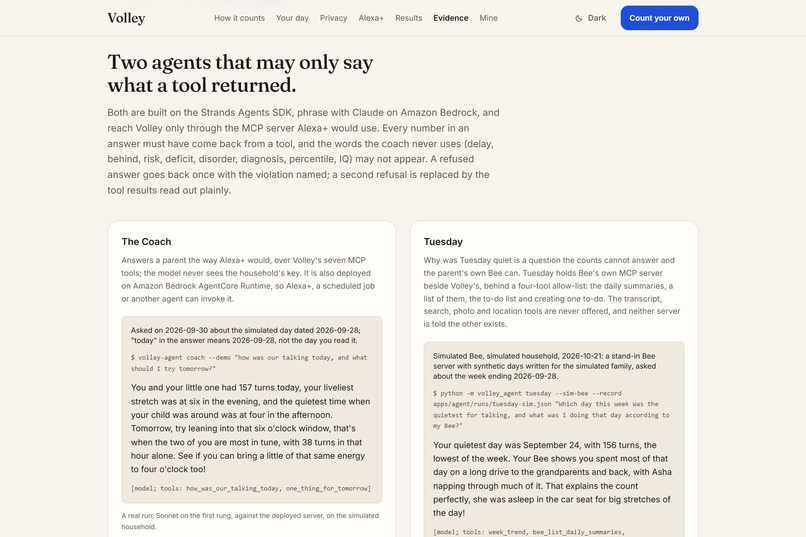
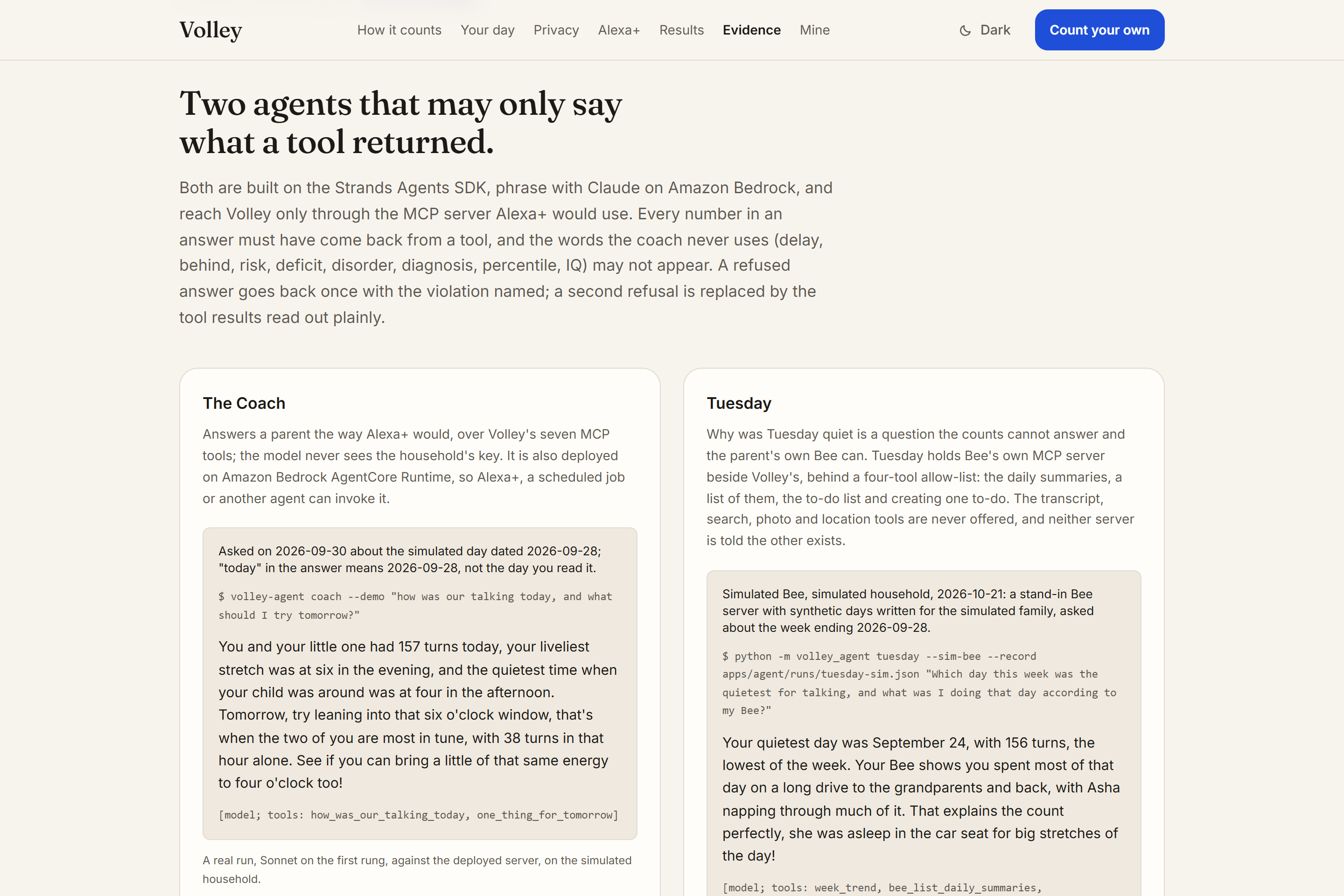
Two Strands agents that may only say what a tool returned. One is hosted on Amazon Bedrock AgentCore.
-
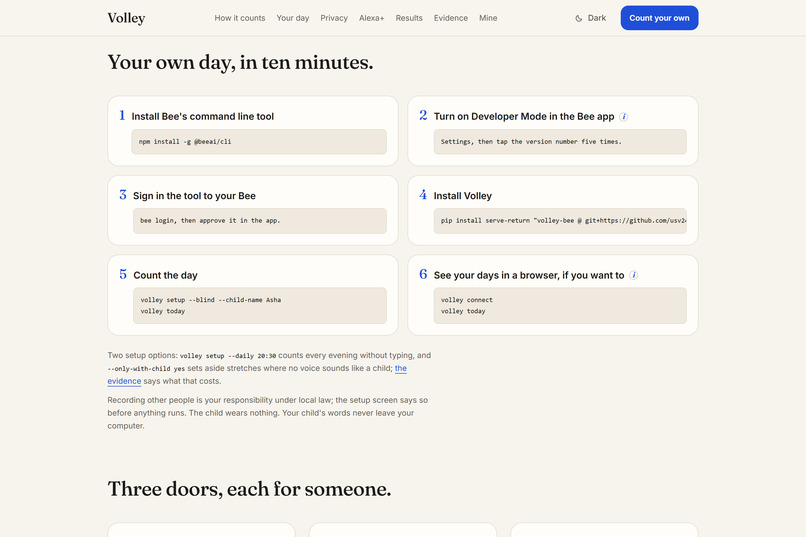
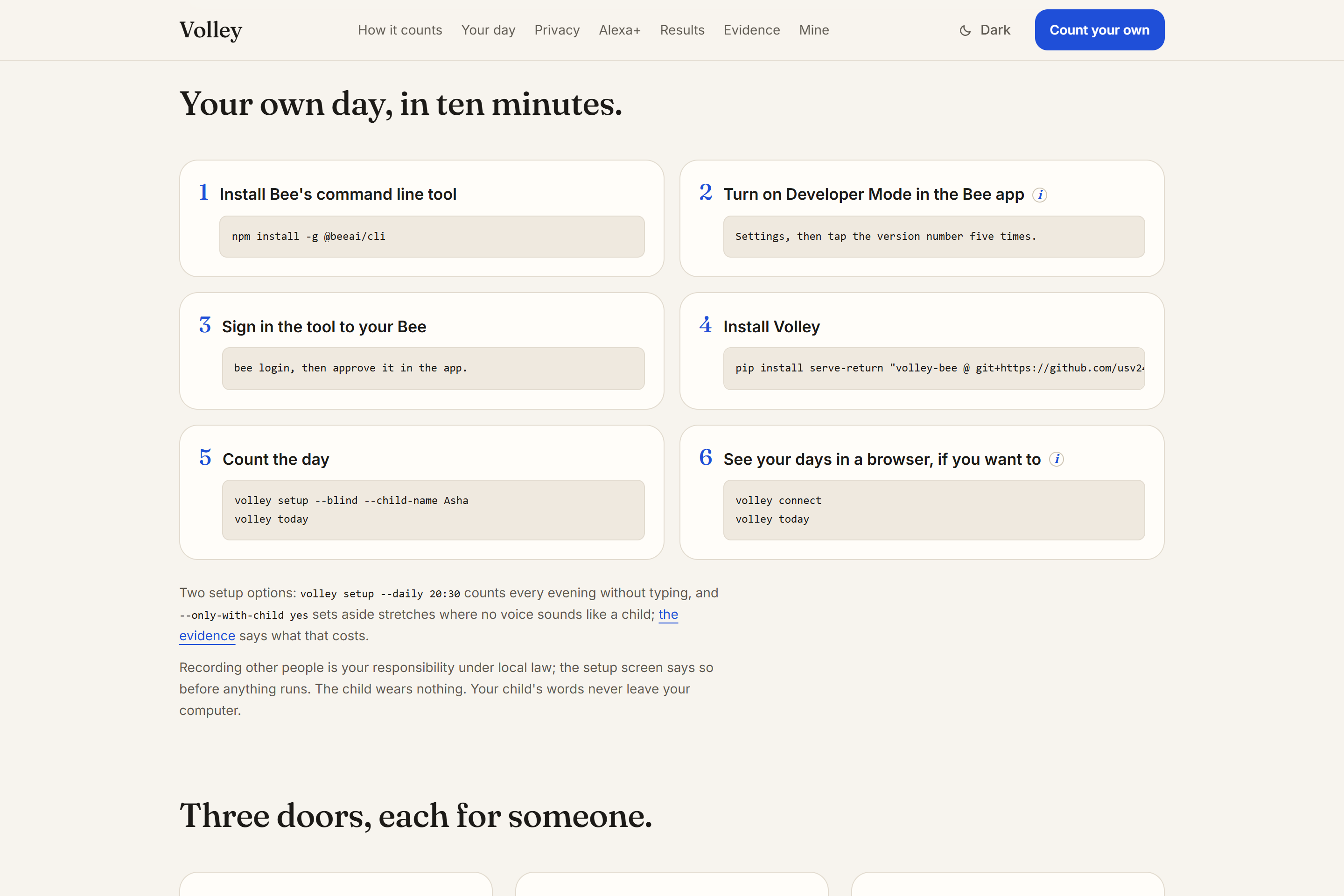
Your own day in ten minutes: six steps with the Bee you already wear.
-
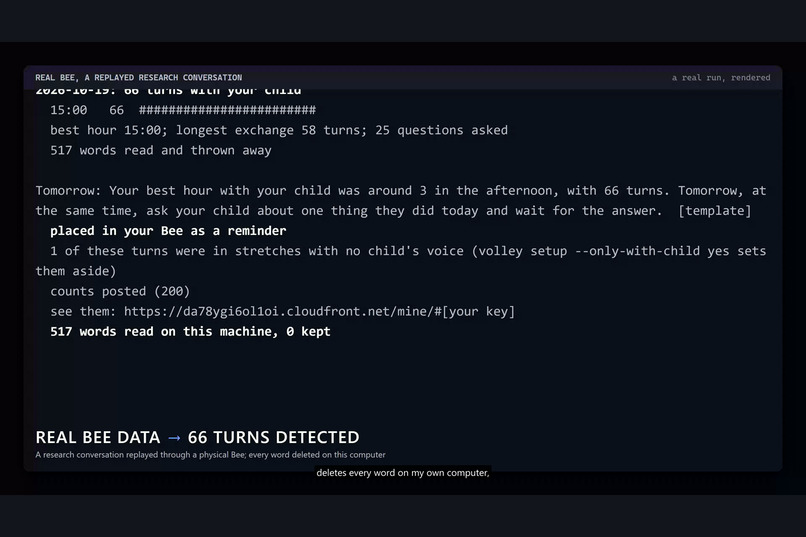
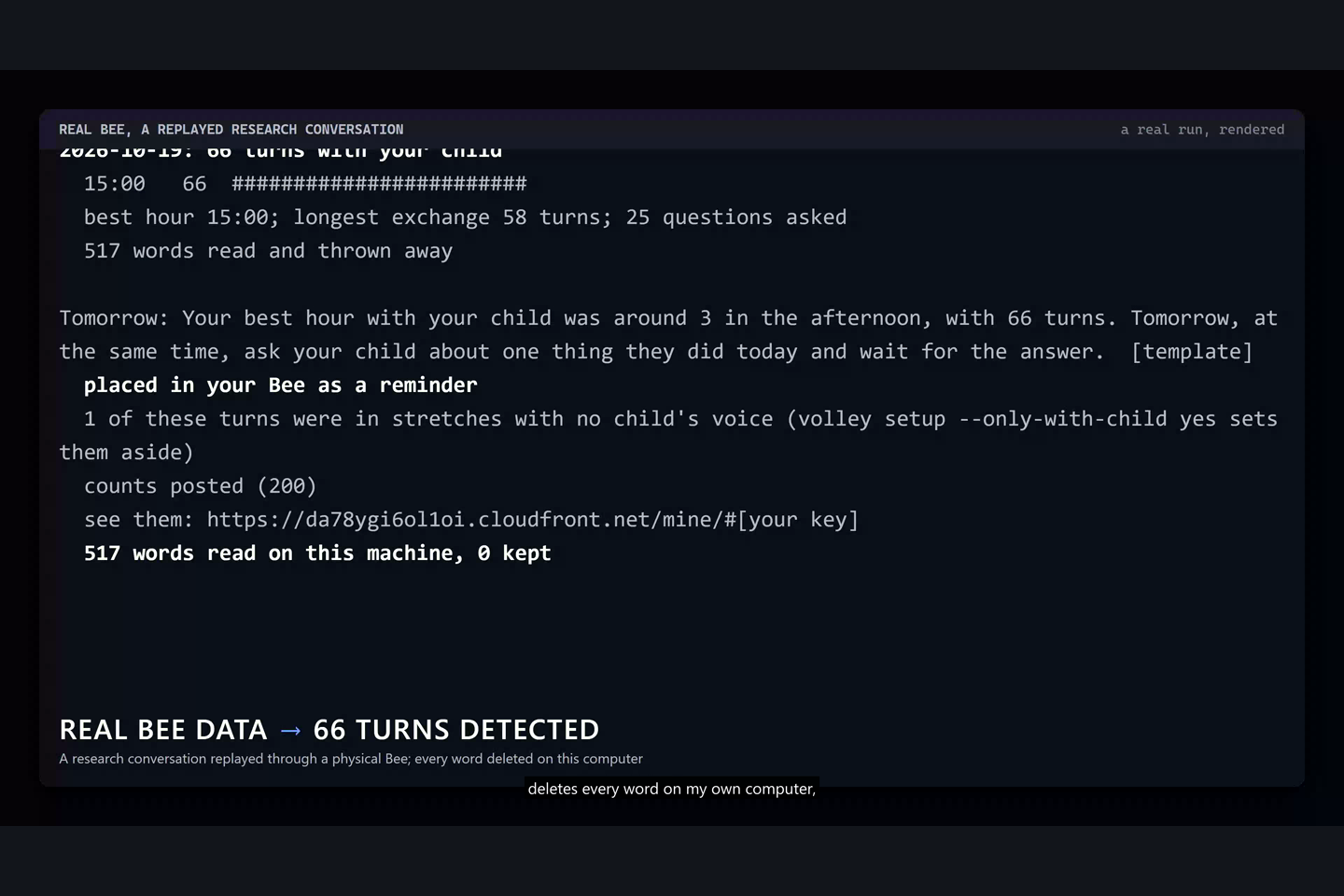
Real Bee data. One command reads the session, finds 66 turns, and deletes every word on my own computer.
-
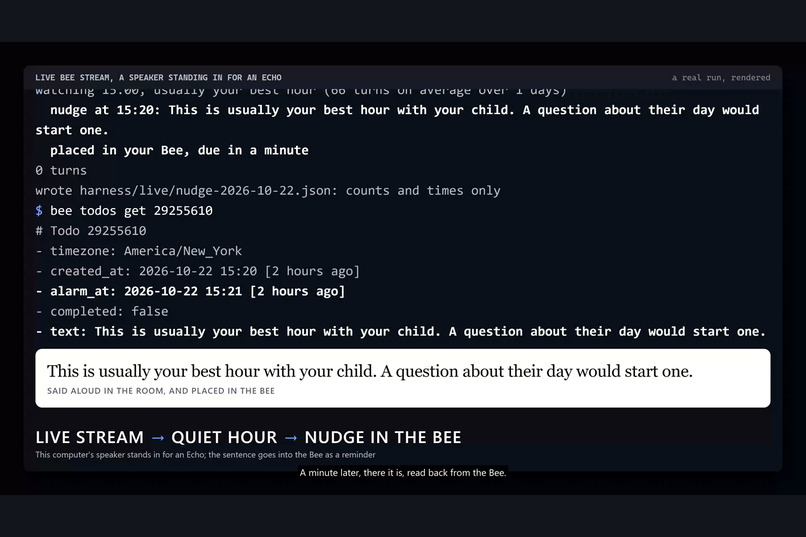
The nudge, live on my Bee: the hour went quiet at 3:20, the sentence was spoken, and the reminder landed.
-
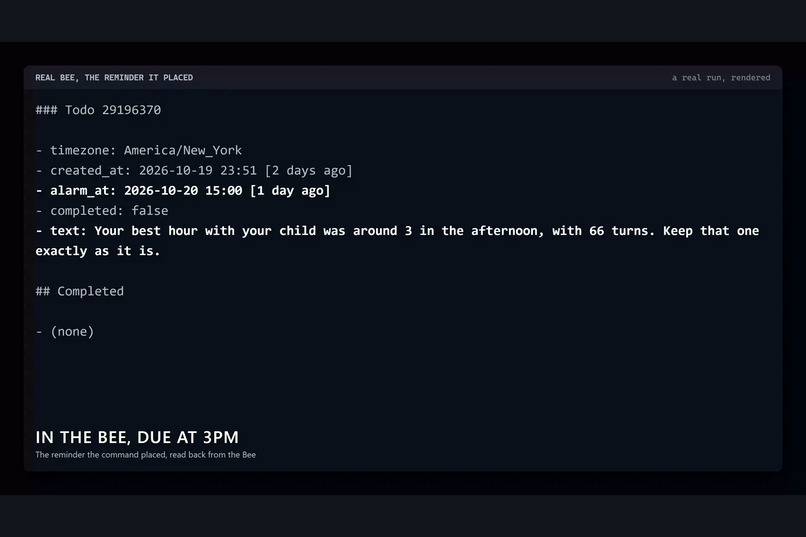
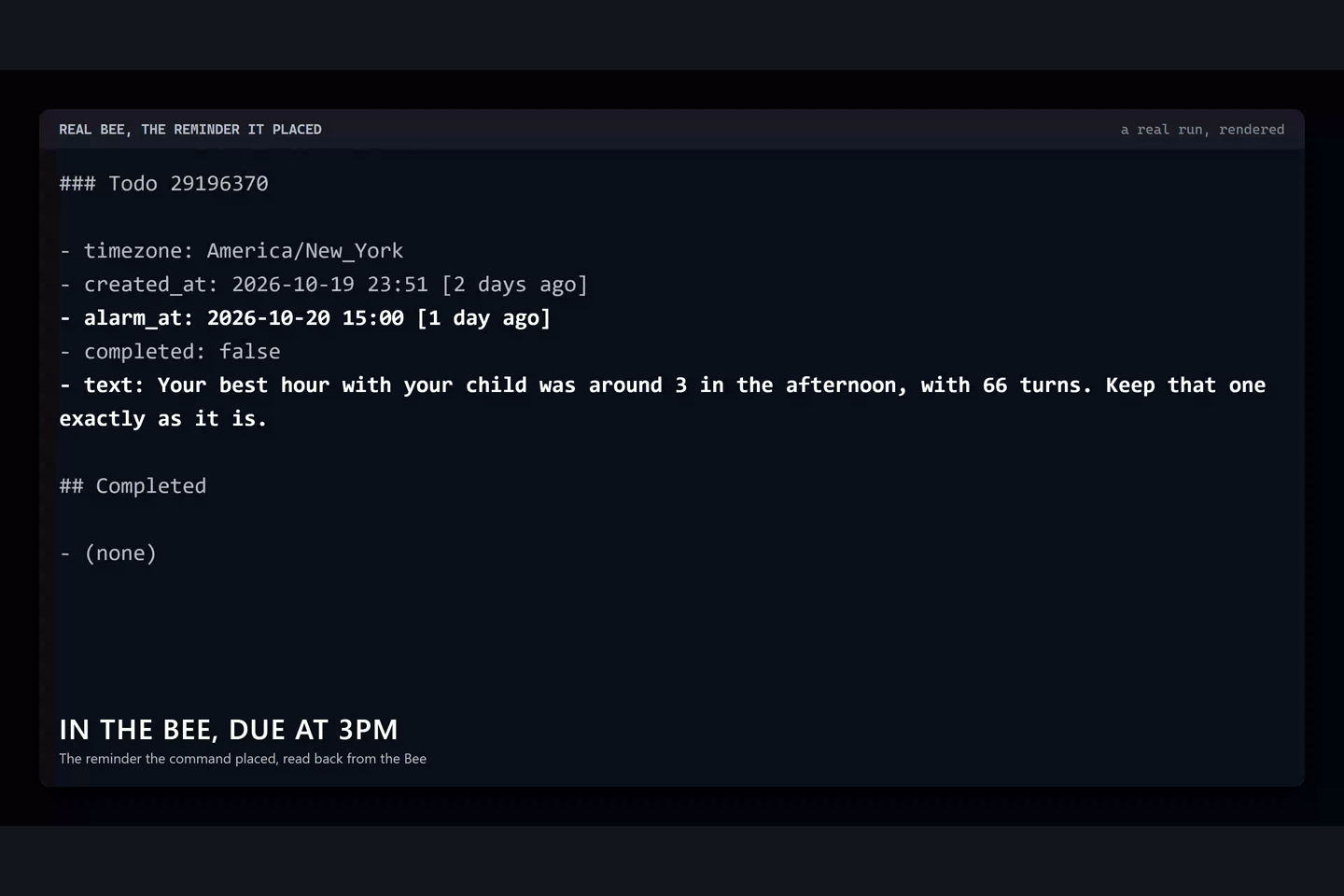
Read back from the Bee: tomorrow's reminder, set for 3pm, the hour it names.
-
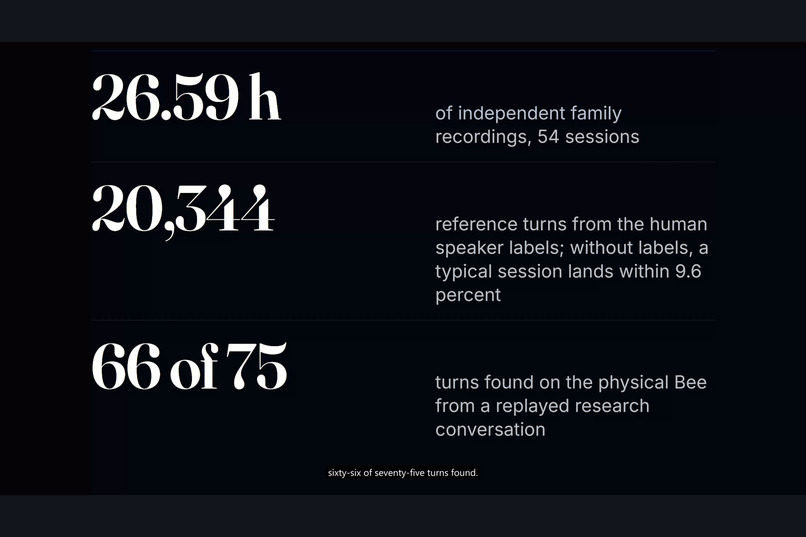
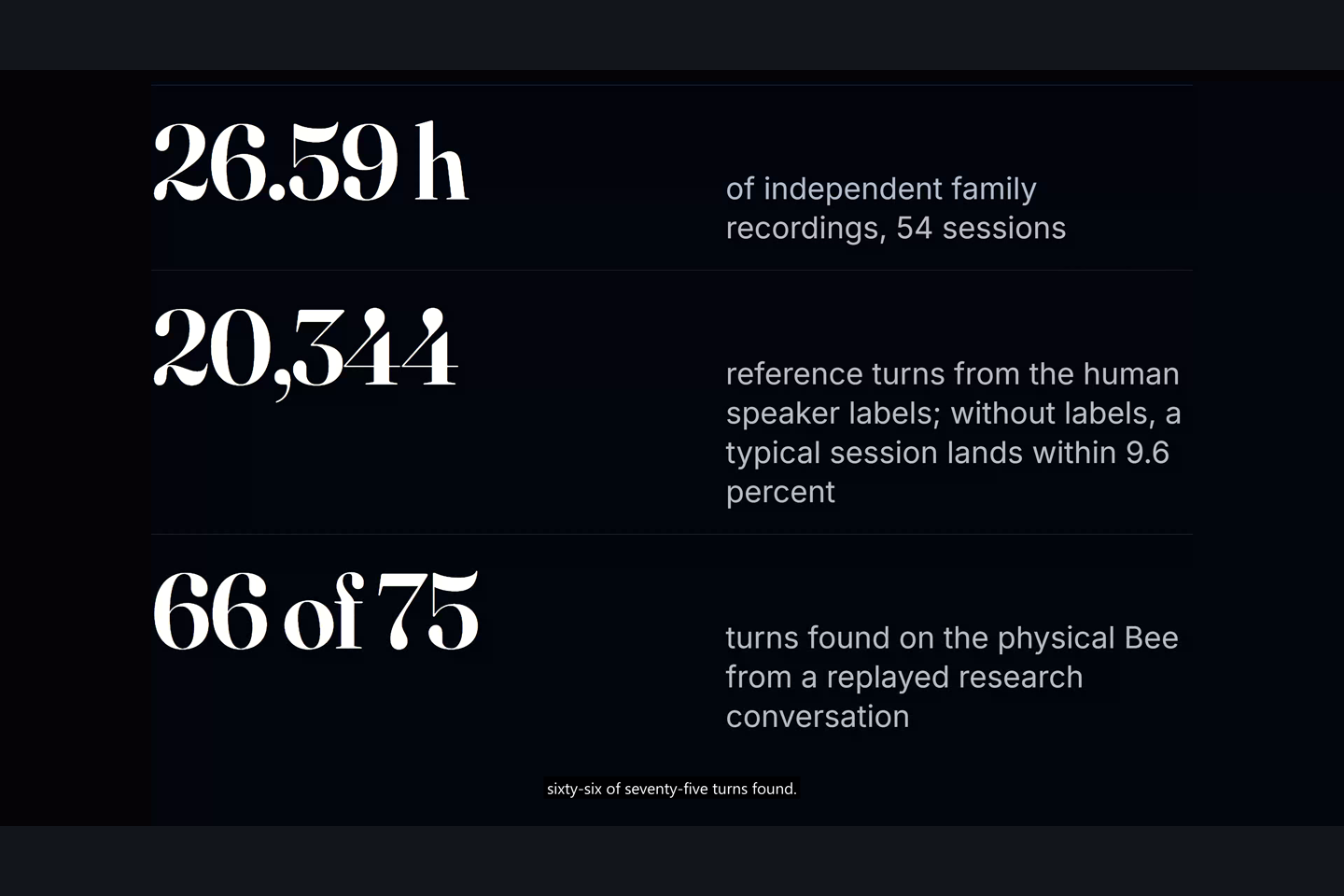
26.59 hours of family recordings, 20,344 reference turns, and 66 of 75 found on the physical Bee.
Inspiration
We count our steps, our sleep, even our heartbeats. Nobody counts the one thing that most shapes how a child's language grows: the back-and-forth between a parent and a child.
For years parents were told "talk more" because of the 30-million-word gap [1]. Then researchers looked inside children's brains and found the words were not the point. The exchanges were. A child says something, the parent answers, the child answers back. The number of those conversational turns at 18 to 24 months predicted IQ, comprehension and vocabulary a decade later, after adjusting for family income, where the number of words heard did not [2]. Turns, not words, tracked activity in the brain's language area [3]. And it is coachable: when parents are shown their own counts, the turns go up, and so does their child's language [4, 5].
The only instrument that counts it is a research recorder sold to clinics and programmes, never to a parent. The Bee on a parent's wrist already hears the whole day. So we built the step counter for conversations, on a band the parent already wears.
What it does
Volley counts the back-and-forth with your child, keeps the numbers, throws the words away, and tells you one thing to try tomorrow.
- Wear the Bee. The parent wears it. The child wears nothing.
- Count the day. One command,
volley today, reads the day through the Bee's own command line tool, counts every exchange by the five-second rule the research uses, and drops the words on your own computer. Only counts are kept.volley setup --daily 20:30does it every evening on its own. - See your day like a step counter. Turns by hour, your best hour, the quiet hour with your child right there, and the week.
- One thing to try tomorrow, placed in your Bee. Chosen by rules from the day's numbers, phrased by Claude on Amazon Bedrock, and written into your Bee as a reminder for the hour it names. A gate in code throws out any sentence carrying a number the counts did not hold.
- A nudge while the hour is still yours. During the hour your family usually talks most,
volley live --nudgewatches the Bee's live stream. If that hour goes quiet, one sentence goes into your Bee right then, and a speaker in the room says it, the way an Echo could. This ran for real on 2026-10-22: watching 3pm on our own Bee, it spoke the nudge at 3:20 and the reminder landed in the Bee a minute later. - A week's plan. Over a week, patterns appear. Claude on Amazon Bedrock turns them into three lines the way a home visitor would: keep the hour that works, one idea for the quiet one, one for the weekend.
- Ask out loud. An MCP server lets Alexa+ answer "How was our talking today?" from the counts alone. Two Strands agents explain a quiet day; one is hosted on Amazon Bedrock AgentCore, the other reads the Bee's own daily summary beside Volley's counts.
- Carry the coaching between visits.
volley sharegives a home visitor a read-only link to the days, the week and the note, and nothing else. The parent ends it with one command.
Try it: https://da78ygi6ol1oi.cloudfront.net
How we built it
- Bee:
apps/ingestis a client of the Bee CLI:conversations,now,changedwith a cursor,stream --jsonfor the live counter, andtodos create --alarm-atfor the reminder and the nudge. - Counting:
serve-return, our open-source Python package on PyPI: the five-second turn rule, counts per hour, and a small model that reads who is speaking from the words and the pauses, so no speaker labels are needed. - Alexa+: a self-hosted MCP server (spec 2025-11-25, Streamable HTTP) with seven tools, and an Agent Skill that tells any assistant how to use them.
- AWS: Claude on Amazon Bedrock phrases the note and the week's plan; Strands Agents for the Coach and the Tuesday agent, the Coach hosted on Amazon Bedrock AgentCore; AWS Lambda, Amazon DynamoDB, Amazon S3 and Amazon CloudFront run the service and the site, deployed with AWS CDK; Amazon Polly voices the on-device test and says the nudge in the room.
- Site: Next.js, with the parent's own page, the coach's view and the evidence page.
Running cost: about 4 cents a family a month at AWS list prices. The Bee is about fifty dollars, once, and the family's.
Challenges we ran into
Counting turns without speaker labels. A turn counter has to know which line is the child's, and the Bee does not yet tell speakers apart. So we built a count that needs no labels at all: a small model, trained on a public archive of real parent-child recordings (CHILDES), that reads the roles from the words and the pauses. Then we measured how good it is before claiming anything.
Proving it on the device without recording a family. We voiced a real recorded parent-child conversation from the research archive with Amazon Polly, an adult and a child voice at the original timing, and played it to the Bee. No person was recorded. On that session the Bee heard 124 of 125 lines, and Volley with no speaker labels found 66 of 75 turns. A second family at dinner, three voices, held up the same way.
Adults talking to each other. Without labels, two adults can read as turns. The child-present check, one switch at setup, sets those stretches aside: on the Bee it took two adults from 21 false turns to 0 and kept all 66 real ones.
Accomplishments that we're proud of
- It works on a real Bee, end to end. Count, reminder into the Bee, and the live nudge, all run on our own band.
- The numbers are measured, not promised. 26.59 hours of independent family recordings, 20,344 reference turns, and the count lands within 10 percent on a typical session with no speaker labels at all.
- Privacy by construction. The words are read on the parent's computer and dropped. The service never sees a word a child said, so neither can Alexa+ or any agent.
- An open-source counter anyone can use:
pip install serve-return. - A product a programme could run tomorrow, for about four cents a family a month.
What we learned
A count you cannot get exactly can still be useful if you say exactly how close it is. Judges, parents and home visitors all read the same page: what it counts, what it rules out, and how it was checked. The Bee turned out to be enough: no new hardware, no app on the child, just the band a parent already wears and one command a day.
What's next for Volley
- One flag from Bee, the wearer's own label, would make the parent's side of the count exact. It is our first feature request.
- The study to run first with a grant: the Bee beside a LENA research recorder on the same afternoon, in a family's home.
- Home visiting programmes already pay for this count and reach 1.8 percent of the families who could benefit [6]. Volley puts it on a fifty-dollar band, so the coaching can keep reading the counts after the visits end.
Sources
- Hart B, Risley TR. Meaningful Differences in the Everyday Experience of Young American Children. Brookes, 1995.
- Gilkerson J et al. Language Experience in the Second Year of Life and Language Outcomes in Late Childhood. Pediatrics 2018. PMID 30201624.
- Romeo RR et al. Beyond the 30-Million-Word Gap. Psychological Science 2018. PMID 29442613.
- Ferjan Ramirez N, Lytle SR, Kuhl PK. Parent coaching increases conversational turns and advances infant language development. PNAS 2020. PMID 32015127.
- Romeo RR et al. Neuroplasticity associated with changes in conversational turn-taking following a family-based intervention. Developmental Cognitive Neuroscience 2021. PMID 34052580.
- National Home Visiting Resource Center. 2026 Home Visiting Yearbook. https://nhvrc.org/yearbook/2026-yearbook
Every number above, with the file it is read from: https://github.com/usv240/volley/blob/main/docs/EVIDENCE.md
Built With
- agent-skills
- alexa-plus
- amazon-bedrock
- amazon-bedrock-agentcore
- amazon-cloudfront
- amazon-dynamodb
- amazon-polly
- amazon-web-services
- aws-cdk
- aws-lambda
- bee
- bee-cli
- childes
- claude
- fastapi
- mcp
- nextjs
- python
- strands-agents
- typescript

Log in or sign up for Devpost to join the conversation.