-
-
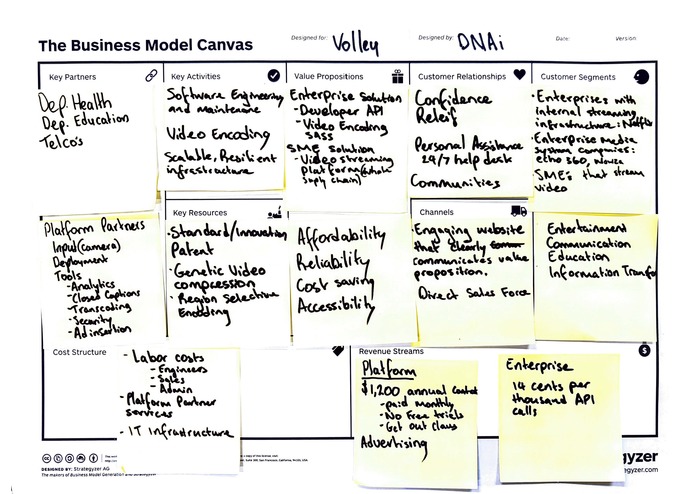
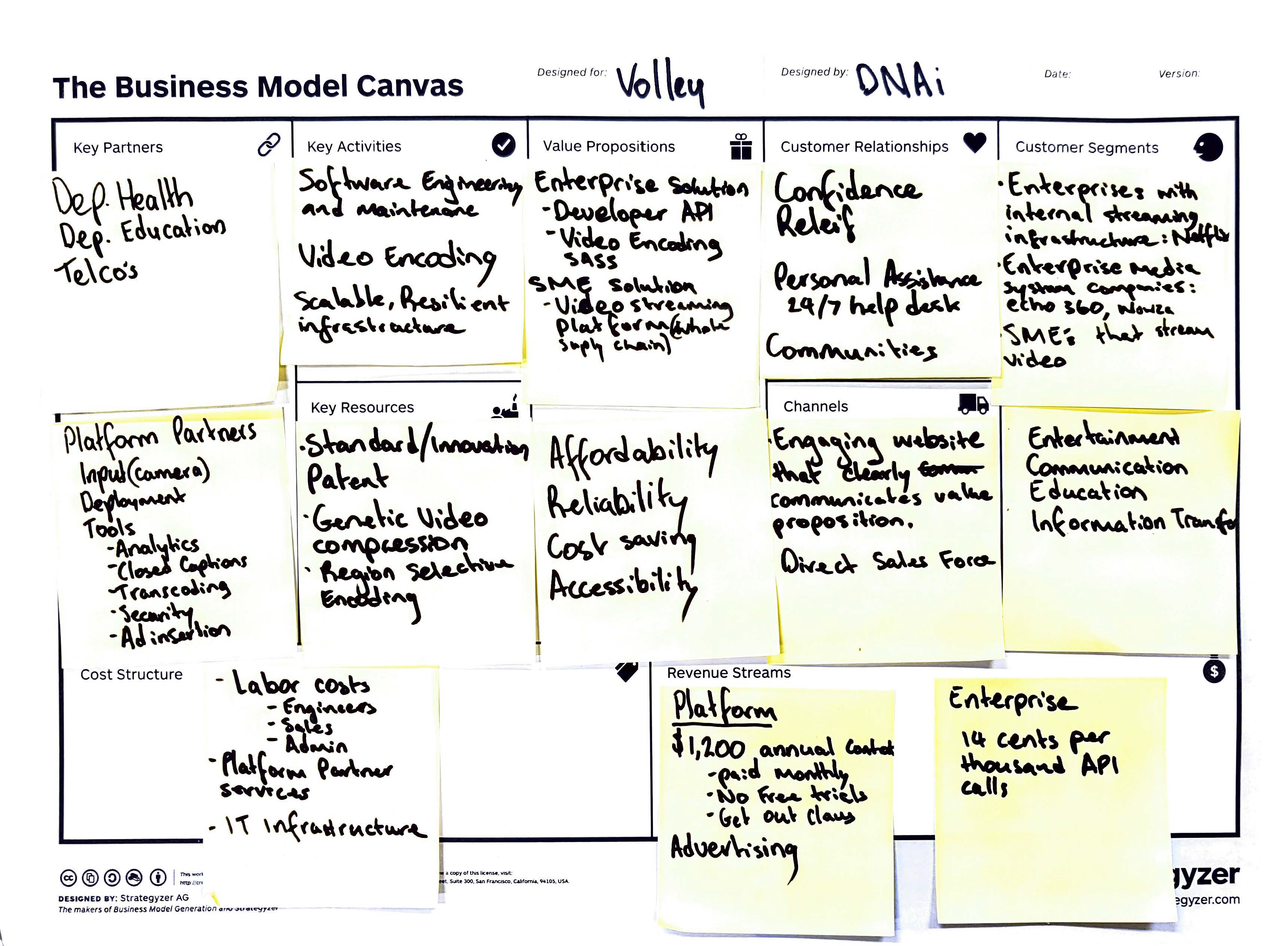
Business Model Canvas
Video streaming is a far more complex problem than is often given credit for. This is clearly evidenced by big businesses failing to deliver reliable streaming, even when it matters most.
Earlier in the year, Optus had to withdraw from their contract to stream the world cup in Australia, as they were unprepared for the infrastructure requirements needed to stream content to that many people, and Optus is a multibillion-dollar company, large-scale video streaming is an incredibly difficult task to pull off.
Moreover, there is a high level of investment required for businesses to develop their own video streaming. This prevents small and medium-sized businesses from entering the market.
Online educational content is revolutionising the way we learn, creating more equitable access for regional areas, this is particularly the case in the developing world. More than half the students who sign up for online educational services do so internationally. This puts pressure on universities in poorer nations. The most successful courses are built around video lectures (khan academy etc. in the background) where teachers can most accurately simulate a classroom experience. As online education services spread to poorer nations where high-speed internet access is less common, the need for this content will only increase. This is just one area where our technology can have a direct influence., other areas include entertainment, communication and information transfer.
So what is the solution?
Volley is an innovative platform that uses genetic video compression which we have created to stream video at a fraction of the bandwidth of current video compression techniques.
This weekend we are developing a prototype that can solve some of the most significant problems with current compression approaches. Due to the time constraints, We are focusing on applying the algorithm just to images as a proof of concept.
Just to give you an idea of the scope in this industry, Erikson published a report in which they identified additional revenue opportunities of $100 billion for video services on just 5G networks by 2026, there is massive potential for a cost-saving technology in this space.
Our approach to compression is made up of two black boxes.
The first is a discriminating neural network that simulates human vision by grading compression quality. This allows us to precisely target the optimum compression scheme, with the added benefit of being highly adaptive to the type of media being compressed.
The second component is a genetic optimisation algorithm. An initial optimisation solution undergoes mutation and reproduction to find the optimal set of parameters for compression
To demonstrate our approach, this weekend we focused on image compression as a proof of concept. The following two images have the same file size. They are compressed from an original image with no prior compression that we extracted from a vector graphics document. The image on the right is the image that we produced. The image on the left is a JPEG saved from photoshop.
The web service is accessed through a web app which is divided into a multi-tier architecture pattern with information streamed into our compression system on the backend. After logging in, the user has access to their video library and a dashboard containing a range of analytics.
The web service is designed to offer an embedding API with a focus on customisability. In comparison to existing video services, our service will allow businesses full control and branding of the behaviour of videos they host with us. The web app we have developed this weekend also has the capability to compress any image the user uploads.
So, volley will have two products for our two customer segments.
First, we are planning to license out the video compression technology to enterprise companies that want to implement it with existing video streaming services.
Second, we are planning a platform for small to medium-sized businesses that can’t invest in their own video streaming infrastructure due to the cost requirements.
As this approach to video compression is the first of its kind, a granted patent could significantly increase the potential growth for a company like this.
The primary video streaming uses that our technology would be providing would be Entertainment, communication, Education and information transfer.
The potential uses for this technology are endless, imagine a world where every organisation can produce and every person can consume content affordably and reliably. Our technology could improve essential services such as education and healthcare in rural and remote areas, as well as areas you might not expect.


Log in or sign up for Devpost to join the conversation.