PROTOTYPE ONLY
We were unable to complete a fully functional product of our idea, but we decided to share our journey here anyway. Visit the Figma file to view our research and final designs.
Problem Statement 🙋♂️
“How might we help people easily discover volunteering opportunities that match their interests, skills, and availability while reducing the barriers to getting involved in their community?”
Inspiration 💫
For this project, our idea started while brainstorming problems we noticed around Davis. Community involvement came up as a topic, and Ryan mentioned that he had friends in community service clubs who struggled with consistently finding volunteering opportunities. That sparked our interest, so we decided to look deeper into whether this was actually a common issue.
To validate the problem, we sent out a survey and found that many people mainly discovered volunteering opportunities through word of mouth. We also learned that when most people think about volunteering, they only think of things like trash cleanups or working at shelters. In reality, there are many other opportunities out there, such as helping at music festivals, local events, creative programs, and community activities that people often overlook because they are not easily visible or accessible.
We realized that volunteering can feel intimidating for people who are interested in getting involved but do not know where to start. Because of this, we wanted to create a platform that makes discovering opportunities feel easier, more approachable, and personalized to each person.
What it does 📍
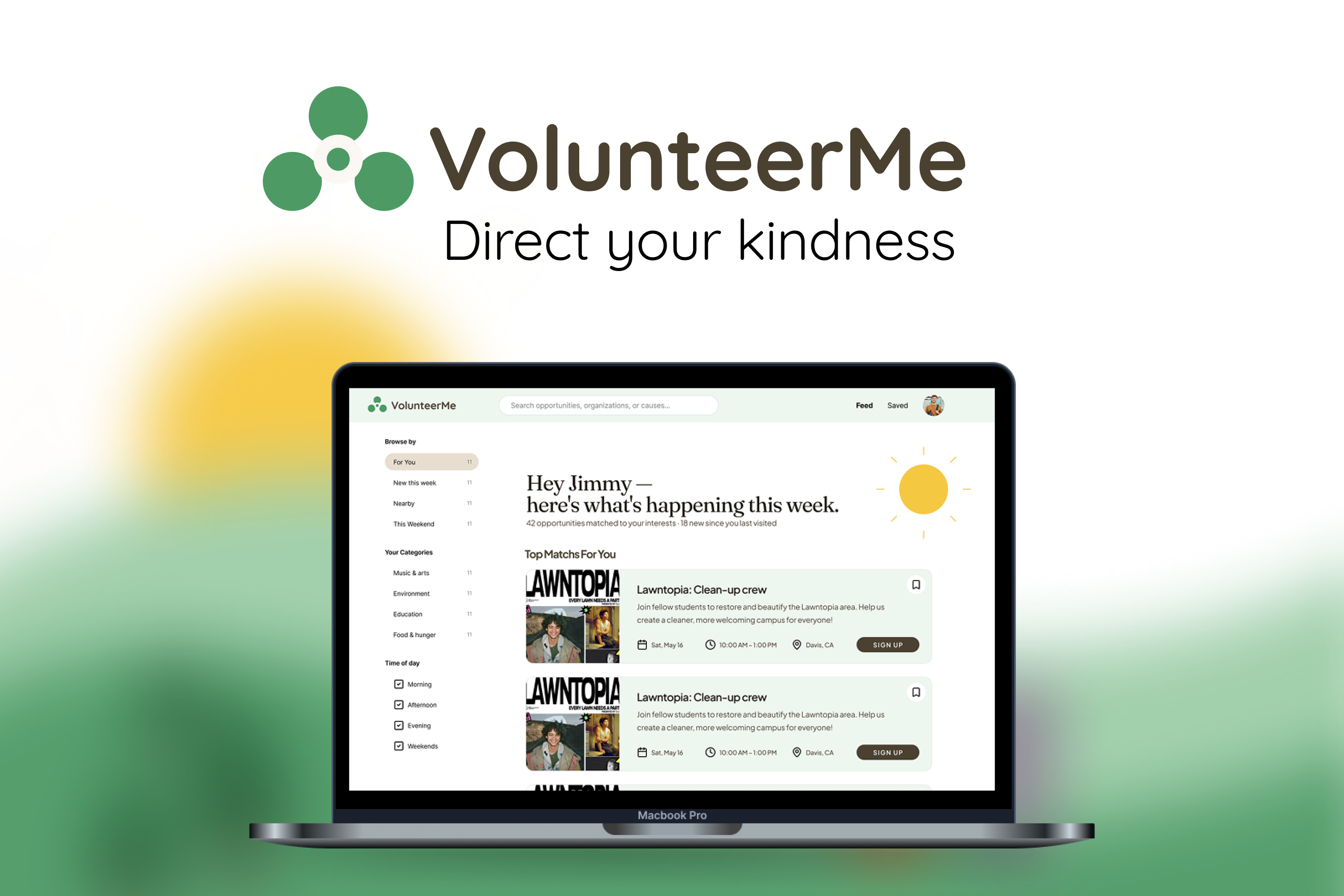
Our website acts as a hub for volunteering opportunities by gathering information from across the web and placing it all into one easy-to-browse platform. Instead of forcing users to search through multiple websites or rely on social media posts and word of mouth, the platform simplifies discovery by bringing opportunities into one centralized feed.
The opportunities are displayed similarly to a social media feed, making it easy and familiar for users to scroll through different options. To make the experience more personalized, the platform includes an onboarding system that learns about the user’s interests and preferences. Based on those interests, the feed sorts and filters opportunities that are most relevant to them.
Overall, the goal of the platform is to make volunteering feel less intimidating and more accessible, especially for people who are interested in giving back to their community but may not know where to begin.
Challenges we ran into 😰
One of our biggest challenges was that this was both of our first hackathons, so we were learning many things on the spot throughout the entire process. Since our team only consisted of two people, we also had to carefully narrow the scope of our project and focus on creating features that were achievable within the limited timeframe. Our designer, Anthony, had never had any experience working with a developer, and thus was unfamiliar with actual implementation of an idea beyond ideation, UX research, and UI drafting. Our developer, Ryan, had only had experience in HTML/JS/CSS and never done backend or full-stack development before. As such, many necessary skills for this project, such as Figma-to-HTML translation, Flask, and database management were learned solely in these past 24 hours alone.
There were many ideas and features we initially wanted to include, but as development continued, we realized we had to prioritize the core experience of volunteer discovery and personalization in order to create something manageable and meaningful before the deadline. This resulted in us having to abandon several core goals for our idea, including a login system, AI-integrated preference matching, and several fully-designed webpages, late into the 24-hour time period.
Accomplishments that we're proud of 😁
We are proud of how much we were able to accomplish despite being beginners and working with a small team. Even though the project is not fully finished or completely functional yet, we are proud that we were able to stay committed to the idea and see the project through until the end of the hackathon.
We are also proud of stepping outside of our comfort zones and taking on challenges that were completely new to us.
What we learned 📚
Throughout this project, we learned many new skills, both technically and creatively. We gained experience working closely with AI tools throughout the design and development process, and we also learned what it is like for designers to work alongside development workflows and technical limitations.
Since both of us were new to this type of environment, the project gave us valuable experience in collaboration, problem-solving, and adapting quickly while learning new tools and concepts in real time.
What's next for the project 🔮
If we had more time, we would expand the platform to support a second target audience: organizations that are actively searching for volunteers. We also want to explore implementing a skill-based recommendation system in which users can input their strengths, experience, or interests to receive personalized volunteering opportunities that match their skill sets. There are many more features that we were planning to add, such as account creation, a calendar link for optional hours, but we tried our best to focus on what we decided was the most valuable.
In the future, we will continue to develop and refine many of the features that we had to leave out, helping turn the project into a more complete and fully functional platform for community engagement.
Built With
- claude
- css3
- figma
- html5
- javascript
- python



Log in or sign up for Devpost to join the conversation.