-
-
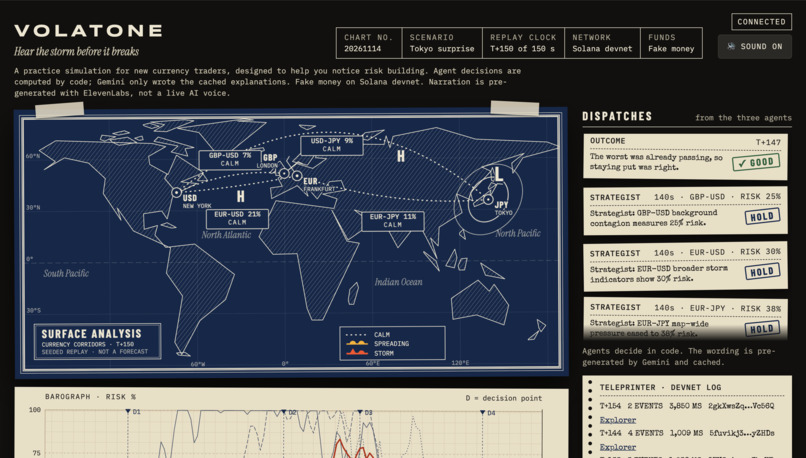
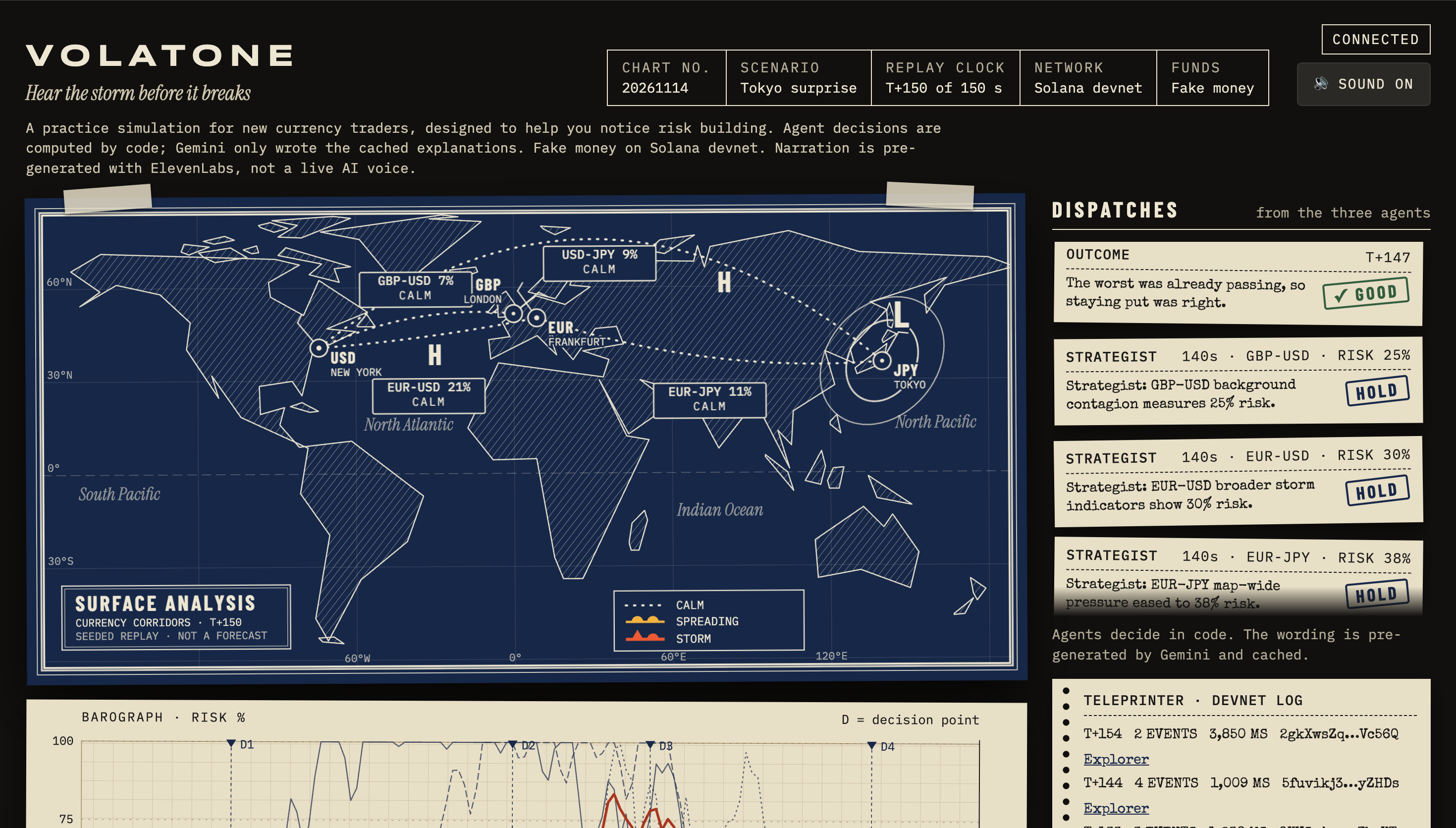
The storm map
-
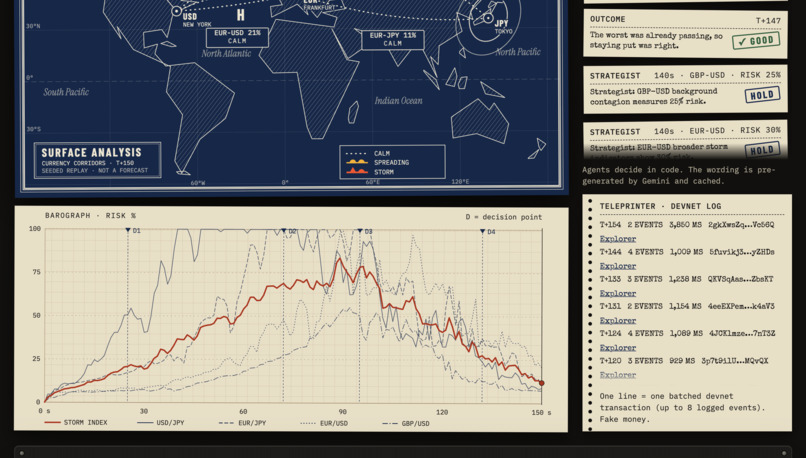
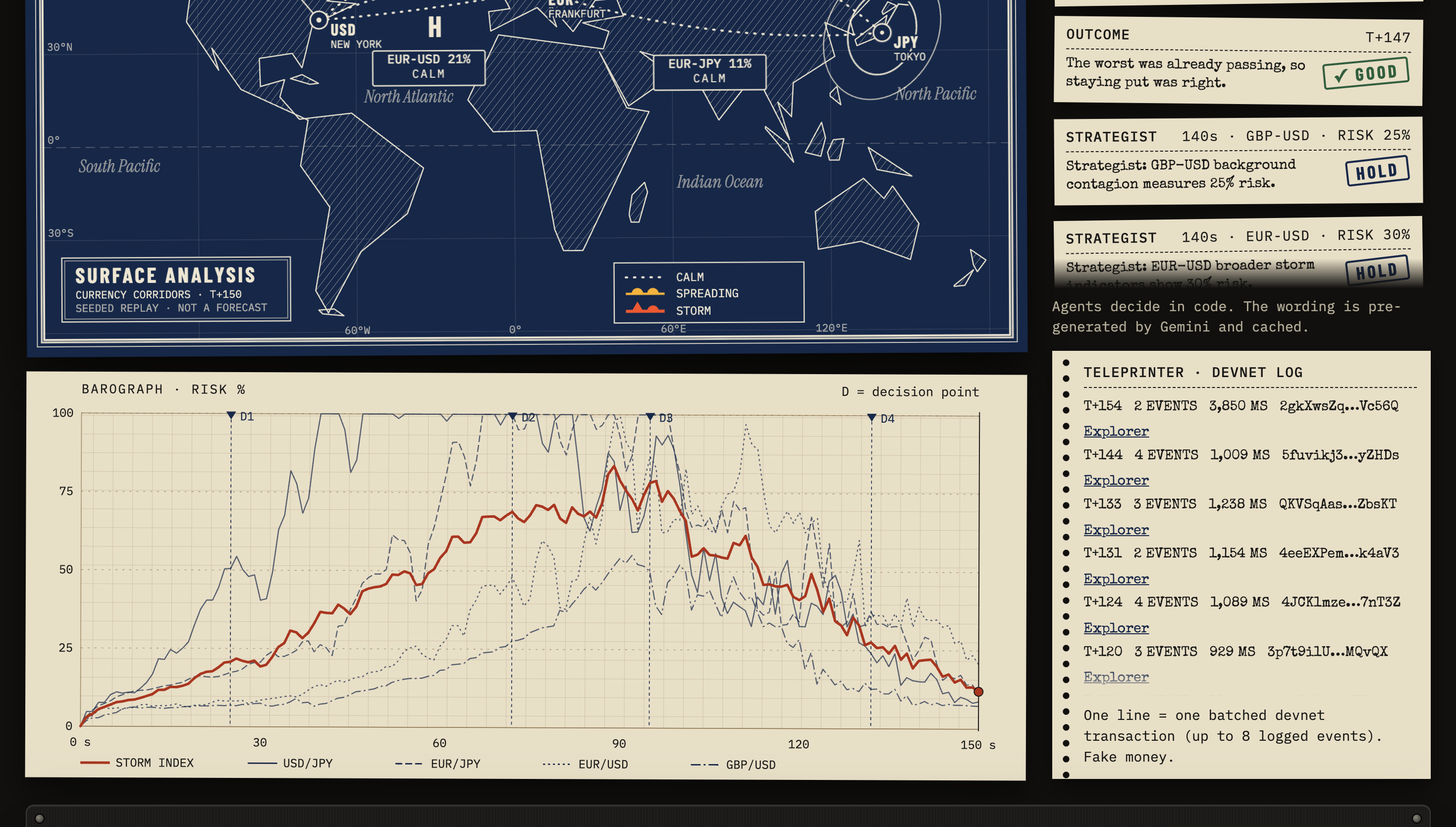
Barograph and teleprinter
-
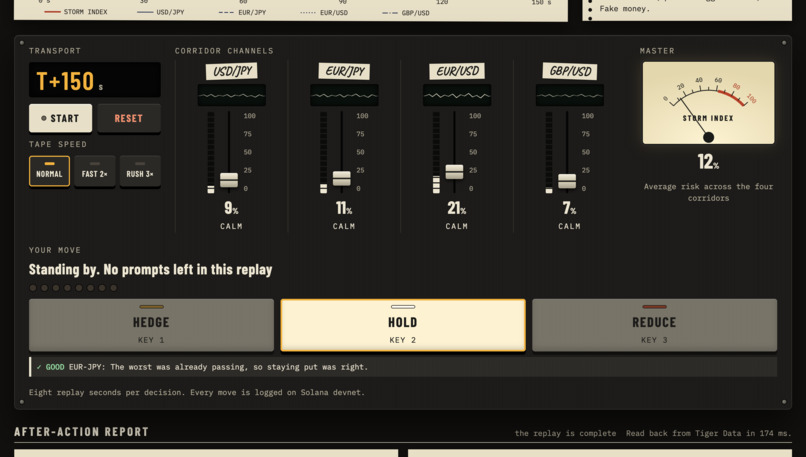
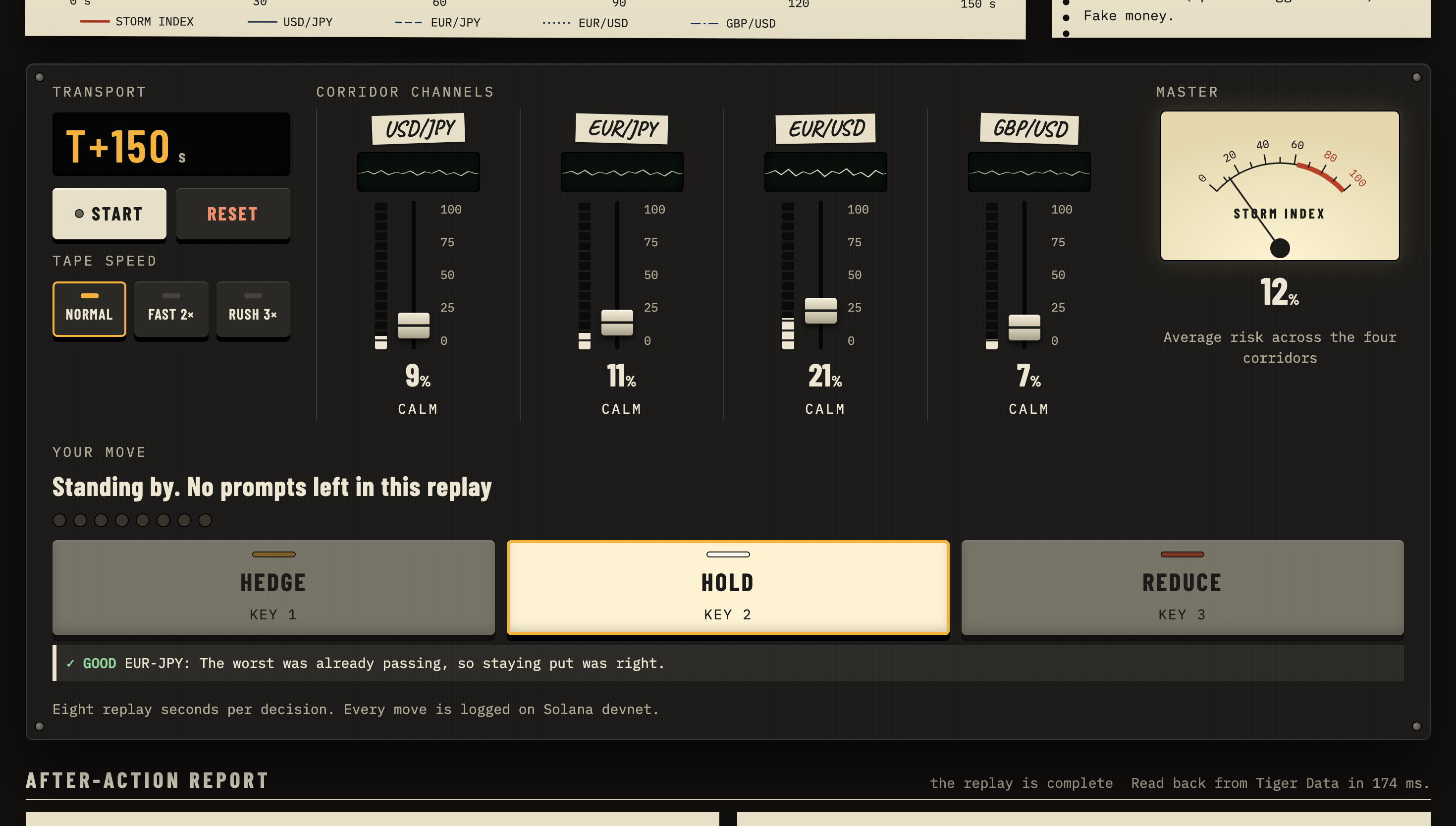
The mixing desk
-
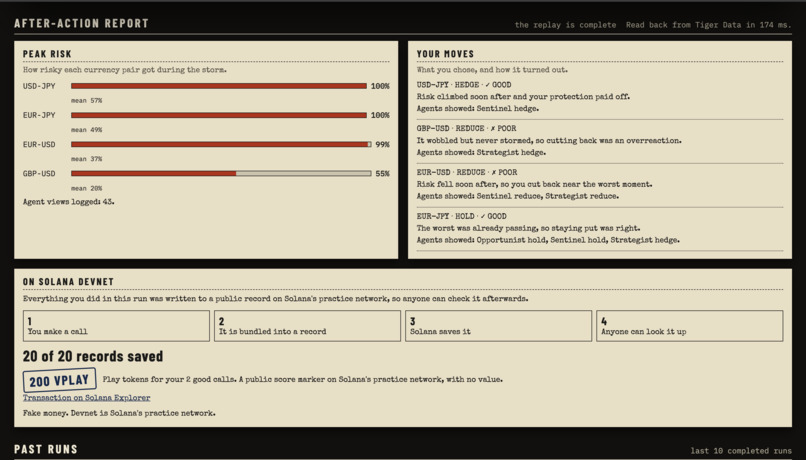
After-action report
-
Solana devnet and past runs
Volatone
Hear the storm before it breaks
Volatone is a flight simulator for market storms, built for people who are new to currency trading. Most beginners meet market stress for the first time with real money on the line. Here they practise first, with fake money: a storm, "Tokyo surprise", replays across four currency pairs (USD-JPY, EUR-JPY, EUR-USD and GBP-USD), and at four decision points the player chooses to hedge, hold or reduce their exposure.
Three code-based agents (Sentinel, Opportunist and Strategist) give early warnings with plain-English reasons, and risk can be heard as well as seen. For the DurHack theme, Composition, the storm composes the music live as risk builds, so a beginner can hear a storm coming.
Every agent view, move and outcome is recorded on Solana devnet by a custom Anchor program, so a player's calls form a public record that can't be edited afterwards. The backend runs on a Vultr server in London, and the game is live at a public link with nothing to install.
The tools, prizes and challenges, and how each applies
Solana: Best Use of Solana
How it is used
- A custom Anchor program,
volatone_log, records every agent view, logged move and outcome on Solana devnet. - Events are batched, up to 8 per transaction, with a memo-transaction fallback. Confirmation typically takes about a second (0.8 to 1.4 s in testing), and one 20-transaction run from the Vultr server confirmed in 796 to 1390 ms.
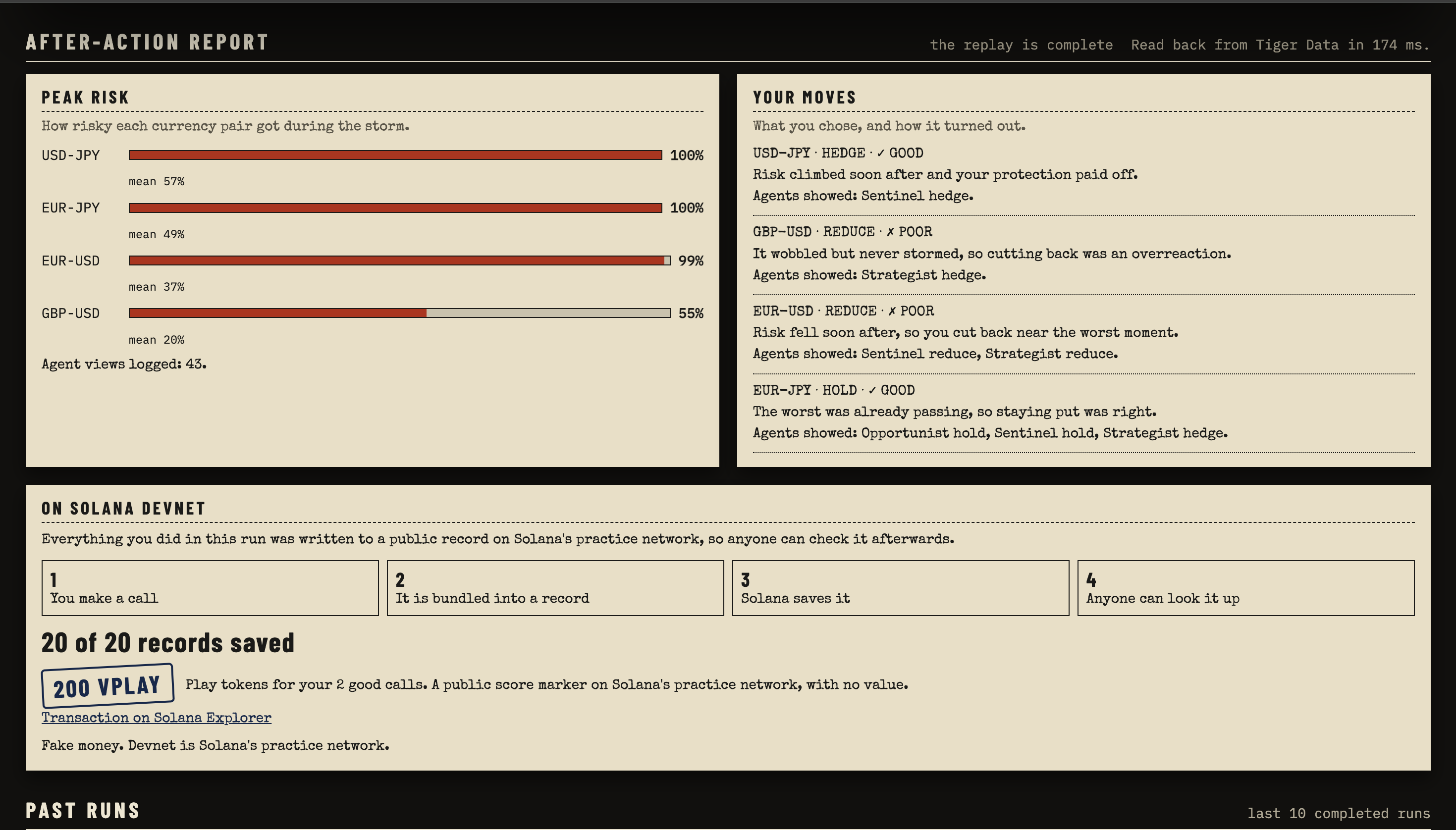
- At the end of a run, the backend mints "Volatone Play" tokens (VPLAY, an SPL token) for good calls. They are a public score marker with no value.
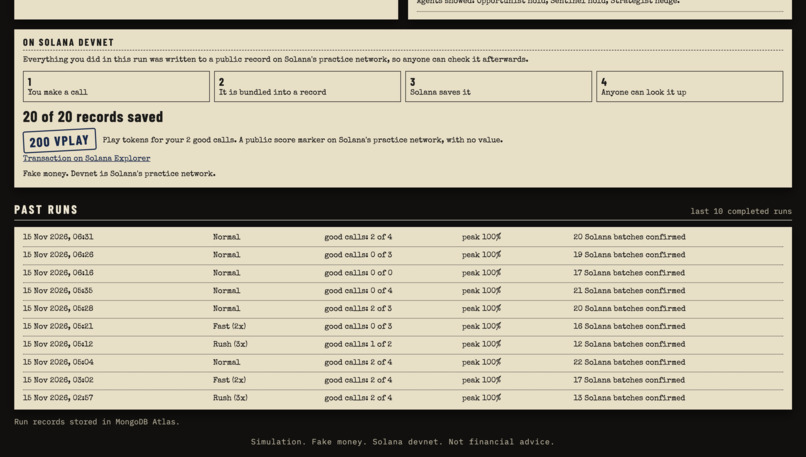
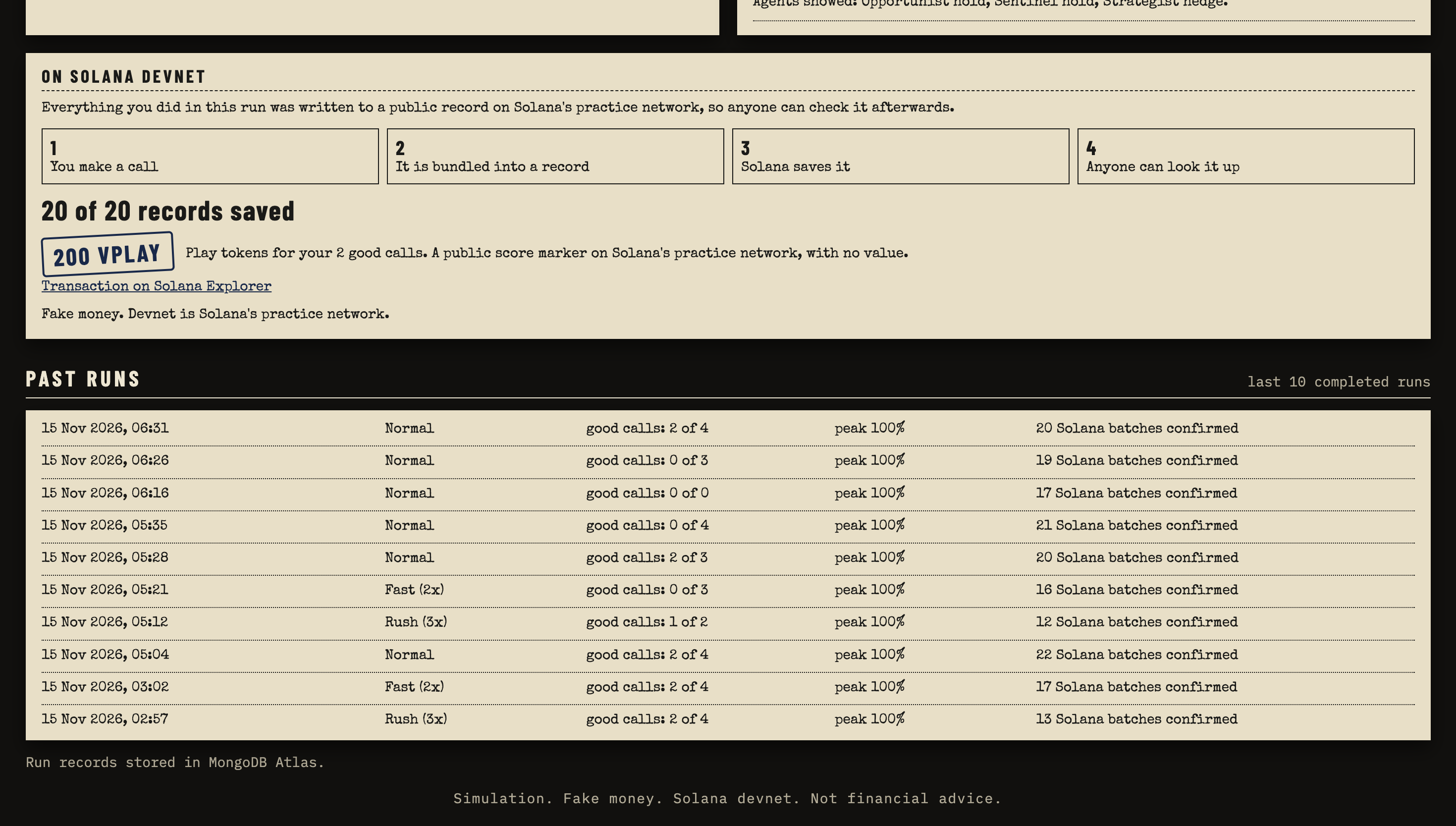
- Every transaction can be opened on Solana Explorer, and the after-action report shows "N of M records saved".
Why it helps the new trader
- A player's calls go into a public record that can't be edited afterwards, so they get an honest log of what they chose and when, to learn from.
- A trainer or teacher can check that history without relying on screenshots or self-reporting.
- The play tokens give a simple, visible score, and no wallet or crypto knowledge is needed.
Why it fits
- Solana is the core of how the project works, not a decoration: logging every decision in fast batched transactions through a custom program is the point of the build.
Vultr: Best Use of Vultr
How it is used
- The backend runs on a Vultr Shared CPU instance (1 vCPU, 2 GB, Ubuntu 24.04) in London, managed by systemd and fronted by nginx, with a firewall limiting open ports.
- The server holds the shared replay clock and the agents, keeps the Solana wallet key and the database passwords out of the browser, and makes every connection to Solana and the databases.
- The game is live at a public address.
Why it helps the new trader
- It is always on, with nothing to install, and the server does the signing and saving, so the player only plays.
Why it fits
- The project needs an always-on server with a safe place for keys and secrets, which a browser-only version could not provide. Vultr supplied one in minutes.
Waterstons: Improve the world by connecting things that usually aren't
How it is used (what is connected)
- Finance training and music: risk numbers are normally read off a screen. Here the storm's risk scores compose the music live, so a beginner can hear risk building as well as see it.
- A public blockchain and beginners: blockchains are usually for people who already understand crypto. Here every decision is written to Solana and the player gets a tamper-proof record without a wallet, a key or any crypto knowledge.
- AI and a rules-based system: Gemini explains each agent's view in plain English while plain code makes the decisions, so the explanations are friendly and the logic stays predictable.
- A cloud server and the browser: a Vultr server holds the clock, the keys and the connections to Solana, Tiger Data and MongoDB Atlas, so a beginner only opens a link.
- Two kinds of database: Tiger Data holds the detailed time-series of each run, and MongoDB Atlas holds the short history of past runs, each doing what it is best at.
Why it helps the new trader
- New traders usually meet market stress for the first time with real money on the line. Connecting these pieces lets them practise reading danger signs and making hedge, hold and reduce calls with no money at risk, then look back at an honest record of what they chose.
Why it fits
- The project touches the same areas Waterstons works in: Software (React, TypeScript and a Node backend with live WebSocket updates), Data & AI (time-series analytics, run history and Gemini explanations), Cyber Security (secrets kept on the server, a record that can't be edited afterwards), and Managed Services and Technology Solutions (a live Vultr server managed with systemd, nginx and a firewall).
SGX FX Challenge 2: Get creative in the trading market storm
How it is used
- Volatone is a game: the storm replays on a weather-chart map and the player makes calls at four decision points.
- It is interactive, with a mixing desk of faders for each currency pair and hedge, hold and reduce controls.
- The soundtrack is composed live from the storm's risk, and plain-English explanations and a narrated walkthrough replace jargon.
Why it helps the new trader
- A beginner can hear and see a storm building and try out calls without needing any trading knowledge.
Why it fits
- The brief asks for "a playful, original way to learn, understand or explore trading" for people who are just starting, and names games, interactive projects and music among the formats. Volatone is all three.
SGX FX Challenge 1: Protect your assets from a trading market storm
How it is used
- Three code-based agents (Sentinel, Opportunist and Strategist) show their view of the risk as it builds, and the music and weather chart make rising risk easy to notice.
- At each decision point the player chooses to hedge, hold or reduce exposure.
Why it helps the new trader
- They practise noticing early warnings and making protective moves, and see how those moves play out, without risking any money.
Why it fits
- The brief lists staying safe and early warning among its goals, and Volatone is practice for those two. It does not try to predict what happens next. It replays a built-in storm, and bringing in SGX's historical pricing data is a planned next step.
Marshall Wace: New Worlds
How it is used
- A market storm that can be heard as well as read, played through as a game, with every decision recorded on a public blockchain.
Why it helps the new trader
- For a beginner, market stress is an unexplored place. Volatone lets them step into it safely.
Why it fits
- The brief asks for something that "opens a door to the unexplored", judged on creativity, technical complexity and presentation. The combination of finance, music and cloud infrastructure is unusual for new traders, the build includes a custom Anchor program, a time-series database and music generated live in the browser, and it is presented through a weather-chart interface, a narrated walkthrough and a public live link.
DurHack theme: Composition
How it is used
- The music is generated live in the browser from the replay's risk scores (Web Audio, no samples, no AI music), so every replay is the storm composing itself.
Why it helps the new trader
- Beginners don't yet know which numbers matter, so sound gives a quick, intuitive sense of how stormy things are.
Why it fits
- The theme asks for art, music and tech mixed in new combinations. Here a hatched weather-chart map, a mixing desk and a Solana record sit together in one product.
Gemini API: Best Use of Gemini API
How it is used
- Gemini writes the plain-English explanation of each agent's view. One request wrote all 43, which were checked, fixed by hand where needed, and cached.
- Decisions and scores are computed by code, and nothing calls Gemini live.
Why it helps the new trader
- Every warning comes with a reason in everyday language instead of jargon, so the player learns why risk is rising.
Why it fits
- A language model is used for the one thing it is good at, explaining, while the decisions stay predictable and testable.
MongoDB Atlas
How it is used
- Every completed run is saved to Atlas as a short summary and shown in the PAST RUNS panel (the last 10 runs).
Why it helps the new trader
- The last few attempts can be compared side by side, making it easy to see whether their calls are improving.
Why it fits
- One summary per finished run is the kind of record a document database suits.
Tiger Data
How it is used
- Runs, risk ticks, events and the transaction log are stored in Tiger Data hypertables, with a continuous aggregate (
risk_10s) feeding the after-action report. - The report was read back in 159 to 174 ms in live tests, and shows peak risk per corridor, how each move turned out and how many records Solana saved.
Why it helps the new trader
- The report appears straight after the storm, while it is still fresh in their mind, with risk over time summarised at a glance.
Why it fits
- It is time-series data in a time-series database, using a real continuous aggregate.
ElevenLabs
How it is used
- The spoken narration is pre-generated with ElevenLabs and plays alongside the replay.
Why it helps the new trader
- The voice talks them through the storm so their eyes can stay on the chart, and the game feels guided rather than intimidating.
Why it fits
- A synthetic voice is one of the pieces joined into the product, and it carries the plain-English explanations to the player.
Entire
How it is used
- The AI-assisted build sessions were recorded with Entire as checkpoints alongside the git history.
Why it helps the new trader
- It is a build tool rather than a player feature, so the benefit is to reviewers: the way the project was built can be checked.
Why it fits
- It keeps the AI-assisted work transparent and reviewable.
Also built with: a React, Vite and TypeScript front end with a WebSocket link to the Vultr server, so it runs in any browser.
Inspiration
SGX's brief says "every trader needs to start somewhere", and that is exactly the problem. Most people meet market stress for the first time with real money on the line, when they have no idea what rising risk looks or feels like. The aim was a flight simulator for market storms: a safe place where a new currency trader can watch risk build, make a call, and see how it turned out without losing anything.
Every call is also written to Solana devnet, so a player's history becomes a record that nobody can quietly edit afterwards. That gives a learner an honest log of what they chose, in the order they chose it, and gives a trainer or teacher something they can check for themselves.
Risk should also be something that can be heard as well as read. A beginner doesn't yet know which numbers matter, so a second signal helps. The theme was Composition, so the storm composes the music: as risk builds across the four currency pairs, the sound changes, giving a new trader a feel for the storm alongside the numbers.
What it does
- Replays a storm: "Tokyo surprise" plays out across four currency corridors on a blue weather chart, at three speeds (Normal about 150 s, Fast 2x, Rush 3x with a labelled autopilot).
- Gives early warnings: Sentinel, Opportunist and Strategist read the risk and say what they would do, each with a plain-English reason and a spoken narration.
- Lets the player decide: at four decision points the player chooses to hedge, hold or reduce.
- Plays the storm as music: the soundtrack changes as risk builds across the four pairs, and a mixing desk has a fader for each pair.
- Records everything publicly: every agent view, move and outcome is written to Solana devnet and can be opened on Explorer.
- Scores good calls: play tokens are minted at the end of a run as a public score marker with no value.
- Reports afterwards: an after-action report shows peak risk per corridor, how each move turned out and how many records Solana saved.
- Remembers past runs: the last runs can be compared side by side.
Challenges
- Getting the Anchor program onto Solana: the public devnet RPC rate-limited the first deploy, so a free Helius RPC replaced it. A batch of 8 events also used 230,201 compute units, over the 200,000 default, so the limit was raised to 400,000 before it could fail in front of a judge.
- Making a realistic storm: the first storm was a straight line down, which looked nothing like a real market, so it was regenerated to whipsaw, with a test locking that in. The agents then flip-flopped between hedge and hold on every wobble, so a "settle" rule was added that only announces an action after several consistent scores.
- Keeping slow services from freezing the game: a blockchain confirmation can take a second or more, and databases can stall. Logging, the Tiger Data writes and the token mint run in the background with time limits and circuit breakers, so the replay never waits on them and a failure shows as "NOT LOGGED" instead of breaking the game.
- Letting AI explain without deciding: Gemini's plain English was wanted, but not its unpredictability, so the agents decide in code and Gemini only explains, with every explanation checked before it was cached.
Accomplishments
Measured against the DurHack judging criteria and the sponsor briefs:
- Creativity & Innovation (and Marshall Wace's "creativity"): a market storm composed into music live, on a weather-chart map, to make risk easier for a beginner to feel.
- Technical Competence & Execution (and Marshall Wace's "technical complexity"): a custom Anchor program, batched devnet transactions, a play-token mint verified as finalised on Explorer, and 20 of 20 records saved in a typical run, plus a live Vultr backend connecting Solana, Tiger Data and MongoDB Atlas, with 136 backend tests and 63 frontend tests.
- Research & Learning: the lessons below.
- Polish & Completion (and Marshall Wace's "good presentation"): a public live link and an after-action report in plain language.
- Connecting things that usually aren't (Waterstons): a cloud server, a public blockchain, two databases, an AI explainer, a synthetic voice and live-composed music working together in one beginner-friendly product.
What was learnt
- About trading: building the agents showed how traders think about hedging, holding and reducing, and why a choppy market makes early warnings hard: a signal that flips every few seconds is useless, which is why the agents needed a rule to settle before speaking up. It also showed how much a beginner needs plain-English reasons, not just numbers.
- About Solana: batching events into fewer transactions keeps logging fast and cheap, and compute limits matter.
- About running on Vultr: one always-running process serves every visitor, so refreshing the page showed the previous run until that was fixed. A real server also meant allowing its address in MongoDB Atlas, opening only the ports needed, and keeping secrets on the server.
- About Tiger Data: a continuous aggregate turns thousands of risk ticks into a small summary the report can read in a fraction of a second.
- About using AI sensibly: keeping code in charge of decisions and using Gemini only to explain makes a project predictable and testable.
- About designing for beginners: every number, sound and sentence has to earn its place.
What's next for Volatone
More to learn from
- More storm scenarios beyond "Tokyo surprise", including ones built from SGX's historical pricing data.
- Testing with real new traders to see whether it helps them notice risk, and improving it from what they say.
- Clearer explanations of each agent's reasoning.
The Solana token and records
- Player-owned tokens: today the play tokens go to the server's wallet because players don't have wallets. Next, a player could connect a wallet and receive their own.
- Non-transferable achievement tokens: using Solana's Token-2022 non-transferable option, so a token proves what a trainee did and can't be traded or sold.
- Proper token identity: on-chain metadata so Explorer shows "Volatone Play" with a name and image instead of "unknown token".
- A verifiable training record: a trainee's decisions across storms sit on-chain, so a trainer or a firm can check their history without taking anyone's word for it.
- Leaderboards from the chain: public rankings built from the on-chain records.
Monetisation
- Training for trading firms and platforms: firms hire graduates and onboard new traders. Volatone could be a practice tool for new joiners, with the on-chain record showing each trainee's decisions to their trainers.
- Courses and universities: finance and economics courses could use it to teach risk, perhaps per student or per class.
- Free to play, paid scenarios: keep the first storm free and charge for extra scenarios modelled on different kinds of market events.
- Careful with the tokens: the play tokens would stay a score and a credential, never something sold or traded for money.
Built With
- anchor
- blockchain
- elevenlabs
- entire
- geminiapi
- github
- helius
- mongodb
- nginx
- node.js
- postgresql
- react
- rust
- solana
- solanadevnet
- spltoken
- systemd
- tigerdata
- timescaledb
- typescript
- ubuntu
- vite
- vultr
- webaudio
- websocket