-
-
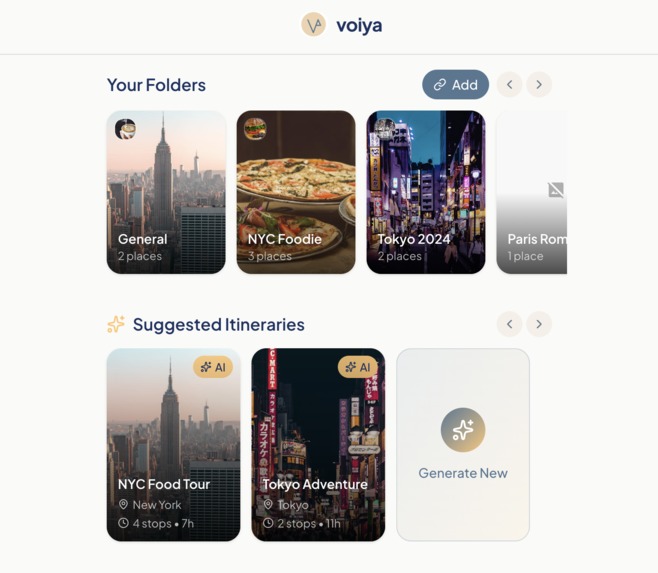
Voiya Home Page
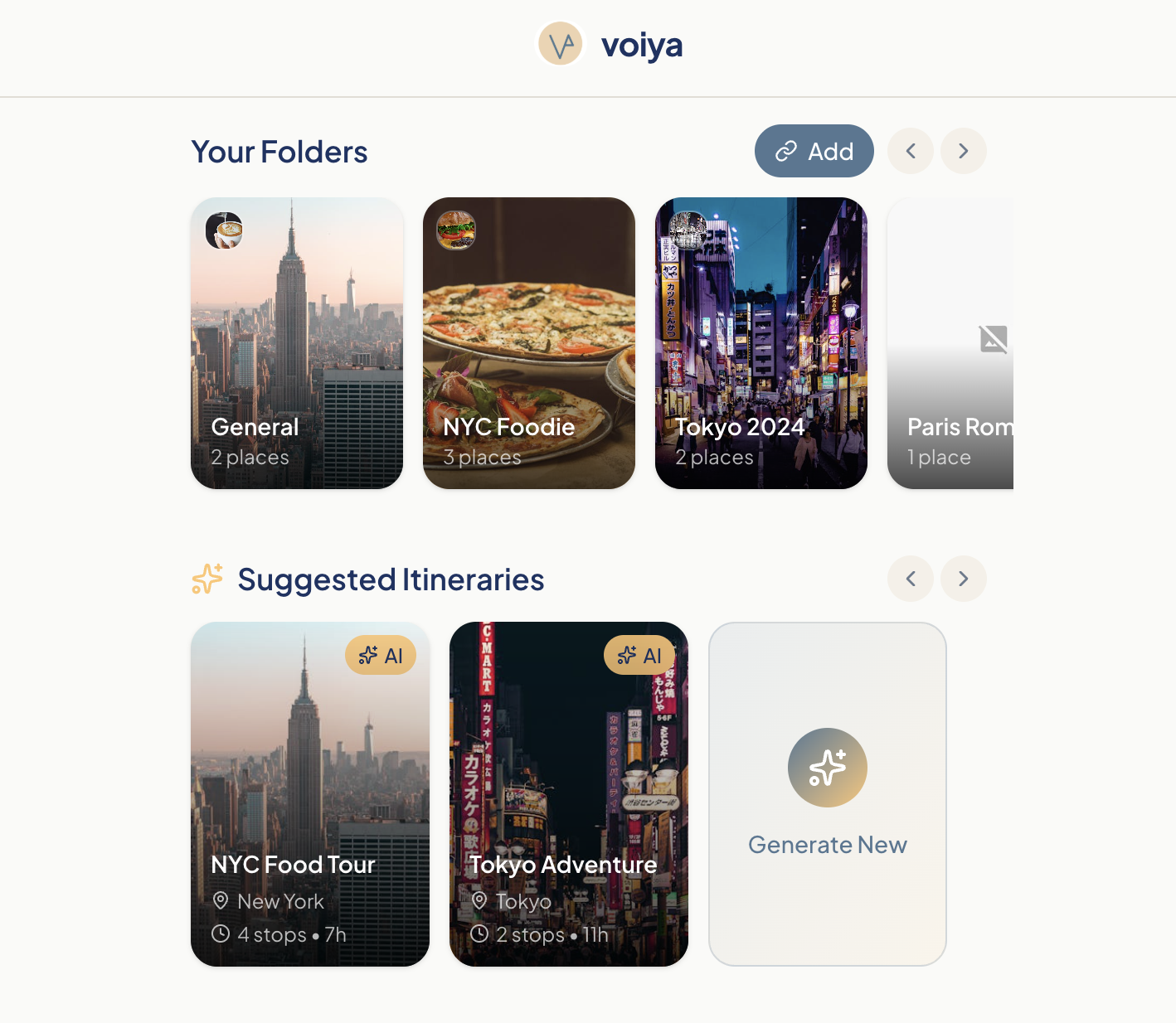
Voiya — Turning Saved Videos into Real Plans
Inspiration
We were inspired by a simple but universal behavior: people constantly save TikToks and Instagram reels of places they want to visit—but rarely act on them. Collections grow into hundreds of saved videos, yet they remain disorganized, overwhelming, and ultimately forgotten.
We thought about a user like Patty, who scrolls daily, saving restaurants, activities, and travel ideas. Despite having great content curated for her, she never turns it into an actual plan. The gap between inspiration and action is where Voiya was born.
Our goal was to transform passive saving into active planning.
What Voiya Does
Voiya is your personal itinerary assistant. It allows users to share videos directly from social media into the app, where AI extracts meaningful information and organizes it into actionable insights.
From a single shared video, Voiya can:
- Identify the location and type of place
- Pull relevant details like reviews, hours, and recommendations
- Suggest best times to visit, dress code, and who to go with
- Automatically organize content into folders
- Generate optimized itineraries based on saved content
Instead of endless scrolling, users can now instantly create plans.
How We Built It
We designed Voiya as a full-stack mobile application with AI at its core.
Frontend:
- React Native (Expo) for cross-platform mobile development
- Custom UI inspired by familiar patterns (Spotify folders, Instagram reels)
Backend:
- Vercel serverless functions for scalability and simplicity
AI Layer:
- OpenAI API for:
- Extracting structured data from unstructured captions
- Generating personalized itineraries
APIs & Integrations:
- Google Maps API for location visualization
- Google Places API for enriched place data
- Google Calendar API for scheduling plans
Technical Approach
At the heart of Voiya is transforming messy, unstructured input into structured outputs.
We modeled extraction as a function:
[ f(\text{caption}, \text{link}) \rightarrow {\text{name, location, attributes}} ]
Then, itinerary generation becomes an optimization problem:
[ \text{maximize} \quad \sum_{i=1}^{n} U(p_i, t_i) ]
Where:
- ( p_i ) = place
- ( t_i ) = time slot
- ( U ) = utility function based on preferences, proximity, and timing
This allows us to create itineraries that are not just valid—but meaningful and efficient.
Challenges We Faced
1. Extracting Reliable Data
Social media content is noisy and inconsistent. Captions can be vague, slang-heavy, or missing key details. We had to design prompts and fallback systems to ensure reliable extraction.
2. Platform Limitations
Apps like TikTok and Instagram don’t provide open access to their data. We had to rely on shared links and captions instead of direct integrations.
3. Turning Chaos into Structure
Saved videos are inherently unorganized. Designing a system that could intelligently categorize and connect them into coherent plans was a major challenge.
4. Meaningful Itinerary Generation
It wasn’t enough to list places—we needed to generate plans that made sense in terms of time, location, and experience flow.
What We Learned
- Users don’t need more content—they need help acting on it
- AI is most powerful when applied to real-world friction points
- Good design is about familiarity—leveraging patterns users already understand
- The hardest problem isn’t discovery—it’s execution
What’s Next
We see Voiya evolving into a smarter, more social planning tool:
- Collaborative itineraries with friends
- Real-time plan adjustments and recommendations
- Deeper personalization based on user behavior
- Integration with more platforms and richer data sources
Conclusion
Voiya bridges the gap between inspiration and action.
Instead of letting saved content fade into the background, we turn it into real experiences, real plans, and real memories.

Log in or sign up for Devpost to join the conversation.