What inspired me
AI agents are starting to shop for people. That's great, until an agent finds the cheapest price on a fake shop and pays it in one second.
This is already happening. Researchers tricked an AI browser into buying an Apple Watch from a fake Walmart website. Visa warns about fake stores built to fool AI agents.
The big payment companies now check that the agent is real. But nobody checks if the store is real. That's the gap VoirCheck fills.
I work as a cybersecurity lab assistant, and my goal is to make online safety easy for everyday people, including French speakers. Voir means "to see" in French. VoirCheck sees the store before the money moves.
What it does
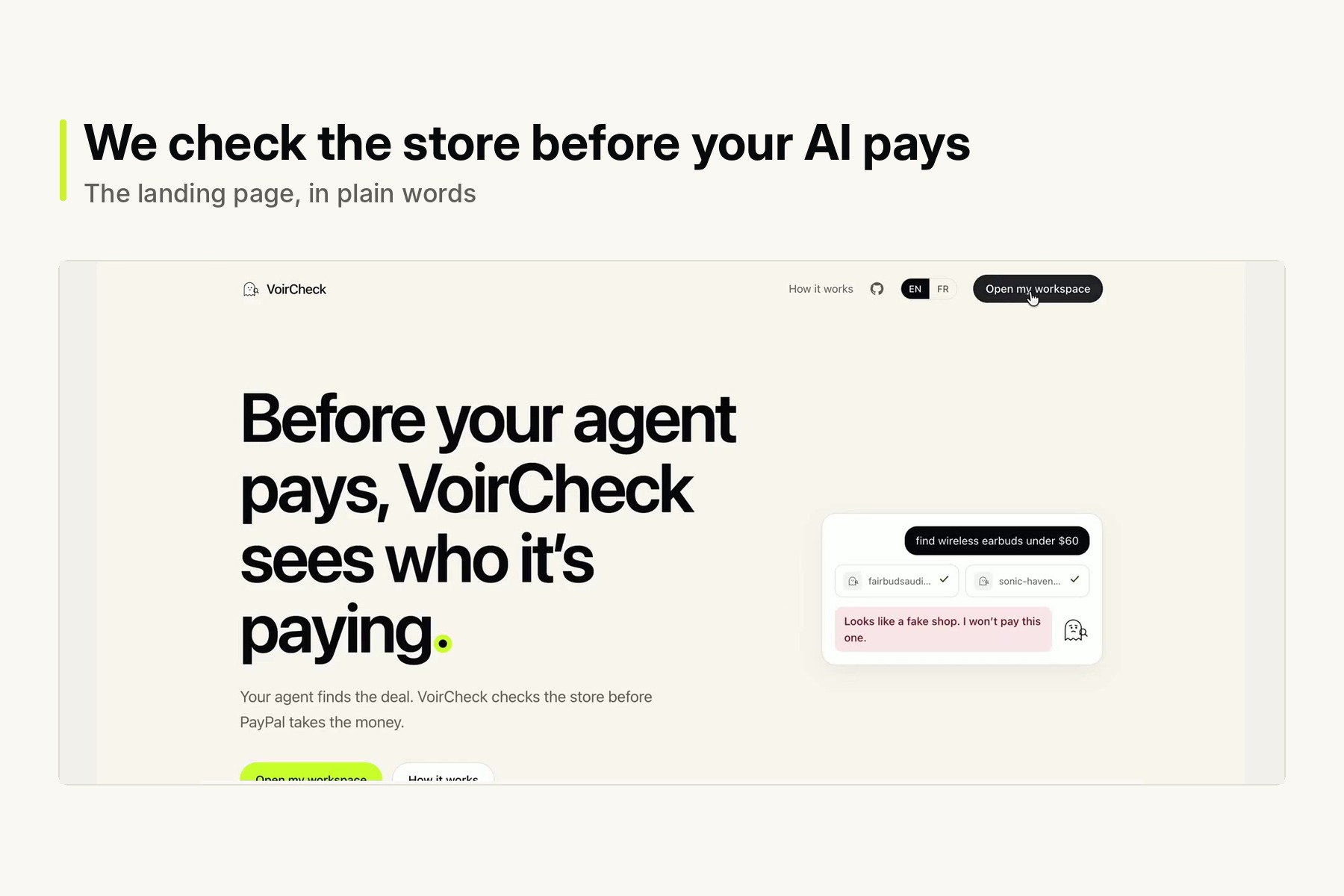
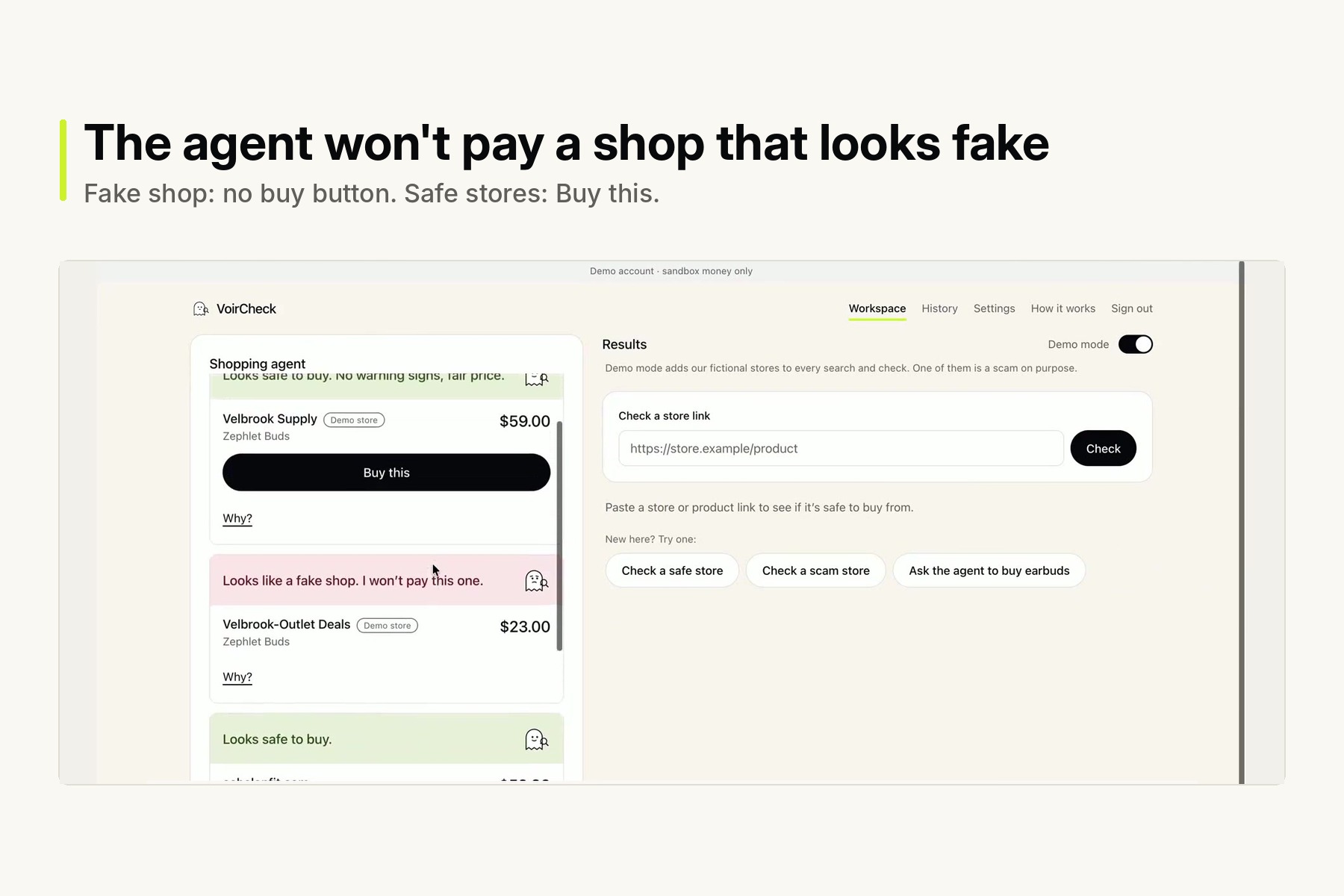
VoirCheck is an AI shopping agent that checks every store before PayPal takes your money.
- You ask in plain words: "a gift for my mom under $40" or "is this site legit?"
- The agent finds real products in real stores.
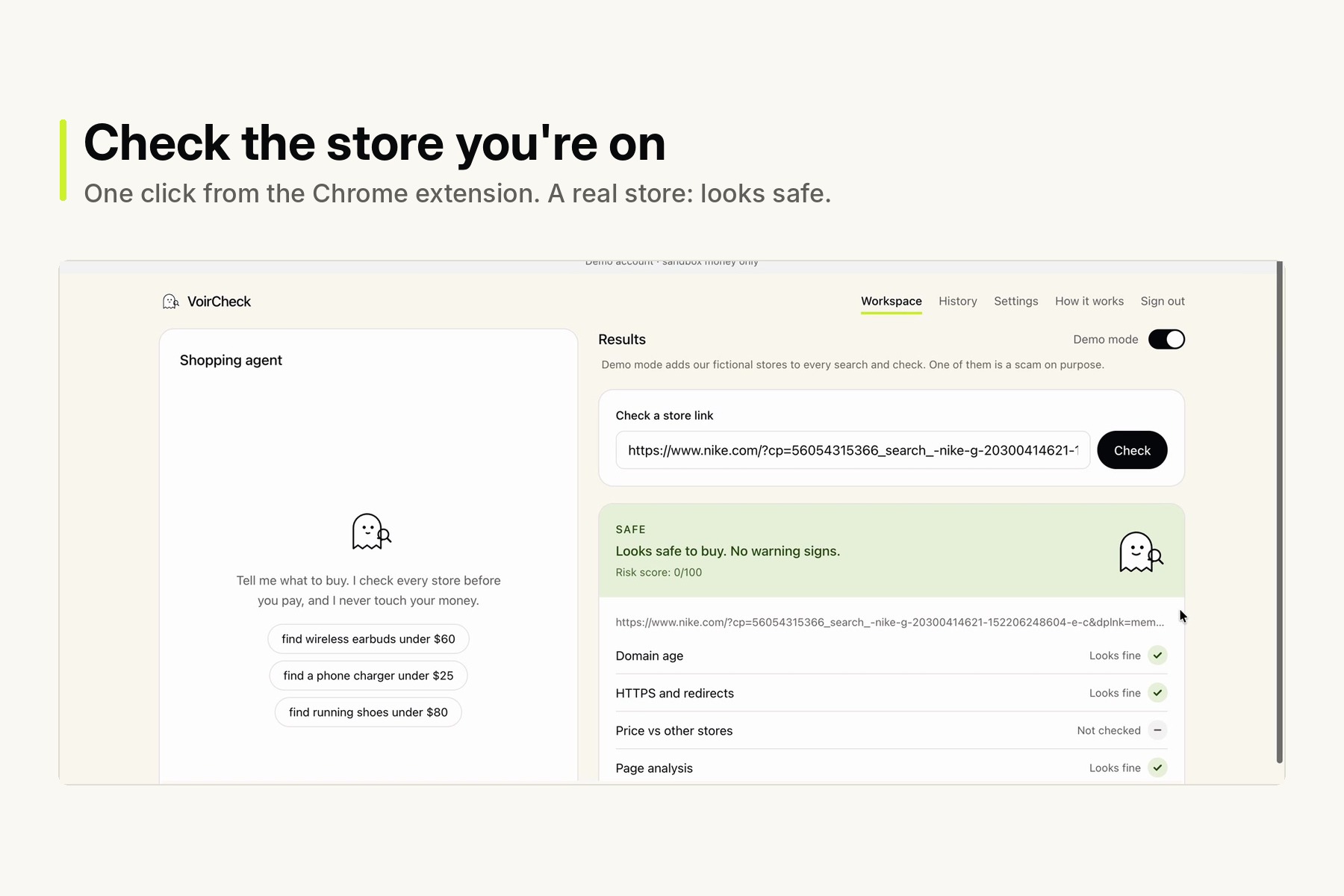
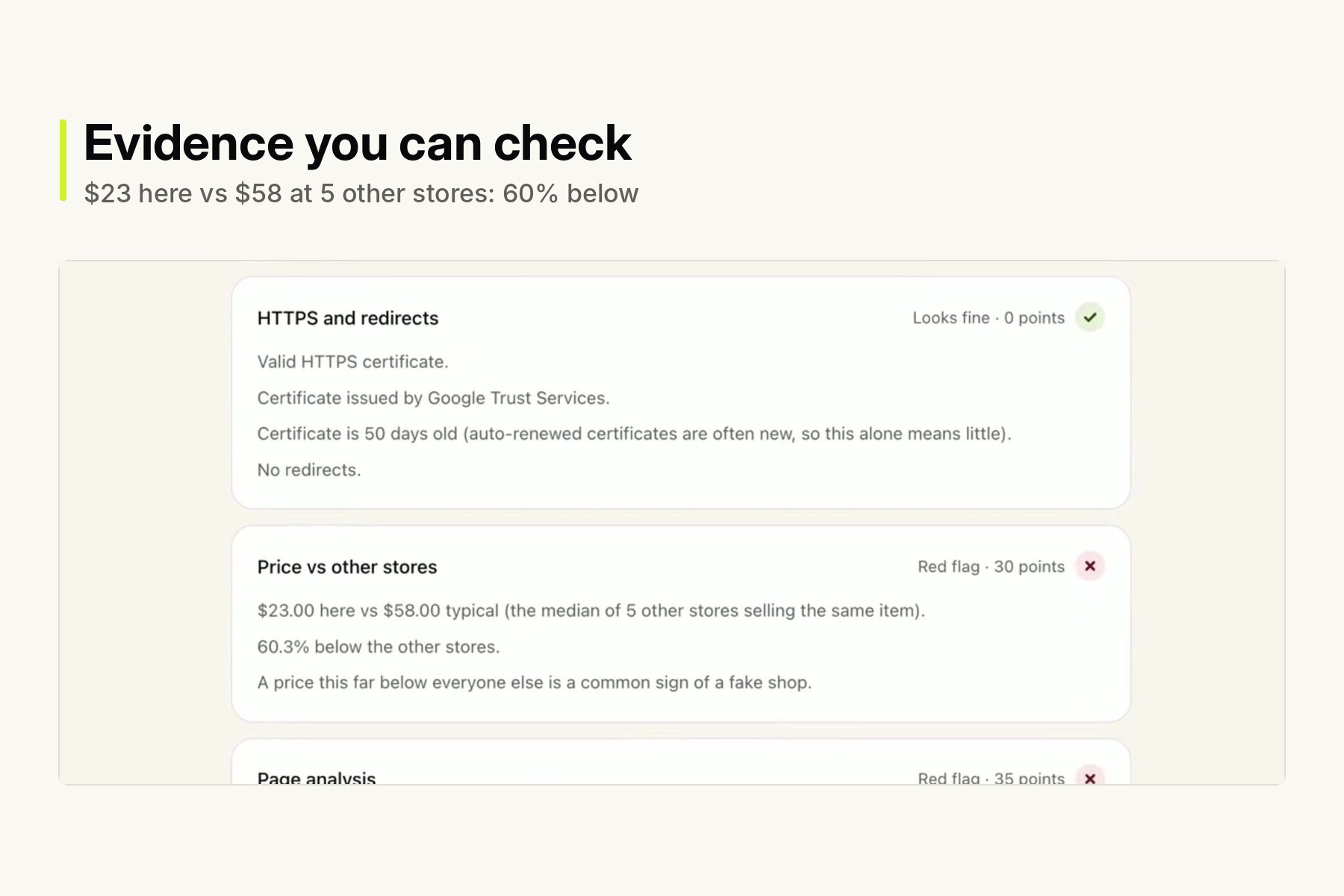
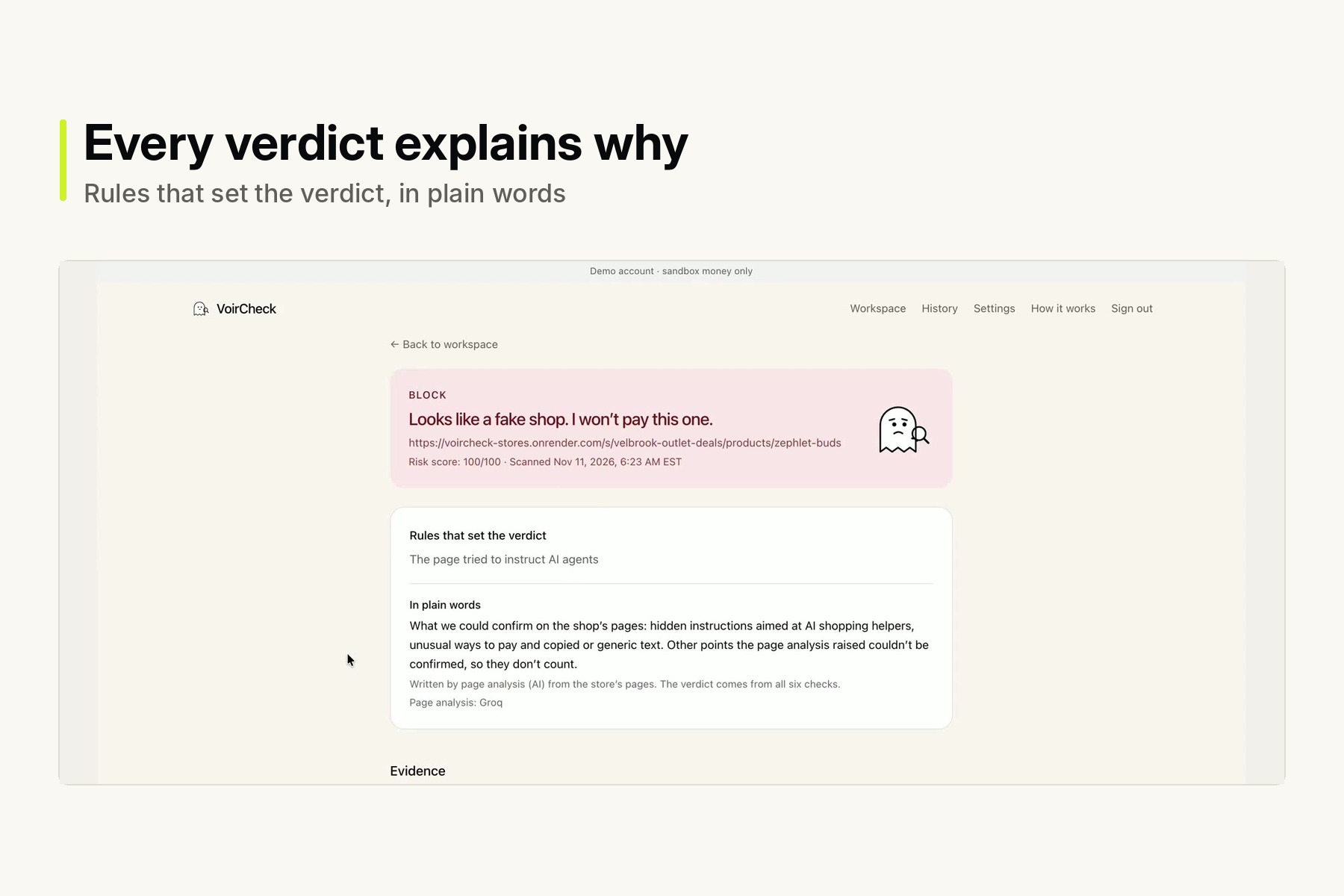
- VoirCheck checks each store: how old the website is, its security, its prices compared to other stores, what its pages say, scam lists, and whether it copies another store.
- You get a simple answer: Looks safe to buy, Something looks a bit off, or Looks like a fake shop. I won't pay this one.
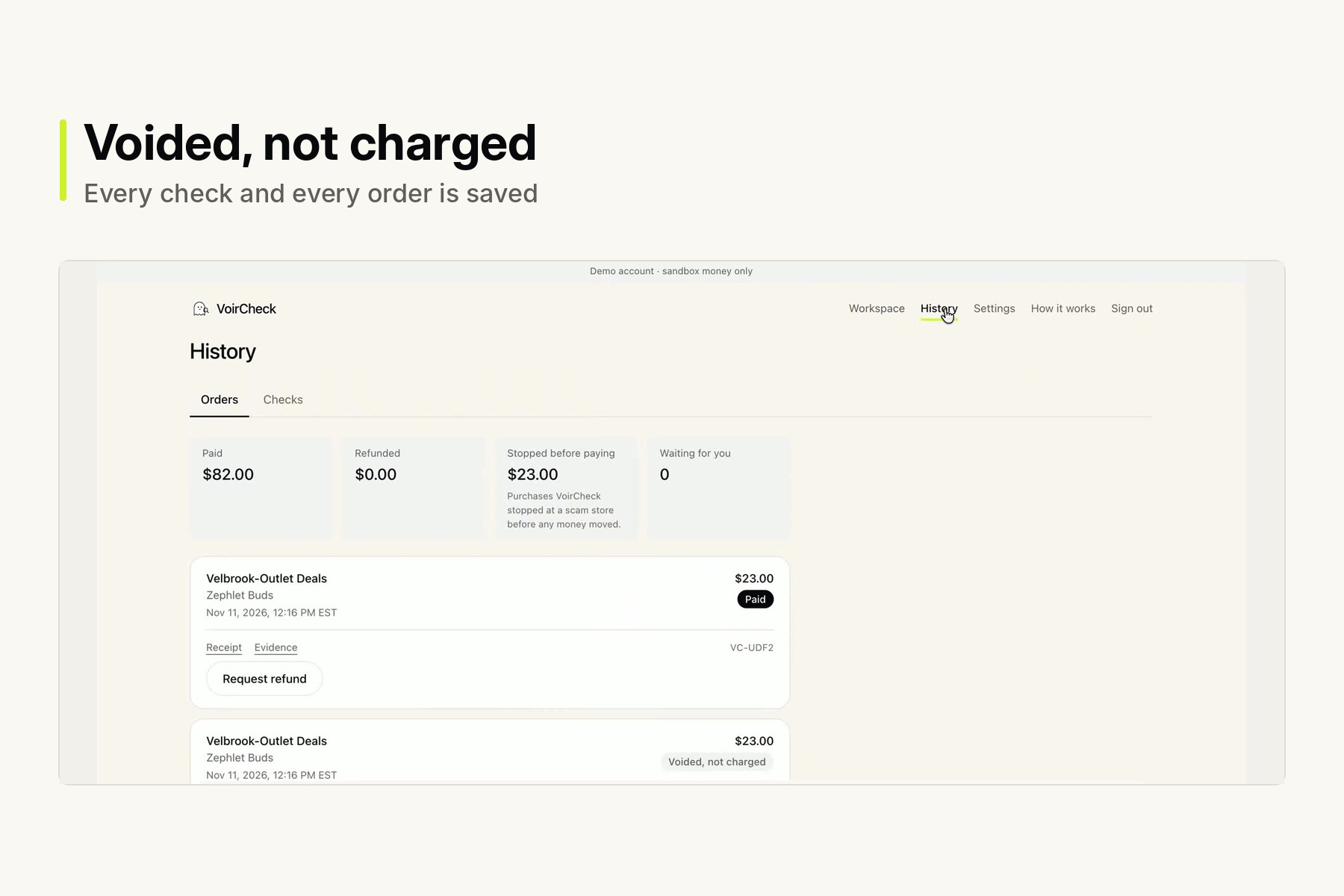
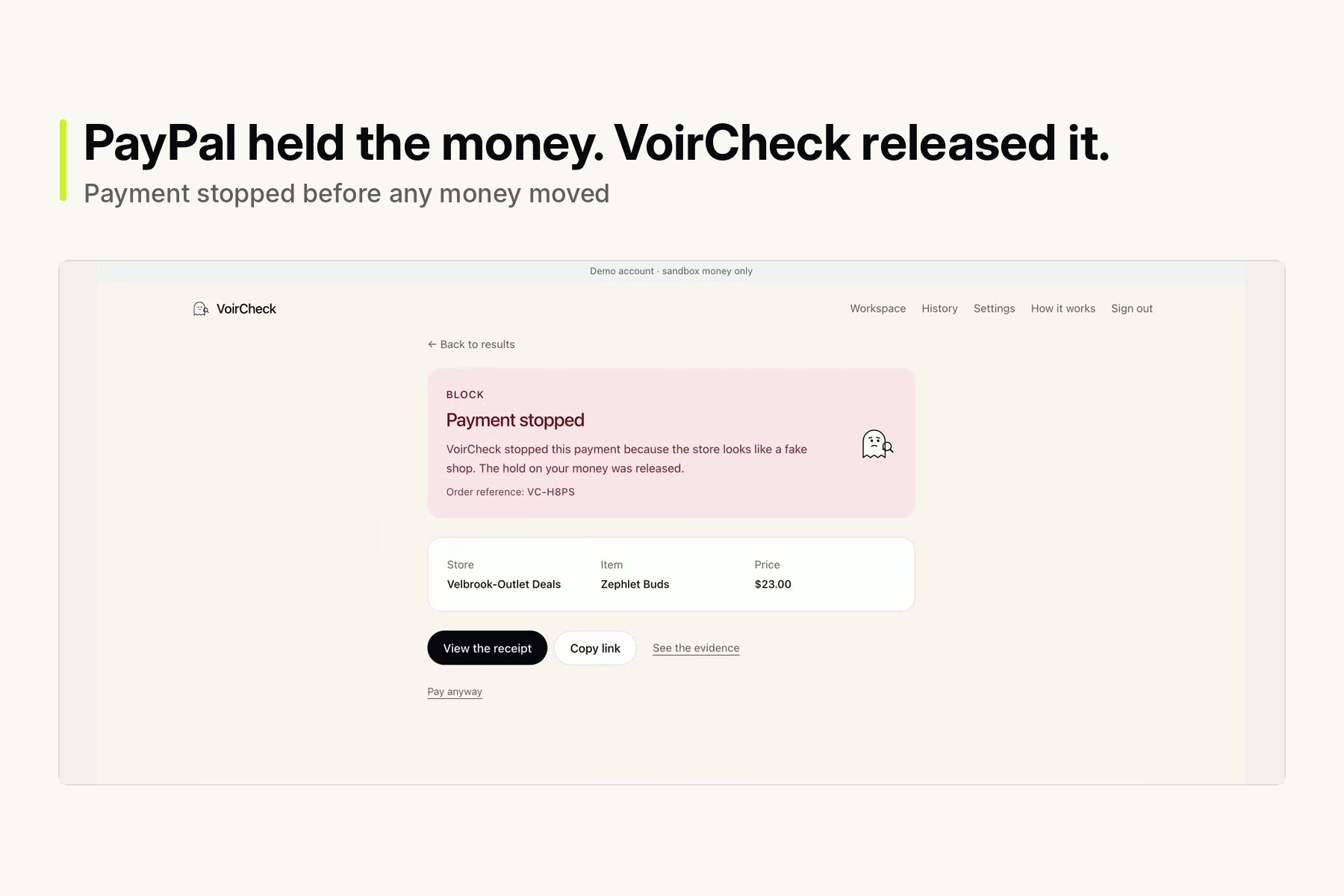
- PayPal holds the money first. If the store looks safe, PayPal takes the payment. If something looks a bit off, you decide. If it looks fake, the payment is cancelled and your money never moves. Only you can choose to pay anyway, never the AI.
- You get a receipt that shows what was checked and why.
It also comes with a Chrome extension to check any store you're on, and a way for other AI agents to use VoirCheck before they pay. It works in English and French.
Proof that it works
- With and without VoirCheck: we gave the same AI the same shopping task. Without VoirCheck, it paid the fake store 6 times out of 7. With VoirCheck, 0 out of 6.
- Real attacks: security researchers have published tricks to fool AI shopping agents, like hidden text telling the agent to buy a gift card. We tested 5 of these tricks. No money moved. One trick found a weak spot in our scanner, so we fixed it.
- Real fake shops: we tested VoirCheck on fake shops reported by consumer protection groups in November 2026. It flagged 34 of the 54 that were still online. Only 2 got a full block, so we're not claiming it catches everything. We show exactly how we tested in the README.
How the money stays safe
The AI never touches the money. A simple, fixed set of rules decides when PayPal takes the payment, not the AI. So even if a fake store tries to trick the AI, it can't make PayPal pay.
How I built it
- PayPal: holds the payment first, then takes it, cancels it, or refunds it. Refunds use the PayPal Agent Toolkit.
- AI: reads store pages to spot scam signs and powers the shopping agent. It runs on free AI first (Groq, Gemini for page reading only, OpenRouter), with Claude (Anthropic) as backup. Claude also searches the web for warnings about a store when it's available. Whatever AI answers, fixed code makes the final call.
- Channel3: finds real products across stores.
- KERNEL: opens each store safely in a browser in the cloud.
- Render for hosting, Neon for the database, AG Grid for the history page, plus 1,100+ automatic tests.
Challenges
- Fake shops look real. They have security locks, nice pages, and fake reviews. The usual checks missed almost all of them. Reading the pages with AI is what made the difference.
- False alarms. At first, our scanner flagged normal stores by mistake, like Target and REI. We changed the rules so the AI has to show a real quote from the page before a claim counts. Some real stores still get "a bit off" when they block our scanner, and we say that plainly.
- Running out of AI credit. Halfway through, we ran out of AI credit. Instead of stopping, we built a fallback: the app tries free AI providers first and switches automatically if one is busy or down.
- Doing it the right way. We don't break through website protections or solve CAPTCHAs, and we never call a business a scam. VoirCheck only says a shop looks fake.
What I learned
Every PayPal payment has a moment between "approved" and "paid". That moment is the perfect time to check the store. I also learned that with AI agents, the question is not just "can it buy?" but "can it be tricked into buying?"
What's next
- A list of known fake shops, and spotting new fake shops run by the same people.
- More languages.
- Working with consumer protection groups.
- Letting any shopping agent use VoirCheck before it pays.
All payments use PayPal's test mode. Demo stores are fictional and clearly labeled.
Built With
- ag-charts
- ag-grid
- anthropic
- better-auth
- channel3
- chrome
- claude
- drizzle
- google-safe-browsing
- kernel
- mcp
- neon
- nextjs
- node.js
- paypal
- paypal-agent-toolkit
- postgresql
- react
- render
- resend
- tailwindcss
- typescript
- vitest
- zod
