-
-
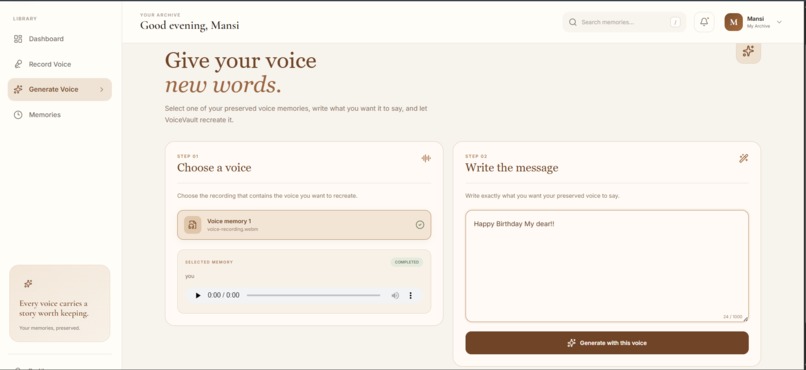
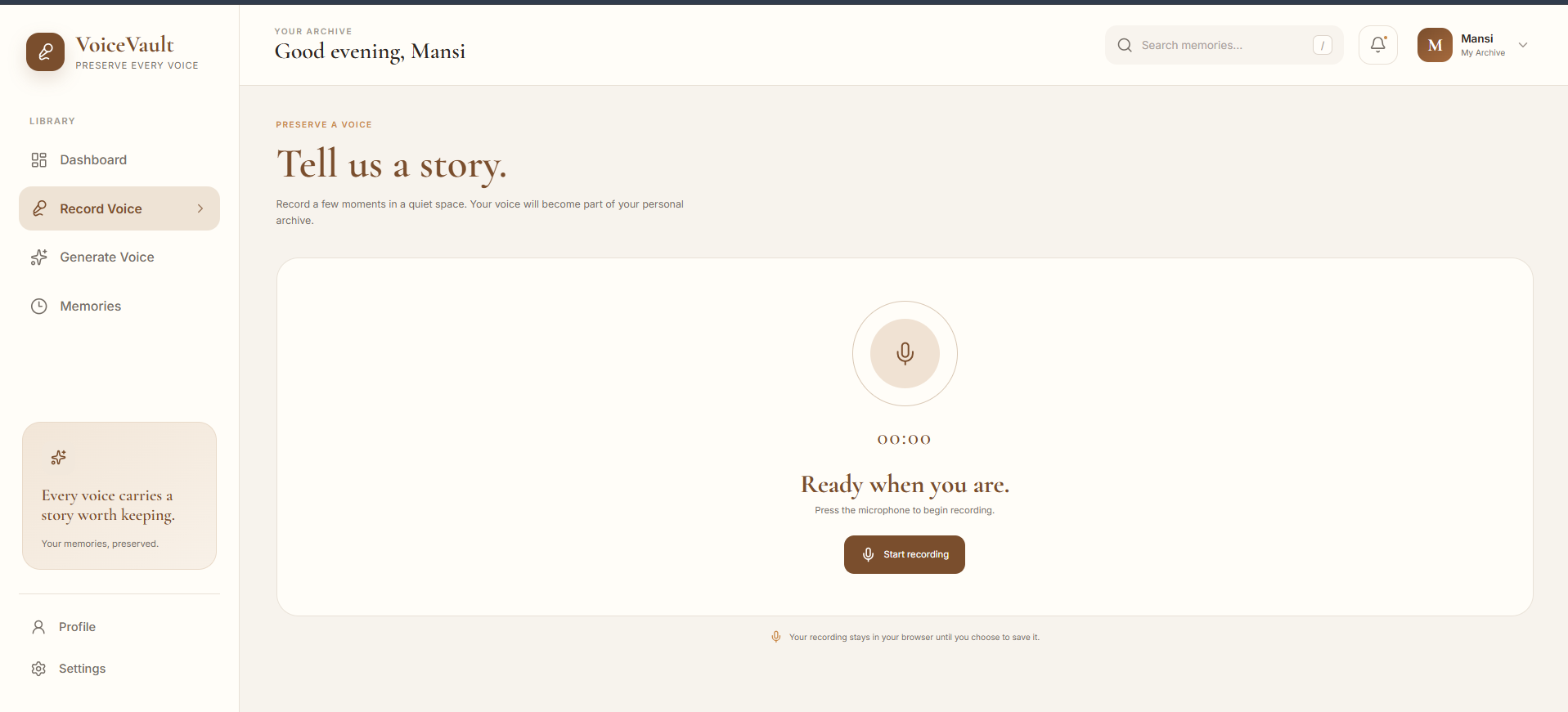
"Preservation starts with just a few spoken moments. No studio, no clinical setup — just a quiet space and a few minutes."
-
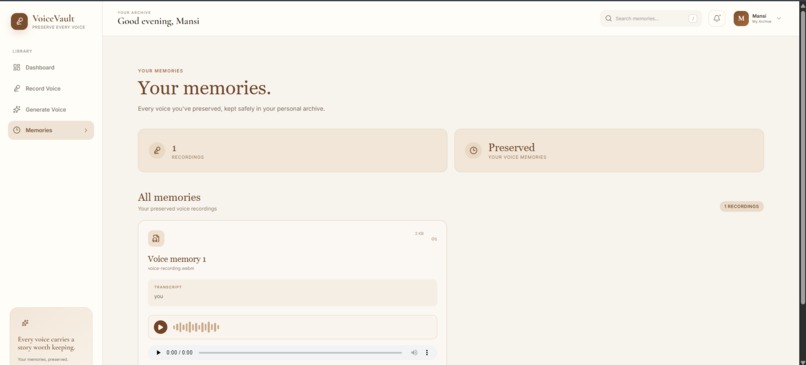
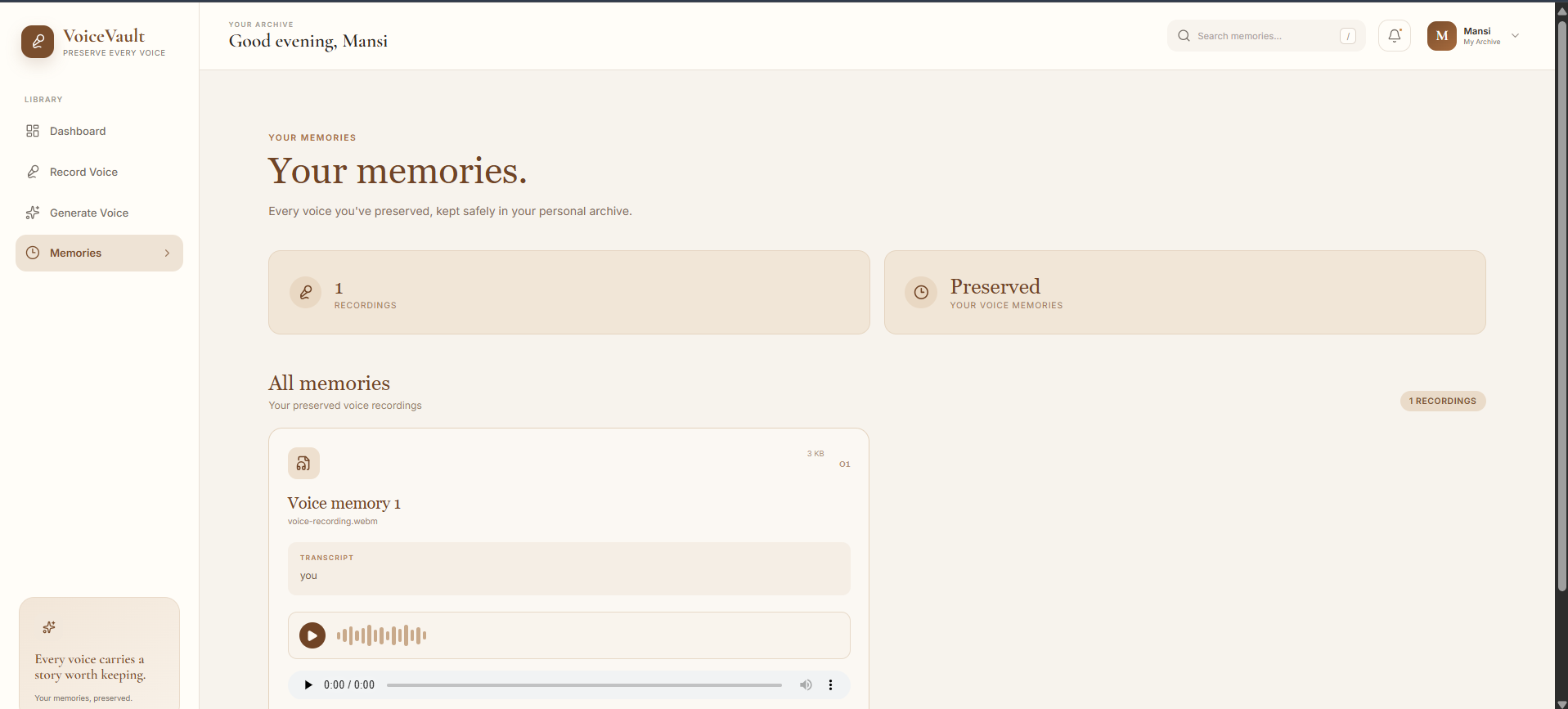
Memories — Archive View ,Every recorded voice becomes a preserved memory — organized, playable, and safely archived for whenever it's needed
-
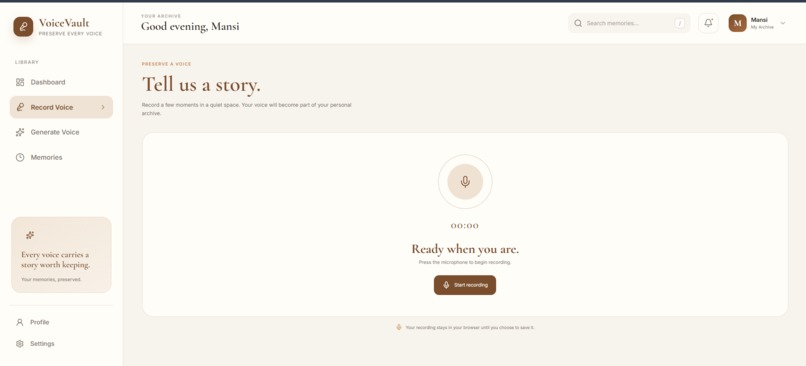
Record Voice - Capture Flow "Preservation starts with just a few spoken moments. No studio setup — just a quiet space and a few minutes."
-
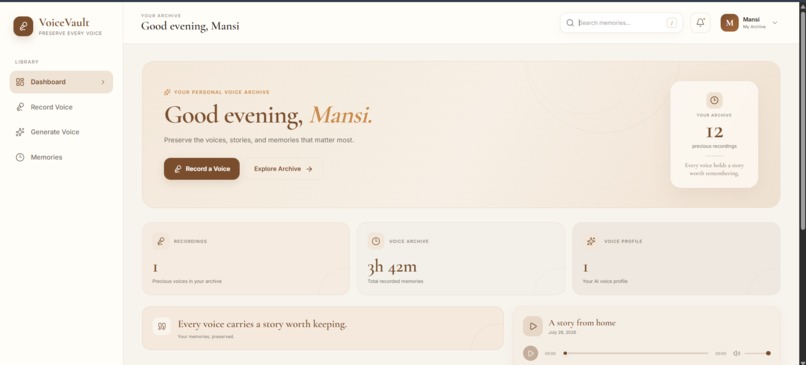
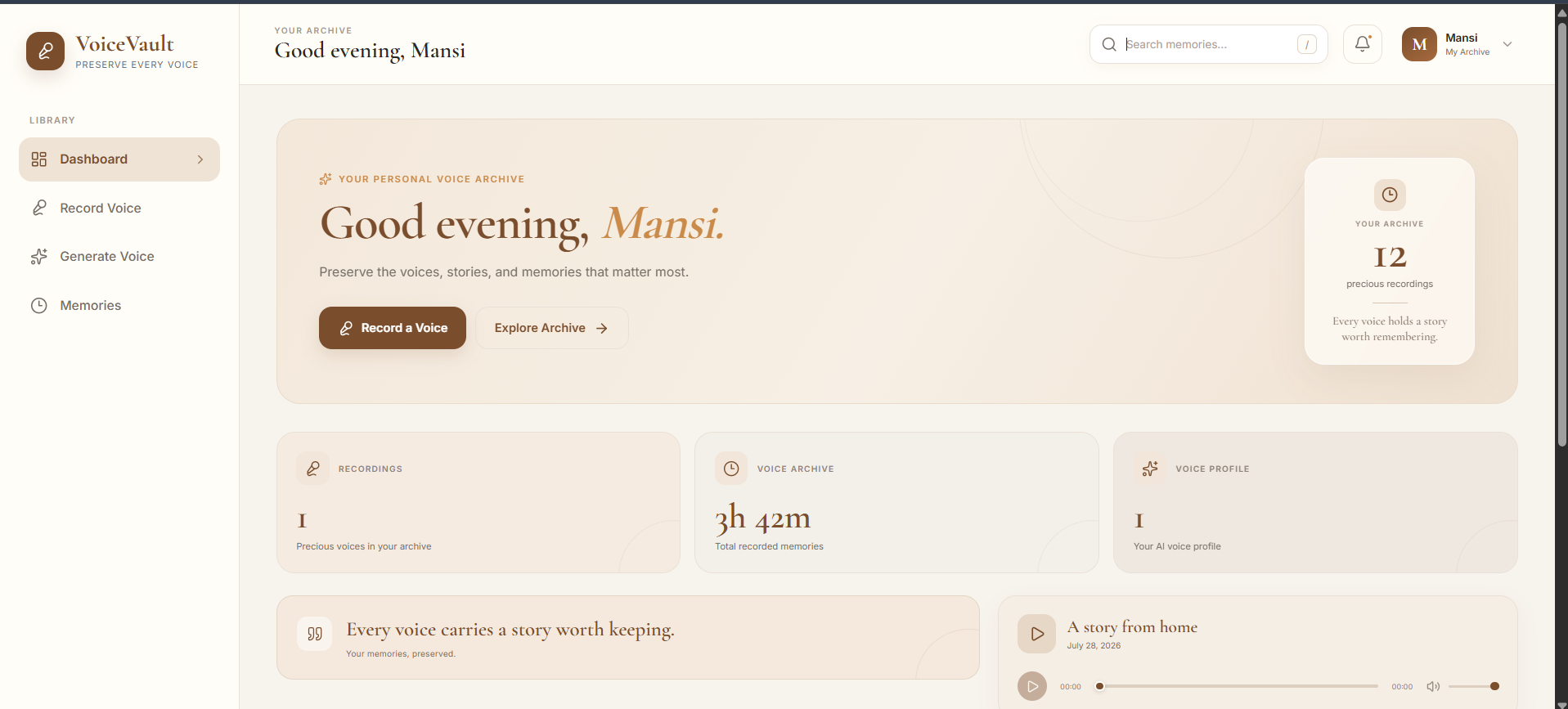
Dashboard — Overview "Your entire voice archive at a glance — recordings, saved memories, and total preserved time, all in one place."
-
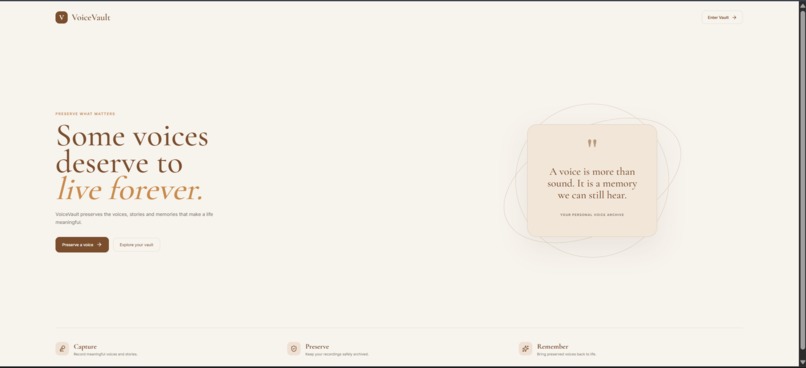
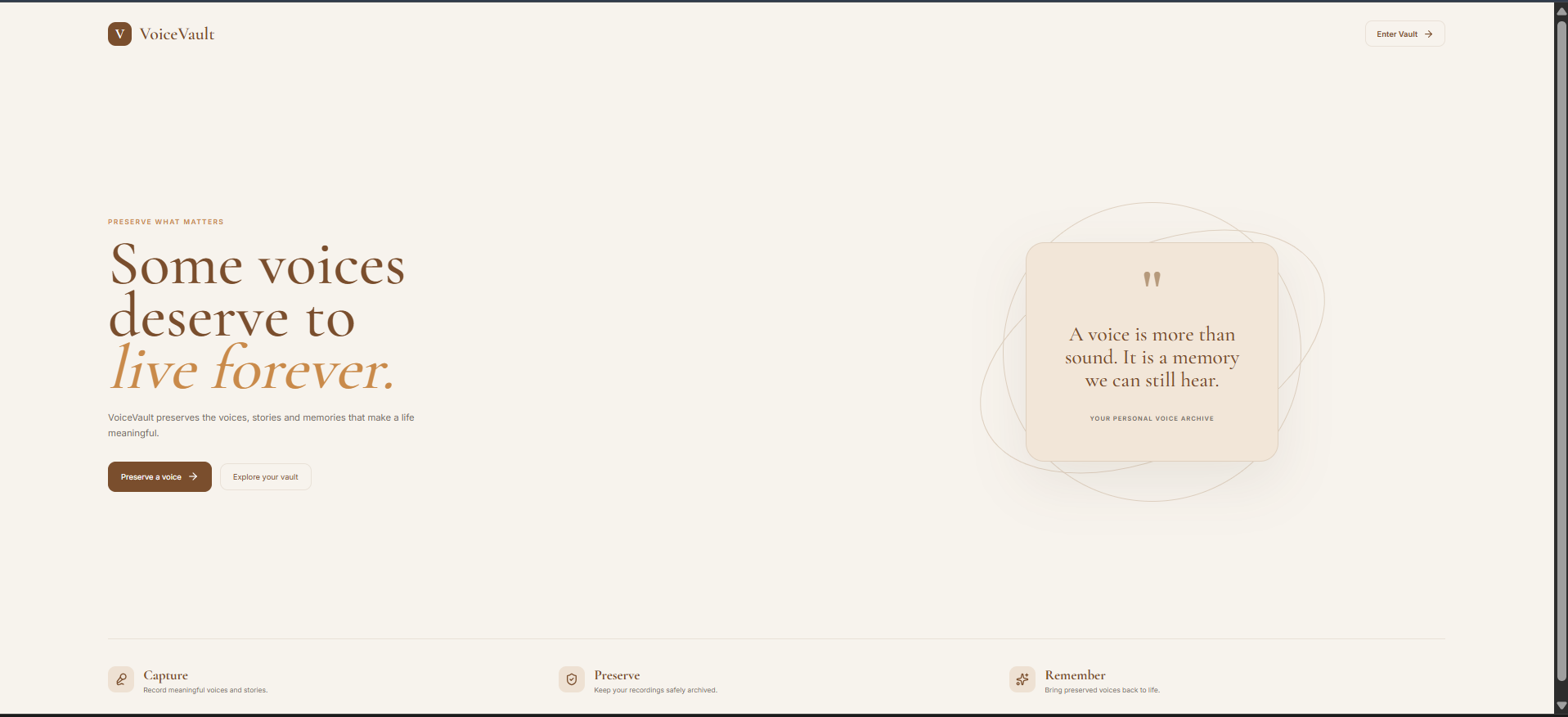
Landing Page — Hero "Some voices deserve to live forever. VoiceVault preserves the stories, and memories that make a life meaningful."
VoiceVault
A voice, held with love.
Inspiration
Everyone knows what it feels like to miss a voice. A parent who's passed. A grandparent whose laugh you can almost hear but not quite remember exactly. What most people don't know is that for millions of people living with ALS, motor neuron disease, Parkinson's, or facing a laryngectomy, that loss isn't a distant possibility — it's a countdown. Somewhere between diagnosis and the day speech disappears, there's a narrow window to do something almost nobody thinks to do in time: save the voice itself.
The tools that exist for this today ask a lot of people who don't have much left to give — hours of studio-quality recording, clinical setups, patience most patients simply don't have the energy for anymore. We kept coming back to one question: what if preserving a voice took minutes, not months — and what if, once saved, a family could trust completely that the voice they were hearing was really theirs, untouched, exactly as it was recorded?
That question became VoiceVault.
What it does
VoiceVault lets someone record a small set of voice samples — a few sentences, nothing more — while they still can. From that, it builds a complete, living voice library: thousands of phrases, ready whenever they're needed, in a voice that's unmistakably the person's own.
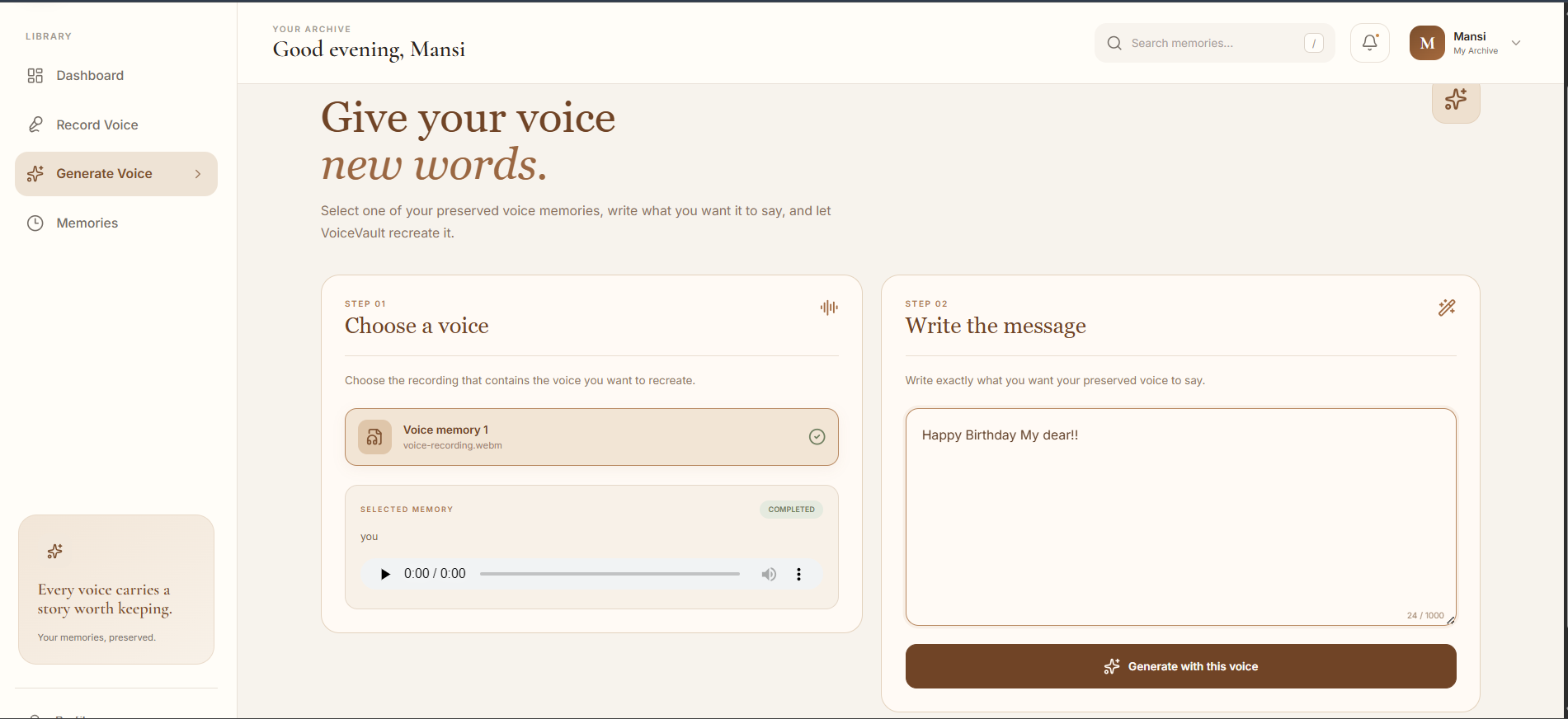
If speech is eventually lost, VoiceVault becomes how that person keeps talking. They can select from banked phrases — I love you, I'm okay, don't worry, happy birthday — or type something new entirely and hear it spoken back immediately, in their own voice, not a generic text-to-speech voice standing in for it.
Behind the scenes, VoiceVault does two things most tools in this space don't:
It doesn't rely on a single AI model. Voice cloning quality varies a lot from voice to voice and provider to provider. VoiceVault orchestrates multiple generation providers, so if one produces a poor match for a particular voice, another is used instead — the goal is always the best possible likeness, not whatever one model happens to produce.
It treats the voice itself as something worth protecting, not just storing. Every generated asset is hashed, timestamped, and sealed the moment it's created, with immutable storage behind it. When a recording might be one of the last real traces of how someone sounded, "we saved it" isn't enough. Families deserve to know it hasn't been — and can't be — quietly altered.
How we built it
The core pipeline moves from recording → multi-provider generation → provenance sealing → storage, with the generation step doing real orchestration work rather than a single API call:
- A short guided recording flow captures the source samples
- Genblaze coordinates generation across multiple voice-cloning providers, selecting or falling back based on output quality for that specific voice
- Every generated phrase is hashed and logged with its model, provider, and generation timestamp, forming a provenance record
- Backblaze B2, with Object Lock enabled, stores both the audio assets and their provenance manifests immutably — once sealed, a voice asset cannot be silently altered or overwritten
- A simple library interface lets the enrolled person (or an authorized family member) browse banked phrases or generate new ones on demand
We built the enrollment and generation flow first, since the emotional core of the product lives entirely in whether the generated voice actually sounds like the person — everything else exists to support that moment.
Challenges we ran into
Getting a convincing voice match from minimal samples. A few sentences is not a lot of source material to clone a voice from, and quality varied noticeably between providers for the same voice. This is exactly why multi-provider orchestration became central to the product rather than a nice-to-have — a single-provider pipeline would have meant accepting whatever quality that one model happened to produce.
Making "sealed" mean something real, not just a label. It would have been easy to store files in B2 and call it done. Making the provenance and immutability claims actually true — hashing at generation time, locking assets so they can't be quietly modified later — took real care, because this is a product where the claim of authenticity has to be earned, not asserted.
Designing for a sensitive audience without being clinical or cold. This isn't a general-purpose voice tool — it's for people in one of the hardest periods of their lives, and for the families around them. Every interface decision had to hold both things at once: genuine technical rigor, and a tone that never feels like a hospital form.
Accomplishments that we're proud of
- Built a working, end-to-end voice preservation pipeline — recording, multi-provider generation, provenance sealing, and playback — not just a concept
- Made multi-provider orchestration do real work: selecting or falling back based on actual output quality, not just calling one API and hoping
- Gave immutability a genuine purpose in the product, not a checkbox — a sealed voice asset is central to what makes VoiceVault trustworthy
- Built something we'd actually want to exist for our own families
What we learned
Some products earn urgency the moment you explain them. We didn't have to convince anyone why this mattered — everyone we described it to immediately understood, often personally.
Orchestration is only meaningful when it changes the outcome. Using multiple AI providers isn't impressive on its own — it's meaningful because it directly improves whether a cloned voice actually sounds like the person, which is the entire point of the product.
Trust has to be built into the architecture, not just claimed in the pitch. Once we decided authenticity mattered, provenance and immutability weren't optional features — they became load-bearing parts of the system.
What's next for VoiceVault
- Emotional tone control — letting banked phrases carry warmth, calm, or urgency, not just words
- Family and caregiver accounts — controlled access so loved ones can request new phrases without full account access
- Expanded everyday phrase libraries — covering the small, constant things people say daily, not just the big emotional ones
- Clinical partnerships — working with speech-language pathologists and ALS/MND care teams to bring VoiceVault into existing care pathways, not just individual use
VoiceVault exists because a voice is not just sound — it's identity, memory, and connection, all at once. We built this so that losing the ability to speak doesn't have to mean losing that.
Built With
- backblaze
- express.js
- genblaze
- gmicloud
- groq
- mongodb
- node.js
- vite

Log in or sign up for Devpost to join the conversation.