-
-
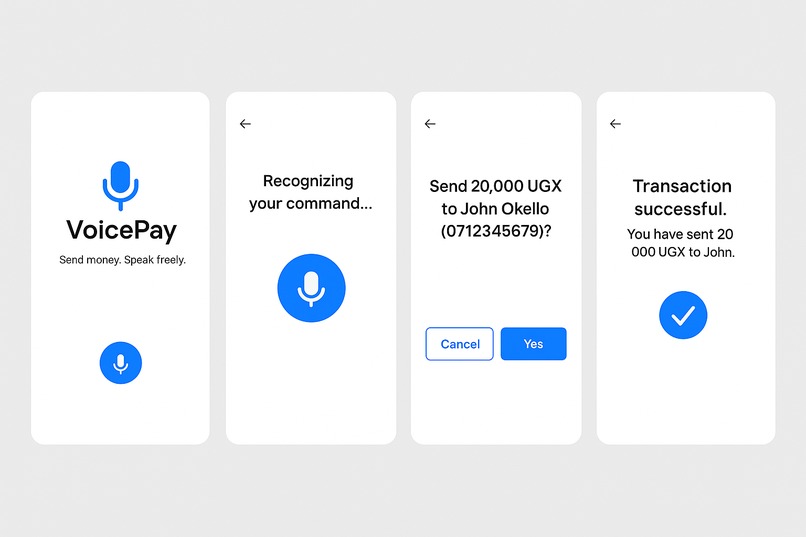
Prototype screenshot
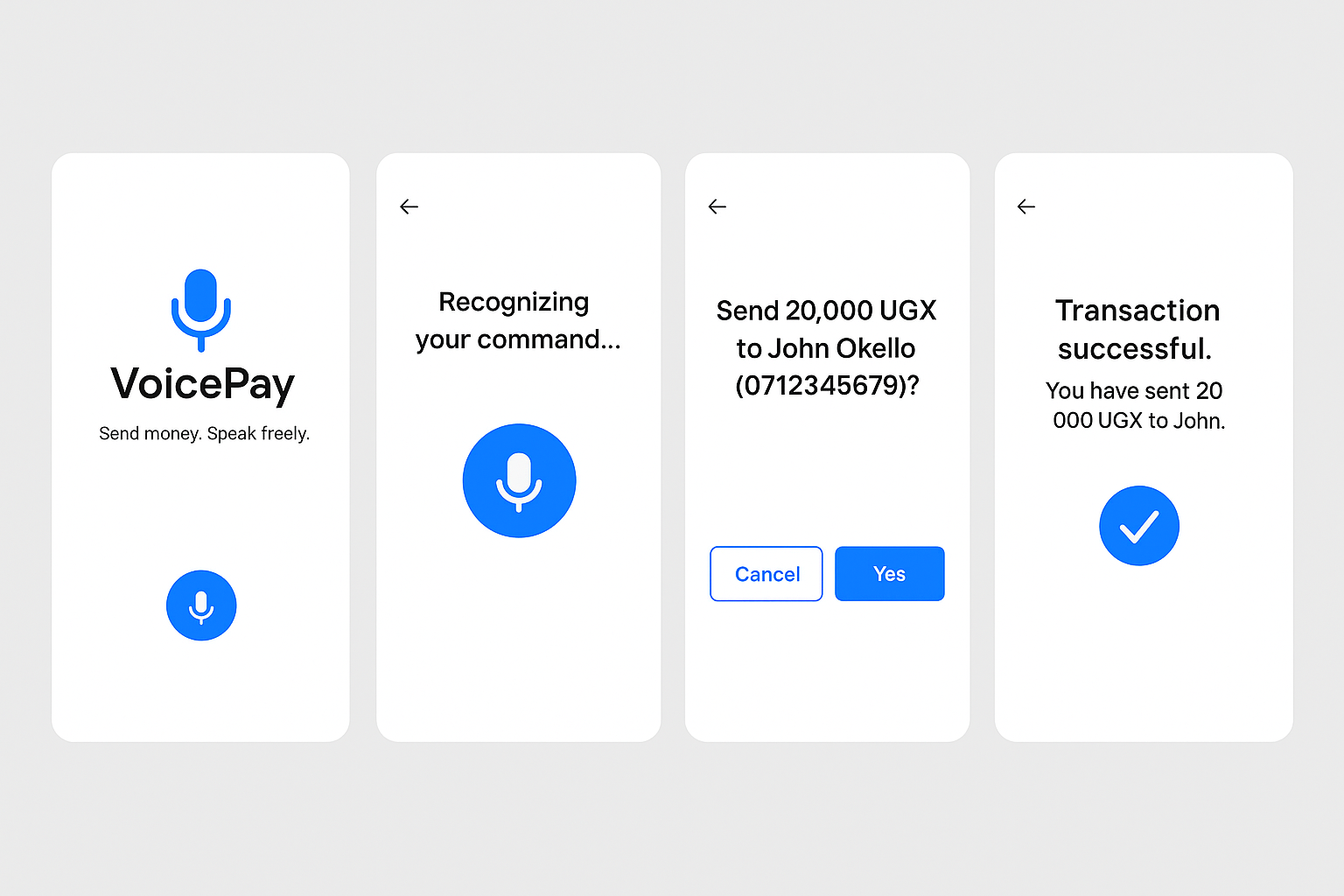
Inspiration
In Uganda, mobile money is a lifeline for financial transactions, yet many users face barriers such as literacy challenges, visual impairments, and the complexity of USSD menus. Observing these struggles, we envisioned a solution that empowers every individual to access mobile money services effortlessly. VoicePay was born out of a desire to create a more inclusive financial system using cutting-edge voice recognition technology.
What it does
VoicePay enables users to perform mobile money transactions using simple voice commands in their preferred local languages.
- Send Money: Transfer funds securely using just your voice.
- Check Balance: Instantly know your account balance.
- Accessibility: Designed for users with limited literacy or visual impairments.
With VoicePay, financial transactions become faster, easier, and more accessible than ever.
How we built it
Frontend:
- Built with React Native for cross-platform compatibility (iOS and Android).
- Integrated @react-native-community/voice for voice recognition.
- Built with React Native for cross-platform compatibility (iOS and Android).
Backend:
- Deployed on AWS Lambda for scalable, serverless computing.
- Used AWS Transcribe to process voice inputs into text.
- Implemented AWS Lex to detect intents like sending money or checking balance.
- Provided voice feedback via AWS Polly.
- Deployed on AWS Lambda for scalable, serverless computing.
Security:
- Integrated AWS Cognito for user authentication.
- Used AWS Key Management Service (KMS) for encrypting sensitive data.
- Integrated AWS Cognito for user authentication.
Mock Database:
- Simulated user accounts and balances using AWS DynamoDB.
- Simulated user accounts and balances using AWS DynamoDB.
Challenges we ran into
- Multilingual Voice Recognition: Training models to accurately understand local languages like Luganda and Runyankore required fine-tuning and collecting representative datasets.
- USSD Integration: Simulating USSD responses in real-time was complex, given the lack of direct APIs from telecom operators.
- User Feedback: Balancing simplicity with functionality for users of diverse tech literacy levels was a continuous process.
- Offline Support: Ensuring core functionality works without an internet connection required edge computing solutions.
Accomplishments that we're proud of
- Successfully implemented a working prototype that can handle basic voice commands.
- Integrated multiple AWS services seamlessly for voice recognition and processing.
- Designed a clean and intuitive user interface that caters to users with various needs.
- Created a scalable architecture ready for future expansions and integrations.
What we learned
- The importance of accessibility in financial services and how technology can bridge gaps.
- Deep insights into voice processing and natural language understanding, especially for underrepresented languages.
- Practical experience with AWS services like Lambda, Lex, Polly, and Transcribe.
- Overcoming technical and logistical challenges in building a voice-first application.
What's next for VoicePay
- Multilingual Support: Expand to more Ugandan languages like Swahili and Acholi.
- Direct API Integrations: Partner with telecom operators to streamline USSD interactions.
- Offline Mode: Enhance offline capabilities with AWS IoT Greengrass for processing on edge devices.
- Financial Literacy Programs: Embed tutorials to educate users on managing finances effectively.
- User Feedback Loop: Continuously improve language models and UI based on user input.
VoicePay aims to redefine how Ugandans interact with mobile money, making financial independence achievable for all.
Built With
- amazon-web-services
- cognito
- dynamodb
- expo.io
- javascript
- kms
- lex
- markdown
- node.js
- polly
- react-native
- transcribe


Log in or sign up for Devpost to join the conversation.