-
-
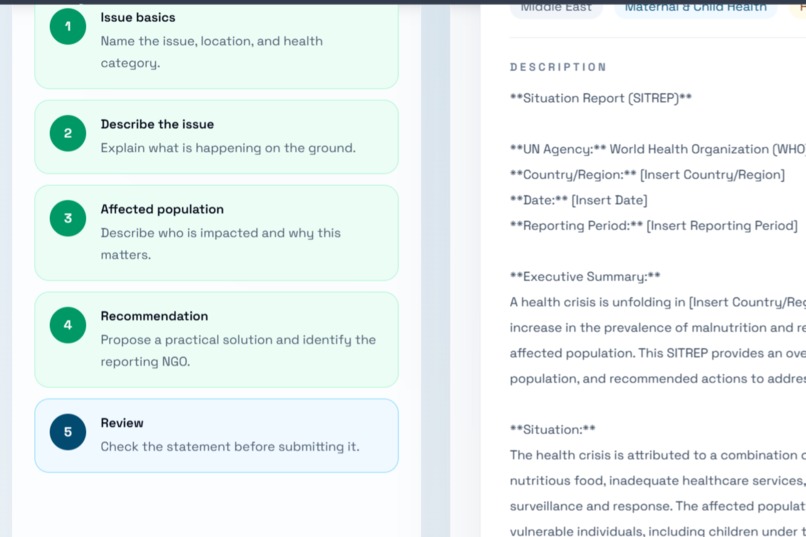
Steps into writing a report
-
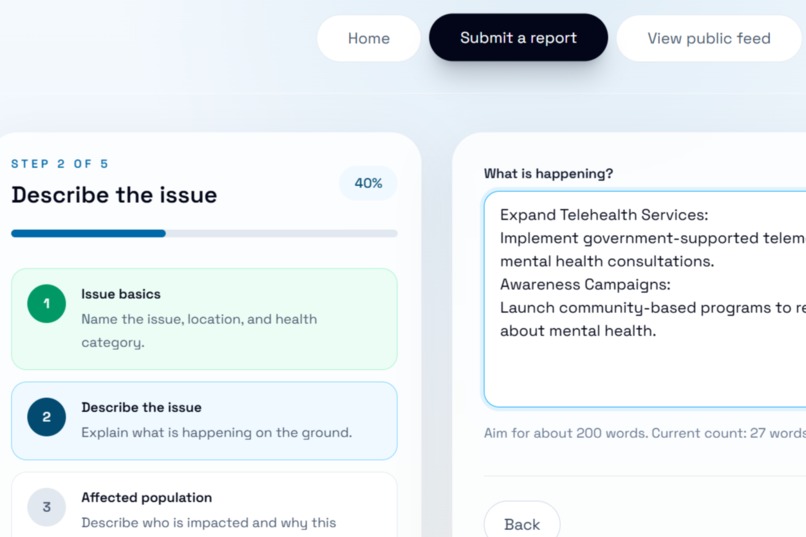
Steps
-
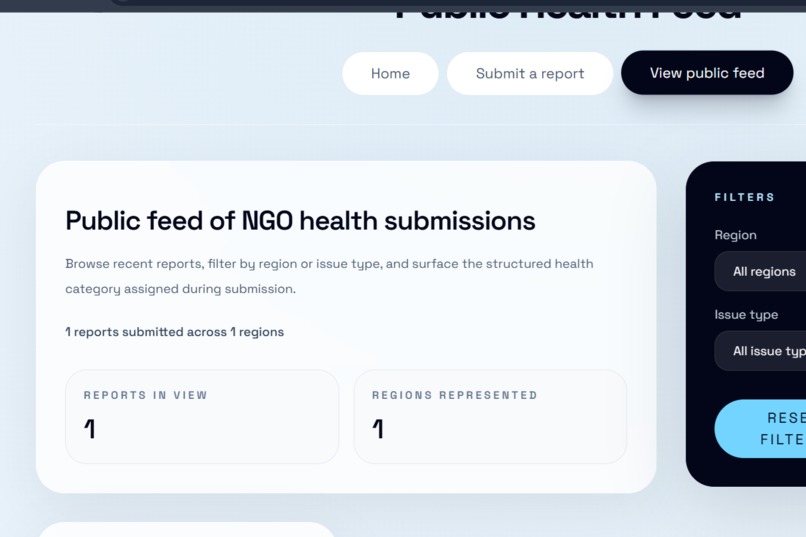
Public feed
-
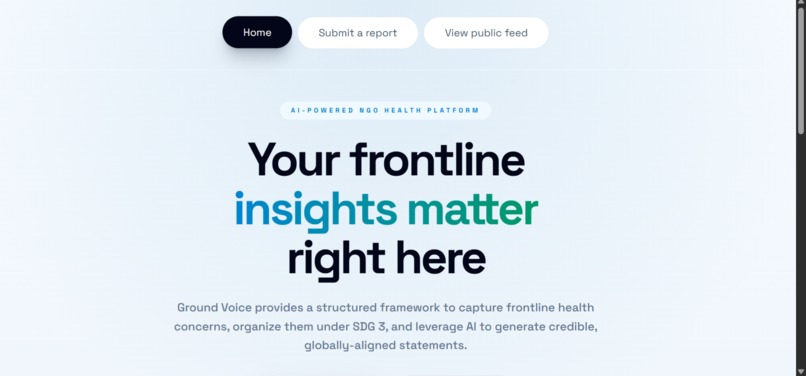
Home page
Inspiration
Small NGOs witness health crises every day, but their reports rarely reach the people with power to act. UN submission processes are complex, and most small organizations simply lack the resources to navigate them. I watched a close friend who works at an NGO struggle with exactly this not because she lacked data, but because she couldn't translate what she saw on the ground into a format the world could act on. Ground Voice is built to close that gap.
What it does
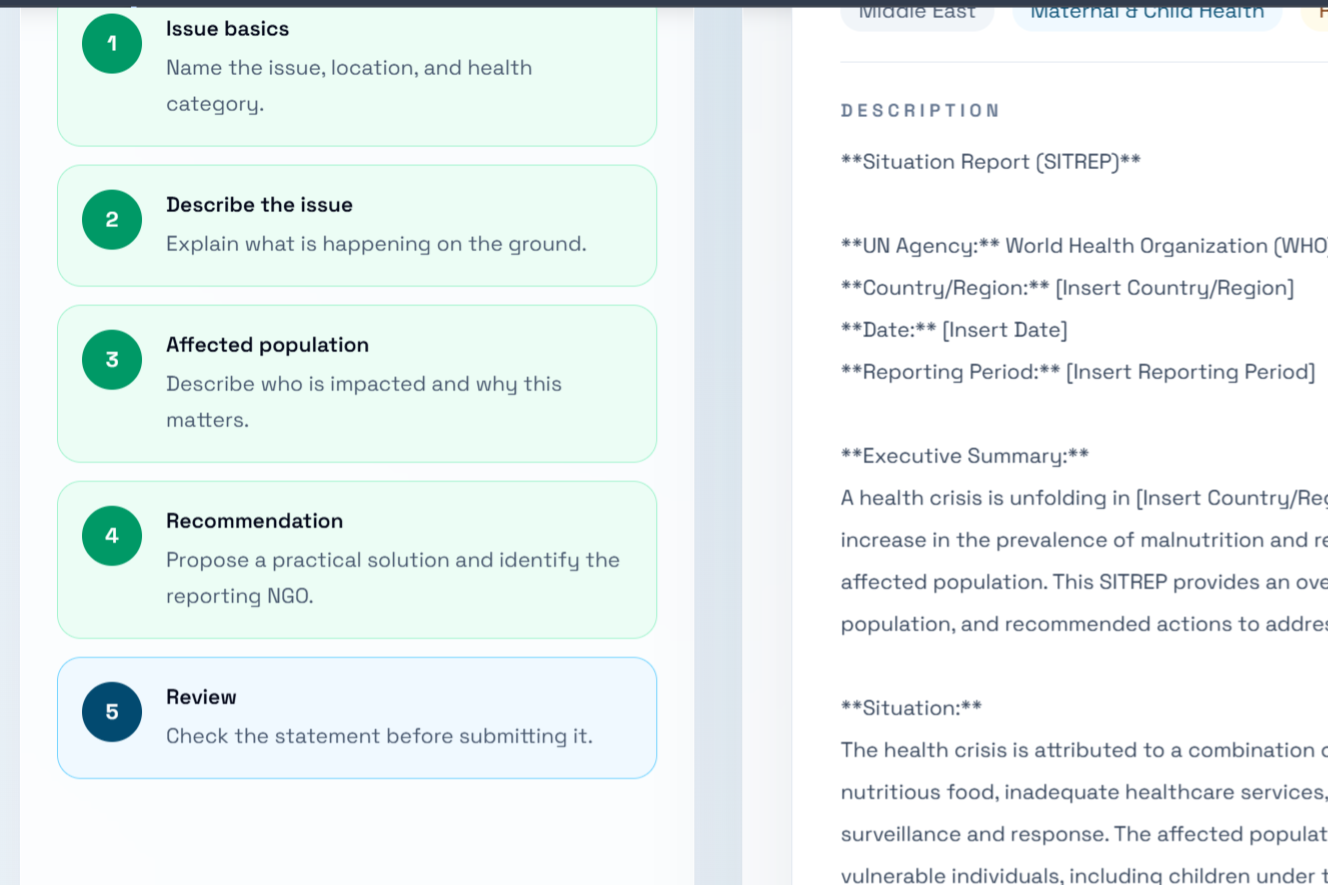
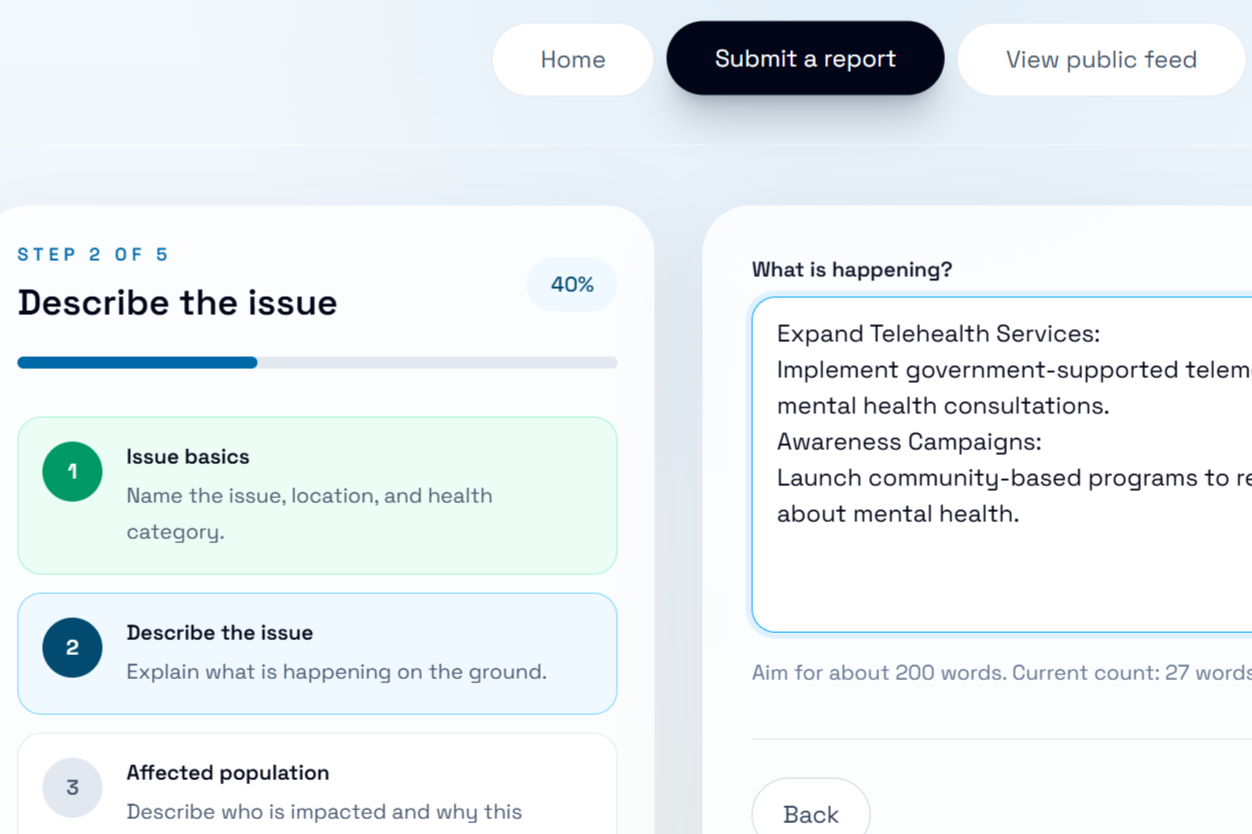
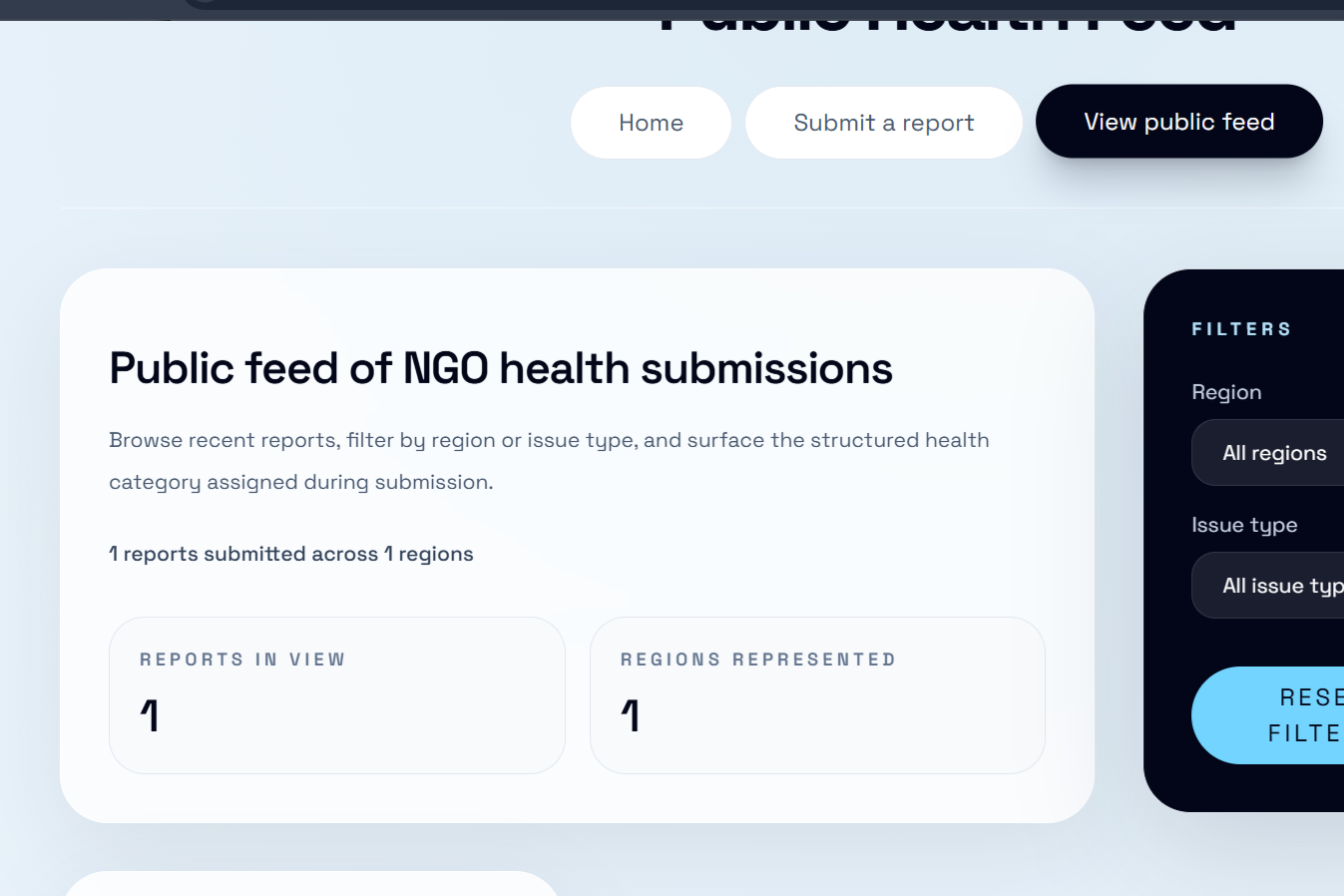
Ground Voice gives frontline NGOs a simple five-step workflow to turn raw field observations into structured, globally legible health reports directly addressing SDG 3: Good Health and Well-being. Each report is automatically mapped to SDG 3 categories and assigned an AI severity score from 1–10, so the most critical crises surface first. An AI model powered by Llama 3.1 then converts the raw observation into a formal UN Situation Report in seconds. Reports appear on a public feed searchable by region and issue type, with a toggle to a live global health map built with Leaflet that plots reports by severity using color coded markers from sky blue (low) to rose red (critical), giving health organizations an instant visual picture of where crises are emerging.
How I built it
The frontend is built with React and TypeScript, styled with Tailwind CSS, and bundled with Vite. The interactive health map uses Leaflet with React-Leaflet and CARTO dark tiles. On the backend, I used Node.js and Express with Prisma ORM connected to a Neon PostgreSQL database. AI powered SITREP generation and severity scoring both run through Hugging Face using Llama 3.1. The guided reporting workflow was designed to stay intuitive even for non-technical users operating under time pressure in the field.
Challenges I ran into
Mapping freeform field reports to structured SDG 3 categories without losing important context was harder than expected. Balancing simplicity for time pressed NGO workers while capturing enough detail for the data to be globally legible took significant iteration. Getting the AI to produce consistently formatted SITREPs from highly varied inputs required careful prompt engineering. Building the severity scoring system to be meaningful rather than arbitrary so that a score of 8 actually reflects a more urgent crisis than a score of 4 was a challenge in itself.
Accomplishments I'm proud of
I shipped a complete end to end workflow solo from five-step report submission to AI generated SITREP to severity scoring to public feed to interactive global health map. The SDG alignment layer works automatically, meaning NGOs get international credibility for their reports without any extra effort. The health map turns what would otherwise be a list of text reports into an immediate, visual picture of global health urgency. Building something this complete, alone, in hackathon time is something I'm genuinely proud of.
What I learned
Good form design is a product challenge, not just a UI challenge. I spent significant time thinking about language, field order, and what questions feel natural to someone who has just returned from a field visit. Simplicity takes more thought than complexity. I also learned a great deal about prompt engineering specifically how much the structure of your input shapes the quality and consistency of AI output.
What's next for Ground Voice
Multilingual support is the most important next step, since many NGOs operate in non English environments. I also plan to build an NGO dashboard for tracking report visibility and reach, add PDF export so reports can be downloaded and shared directly, and explore direct integrations with UN data portals to close the loop from field observation to policy action.
Built With
- express.js
- node.js
- postgresql
- prisma
- react
- tailwind
- typescript
- vite


Log in or sign up for Devpost to join the conversation.